MBOSE Class 10 Question Paper 2019 for Science and Technology Old Course
Finished viewing? Save it for later —
Download MBOSE Class 10 Question Paper 2019 for Science and Technology Old Course (PDF · 12 pages)About MBOSE Class 10 Question Paper 2019 for Science and Technology Old Course
MBOSE Class 10 Question Paper 2019 for Science and Technology Old Course is available here for free download. Published by Meghalaya Board for Class 10, this question paper can be viewed online or downloaded as a PDF (12 pages). Candidates preparing for Class 10 can use MBOSE Class 10 Question Paper 2019 for Science and Technology Old Course to understand the exam pattern, the type of questions asked, and the overall difficulty level.
Frequently Asked Questions
How can I download MBOSE Class 10 Question Paper 2019 for Science and Technology Old Course?
Open this page and click the Download button to save MBOSE Class 10 Question Paper 2019 for Science and Technology Old Course as a PDF. It is completely free on AglaSem Docs.
Is MBOSE Class 10 Question Paper 2019 for Science and Technology Old Course free to download?
Yes. MBOSE Class 10 Question Paper 2019 for Science and Technology Old Course can be viewed online and downloaded as a PDF free of cost on AglaSem Docs.
How many pages does MBOSE Class 10 Question Paper 2019 for Science and Technology Old Course have?
MBOSE Class 10 Question Paper 2019 for Science and Technology Old Course contains 12 pages, which you can read online or download together as a single PDF.
Where can I find more Class 10 study material?
You can find more Class 10 question papers, sample papers, syllabus, and answer keys on AglaSem Docs.
MBOSE Class 10 Question Paper 2019 for Science and Technology Old Course – Text
Read the full text of this question paper below — useful to quickly search, copy and reference the content online without downloading the PDF.
📄 View text version (12 pages)
Page 1
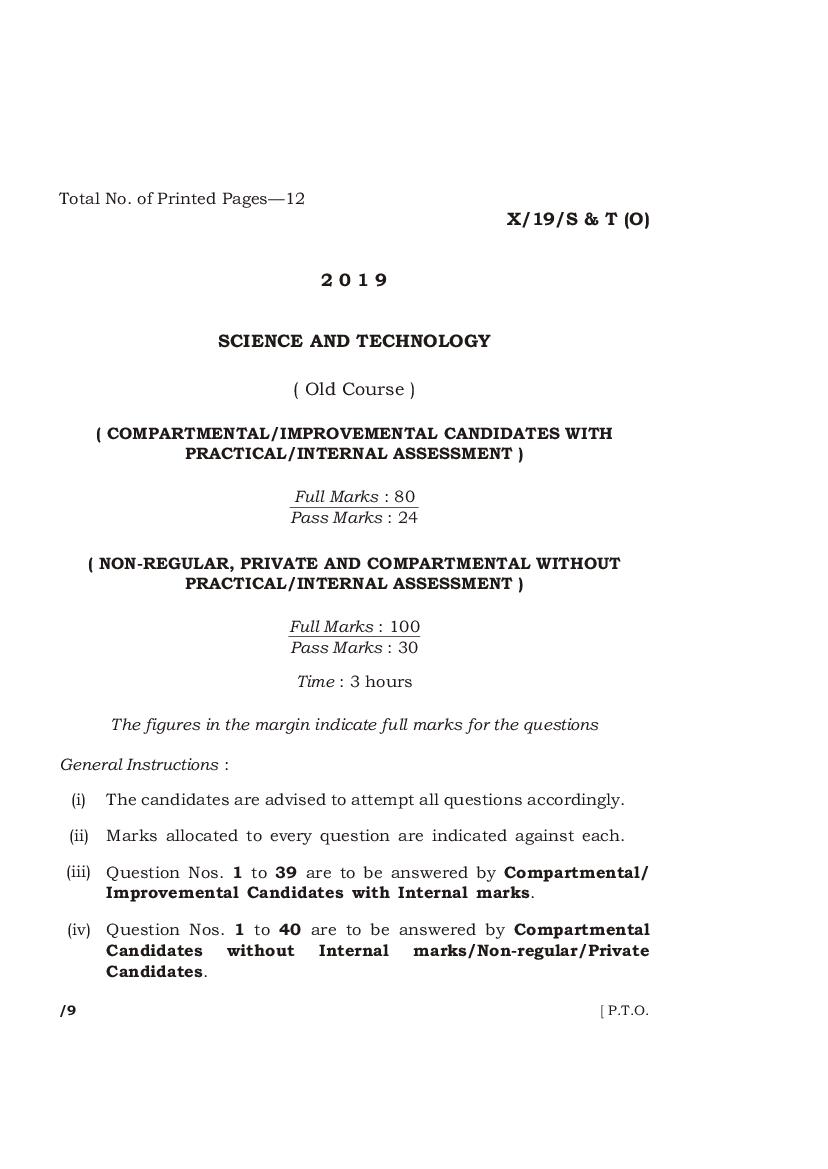
X/19/S & T (O)
2019
SCIENCE AND TECHNOLOGY
( Old Course )
( COMPARTMENTAL/IMPROVEMENTAL CANDIDATES WITH
PRACTICAL/INTERNAL ASSESSMENT )
Full Marks : 80
Pass Marks : 24
( NON-REGULAR, PRIVATE AND COMPARTMENTAL WITHOUT
PRACTICAL/INTERNAL ASSESSMENT )
Full Marks : 100
Pass Marks : 30
Time : 3 hours
The figures in the margin indicate full marks for the questions
General Instructions :
(i) The candidates are advised to attempt all questions accordingly.
(ii) Marks allocated to every question are indicated against each.
(iii) Question Nos. 1 to 39 are to be answered by Compartmental/
Improvemental Candidates with Internal marks.
(iv) Question Nos. 1 to 40 are to be answered by Compartmental
Candidates without Internal marks/Non-regular/Private
Candidates.
/9 [ P.T.O.
Page 2
SECTION—A
( PHYSICS )
( Marks : 26 )
Choose and write the correct answers from the following : 1×3=3
1. Refraction of light takes place due to the change in its
(a) speed
(b) wavelength
(c) nature
(d) None of the above 1
2. A fuse is always connected with the electrical circuit
(a) in parallel
(b) in series
(c) Both in series and parallel
(d) None of the above 1
3. The core of an electromagnet is
(a) steel
(b) magnesium
(c) soft iron
(d) copper 1
X/19/S & T (O)/9 [ Contd.
Page 3
Answer the following questions in one word or one sentence each :
1×3=3
4. What is the speed of light in air? 1
5. Which will offer more resistance—a short wire or a long wire? 1
6. What is a magnetic field? 1
Answer the following short-answer type questions in 30–40 words
each : 2×3=6
7. Either
(a) State the laws of reflection of light. 2
Or
(b) What are the two possible causes of myopia? 1+1=2
8. Write any two advantages of alternating current over direct
current. 1+1=2
9. Why are two magnetic lines of force never found to intersect
each other? 2
Answer the following short-answer type questions in 50–60 words
each : 3×3=9
10. (a) What is the formula for a lens connecting image distance v,
object distance u and focal length f ? 1
(b) Define one dioptre. Name the instrument used for
measuring the power of a lens. 1+1=2
X/19/S & T (O)/9 [ P.T.O.
Page 4
11. (a) Define electric current. 1
(b) 30 coulombs of charge flows through any cross-section of
a conductor in 20 seconds. What is the current flowing
through the conductor? 2
12. Either
(a) Distinguish between real image and virtual image. 3
Or
(b) Derive the relationship between SI unit of electrical energy
and commercial unit of electrical energy. 3
Answer the following long-answer type questions in 70–80 words : 5
13. Either
(a) State Ohm’s law. 2
(b) State the mathematical expression to verify the law. 1
(c) An electric heater draws a current of 11 A, when
connected to 220 V main supply. Calculate the resistance
of the filament of the heater. 2
Or
(d) Define power of accommodation. 1
(e) Mention any two uses of concave mirror. 2
(f) What is the nature of the lens, if the power of the lens is
(i) positive and (ii) negative? 2
X/19/S & T (O)/9 [ Contd.
Page 5
SECTION—B
( CHEMISTRY )
( Marks : 26 )
Choose and write the correct answers from the following : 1×3=3
14. The metal which can be cut with a knife is 1
(a) sodium
(b) iron
(c) lithium
(d) caesium
15. Which of the following is a strong acid? 1
(a) CH 3COOH
(b) H 3PO4
(c) H2CO 3
(d) HCl
16. The number of periods in the periodic table is 1
(a) 6
(b) 7
(c) 10
(d) 8
X/19/S & T (O)/9 [ P.T.O.
Page 6
Answer the following questions in one word or one sentence each :
1×2=2
17. Define an acid according to Brönsted-Lowry concept. 1
18. What is metallurgy? 1
Answer the following short-answer type questions in 30–40 words
each : 2×2=4
19. Define corrosion. Name two methods used for the prevention
of corrosion. 1+½+½=2
20. Either
(a) What are normal salts? Give two examples. 1+½+½=2
Or
(b) How is bleaching powder prepared? Give the chemical
equation. 1+1=2
Answer the following short-answer type questions in 50–60 words
each : 3×4=12
21. (a) What do you mean by combination reaction? Give an
example. 1+1=2
(b) Why do gold and silver not corrode in moist air? 1
22. (a) What happens when iron reacts with steam? Give the
equation. 1+1=2
(b) State modern periodic law. 1
X/19/S & T (O)/9 [ Contd.
Page 7
23. Differentiate between the roasting and calcination processes
used in metallurgy. Give one example of each. 2+½+½=3
24. Either
(a) What is a functional group in an organic compound? 1
(b) What are carboxylic acids? What happens when ethanoic
acid reacts with ethyl alcohol? 1+1=2
Or
(c) Name two crystalline allotropes of carbon. ½+½=1
(d) What are isomers? 1
(e) Write the IUPAC name of the following compound : 1
H H H O
H—C—C—C—C—OH
H H H
Answer the following long-answer type questions in 70–80 words : 5
25. Either
(a) What is flux? What chemical process is used for obtaining
a metal from its oxide? 1+1=2
(b) Describe the process of froth flotation. 3
Or
(c) What are soaps? 1
(d) Name the raw materials used for making soap. 2
(e) How is transparent soap prepared from soft soap? 2
X/19/S & T (O)/9 [ P.T.O.
Page 8
SECTION—C
( BIOLOGY )
( Marks : 28 )
Choose and write the correct answers from the following : 1×3=3
26. The mode of nutrition in fungi (mushroom) is called
(a) autotrophic
(b) holozoic
(c) heterotrophic
(d) saprophytic 1
27. The lungs are covered by a membrane called
(a) pericardium
(b) pleura
(c) myelin sheath
(d) periosteum 1
28. Which of the following is not a plant hormone?
(a) Gibberellin
(b) Oxytocin
(c) Ethylene
(d) Cytokinin 1
X/19/S & T (O)/9 [ Contd.
Page 9
Answer the following questions in one word or one sentence each :
1×3=3
29. Name the enzyme present in saliva of human beings. 1
30. How do insects and fishes respire? ½+½=1
31. What is gene? 1
Answer the following short-answer type questions in 20–30 words
each : 2×4=8
32. What are the factors that affect the rate of photosynthesis? 2
33. What is blood pressure? Name the instrument used to
measure blood pressure. 1+1=2
34. Either
(a) Name three types of blood corpuscles present in the
human blood. 1½
(b) Which fluid transports fatty acids and glycerol in the
human body? ½
Or
(c) Name any four sense organs for receptor. ½×4=2
35. Mention any two basic features of asexual reproduction. 2
X/19/S & T (O)/9 [ P.T.O.
Page 10
Answer the following short-answer type questions in 50–60 words
each : 3×3=9
36. What are vestigial organs? Name four vestigial organs. 1+2=3
37. Either
(a) What are the four great blood vessels of the heart? 2
(b) What is the respiratory pigment present in erythrocytes? 1
Or
(c) Give any three important characteristics of hormone. 3
38. (a) What is tissue culture? 1
(b) Distinguish between binary and multiple fission. 2
Answer the following long-answer type questions in 70–80 words : 5
39. Either
(a) Write any five main functions of human blood. 5
Or
(b) What are the functions of saliva? 5
X/19/S & T (O)/9 [ Contd.
Page 11
[ For Candidates (without Practicals) only ]
40. I. Answer any three of the following questions : 2×3=6
(a) What do you mean by magnification of spherical
mirror? 2
(b) What is dispersion of light? Which colour bends
the most? 1+1=2
(c) What are insulators? Give two examples. 1+1=2
(d) (i) What is meant by magnetic effect of current? 1
(ii) How does a conductor behave when electric
current flows through it? 1
(e) Name the instruments used to measure current and
potential difference. 1+1=2
II. Answer any three of the following questions : 2×3=6
(a) Define the terms (i) oxidation and (ii) reduction. 1+1=2
(b) (i) Name the simplest hydrocarbon. 1
(ii) Give the general formula of alkanes. 1
(c) (i) Name the non-metal which is good conductor
of electricity. 1
(ii) What is an alloy? 1
(d) Mention any two applications of pH. 2
(e) What are malleability and ductility? 1+1=2
X/19/S & T (O)/9 [ P.T.O.
Page 12
III. Answer any four of the following questions : 2×4=8
(a) Name the four chambers of human heart. ½×4=2
(b) Name the accessory whorls and the reproductive
whorls of a flower. ½×4=2
(c) Define transpiration. Name the plant tissue
concerned with transport of water and food materials.
1+1=2
(d) (i) What is ultrafiltration? 1
(ii) Name the main excretory organs in human
beings. 1
(e) Name the different parts of central nervous system
of the human body. 2
(f) How does vegetative reproduction occur in colocacia,
chrysanthemum, onion and strawberry? ½×4=2
HHH
X/19/S & T (O)/9 K9—19660
Document Details
| Board / Org | Meghalaya Board |
| Exam | Class 10 |
| Type | Question Paper |
| Pages | 12 |
| Updated | 30 Apr 2026 |