TN 11th Model Question Paper Botany
Finished viewing? Save it for later —
Download TN 11th Model Question Paper Botany (PDF · 3 pages)About TN 11th Model Question Paper Botany
TN 11th Model Question Paper Botany is available here for free download. Published by Tamil Nadu Board for Class 11, this sample paper can be viewed online or downloaded as a PDF (3 pages). Candidates preparing for Class 11 can use TN 11th Model Question Paper Botany to understand the exam pattern, the type of questions asked, and the overall difficulty level.
Frequently Asked Questions
How can I download TN 11th Model Question Paper Botany?
Open this page and click the Download button to save TN 11th Model Question Paper Botany as a PDF. It is completely free on AglaSem Docs.
Is TN 11th Model Question Paper Botany free to download?
Yes. TN 11th Model Question Paper Botany can be viewed online and downloaded as a PDF free of cost on AglaSem Docs.
How many pages does TN 11th Model Question Paper Botany have?
TN 11th Model Question Paper Botany contains 3 pages, which you can read online or download together as a single PDF.
Where can I find more Class 11 study material?
You can find more Class 11 question papers, sample papers, syllabus, and answer keys on AglaSem Docs.
TN 11th Model Question Paper Botany – Text
Read the full text of this sample paper below — useful to quickly search, copy and reference the content online without downloading the PDF.
📄 View text version (3 pages)
Page 1
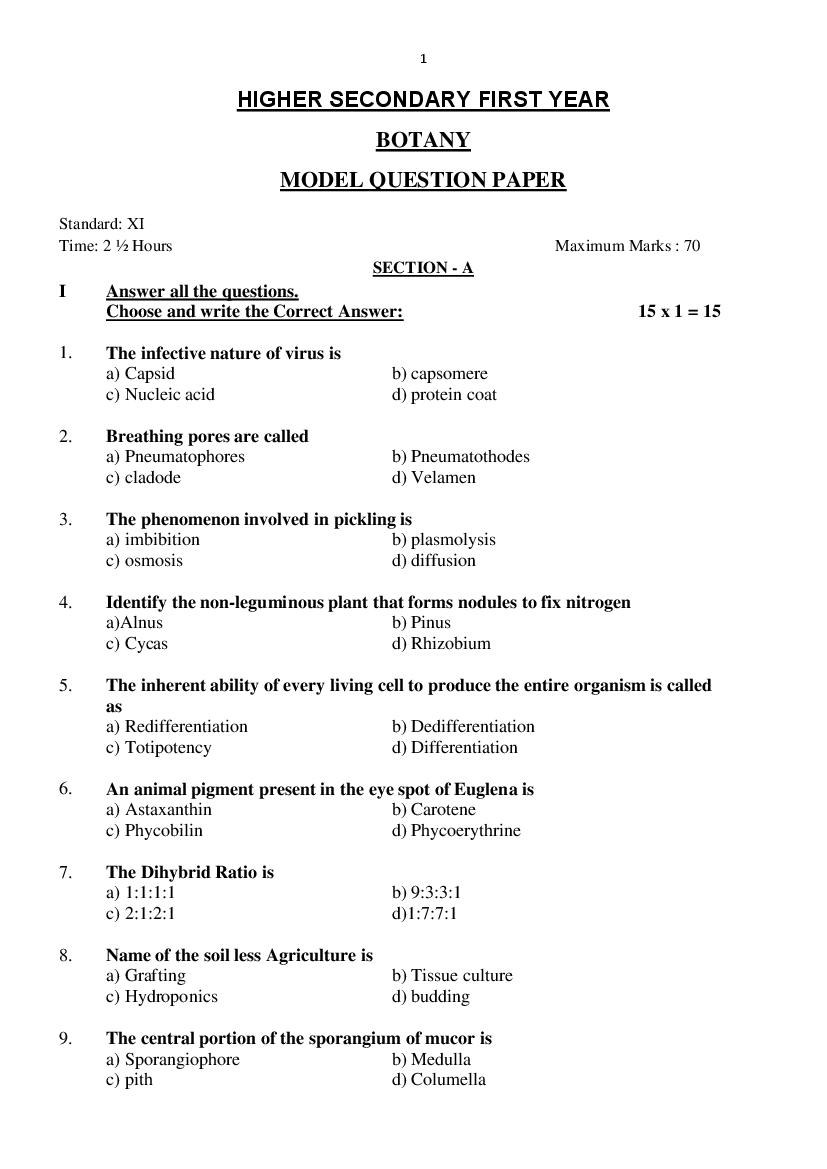
HIGHER SECONDARY FIRST YEAR
BOTANY
MODEL QUESTION PAPER
Standard: XI www.tnschools.co.in
Time: 2 ½ Hours Maximum Marks : 70
SECTION - A
I Answer all the questions.
Choose and write the Correct Answer: 15 x 1 = 15
1. The infective nature of virus is
a) Capsid b) capsomere
c) Nucleic acid d) protein coat
2. Breathing pores are called
a) Pneumatophores b) Pneumatothodes
c) cladode d) Velamen
3. The phenomenon involved in pickling is
a) imbibition b) plasmolysis
c) osmosis d) diffusion
4. Identify the non-leguminous plant that forms nodules to fix nitrogen
a)Alnus b) Pinus
c) Cycas d) Rhizobium
5. The inherent ability of every living cell to produce the entire organism is called
as
a) Redifferentiation b) Dedifferentiation
c) Totipotency d) Differentiation
6. An animal pigment present in the eye spot of Euglena is
a) Astaxanthin b) Carotene
c) Phycobilin d) Phycoerythrine
7. The Dihybrid Ratio is
a) 1:1:1:1 b) 9:3:3:1
c) 2:1:2:1 d)1:7:7:1
8. Name of the soil less Agriculture is
a) Grafting b) Tissue culture
c) Hydroponics d) budding
9. The central portion of the sporangium of mucor is
a) Sporangiophore b) Medulla
c) pith d) Columella
Page 2
10. Double Fertilization was introduced by
a) Nawaschine b) Goldsmith
c) Gardiner d) Renner
11. Phagocytosis is called as
a) Cell death b) Cell drinking
c) PCD d) Cell eating
12. The algae to produce toxin such as hydroxylamine which causes death of Fish
and Cattle
a) Microcystis b) Spirogyra
c) Chlorella d) Chara
13. Perianth is a condition in which
a) calyx and corolla are not distinct b) calyx is present but corolla is absent
c) corolla is present but calyx is d) calyx and corolla are not present
absent
14. Which of the following is incorrect?
a) Roots help in water and mineral b) Roots provide a proper anchorage.
absorption from soil.
c) Roots store food materials. d) Roots lack meristematic activity.
15. Plants are classified on the basis of water requirements by
a) Warming b) Reitter
c) Haeckel d) Adam
SECTION -B
II Answer any six of the following: 6 x 2 = 12
Question No.22 is compulsory:
16. What is phylogeny?
17. What are oncogenic viruses?
18. Mention any two functions of cell wall.
19. What are polyribosomes?
20. What is cladode?
21. What is protandry?
22. Why do farmers use leguminous plants to provide nitrogen to the soil? Explain.
23. Hibiscus and Moringa plants are propagated by vegetative method only. How?
24. A person gets hurt and his tissues are damaged. After sometime the wound gets
healed. Identify the type of cell division that has taken place?
Page 3
SECTION - C
III Answer any SIX of the following: 6 x 3 = 18
Question No.27 is compulsory:
25. What is Phyllotaxy?
26. Mention the important aspects of cell theory. (any three)
27. Differentiate dicot seed from monocot seed (any three)
28. In complementary gene interaction when two white flowered plants are crossed,
the F1 hybrids were all purple flowered plants. Interpret your answer with suitable
reason.
29. What is ecological succession?
30. What is Siesmonasty?
31. Draw and label the ultrastructure of an mitochondrion.
32. Mention the different types of hydrophytes.
33. Flower is a modified shoot. Justify the statement.
SECTION - D
IV Answer all the questions 5 x 5 = 25
34. Write the Significance of Viruses.
(OR)
Mention the factors influencing stomatal movement.
35. Write note on internal structure of a Riccia thallus
(OR)
Hydrophonics have been shown to be a successful technique for growing plants, yet
most of the crops still grown on land. Why?
36. Write note on physiology of senescence
(OR)
Draw and label the T.S. of Nerium leaf.
37. Write a checker board for dihybrid cross.
(OR)
Mention about the modifications of taproot.
38. Describe the Pitcher plant.
(OR)
Differentiate Prokaryotes from Eukaryotes.
Powered by TCPDF (www.tcpdf.org)
Document Details
| Board / Org | Tamil Nadu Board |
| Exam | Class 11 |
| Type | Sample Paper |
| Pages | 3 |
| Language | english |
| Updated | 09 Jun 2026 |