CMI Entrance Exam 2022 Question Paper for B.Sc Maths & Computer (23 May)
Finished viewing? Save it for later —
Download CMI Entrance Exam 2022 Question Paper for B.Sc Maths & Computer (23 May) (PDF · 6 pages)About CMI Entrance Exam 2022 Question Paper for B.Sc Maths & Computer (23 May)
CMI Entrance Exam 2022 Question Paper for B.Sc Maths & Computer (23 May) is available here for free download. Published by Default for CMI Entrance Exam, this question paper can be viewed online or downloaded as a PDF (6 pages). Candidates preparing for CMI Entrance Exam can use CMI Entrance Exam 2022 Question Paper for B.Sc Maths & Computer (23 May) to understand the exam pattern, the type of questions asked, and the overall difficulty level.
Frequently Asked Questions
How can I download CMI Entrance Exam 2022 Question Paper for B.Sc Maths & Computer (23 May)?
Open this page and click the Download button to save CMI Entrance Exam 2022 Question Paper for B.Sc Maths & Computer (23 May) as a PDF. It is completely free on AglaSem Docs.
Is CMI Entrance Exam 2022 Question Paper for B.Sc Maths & Computer (23 May) free to download?
Yes. CMI Entrance Exam 2022 Question Paper for B.Sc Maths & Computer (23 May) can be viewed online and downloaded as a PDF free of cost on AglaSem Docs.
How many pages does CMI Entrance Exam 2022 Question Paper for B.Sc Maths & Computer (23 May) have?
CMI Entrance Exam 2022 Question Paper for B.Sc Maths & Computer (23 May) contains 6 pages, which you can read online or download together as a single PDF.
Where can I find more CMI Entrance Exam study material?
You can find more CMI Entrance Exam question papers, sample papers, syllabus, and answer keys on AglaSem Docs.
CMI Entrance Exam 2022 Question Paper for B.Sc Maths & Computer (23 May) – Text
Read the full text of this question paper below — useful to quickly search, copy and reference the content online without downloading the PDF.
📄 View text version (6 pages)
Page 1
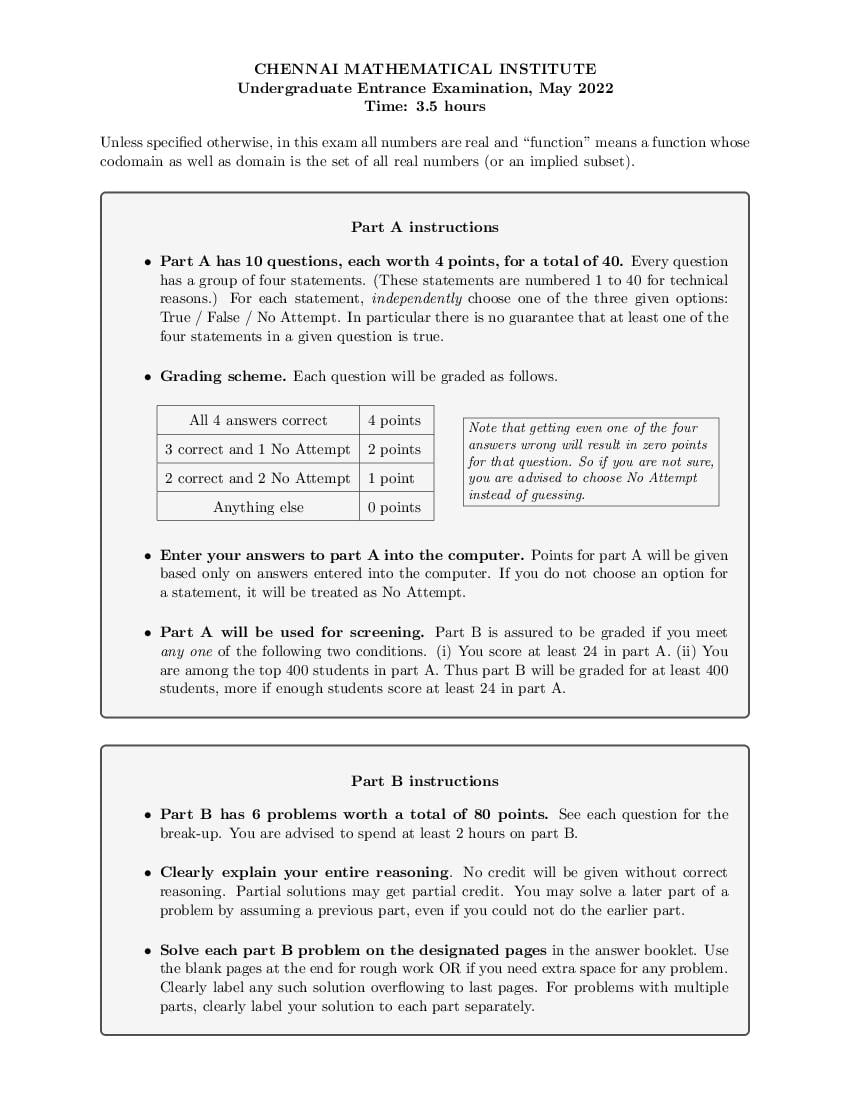
Undergraduate Entrance Examination, May 2022
Time: 3.5 hours
Unless specified otherwise, in this exam all numbers are real and “function” means a function whose
codomain as well as domain is the set of all real numbers (or an implied subset).
Part A instructions
• Part A has 10 questions, each worth 4 points, for a total of 40. Every question
has a group of four statements. (These statements are numbered 1 to 40 for technical
reasons.) For each statement, independently choose one of the three given options:
True / False / No Attempt. In particular there is no guarantee that at least one of the
four statements in a given question is true.
• Grading scheme. Each question will be graded as follows.
All 4 answers correct 4 points Note that getting even one of the four
3 correct and 1 No Attempt 2 points answers wrong will result in zero points
for that question. So if you are not sure,
2 correct and 2 No Attempt 1 point you are advised to choose No Attempt
instead of guessing.
Anything else 0 points
• Enter your answers to part A into the computer. Points for part A will be given
based only on answers entered into the computer. If you do not choose an option for
a statement, it will be treated as No Attempt.
• Part A will be used for screening. Part B is assured to be graded if you meet
any one of the following two conditions. (i) You score at least 24 in part A. (ii) You
are among the top 400 students in part A. Thus part B will be graded for at least 400
students, more if enough students score at least 24 in part A.
Part B instructions
• Part B has 6 problems worth a total of 80 points. See each question for the
break-up. You are advised to spend at least 2 hours on part B.
• Clearly explain your entire reasoning. No credit will be given without correct
reasoning. Partial solutions may get partial credit. You may solve a later part of a
problem by assuming a previous part, even if you could not do the earlier part.
• Solve each part B problem on the designated pages in the answer booklet. Use
the blank pages at the end for rough work OR if you need extra space for any problem.
Clearly label any such solution overflowing to last pages. For problems with multiple
parts, clearly label your solution to each part separately.
Page 2
Part A. Select True or False or No Attempt for each statement.
A1. The three sides of triangle a < b < c are in arithmetic progression (AP) with common
di↵erence d = b a = c b. Denote the angles opposite to sides a, b, c respectively by
A, B, C.
(1) d must be less than a.
(2) d can be any positive number less than a.
(3) The numbers sin A, sin B, sin C are in AP.
(4) The numbers cos A, cos B, cos C are in AP.
A2. You are asked to take three distinct points 1, !1 and !2 in the complex plane such that
|!1 | = |!2 | = 1. Consider the triangle T formed by the complex numbers 1, !1 and !2 .
(5) There is exactly one such triangle T that is equilateral.
(6) There are exactly two such triangles T that are right angled isosceles.
(7) If !1 + !2 is real, the triangle T must be isosceles.
(8) For any nonzero complex number z, the numbers z, z!1 and z!2 form a triangle that is
similar to the triangle T.
A3. M is a 3 ⇥ 3 matrix with integer entries. For M we have
(Sum of column 2) = 4 ⇥ (sum of column 1). (Sum of column 3) = 4 ⇥ (sum of column 2).
(Sum of row 2) = 6 + (sum of row 1).
(Sum of row 3) = 6 + (sum of row 2).
(9) The sum of all the entries in M must be divisible by 21.
(10) None of the row sums is divisible by 7.
(11) One of the column sums must be divisible by 7.
(12) None of the column sums is divisible by 6.
Page 3
(13) As x ! 1 the function cos(ex ) tends to a finite limit.
(14) As x ! 1 the function cos(ex ) changes sign infinitely many times.
(15) As x ! 1, the function sin(ln(x)) tends to a finite limit.
(16) sin(ln(x)) changes sign only finitely many times as x goes towards 0 from 1.
A5. Statements
p p
(17) 4 4 < 5 5.
(18) log10 11 > log11 12.
p p
(19) ⇡4 < 2 2.
(20) (2022!)2 > 20222022 .
sin x 1.001
R x Let f (x) = | x |
A6. for x 6= 0 and f (0) = L such that f is continuous. Let I(x) =
0
f (t)dt.
(21) L = 1.001
(22) I(0.001) > 0.001.
(23) As x ! 1 the limit of I(x) is greater than 1001 (possibly 1).
(24) The function I(x) is NOT di↵erentiable at infinitely many points.
A7. Statements
(25) There is a unique natural number n such that n2 + 19n n! = 0.
(26) There are infinitely many pairs (x, y) of natural numbers satisfying
(1 + x!)(1 + y!) = (x + y)!.
(27) For any natural number n, consider GCD of n2 + 1 and (n + 1)2 + 1. As n ranges over
all natural numbers, the largest possible value of this GCD is 5.
(28) If n is the largest natural number for which 20! is divisible by 80n , then n 5.
Page 4
f has a flex point at a if we can find a small interval (a ✏, a + ✏) in the domain of f such
that the following happens: (i) for all x in the open interval (a ✏, a) the sign of f 00 (x) is
constant and, (ii) for all x in the open interval (a, a + ✏) the sign of f 00 (x) is constant and
opposite to the sign of f 00 (x) in (a ✏, a).
(29) If f is a cubic polynomial with a local maximum at x = p and a local minimum at
x = q, then f has a unique flex point at x = p+q
2
.
(30) If f 00 (a) = 0 then f must have a flex point at a.
(31) Let f (x) = x2 for x 0 and f (x) = x2 for x < 0. Then f has no flex points.
(32) If f 0 is monotonic on an open interval I, then f cannot have a flex point in I.
A9. Suppose A, B and C are three events and P (A) = a, P (B) = b, P (C) = c are known.
Let P (A [ B [ C) = p. The statements below are about whether we can find the value of
p if we know some additional information. (Note: [ is the same as OR. Similarly \ is the
same as AND.)
(33) We can find the value of p if we know that at least one of a, b, c is 1.
(34) We can find the value of p if we know that at least one of a, b, c is 0.
(35) We can find the value of p if we know that any two of A, B and C are mutually exclusive.
(36) We can find the value of p if we know that any two of A, B and C are independent and
we know the value of P (A \ B \ C).
2 3 2 3
1 2 3 x
A10. Let A = 10 20 31 and v = y 5, where k is a constant and x, y, z are variables.
4 5 4
11 22 k z
(37) Regardless of the value of k, the matrix A is not invertible, i.e., there is no 3 ⇥ 3 matrix
B such that BA = the 3 ⇥ 3 identity matrix.
(38) There is a unique k such that determinant of A is 0. 2 3
0
(39) The set of solutions (x, y, z) of the matrix equation Av = 405 is either a line or a plane
0
containing the origin. 2 3
p
(40) If the equation Av = 4q 5 has a solution, then it must be true that q = 10p.
r
Page 5
B1. [12 points] Let N = {1, 2, 3, 4, 5, 6, 7, 8, 9} and L = {a, b, c}.
(i) Suppose we arrange the 12 elements of L [ N in a line such that no two of the three
letters occur consecutively. If the order of the letters among themselves does not matter,
find the number such arrangements.
(ii) Find the number of functions from N to L such that exactly 3 numbers are mapped to
each of a, b and c.
(iii) Find the number of onto functions from N to L.
B2. [12 points] Let f be a function from natural numbers to natural numbers that satisfies
f (n) = n 2 for n > 3000;
f (n) = f (f (n + 5)) for n 3000.
Show that f (2022) is uniquely decided and find its value.
B3. [14 points] In 4ABC, \BAC = 2 \ACB and 0 < \BAC < 120 . A point M
is chosen in the interior of 4ABC such that BA = BM and M A = M C. Prove that
\M CB = 30 . See the schematic figure below (NOT to scale).
Hint (use this or your own method): Draw a suitable segment CD of appropriate length
making an appropriate angle with CA.
C
M
A B
Page 6
the following property.
p(x) ⇣ 1 ⌘
Letting q(x) := , q(x) = q for all x 2
/ {0, 1}.
x(1 x) 1 x
(i) Find one such polynomial with the smallest possible degree.
(ii) Find one such polynomial with the largest possible degree OR show that the degree of
such polynomials is unbounded.
B5. [14 points] Let R+ denote the set of positive real numbers. A one-to-one and onto
function f : R+ ! R+ is called golden if f 0 (x) = f 1 (x) for every x 2 R+ .
(i) Find all golden functions (if any) of the form f (x) = a xb . Find all golden functions (if
any) of the form f (x) = a bx . In both cases a and b are suitable real numbers.
(ii) Show that there is no one-to-one and onto function f : R ! R such that f 0 (x) = f 1 (x)
for every x 2 R.
B6. [14 points] Suppose an integer n > 1 is such that n + 1 is not a multiple of 4 (i.e.,
such that n is not congruent to 3 mod 4). Prove that there exist 1 i < j n such that
the following is a perfect square.
1! 2! · · · n!
i! j!
Hint (use this or your own method): Make cases and first treat the case n = 4k.
Document Details
| Board / Org | Default |
| Exam | CMI Entrance Exam |
| Type | Question Paper |
| Pages | 6 |
| Updated | 09 Jun 2026 |