Goa Board Class 12 Question Paper Mar 2019 Political Science
Finished viewing? Save it for later —
Download Goa Board Class 12 Question Paper Mar 2019 Political Science (PDF · 5 pages)About Goa Board Class 12 Question Paper Mar 2019 Political Science
Goa Board Class 12 Question Paper Mar 2019 Political Science is available here for free download. Published by Goa Board for Class 12, this question paper can be viewed online or downloaded as a PDF (5 pages). Candidates preparing for Class 12 can use Goa Board Class 12 Question Paper Mar 2019 Political Science to understand the exam pattern, the type of questions asked, and the overall difficulty level.
Frequently Asked Questions
How can I download Goa Board Class 12 Question Paper Mar 2019 Political Science?
Open this page and click the Download button to save Goa Board Class 12 Question Paper Mar 2019 Political Science as a PDF. It is completely free on AglaSem Docs.
Is Goa Board Class 12 Question Paper Mar 2019 Political Science free to download?
Yes. Goa Board Class 12 Question Paper Mar 2019 Political Science can be viewed online and downloaded as a PDF free of cost on AglaSem Docs.
How many pages does Goa Board Class 12 Question Paper Mar 2019 Political Science have?
Goa Board Class 12 Question Paper Mar 2019 Political Science contains 5 pages, which you can read online or download together as a single PDF.
Where can I find more Class 12 study material?
You can find more Class 12 question papers, sample papers, syllabus, and answer keys on AglaSem Docs.
Goa Board Class 12 Question Paper Mar 2019 Political Science – Text
Read the full text of this question paper below — useful to quickly search, copy and reference the content online without downloading the PDF.
📄 View text version (5 pages)
Page 1
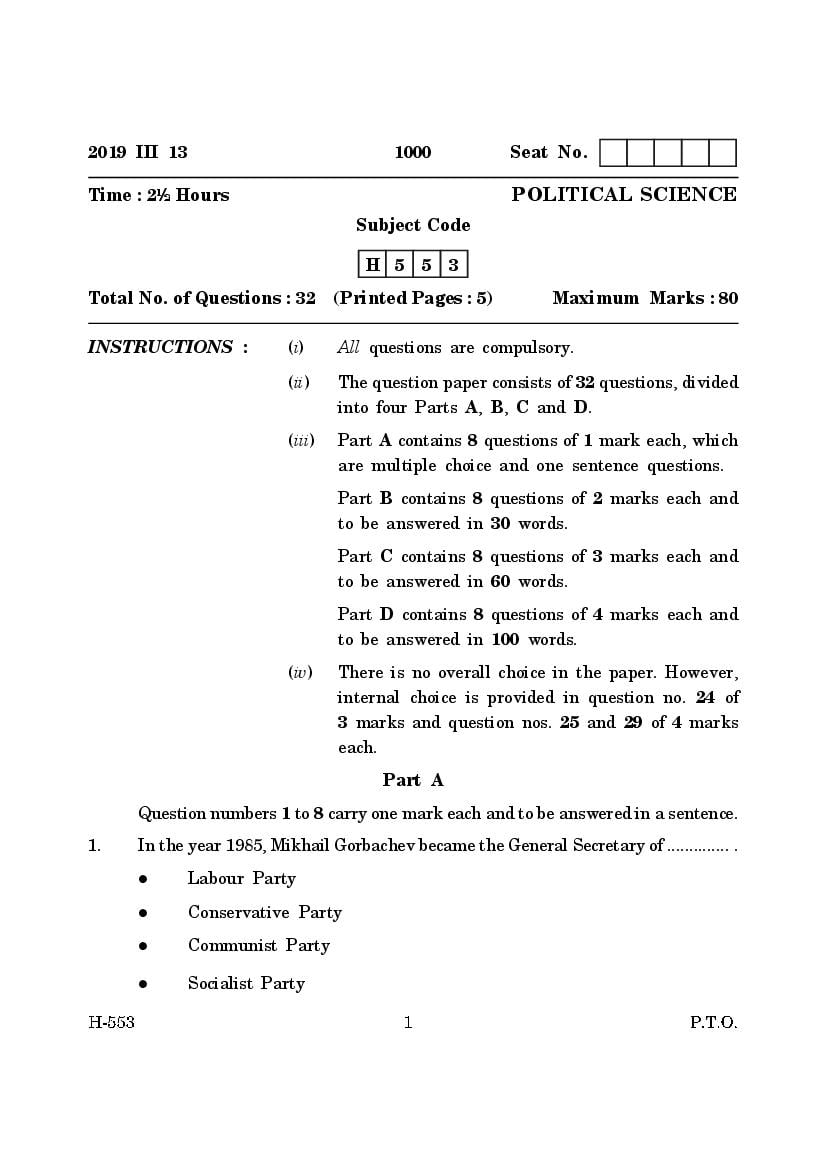
Time : 2½ Hours POLITICAL SCIENCE
Subject Code
H 5 5 3
Total No. of Questions : 32 (Printed Pages : 5) Maximum Marks : 80
INSTRUCTIONS : (i) All questions are compulsory.
(ii) The question paper consists of 32 questions, divided
into four Parts A, B, C and D.
(iii) Part A contains 8 questions of 1 mark each, which
are multiple choice and one sentence questions.
Part B contains 8 questions of 2 marks each and
to be answered in 30 words.
Part C contains 8 questions of 3 marks each and
to be answered in 60 words.
Part D contains 8 questions of 4 marks each and
to be answered in 100 words.
(iv) There is no overall choice in the paper. However,
internal choice is provided in question no. 24 of
3 marks and question nos. 25 and 29 of 4 marks
each.
Part A
Question numbers 1 to 8 carry one mark each and to be answered in a sentence.
1. In the year 1985, Mikhail Gorbachev became the General Secretary of .............. .
Labour Party
Conservative Party
Communist Party
Socialist Party
Page 2
on the UN Security Council are Britain and ...................... .
Spain
France
Italy
Germany
3. The country that Indians can travel without a Visa and Passport is ................
Sri Lanka
Bhutan
Nepal
Bangladesh
4. In India, the description ‘Indigenous People’ is usually applied to the ................. .
Scheduled Castes
Upper Caste
Scheduled Tribes
Other Backward Classes
5. Which was the first state of India to hold an election based on universal adult
franchise ?
Page 3
year 1955 ?
7. Who was the leader of the students’ movement of 1974 in Bihar ?
8. Name the river on which Sardar Sarovar Dam is built.
Part B
Question numbers 9 to 16 carry 2 marks each and have to be answered in
30 words each.
9. Mention the reforms proposed under New International Economic Order
(NIEO).
10. Explain any two constraints on American hegemony.
11. What is the need of an international organization ?
12. Explain the steps taken by the Government of India to protect the
environment.
13. What is the role played by the opposition parties in India during the first
general election ?
14. Discuss the land reforms carried out in India after independence.
15. Explain the electoral verdict of fourth general election of 1967.
16. State the objectives of Dalit Panthers.
Part C
Question numbers 17 to 24 carry 3 marks each and have to be answered
in 60 words each.
17. Explain the Cuban Missile Crisis.
Page 4
19. Explain the criteria required for the permanent membership of UN Security
Council.
20. Explain any three components of India’s security strategy.
21. Explain the dominance of the Congress in the first three general elections.
22. Discuss the key areas of First Five Year Plan.
23. Discuss the issues that led to the formal split of the Indian National Congress
in the year 1969.
24. Explain the movement against outsiders in Assam.
Or
Explain the reactions against the Article 370 of the Constitution of India.
Part D
Question Numbers 25 to 32 carry 4 marks each and have to be answered
in 100 words each.
25. Examine the causes of distintegration of the Soviet Union.
Or
Examine the consequences of the shock therapy.
26. Explain the causes that led to the rise of Chinese economy.
27. Analyse the factors that led the Indian government to send Indian Peace
Keeping Force (IPKF) to Sri Lanka.
28. Examine the economic consequences of globalisation.
Page 5
Or
Evaluate the accession of Hyderabad to the Indian Union.
30. Discuss the impact of Chinese Invasion of 1962 on India.
31. Examine the consequences of Emergency of 1975.
32. Explain the political rise of Other Backward Classes in India.
Document Details
| Board / Org | Goa Board |
| Exam | Class 12 |
| Type | Question Paper |
| Pages | 5 |
| Updated | 22 Jul 2026 |