DUET 2021 Question Paper M.Phil Ph.D in Statistics
Finished viewing? Save it for later —
Download DUET 2021 Question Paper M.Phil Ph.D in Statistics (PDF · 13 pages)About DUET 2021 Question Paper M.Phil Ph.D in Statistics
DUET 2021 Question Paper M.Phil Ph.D in Statistics is available here for free download. Published by NTA for DUET, this question paper can be viewed online or downloaded as a PDF (13 pages). Candidates preparing for DUET can use DUET 2021 Question Paper M.Phil Ph.D in Statistics to understand the exam pattern, the type of questions asked, and the overall difficulty level.
Frequently Asked Questions
How can I download DUET 2021 Question Paper M.Phil Ph.D in Statistics?
Open this page and click the Download button to save DUET 2021 Question Paper M.Phil Ph.D in Statistics as a PDF. It is completely free on AglaSem Docs.
Is DUET 2021 Question Paper M.Phil Ph.D in Statistics free to download?
Yes. DUET 2021 Question Paper M.Phil Ph.D in Statistics can be viewed online and downloaded as a PDF free of cost on AglaSem Docs.
How many pages does DUET 2021 Question Paper M.Phil Ph.D in Statistics have?
DUET 2021 Question Paper M.Phil Ph.D in Statistics contains 13 pages, which you can read online or download together as a single PDF.
Where can I find more DUET study material?
You can find more DUET question papers, sample papers, syllabus, and answer keys on AglaSem Docs.
DUET 2021 Question Paper M.Phil Ph.D in Statistics – Text
Read the full text of this question paper below — useful to quickly search, copy and reference the content online without downloading the PDF.
📄 View text version (13 pages)
Page 1
Topic:‐ STATS MPHIL
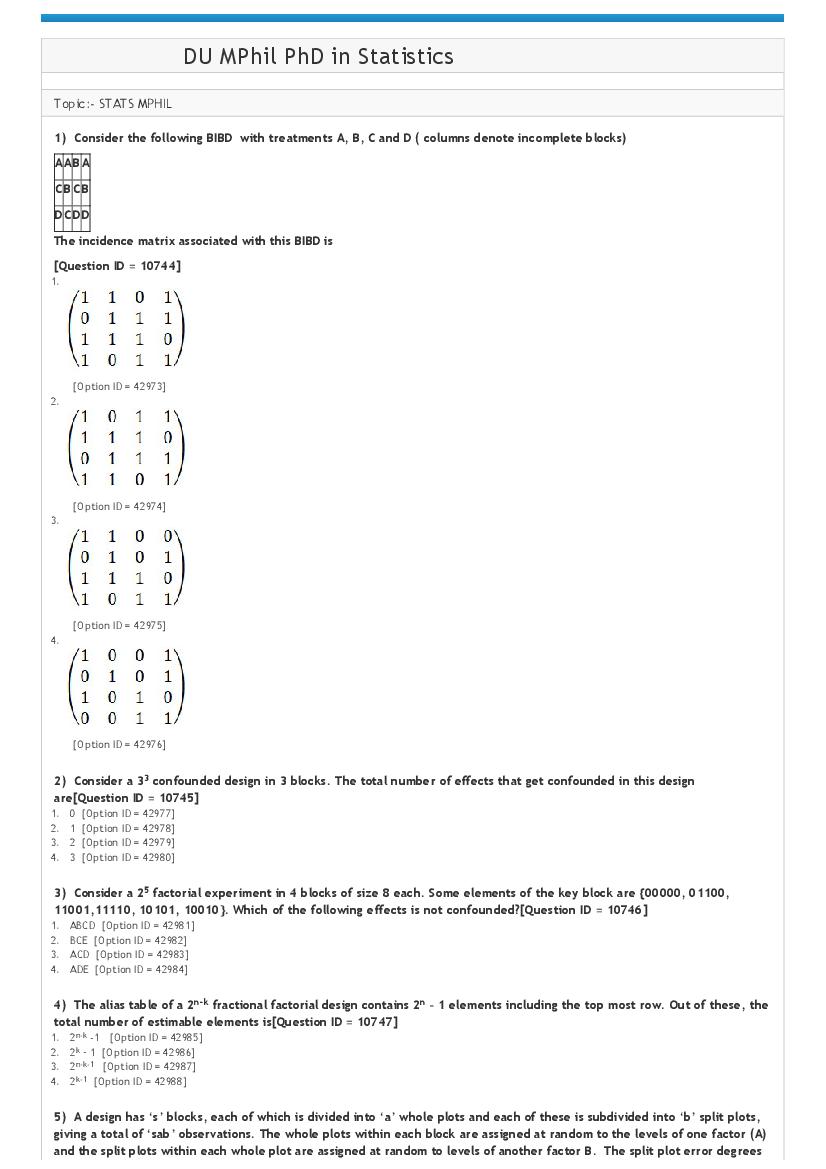
1) Consider the following BIBD with treatments A, B, C and D ( columns denote incomplete blocks)
AAB A
CBCB
DC DD
The incidence matrix associated with this BIBD is
[Question ID = 10744]
1.
[Option ID = 42973]
2.
[Option ID = 42974]
3.
[Option ID = 42975]
4.
[Option ID = 42976]
2) Consider a 33 confounded design in 3 blocks. The total number of effects that get confounded in this design
are[Question ID = 10745]
1. 0 [Option ID = 42977]
2. 1 [Option ID = 42978]
3. 2 [Option ID = 42979]
4. 3 [Option ID = 42980]
3) Consider a 25 factorial experiment in 4 blocks of size 8 each. Some elements of the key block are {00000, 01100,
11001,11110, 10101, 10010}. Which of the following effects is not confounded?[Question ID = 10746]
1. ABCD [Option ID = 42981]
2. BCE [Option ID = 42982]
3. ACD [Option ID = 42983]
4. ADE [Option ID = 42984]
4) The alias table of a 2n‐k fractional factorial design contains 2n – 1 elements including the top most row. Out of these, the
total number of estimable elements is[Question ID = 10747]
1. 2n‐k ‐1 [Option ID = 42985]
2. 2k – 1 [Option ID = 42986]
3. 2n‐k‐1 [Option ID = 42987]
4. 2k‐1 [Option ID = 42988]
5) A design has ‘s’ blocks, each of which is divided into ‘a’ whole plots and each of these is subdivided into ‘b’ split plots,
giving a total of ‘sab’ observations. The whole plots within each block are assigned at random to the levels of one factor (A)
and the split plots within each whole plot are assigned at random to levels of another factor B. The split plot error degrees
Page 2
1. (b‐1)(s‐1) [Option ID = 42989]
2. (a‐1)(b‐1) [Option ID = 42990]
3. abs‐1 [Option ID = 42991]
4. a(b‐1)(s‐1) [Option ID = 42992]
6) If the sample size is large, the ratio estimator is more efficient than the simple mean if the following relation holds.
C x and Cy are the co‐efficient of variation of x and y respectively, and ρ is the population correlation coefficient between x and y.
[Question ID = 10749]
1.
[Option ID = 42993]
2. ρ <
[Option ID = 42994]
3. ρ >
[Option ID = 42995]
4. ρ >
[Option ID = 42996]
7) A random sample of size n is drawn without replacement from a finite population of size N with variance σ2. The
covariance between any two units of the sample is[Question ID = 10750]
1.
[Option ID = 42997]
2.
[Option ID = 42998]
3.
[Option ID = 42999]
4.
[Option ID = 43000]
8) Consider a population of NM elements grouped into N =50 first stage units and M=20 second stage units. A sample of n
first stage units is selected and then m second stage units are drawn from each of these first stage units. If m = M this
corresponds to[Question ID = 10751]
1. Cluster Sampling [Option ID = 43001]
2. SRSWOR [Option ID = 43002]
3. Stratified Sampling [Option ID = 43003]
4. None of the above [Option ID = 43004]
9) Two stage sampling is generally better than single stage sampling when
[Question ID = 10752]
1. Elements in the same stage are positively correlated
[Option ID = 43005]
2. Elements in the same stage are negatively correlated
[Option ID = 43006]
Page 3
[Option ID = 43007]
4. Two stage sampling is always better than single stage sampling
[Option ID = 43008]
10) A sample of size n is drawn from a finite population of N units with probabilities proportional to size. Size here refers to
[Question ID = 10753]
1. Size of the sample
[Option ID = 43009]
2. Size of the population units
[Option ID = 43010]
3. Size as decided by the experimenter
[Option ID = 43011]
4. None of the above
[Option ID = 43012]
11) In a population of size N=250, suppose P denotes the proportion of units possessing a characteristic that is rare.
A sample of size n= 10 is drawn using inverse sampling procedure and an estimate of P is calculated as 0.09.
An estimator of variance of is given by:
[Question ID = 10754]
1.
[Option ID = 43013]
2.
[Option ID = 43014]
3.
[Option ID = 43015]
4. 0.010
[Option ID = 43016]
12) Consider a random sample of size n from a distribution with the following p.d.f.
, where μ is unknown.
Which of the following is a consistent estimator of μ?
[Question ID = 10755]
1. Sample mean,
[Option ID = 43017]
2. Sample median, .
[Option ID = 43018]
3. A consistent estimator does not exist for μ.
[Option ID = 43019]
4. n‐th order statistic, X(n).
[Option ID = 43020]
13) Let X1, X2, X3, …, Xn be independently and identically distributed random variables following Normal distribution with mean θ and variance aθ2;
where a is a known constant and θ > 0. Which of the following statements is TRUE about the two‐dimensional statistic, ?
[Question ID = 10756]
1. T is a complete‐sufficient statistic for θ.
[Option ID = 43021]
2. T is a sufficient statistic for θ, but its family of distribution is not complete.
[Option ID = 43022]
3. T, being a two‐dimensional statistic, cannot be considered as a sufficient statistic for a single parameter θ.
[Option ID = 43023]
4. T is a complete statistic but is not sufficient for θ.
[Option ID = 43024]
14)
Page 4
1.
[Option ID = 43025]
2.
[Option ID = 43026]
3.
[Option ID = 43027]
4.
[Option ID = 43028]
15) Pivotal Quantity method is popularly used for constructing confidence intervals of unknown population parameters.
Which of the following statements correctly describes a Pivotal Quantity?[Question ID = 10758]
1. It is a statistic whose distribution depends upon the unknown parameter. [Option ID = 43029]
2. It is a statistic whose distribution is independent of the unknown parameter. [Option ID = 43030]
3. It is a function of a statistic and the unknown parameter, and its distribution is independent of the unknown parameter. [Option ID = 43031]
4. It is a function of a statistic and the unknown parameter, and its distribution should depend upon the unknown parameter. [Option ID = 43032]
16)
[Question ID = 10759]
1.
[Option ID = 43033]
2.
[Option ID = 43034]
3.
[Option ID = 43035]
4.
[Option ID = 43036]
17) Let X1, X2, …, Xn be independently and identically distributed random variables following N(μ, σ2) distribution, where
both μ and σ2 are unknown. Which of the following statements is NOT TRUE? [Note: ]
[Question ID = 10760]
1.
[Option ID = 43037]
Page 5
[Option ID = 43038]
3. Minimal sufficient statistic of (μ, σ2) is not unique.
[Option ID = 43039]
4. Sufficient statistic of (μ, σ2) is not unique.
[Option ID = 43040]
18) Let X1, X2, …, Xn be observations on independently and identically distributed random variables following
Uniform(θ, θ+1), . Also, let X(1)<(2)<.....X (n) be the order‐statistics from the sample.
Then, which of the following is an ancillary statistic?
[Question ID = 10761]
1. X(n)
[Option ID = 43041]
2. X(1)
[Option ID = 43042]
3. X(n) – X(1)
[Option ID = 43043]
4. [X(n) + X(1)]/ 2
[Option ID = 43044]
19) Match the stochastic processes defined in List I with their type in List II.
List I List II
(Stochastic Process) (Type)
A. Let X(t) represents the maximum temperature at a place in (0, t). Then, the I. Discrete time and continuous
stochastic process {X(t), t ϵ T} has: state‐space.
B. Let X(t) represents the number of incoming calls at a switchboard in (0, t). Then, the II. Continuous time and continuous
stochastic process {X(t), t ϵ T} has: state‐space.
C. Let Xn represents the weight measured at the n‐th visit of a patient in a hospital. III. Continuous time and discrete
Then, the stochastic process {Xn} has: state‐space.
D. Let Xn be the total number of sixes appearing in the first n throws of a die. Then, the IV. Discrete time and discrete
stochastic process {Xn} has: state‐space.
Choose the correct answer from the options given below:
[Question ID = 10762]
1. A ‐ II, B ‐ III , C ‐ I , D ‐ IV
[Option ID = 43045]
2. A ‐ III , B ‐ II , C ‐ I , D ‐ IV
[Option ID = 43046]
3. A ‐ II , B ‐ III , C ‐ IV , D ‐ I
[Option ID = 43047]
4. A ‐ III , B ‐ II, C ‐ IV , D ‐ I
[Option ID = 43048]
20) Let {Xn , n ≥ 0} be a Markov chain having state‐space S = {1, 2, 3, 4} and transition probability matrix,
1 2 3 4
1 1/3 2/3 0 0
2 1 0 0 0
3 1/2 0 1/2 0
4 0 0 1/2 1/2
A. State 3 is transient.Which of the following statements is/ are TRUE about the type of the states?
B. State 1 is transient.
C. State 1 is ergodic.
D. State 4 is persistent (recurrent).
Choose the correct answer from the options given below:
[Question ID = 10763]
1. A, B and D only
[Option ID = 43049]
2. A and C only
[Option ID = 43050]
Page 6
[Option ID = 43051]
4. C and D only
[Option ID = 43052]
21) A machine goes out of order whenever a component part fails. The failure of this part is in accordance with a Poisson
process with mean rate of 1 per week. Suppose that there are 5 spare parts of the component in an inventory and that the
next supply is not due in 10 weeks. What is the probability that the machine will not be out of order in the next 10 weeks?
[Question ID = 10764]
1.
[Option ID = 43053]
2.
[Option ID = 43054]
3.
[Option ID = 43055]
4.
[Option ID = 43056]
22) Let a stochastic process X(t) be defined as,
where, W(t) is a Weiner process. What are the mean and variance of X(t)?
[Question ID = 10765]
1. Mean = 0, Var =
[Option ID = 43057]
2.
[Option ID = 43058]
3. Mean = 0, Var =
[Option ID = 43059]
4.
[Option ID = 43060]
23) Let Z1, Z2, Z3, … be independent random variables uniformly distributed on (0, a). Let X0 = 1 and Xt = Ct.Z1.Z2…..Zt
For what value of the constant Ct is Xt a martingale?
[Question ID = 10766]
1.
Page 7
2.
[Option ID = 43062]
3.
[Option ID = 43063]
4.
[Option ID = 43064]
24) During an eight‐hour work day, starting from 9 a.m., customers of a company arrive at a Poisson rate of 2 per hour.
Assuming that during the period from 10 a.m. to 11 a.m., no customer arrived, what is the probability that during the next
half an hour there will be no customer either? (Take e = 2.718)[Question ID = 10767]
1. 0.135 [Option ID = 43065]
2. 0.368 [Option ID = 43066]
3. 0.049 [Option ID = 43067]
4. 0.007 [Option ID = 43068]
25) The average number of samples required to declare a process out of statistical control, when the probability of a
sample point falling between the control limits is half, is [Question ID = 10768]
1. One [Option ID = 43069]
2. Two [Option ID = 43070]
3. Three [Option ID = 43071]
4. Four [Option ID = 43072]
26) The OC function of a sequential sampling plan with best incoming lot quality is‐
[Question ID = 10769]
1. (1‐α)
[Option ID = 43073]
2. β
[Option ID = 43074]
3. One
[Option ID = 43075]
4. Zero
[Option ID = 43076]
27) The Lx column of a life table represents :
[Question ID = 10770]
1. the number of persons alive at age x.
[Option ID = 43077]
2. the number of deaths in the age interval (x, x+1).
[Option ID = 43078]
3. the complete expectation of life at age x.
[Option ID = 43079]
4. person‐years lived by cohort between x and (x+1) years.
[Option ID = 43080]
28) The expectation of life decreases as age increases with a single exception of‐[Question ID = 10771]
1. first year of life. [Option ID = 43081]
2. young age. [Option ID = 43082]
3. old age. [Option ID = 43083]
4. none of the above. [Option ID = 43084]
29) The reliability of a parallel system can be improved by improving the reliability of its‐[Question ID = 10772]
1. weakest component. [Option ID = 43085]
2. best component. [Option ID = 43086]
3. best as well as weakest component. [Option ID = 43087]
4. none of the above. [Option ID = 43088]
30) The reliability of a series system decreases with‐[Question ID = 10773]
1. a decrease in the number of its components. [Option ID = 43089]
2. an increase in the number of its components. [Option ID = 43090]
3. no change in the number of its components. [Option ID = 43091]
4. none of the above. [Option ID = 43092]
Page 8
[Question ID = 10774]
1.
[Option ID = 43093]
2.
[Option ID = 43094]
3.
[Option ID = 43095]
4.
[Option ID = 43096]
32)
[Question ID = 10775]
1.
[Option ID = 43097]
2.
[Option ID = 43098]
3.
[Option ID = 43099]
4.
[Option ID = 43100]
33)
[Question ID = 10776]
1.
[Option ID = 43101]
2.
[Option ID = 43102]
3.
[Option ID = 43103]
4.
[Option ID = 43104]
34)
Page 9
1.
[Option ID = 43105]
2.
[Option ID = 43106]
3.
[Option ID = 43107]
4.
[Option ID = 43108]
35) Consider the following two statements
A. Principal components are invariant under a non‐singular linear transformation
B. Principal components are uncorrelated
then, which of the above statement(s) is/are correct?
[Question ID = 10778]
1. Both A and B
[Option ID = 43109]
2. Only B
[Option ID = 43110]
3. Only A
[Option ID = 43111]
4. None of the above
[Option ID = 43112]
36) Using Cholesky decomposition, a positive definite matrix A can be factored into
[Question ID = 10779]
1.
, where, T is a nonsingular upper triangular matrix
[Option ID = 43113]
2.
, where, T is a nonsingular lower triangular matrix
[Option ID = 43114]
3.
, where, T is a nonsingular upper triangular matrix
[Option ID = 43115]
4.
, where, T is nonsingular lower triangular matrix
[Option ID = 43116]
37)
Page 10
1. Demand function is unidentified and Supply function is identified [Option ID = 43117]
2. Demand function is identified and Supply function is unidentified [Option ID = 43118]
3. Demand function is identified and Supply function is identified [Option ID = 43119]
4. Demand function is unidentified and Supply function is unidentified [Option ID = 43120]
38)
[Question ID = 10781]
1. 4 [Option ID = 43121]
2. 8 [Option ID = 43122]
3. 5 [Option ID = 43123]
4. 6 [Option ID = 43124]
39)
[Question ID = 10782]
1.
[Option ID = 43125]
2.
[Option ID = 43126]
3.
[Option ID = 43127]
4. None of the above
[Option ID = 43128]
40) Consider the process, and the three statements.
A. It is a second‐order autoregressive process
B. Process is stationary
C. Process is non‐stationary
Which of the above statements is/are correct?
[Question ID = 10783]
1. Both A and B
[Option ID = 43129]
2. Both A and C
[Option ID = 43130]
3. Both B and C
[Option ID = 43131]
4. Only A
[Option ID = 43132]
41) Consider the process, , then the first and second autocorrelation are given by
[Question ID = 10784]
Page 11
[Option ID = 43133]
2.
[Option ID = 43134]
3.
[Option ID = 43135]
4.
[Option ID = 43136]
42) The simple exponential smoother is represented by[Question ID = 10785]
1.
[Option ID = 43137]
2.
[Option ID = 43138]
3.
[Option ID = 43139]
4.
[Option ID = 43140]
43) If a random variable X has the cumulative distribution function
then, E[X] equals to
[Question ID = 10786]
1.
[Option ID = 43141]
2.
[Option ID = 43142]
3.
[Option ID = 43143]
4.
[Option ID = 43144]
44) If the characteristic function of i.i.d. random variables X1 and X2 is ϕ(t) where ϕ: ℜ → ℜ, then the characteristic function
of X1‐ X2 is
[Question ID = 10787]
1.
[Option ID = 43145]
2.
[Option ID = 43146]
3.
[Option ID = 43147]
4.
[Option ID = 43148]
45)
Page 12
1. 0.8413 [Option ID = 43149]
2. 0.9413 [Option ID = 43150]
3. 0.7413 [Option ID = 43151]
4. 0.6413 [Option ID = 43152]
46)
[Question ID = 10789]
1. Both A and C [Option ID = 43153]
2. Both B and D [Option ID = 43154]
3. B only [Option ID = 43155]
4. D only [Option ID = 43156]
47) Let X1, X2,..., Xn be independent random variables with sum Sn and average An . Let . Which of the following can
you approximate using the central limit theorem?
[Question ID = 10790]
1. P(An ≥ ∈)
[Option ID = 43157]
2. P(Sn ≤ ∈)
[Option ID = 43158]
3. P(‐∈ < An ≤ 2∈)
[Option ID = 43159]
4. All of the above
[Option ID = 43160]
48) The cumulative distribution function F(x) of a discrete random variable X is given by F(0) = 0.30, F(1) = 0.70, F(2) =
0.90, and F(3) = 1.0, then the value of the probability mass function p(x) at x = 1 is[Question ID = 10791]
1. 0.30 [Option ID = 43161]
2. 0.40 [Option ID = 43162]
3. 0.20 [Option ID = 43163]
4. 0.80 [Option ID = 43164]
49)
[Question ID = 10792]
1.
[Option ID = 43165]
2.
[Option ID = 43166]
3.
[Option ID = 43167]
4.
[Option ID = 43168]
50) Which of the following statements is/are true of a BIBD with usual notations?
A. The necessary conditions for the existence of a BIBD are vr = bk, r(k‐1) = λ (v‐1), b ≤ v
Page 13
C. BIBD exists for all choices of v, b, r and k.
Choose the correct option.
[Question ID = 11367]
1. A, B and C
[Option ID = 45465]
2. A and B only
[Option ID = 45466]
3. B only
[Option ID = 45467]
4. B and C only
[Option ID = 45468]
Document Details
| Board / Org | NTA |
| Exam | DUET |
| Type | Question Paper |
| Pages | 13 |
| Language | english |
| Updated | 30 Apr 2026 |