NEET Biology Question Bank - Locomotion and Movement
Finished viewing? Save it for later —
Download NEET Biology Question Bank - Locomotion and Movement (PDF · 16 pages)About NEET Biology Question Bank - Locomotion and Movement
NEET Biology Question Bank - Locomotion and Movement is available here for free download. Published by NTA for National Eligibility cum Entrance Test (Undergraduate), this question bank can be viewed online or downloaded as a PDF (16 pages). Candidates preparing for National Eligibility cum Entrance Test (Undergraduate) can use NEET Biology Question Bank - Locomotion and Movement to understand the exam pattern, the type of questions asked, and the overall difficulty level.
Frequently Asked Questions
How can I download NEET Biology Question Bank - Locomotion and Movement?
Open this page and click the Download button to save NEET Biology Question Bank - Locomotion and Movement as a PDF. It is completely free on AglaSem Docs.
Is NEET Biology Question Bank - Locomotion and Movement free to download?
Yes. NEET Biology Question Bank - Locomotion and Movement can be viewed online and downloaded as a PDF free of cost on AglaSem Docs.
How many pages does NEET Biology Question Bank - Locomotion and Movement have?
NEET Biology Question Bank - Locomotion and Movement contains 16 pages, which you can read online or download together as a single PDF.
Where can I find more National Eligibility cum Entrance Test (Undergraduate) study material?
You can find more National Eligibility cum Entrance Test (Undergraduate) question papers, sample papers, syllabus, and answer keys on AglaSem Docs.
NEET Biology Question Bank - Locomotion and Movement – Text
Read the full text of this question bank below — useful to quickly search, copy and reference the content online without downloading the PDF.
📄 View text version (16 pages)
Page 1
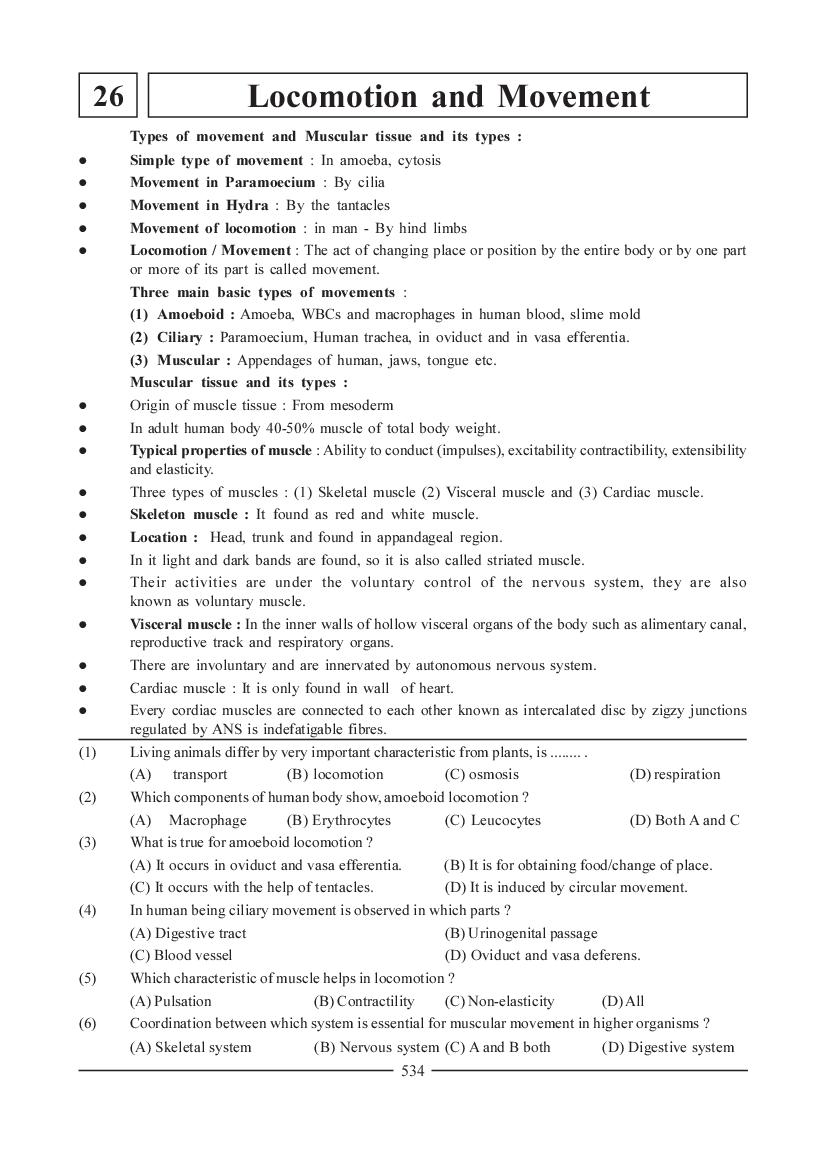
Types of movement and Muscular tissue and its types :
Simple type of movement : In amoeba, cytosis
Movement in Paramoecium : By cilia
Movement in Hydra : By the tantacles
Movement of locomotion : in man - By hind limbs
Locomotion / Movement : The act of changing place or position by the entire body or by one part
or more of its part is called movement.
Three main basic types of movements :
(1) Amoeboid : Amoeba, WBCs and macrophages in human blood, slime mold
(2) Ciliary : Paramoecium, Human trachea, in oviduct and in vasa efferentia.
(3) Muscular : Appendages of human, jaws, tongue etc.
Muscular tissue and its types :
Origin of muscle tissue : From mesoderm
In adult human body 40-50% muscle of total body weight.
Typical properties of muscle : Ability to conduct (impulses), excitability contractibility, extensibility
and elasticity.
Three types of muscles : (1) Skeletal muscle (2) Visceral muscle and (3) Cardiac muscle.
Skeleton muscle : It found as red and white muscle.
Location : Head, trunk and found in appandageal region.
In it light and dark bands are found, so it is also called striated muscle.
Their activities are under the voluntary control of the nervous system, they are also
known as voluntary muscle.
Visceral muscle : In the inner walls of hollow visceral organs of the body such as alimentary canal,
reproductive track and respiratory organs.
There are involuntary and are innervated by autonomous nervous system.
Cardiac muscle : It is only found in wall of heart.
Every cordiac muscles are connected to each other known as intercalated disc by zigzy junctions
regulated by ANS is indefatigable fibres.
(1) Living animals differ by very important characteristic from plants, is ........ .
(A) transport (B) locomotion (C) osmosis (D) respiration
(2) Which components of human body show, amoeboid locomotion ?
(A) Macrophage (B) Erythrocytes (C) Leucocytes (D) Both A and C
(3) What is true for amoeboid locomotion ?
(A) It occurs in oviduct and vasa efferentia. (B) It is for obtaining food/change of place.
(C) It occurs with the help of tentacles. (D) It is induced by circular movement.
(4) In human being ciliary movement is observed in which parts ?
(A) Digestive tract (B) Urinogenital passage
(C) Blood vessel (D) Oviduct and vasa deferens.
(5) Which characteristic of muscle helps in locomotion ?
(A) Pulsation (B) Contractility (C) Non-elasticity (D) All
(6) Coordination between which system is essential for muscular movement in higher organisms ?
(A) Skeletal system (B) Nervous system (C) A and B both (D) Digestive system
534
Page 2
(A) Electricity (B) Durability (C) Contractility (D) Elasticity
(8) Skeletal muscles are responsible for ........ .
(A) movement (B) change in body posture
(C) locomotion of internal organs (D) A and B Both
(9) Which substances are transported in tubule of organs with the help of muscles ?
(A) striated muscle (B) cardiac muscle (C) visceral muscle (D) skeletal muscle
(10) Which muscles obtain large amount of blood supply ?
(A) visceral muscle (B) skeletal muscle (C) cardiac muslce (D) Non-striated muscles
Answers : (1-B), (2-D), (3-B), (4-D), (5-B), (6-C), (7-B), (8-D), (9-C), (10-C)
Structure of skeletal muscle, strucure of contractile proteins and Mechanism of muscle
contraction.
Skeletal muscle :
It is multinucleated, cytoplasm called as sarcoplasma which have mitochondria.
The light bands are isotropic (having same refractive index in all planes) and are known as isotropic
or I-band.
The dark bands are anisotropic (refract light differently in different plane) and are known as
anisotropic or Abands.
Sarcomere : The part of the myofibric between two successive Z-lines in called sarcomere. It is
structural and functional unit of skeletal muscle.
Controctile protein : Two types (1) Actin (2) Myosin.
Actin : It is in two form (1) Monomer G-actin and polymeric F actin.
Tropomyosin : Rod shaped fibrous protein. It forms two helical strands, which are wrapped around
F actin.
Traponin : It is a complex small globular protein which distributed at regular intervals on the
tropomyosin. They are three type : TpC, TpI, TpT
Myosin : Each myosin molecule has two parts.
(1) A globular head with heavy meromyosin (HMM), which act as a atpase.
(2) Tail - It consist of light meromysin (LMM).
Region which is form by myosin only it is called H-region / H-line.
Region which is form by actin only, it is called I- region / H band.
A band - having Actin and myosin both present in this region.
Mechanism of muscle contraction :
Initiation of muscle contraction ® CNS ® Motor nerve ® neuromusculo junction ® Acetyl choline
® Potential ® Ca+2 release in sarcoplasma ® Head of myosin active open location of actin bridge
formation between them ® Attached actin fibers pulled toward the middle part of A band ® pulled
inner side z line which is also attached with the actin so ® Sarcomere becomes shorten ® muscle
contraction by myosin release the ADP and Pi ® muscle relaxation a enlargement can occur.
Bridge formation : Only in absence of ATP, Break in presence of ATP.
535
Page 3
(A) Thick (B) Thin (C) A and B both (D) None
(12) Which is structural and functional unit of muscle fibre ?
(A) Myofibrils (B) sarcomere (C) sarcolemma (D) muscle fibre
(13) Thin filaments are of ........ structure.
(A) Monomer G-actin (B) Tropomyosin
(C) polymericfactin (D) A and C both
(14) Which is complex, small and globular protein ?
(A) Tropomyosin (B) Troponin (C) Meromyosin (D) F-actin
(15) Of the following, which one is globular protein ?
(A) Troponin (B) Monomer G-actin (C) A and B both (D) None
(16) Who forms bridge at the open, activated site of actin filament ?
(A) Troponin (B) Tropomyosin (C) Head of myosin (D) Tail of myosin
(17) Where is location of troponin in actin filament of striated muscle ?
(A) On Tropomyosin (B) F-actin (C) G-actin (D) all of above
(18) Which substance is secreted at neuromuscular junction when nerve impulses reach there ?
(A) Acetyl esterase (B) Acetyl choline (C) Acetic acid (D) Oxytocin
(19) Sarcomere shortens when (P) linked wiht actin is also pulled toward ........ inner side.
(A) M-line (B) H-line (C) A-line (D) Z-line
(20) Relaxation of sarcoplasm is due to decrease in concentration of ........ .
(A) Ca+2 (B) Mg+2 (C) C1- (D) Na+
(21) Accumulation of Lactic acid in muscle fibre is due to ........ .
(A) Less activity of muscles (B) More activity of muscles
(C) Inactivation of muscles (D) Non-elasticity of muscle fibre
(22) Which action is important during muscle contraction ?
(A) Bridge formation (B) Bridge is not formed
(C) Bridge formed and stabilizes (D) Bridge formed and break-down
(23) What is improper for red muscles ?
(A) It stores more amount of CO2 (B) It has large number of mitochondria
(C) It has more amount of myoglobin (D) Stores more O2 and ATP formation
Answers : (11 - B), (12 - B), (13 - D), (14 - B), (15 - C), (16 - A), (17 - C), (18 - B), (19 - D), (20 - A),
(21 - B), (22 - D), (23 - A)
536
Page 4
Study of skeletal system is called Osteology.
In human beings this system is made up of 206 bones and a few cartilages.
Skeleton System of Human being (206)
¯
¯ ¯
Axial skeleton system (80) Appendicular skeleton system (126)
¯ ¯
¯ ¯ ¯ ¯
Skull Vertebral column Ribs Sternum
(29) (26) (24) (1)
® Cranial bones (8) ®Cervical vertebrae(7) ® 1 to 7 ribs (1 pair) -True ribs
(1) Frontal bone-1 ®Thoracic vertebrae-12 ® 8 to 10 ribs - False ribs
(2) Parietal bones-2 ® Lumbar vertebrae-5 ® 11, 12 ribs - Floating ribs
(3) Temporal bones-2 ® Sacral (5 part join-1)
(4) Occipital condyle bone-1 vertabrae-1
(5) Ethmoid bone-1 ® Coccygeal (4 partsjoin-1)
(6) Sphenoid bone-1 vertabrae
® Facial bones (14)
(1) Nasal bones-2
(2) Maxillae bones-2
(3) Palatine bones-2
(4) Zygomatic bones-2
(5) Lacrimal bones-2
(6) Interior nasal conchae-2
(7) Vomer bone-1
(8) Mandible bone-1
® Bones of middle ear (6)
Malleus-2
Incus- 2
Stapes - 2
® Floor bone of lower jaw
Hyoid bone - 1
(24) Mention the number of bones sequentially of skull, pectoral girdle, one fore limb and verebral column.
(A) 29, 2, 30, 33 (B) 29, 4, 60, 33 (C) 29, 4, 30, 26 (D) 29, 2, 30, 31
(25) Which of the following is function of vertebral column ?
(A) Induces head movement (B) Prevents movement of ribs
(C) Inhibits head movement (D) Connects the femur bone
(26) Bone and cartilage are which type of tissue ?
(A) Liquid connective tissue (B) Connective tissue proper
(C) Skeletal connective tissue (D) Simple epithelial tissue
537
Page 5
(A) Temporal and Ethemoid (B) Parietal and sphenoid
(C) Frontal and occipital (D) Temporal and parietal
(28) Which bones can not be seen externally on face ?
(A) Vomer (B) Nasal (C) Zygomatic (D) Lacrymal
(29) Which is only bone 'U' shaped ?
(A) Vomer (B) Maxillae (C) Mandible (D) Hyoid bone
(30) Which is pair of false ribs, sequentially in human ?
(A) 7, 8 and 9th pair (B) 8, 9, 10th pair (C) 10, 11, 12th pair (D) 11, 12th pair
(31) In the formation of ribcage which of the following are linked sequentially ?
(A) Clavicle, sternum, scapulla (B) Thoracic vertebral, femur and ribs
(C) Clavicle, sternum, ribs (D) Thoracic vertebral, sternum and ribs
(32) Which vertebrae are located on the post most part of vertebral column ?
(A) Cervical, coccyx (B) Cervical, sacrum
(C) Sacrum, coccyx (D) Sacrum, thoracic
(33) Vertebral column is connected with which part ?
(A) Skull and pelvic girdle (B) Only skull (C) Ribs (D) Both A and C
(34) Sacrum is present in which structure in human ?
(A) Pelvic girdle (B) Vertebral column (C) Pectoral girdle (D) Fore limb
(35) Cumber curve of vertebral column is between ........ vertebrae.
(A) 20 to 24 (B) 8 to 19 (C) 1 to 7 (D) 25 to 29
(36) Thoracic curve of vertebral column is between ........ vertebrae.
(A) 1 to 7 (B) 8 to 19 (C) 20 to 24 (D) 25 to 29
37) Which cells are formed in the bone marrow of hollow bone ?
(A) Muscle cells (B) Stem cells (C) Nerve cells (D) Collar cells
(38) Smallest bone, in human is located at ........ .
(A) Vertebral column (B) Carpals (C) Phalanges (D) Middle ear
(39) Smallest bone in human - ........ .
(A) Incus (B) Malleus (C) Stapes (D) Patella
(40) What is number of bones in axial skeleton of trunk region ?
(A) 50 (B) 80 (C) 29 (D) 51
(41) Which of the following is connected with ribs ?
(A) T2 (B) S4 (C) L5 (D) L4
(42) Which bone is unpaired in face ?
(A) Nasal (B) Palatine (C) Vomerbone (D) Lacrimal
(43) What is the number of floating ribs in human ?
(A) 2 pair (B) 5 pair (C) 6 pair (D) 3 pair
538
Page 6
(A) 35 (B) 40 (C) 30 (D) 33
(45) Spinal cord is connected with brain by ........ .
(A) Fovea ovalis (B) Foramen of magnum
(C) Large aperture (D) Magendils aperture
(46) Which is helpful in human for neck movement ?
(A) Atlas vertebrae (B) sacral vertebrae (C) lumbar vertebrae (D) Axis
(47) Who possess 7 pairs of true ribs ?
(A) Frog (B) Human (C) Both A and B (D) None
Answers : (24-C), (25-A), (26-C), (27-D), (28-A), (29-D), (30 -B), (31 -D), (32-C), (33-D), (34-B),
(35 - A), (36 - B), (37 - B), (38 - D), (39 - A), (40 - D), (41 - A), (42 - C), (43 - A), (44 - D), (45 - B),
(46-D), (47-B)
Appendicular Skeleton System : Joints and its types :
Appendicular skeleton system consists of girdles and bones of fore and hind limbs.
Girdles are attached with axial and appendicular skeleton systems.
Appendicular Skeleton System (126)
¯
¯ ¯
Girdles (06) Bones of limbs (120)
¯ ¯
¯ ¯ ¯ ¯
Pectoral girdle (4) Pelvic girdle (2) Bones of Fore limbs (60) Bones of Hind limbs (60)
® Scapula (2) ® Coxal bones (2) (In two hand)
® Clavicle (2) (02) ® Humreus-2 ® Femur-2
(4) ® Radio Ulna-4 ® Patella-2
® Car pals-16 ® Tibia-2
® Metcarpals-10 ® Fibula-2
® phalanges-28 ® Tarsals-14
(60) ® Metatarsals-10
® Phalanges-28
(60)
All types of joins are essential for locomotion / movement.
(1) Fibrous - Fixed - immovable joints :- Occur between the bones of the cranium.
(2) Cartilaginous of Slightly movable joints: Found between the centre of vertebrae, at the pubic
symphysis. Joint (cartilage and other) of ribs.
(3) Freely movable joint / synovial joints : It is full of fluid in cavity (Synovial).
Disorders of Skeleton system :
(1) Myasthenia gravis : It is an auto immune disorder that affects neuromuscular junction leading to
fatigue, weakening and paralysis of skeletal muscle.
(2) Tetany : It is a muscular disorder in which rapid spasms in muscle occur due to lesser Ca+2 in the
body fluid.
539
Page 7
(A) Humerus (B) Femur (C) Tibia (D) Axial bone
(49) Metatarsal of ankle is present in ........ .
(A) Hind limb of Frog (B) Fore limb of rabbit
(C) Fore limb of human (D) Hind limb of human
(50) Scapula is part of ........ .
(A) Pelvic girdle (B) Skull (C) Vertebral column (D) Pectoral girdle
(51) In each hind limb of human, what are the number of tarsals ?
(A) 6 (B) 8 (C) 7 (D) 2
(52) Number of scapula in pectoral girdle ........ .
(A) 1 (B) 2 (C) 3 (D) 4
(53) Wrist joint is of ........ type.
(A) pivotal joint (B) synovide joint (C) hinge joint (D) ball and socket joint
(54) Synovial fluid is secreted by ........ .
(A) bone (B) blood (C) cartilage (D) synovial membrane
(55) Which type of joint is found between numerous and radio-ulna bone ?
(A) Synovial joint (B) Hinge joint (C) Pivotal joint (D) Cartelagenous joint
(56) Which type of joint is found in cranium ?
(A) Movable (B) Partially movable (C) Suture (D) None
(57) What is hinge joint ?
(A) Wrist (B) Between metacarpals (C) Ankle (D) All of above
(58) What is pivotal joint ?
(A) Shoulder joint (B) Atlas - Axis Joint (C) Pelvic joint (D) Thumb joint
(59) Number of Ischium bone in pelvic girdle.
(A) 2 (B) 1 (C) 4 (D) 3
Answers : (48 - B), (49 - D), (50 - D), (51 - C), (52 - B), (53 - C), (54 - D), (55 - B), (56 - C), (57 - D),
(58 - B), (59 - A)
A = statement R = Reason, type questions :
Select answers of following questions from options given below.
(A) A and R both correct. R is explanation of A.
(B) A and R both correct but R is not explanation of A.
(C) A is correct, R false.
(D) A is false, R correct.
(60) Statement A : Change of place and obtaining food is through pseudopodia in Amoeba.
Reason R : Pseudopodia is formed due to activation of cilia.
(A) (B) (C) (D)
540
Page 8
Reason R : Cardiac muscles are present in the wall of the heart.
(A) (B) (C) (D)
(62) Statement A : H region has only thin filaments.
Reason R : A band has thick and thin Filaments on both side.
(A) (B) (C) (D)
(63) Statement A : Double hellicle chains of tropomyosin is innervated surrounding to G-actin.
Reason R : In myosin filament Head is formed of heavy meromysin and tail is light meromyosin.
(A) (B) (C) (D)
(64) Statement A : Calcium activates inter effect of actin and myosin.
Reason R : Sarcomere, is shortened as Z line is pulled in side, attached with myosin.
(A) (B) (C) (D)
(65) Statement A : Striated muscles get fatigued due to long time activation.
Reason R : Due to anaerobic decomposition of glycogen, adds lactic acid in muscles.
(A) (B) (C) (D)
(66) Statement A : In voluntary muscles, dark and light transverse lines are seen.
Reason R : Voluntary muscles are also known as skeletal muscles.
(A) (B) (C) (D)
(67) Statement A : Active electric potential is generated in sarcomere.
Reason R : Head of myosin, forms bridge with open active place of actin.
(A) (B) (C) (D)
(68) Statement A : Coccyx is formed by 4 tail vertebrae.
Reason R : It is found in vestigeal spinal cord.
(A) (B) (C) (D)
(69) Statement A : Dark band of sarcomere is A disc.
Reason R : A band, reflects light at various angles, in different plane.
(A) (B) (C) (D)
(70) Statement A : Hinge joint is found between first and second vertebrae.
Reason R : Synovial joint is found between vertebrae.
(A) (B) (C) (D)
(71) Statement A : Frontal, parietal and occipital bones are joined by suture joint.
Reason R : Bones of skull are joined by cortilagenous joint.
(A) (B) (C) (D)
(72) Statement A : During muscle contraction I band shortens.
Reason R : During muscle contraction myosin fibre contracts.
(A) (B) (C) (D)
541
Page 9
Reason R : Lower jaw is attached by muscles with head region.
(A) (B) (C) (D)
Answers : (60-C), (61-B), (62- D), (63-D), (64-C), (65-A), (66-B), (67-D), (68-C), (69-A), (70-B),
(71 - C), (72 - C), (73 - B)
True / False type questions
In the given sentences, select correct option for true / false.
(74) For human skeletal system select proper option for true/ false sentence.
(1) Human skull is formed of 22 bones.
(2) Human skeletal system is formed of 206 bones.
(3) In adult human vertebral column is formed by 31 vertebrae.
(4) Appendicular skeletal, in human is formed of 120 bones.
(A) TTFF (B) TFTF (C) FFTT (D) FTFT
(75) Select proper option, for the given statement, whether T / F.
(1) All organisms show movement.
(2) All movements are locomotion.
(3) Cardiac muscle are innervated by nerves of voluntary nervous system.
(4) All organisms show locomotion.
(A) TTFF (B) FTFT (C) FTTF (D) TFTF
(76) Select proper option, for the given statement, whether T / F.
(1) In the middle of I disc, line present is called M line.
(2) Myosin fibres are thick muscle fibres.
(3) I disc, shortens during muscle contraction.
(4) Actin, acts as ATpase in muscle contraction.
(A) TFFT (B) FTFT (C) FTTF (D) FFTT
(77) Which option is correct in human skeletal system for number of Axial skeletal system.
(1) Human skull is formed of 29 bones.
(2) Pectoral girdle and pelvic girdle are included in skeletal system.
(3) Sternum, thoracic vertebrae and ribs form ribcage.
(4) Humerus, nasal, vomer and palatine are bones of face.
(A) TFTF (B) TTFF (C) FTFT (D) FFTT
(78) Given statements are (T) or (F), select proper option for it.
(1) In cardiac muscles, specific structure intercalated disc is present.
2) 8, 9, 10 ribs are called false ribs.
(3) Palatine forms the floor of mouth.
(4) 11th and 12th ribs are joined with sternum bone.
(A) TTTT (B) TTFF (C) FTTF (D) TFTF
542
Page 10
(1) Ball and socket joints are most movable joint.
(2) Bones of skulls are joined by cartilagenous joint.
(3) Fore limbs are connected with axial skeletal system by pelvic girdle.
(4) Muscle contraction is reaction between actin and myosin.
(A) TTFF (B) FFTT (C) FTFT (D) TFFT
80) Select proper option for (T) or (F) for the given statements.
(1) Paramoecium shows amoeboid movement.
2) Clavicle is bone of pelvic girdle, which has two curves.
(3) Sternum is longest bone of hind limb.
(4) Cardiac fluid is present in synovial joint.
(A) FTFT (B) TTTT (C) FFFF (D) TFTF
(81) Given Statements are T or F, select proper option for it.
(1) In skull, cranium has 2 paired and 4 unpaired bones.
(2) In appendicular skeletal system, 126 bones are present.
(3) Between Atlas and Axis, hinge joint is observed.
(4) Between Humerus and glenoid cavity suture type of joint is present.
(A) TTFF (B) TFTF (C) FFTT (D) TFFT
Answers : (74-D), (75-B), (76-C), (77-A), (78-B), (79-D), (80-C), (81-A)
(82) Select proper option for column-I and column-II.
Column - I Column - II
(I) WBC (P) Intercalated disc (A) I-R, II-Q, III- P, IV-S
(II) Visceral muscles (Q) disc/band (B) I-R, II-S, III- P, IV- Q
(III) Cardiac muscles (R) Amoeboid movement (C) I-R, II-S, III- Q, IV-P
(IV)Striated muscles (S) Non-striated muscles (D) I-P, II-S, III- Q, IV- R
(83) Select proper option for column-I and column-II
Column - I Column - II
(I) Troponin (P) Rod shaped fibrillar protein (A) I-Q, II- S, III- P, IV-R
(II) G- actin (Q) Globular protein (B) I-Q, II-P, III- S, IV- R
(III)Tropo myosin (R) Polymeric protein (C) I-Q, II-S, III- R, IV-P
(IV)F-actin (S) Monomeric protein (D) I-P, II-Q, III- S, IV- R
543
Page 11
Column - I Column - II
(I) Hyoid bone (P) Bone of cranium (A) I-P, II-Q, III- S, IV-R
(II) Ethemoid (Q) Bone of floor of buccal cavity (B) I-Q, II-P, III- R, IV- S
(III) Lacrimal (R) Bone of pectoral girdle (C) I-R, II-P, III- Q, IV-S
(IV) Clavicle (S) Bone of Face (D) I-Q, II-P, III- S, IV- R
(85) Match column-I with column-II. Select proper options.
Column - I Column - II
(I) Tarsals (P) 8 (A) I-R, II-P, III- Q, IV-S
(II) Carpals (Q) 24 (B) I-P, II-Q, III- R, IV- S
(III)Vertebrae (R) 7 (C) I-R, II-P, III- S, IV-Q
(IV)Ribs (S) 26 (D) I-R, II-Q, III- S, IV- P
86 Match column-I with column-II. Select proper options.
Column - I Column - II
(I) Pectoral girdle (P) Coxal bone (A) I-R, II-S, III- P, IV-Q
(II) Clavicle (Q) Four curves (B) I-P, II-S, III- R, IV- Q
(III)Pelvic girdle (R) Acromion process (C) I-R, II-S, III- Q, IV-P
(IV)Vertebral column (S) Two curves (D) I-Q, II-R, III- S, IV- P
87 Match column-I with column-II. Select proper options.
Column - I Column - II
(I) Cranium (P) 37 bones (A) I-S, II-P, III- R, IV-T, V-Q
(II) Calcium (Q) 5 metacarpals (B) I-S, II-T, III- R, IV- P, V-Q
(III)Ribcage (R) require for muscle contraction (C) I-S, II-R, III- P, IV-T, V-Q
(IV)Vertebral column (S) 8 Bones (D) I-S, II-R, III- T, IV- Q, V-P
(V) Palm (T) 26 vertebrae
Answers : (82-B), (83-A), (84-D), (85-C), (86-A), (87-C)
(88) Which is given Figure I ?
(A) Visceral muscle
(B) Unstriated muscle
(C) Cardiac muscle
(D) Striated muscle
(89) What is true for muscle shown in Fig. I
(A) They do not fatigue (B) They function slowly
(C) They fatigued speedily (D) None of these
544
Page 12
(A) Ball and socket joint
(B) Pivot joint
(C) Hinge joint
(D) None Figure 2
(91) Joint shown in Fig. 2 is seen in ........ .
(A) Forearm and wrist (B) Atals and axis
(C) Sternum and ribs (C) Humerus and glenoid cavity
(92) In the given Fig 3. P indicates ?
(A) Structure of H region
(B) Arrangement of myosin.
(C) Arrangement of actin
(D) B and C Both
(93) In the given Fig.3 Q indicates which part ? Figure 3
(A) Arrangement of myosin (B) Arrangement of actin
(C) A and C Both (D) Structure of I disc
(94) What is shown in Fig. 4 ?
(A) Pivot joint (B) Hinge joint (C) Ball and socket joint(D) Cartilagenous joint
(95) Joint shown in Fig. 4 is seen between ........ .
(A) Femur and Acetabulum
(B) Humerus and Radio-ulna
(C) Humerus and glenoid cavity
(D) A and C Both
Figure 4
(96) N Part indicated in Fig. 5 suggests ........ .
(A) Linkage of Actin
(B) ATP linkage
(C) Ca+ linkage
(D) Mg+2 linkage
(97) M part shown in Fig.5 indicates ........ . Figure 5
(A) ADP linkage (B) Ca+2 linkage (C) Actin linkage (D) ATP linkage
(98) R part shown in Fig.5 indicates ........ .
(A) LMM (B) HMM (C) ATPase (D) MHH
545
Page 13
(A) TpT
(B) TpL
(C) TpC
Figure 6
(D) All of above
(100) In the given fig. 6 what is indicated by 'Q' ?
(A) TpT (B) Tpl (C) TpM (D) TpC
(101) In the given Fig. 6 what is indicated by 'R' ?
(A) TpT (B) TpC (C) TpI (D) TpM
Answer : (88-C), (89-A), (90-C), (91-B), (92-C), (93-A), (94-C), (95-D), (96-A), (97-D)
(98-B), (99 - C), (100 - B), (101 -A)
Questions for NEET :
(102) In muscle fibre Ca+2 is stored in ........ .
(A) sarcoplasm (B) sarcosome (C) sarcomere (D) sarcolemma
(103) Cardiac muscle is ........ .
(A) striated, voluntary (B) striated, involuntary
(C) non-striated, voluntary (D) involuntary, non striated
(104) During resting phase, middle of thick filament not innervated by thin filament is ........ .
(A) A - disc (B) M-line (C) H-zone (D) I-disc
(105) Where is ciliary movement observed ?
(A) Macrophage and WBC (B) Oviduct and blood capillary
(C) Oviduct and Trachae (D) Tongue and appandages
(106) Where is amoeboid movement observed ?
(A) Appandages and jaws (B) Macrophage and WBC
(C) Trachae, oviduct (D) RBC, WBC
(107) During muscle contraction ........ .
(A) thin filaments slide over thick filament (B) thick Filaments slide over thin filament
(C) both filaments slide over each other (D) filaments do not slide during contraction
(108) Which character is not linked with white muscle fibre ?
(A) Less amount of myoglobin (B) Less amount of mitochondria
(C) Less amount of sarcoplasmic fibres (D) Depend on anaerobic process for energy
(109) Which point is correct for process of visceral muscle ?
(A) They form the wall of hollow visceral organs. (B) They do not show any bands.
(C) Their contraction is under control of involuntary nervous system. (D) All of above
(110) Which muscle, during activation is coenocytic ?
(A) Cardiac muscle (B) Smooth muscle (C) Voluntary muscle (D) All of above
(111) Elastic fiber in the middle of I disc, divides it into two parts, is ........ .
(A) H-zone (B) M-line (C) Z-line (D) A-band
546
Page 14
(A) Neuro mucular junction (B) Motor and disc
(C) Motor unit (D) A and B Both
(113) Which type of joints are found in bones of cranium ?
(A) Fibrillar (B) Hinge (C) Synovial (D) None
(114) Coxal bone is formed by ........ .
(A) Ilium (B) Ischium (C) Pubis (D) All of above
(115) Which is contractile protein of muscle ?
(A) Myosin (B) Tropomyosin (C) Tropoin (D) Tubulin
(116) Which of the following pair is proper ?
(A) Hinge joint - Between vertebrae
(B) Sliding joint - Zygapophysis of sequential vertebrae
(C) Cartilagenous joint - Bones of skull
(D) Fibrillar joint - Between phalanges
(117) Which is correct, in human body, anatonically ?
(A) Collar Bone - 3 pair (B) Salivary gland - 1 pair
(C) Cranial nerves - 10 pair (D) Floating ribs - 2 pair
(118) Of the following, one shows its correct number.
(A) Floating ribs - 4 (B) Amino acid obtained from protein - 16
(C) Types of Diabetes - 3 (D) Cervical vertebral in human-8
(119) Wrist joint is example of ........ .
(A) Hinge (B) Sliding (C) Ball and socket (D) Pivotal
(120) For human skeletal system, Find the mismatch.
(A) Sternum and ribs - axial skeleton (B) Clavicle and glenoid cavity - pectoral girdle
(C) Humerus - ulna hind - limb (D) Malleus and stape - ear
(121) During muscle contraction, energy is provided by ........ .
(A) AMP (B) Glucose (C) ATP (D) Acetyl Co-A
(122) Which of the following structure is formed of single bone, in human ?
(A) Upper jaw (B) Zygomatic process (C) Lower jaw (D) Rib cage
(123) What is the form of actin and myosin during muscle contraction ?
(A) Myoplasm (B) Sarcoplasm (C) Plastocine (D) Ectoplasm
(124) What is called part of cyloplasm in striated muscle ?
(A) Sarcomere (B) Sarcoplasm (C) Neuron (D) Large segment
(125) In striated muscle, contractile substance present between two successive z disc is ........ .
(A) sarcomere (B) sarcoplasm (C) myofilament (D) all
(126) Shoudler blade is formed of ........ .
(A) ilium (B) humerus (C) clavicle (D) scapula
(127) Player follows speedily ball in the game of cricket. Which of the following bonegroup participate in it ?
(A) Femur, incus, tibio, metacarpals (B) Tarsals, femur, metatarsals, tibia
(C) Sternum, femur, tibia, fibula (D) Tarsal, pelvic girdle, ulna, tibia
547
Page 15
(A) Humerus (B) Femur (C) Tibia (D) Fibula
(129) Which is cup shaped cavity on the head of femur bone, for articulation ?
(A) Glenoid cavity (B) Acetabulum (C) Sigmoid notch (D) Femur aperture
(130) What is present in ball and socket joint to reduce friction ?
(A) Coelomic fluid (B) Synovial fluid (C) Pericardial fluid (D) Mucous
(131) Contractile protein of striated muscle, which links with ATPase action process.
(A) Troponin (B) Tropomysin (C) Myosin (D) Actin
(132) Which is largest synovial joint ?
(A) Thigh (B) Knee (C) Shoulder (D) Ankle
(133) Where is neuromotor connection observed ?
(A) Between nerve cell and sarcolemma of muscle (B) Between two nerve cells
(C) Between two muscles (D) B and C Both
(134) Where does synovial fluid is formed ?
(A) Blood (B) Cartilage (C) Bones (D) Synovial membrane
(135) Patella is linked with ........ .
(A) wrist (B) knee (C) neck (D) ankle
(136) Which of the following is associated with appendicular skeleton ?
(A) Bones of cranium (B) Bones of vertebral column
(C) Ribs (D) Bones of fore limb and hind limb
(137) By which vertebral column is linked with pelvic girdle ?
(A) Coccyx (B) Sacrum (C) Lumbar vertebral (D) Cervical vertebrae
(138) Shoulder joint is example of ........ .
(A) Pivotal joint (B) Hinge joint (C) Sliding joint (D) Ball and socket joint
(139) ............ is joint between ribs and sternum.
(A) Cartilagenous joint (B) Curved joint (C) Fibrillar joint (D) Sliding joint
(140) Terminal end of long bones are covered by ........ .
(A) Ligament (B) Bony joint (C) Cartilage (D) Muscle joint
(141) Sarcomere is region between ........ .
(A) two I - disc (B) A and I disc (C) Two Z-disc (D) Z and A disc
(142) Lumbar vertebrae are situated ........ .
(A) neck region (B) abdominal region (C) hip region (D) thoracic region
Answers :(102 - A), (103 - D), (104 - C), (105 - C), (106 - B), (107 - A), (108 - C), (109 - D), (110 - C),
(111 - C), (112 - C), (113 - A), (114 - D), (115 - A), (116 - B), (117 - D), (118 - A), (119 - A), (120 - C),
(121 - C), (122-C), (123 - B), (124 - B), (125 - C), (126 - D), (127 - B), (128 - A), (129-B), (130 - B),
(131 - C), (132 - B), (133 - A), (134 - D), (135 - B), (136 - D), (137 - B), (138 - D), (139 - A), (140 - C),
(141-C), (142-C)
548
Page 16
Attached to bones, voluntary, exhibit Functional unit of contraction. They are delivered by a very
® ® thin and comparitively dense Z-line.
transverse strips hence called striated.
¯
¯ ¯
Locomotion and movement
Primary Myofilament Secondary Myofilament
It is formed of myosin protein It is composed of actin and regulatory proteins
Myosin (thick) filament is a polymerized protein of many tropomyosin and tronin.
monomers. In resting state, subunit of troponin masks the
Myosin monomer has head and short arm which project active binding sites for myosin on the actin
outwords at regular distance and angle from myosin (thin) filament.
filament.
Head has ATPase and binding site for actin.
¯
Sliding filament theory of muscle contraction
Neural Ach Action Ca+2 Binds to Change in shape
Signal ® released ® potentinal ® released ® troponin ® exposes active sites
generated
¯
Thin myofilament Energized myosin Myosin ATPase in
presence of Ca2+ Myosin - actin
slide along the thick cross bridges bind
¬ to actin and move ¬ and Mg2+ breaks ¬ cross bridges are
myofilament formed
ATP to ADP
Skeletal System ® Axial Skeleton - 80 bones
Skull
Each limb contains 30 bones Skull consists of cranium and facial bones
Fore limb : 1 humerus ® 22 total bones ; out of these 8 are bones of
1 radius, 1 ulna, 8 carpals cranium and 14 are facial bones
® 5Hind
metacarpals, 14 Phalanges
limb : 1 femur, Foramen Magnum
1 tibia, 1 fibula, 1 patella, ® foramen
Skull possesses a posterior aperture called
magnum.
7 tarsals, 5 metatarsals
and 14 Phalanges Through which the brain communication with
spinal cord.
Girdles
Ribs
Pectoral girdles (4 bones)
® Pelvic girdle (2 bones) Ribs joins with strenum and form a rib-cage 12
articulation between axial and appendicular skel- ® pairs of ribs 1 to 7 pairs are true ribs; 8, 9, 10 pairs
are false ribs 11, 12 pairs are floating ribs.
etal components
Sternum
Joints ® Single flat bone located at mid- ventral region
Fibrous / immovable joint of theracic cavity
Eq : Joints of skill bones
¬
Cartilagenous / partially movable joints Vertabral column
Eq : Joints between vertabrae formed by union of 26 small bones called
Synovial / freely movable joints vertabrae
Eq : Ball and socket joints hinge joints 7 - Cervical vertabrae
Skeletal System 12 - Thoracic vertabrae
Out of total 206 bones of human, 6 bones are
® 5 - Lumbar vertabrae
® present in ears 3 bones in each ear as ear ossicles 1 - Sacral vertabrae ( 5 bones join to from 1 bones)
and remaining are distributed into axial and 1 - Coccygeal bone (4 bones join to from 1 bone)
appendicular skeleton
549
Document Details
| Board / Org | NTA |
| Exam | National Eligibility cum Entrance Test (Undergraduate) |
| Type | Question Bank |
| Pages | 16 |
| Updated | 22 Jul 2026 |