NEET Biology Question Bank - Organism and Population
Finished viewing? Save it for later —
Download NEET Biology Question Bank - Organism and Population (PDF · 23 pages)About NEET Biology Question Bank - Organism and Population
NEET Biology Question Bank - Organism and Population is available here for free download. Published by NTA for National Eligibility cum Entrance Test (Undergraduate), this question bank can be viewed online or downloaded as a PDF (23 pages). Candidates preparing for National Eligibility cum Entrance Test (Undergraduate) can use NEET Biology Question Bank - Organism and Population to understand the exam pattern, the type of questions asked, and the overall difficulty level.
Frequently Asked Questions
How can I download NEET Biology Question Bank - Organism and Population?
Open this page and click the Download button to save NEET Biology Question Bank - Organism and Population as a PDF. It is completely free on AglaSem Docs.
Is NEET Biology Question Bank - Organism and Population free to download?
Yes. NEET Biology Question Bank - Organism and Population can be viewed online and downloaded as a PDF free of cost on AglaSem Docs.
How many pages does NEET Biology Question Bank - Organism and Population have?
NEET Biology Question Bank - Organism and Population contains 23 pages, which you can read online or download together as a single PDF.
Where can I find more National Eligibility cum Entrance Test (Undergraduate) study material?
You can find more National Eligibility cum Entrance Test (Undergraduate) question papers, sample papers, syllabus, and answer keys on AglaSem Docs.
NEET Biology Question Bank - Organism and Population – Text
Read the full text of this question bank below — useful to quickly search, copy and reference the content online without downloading the PDF.
📄 View text version (23 pages)
Page 1
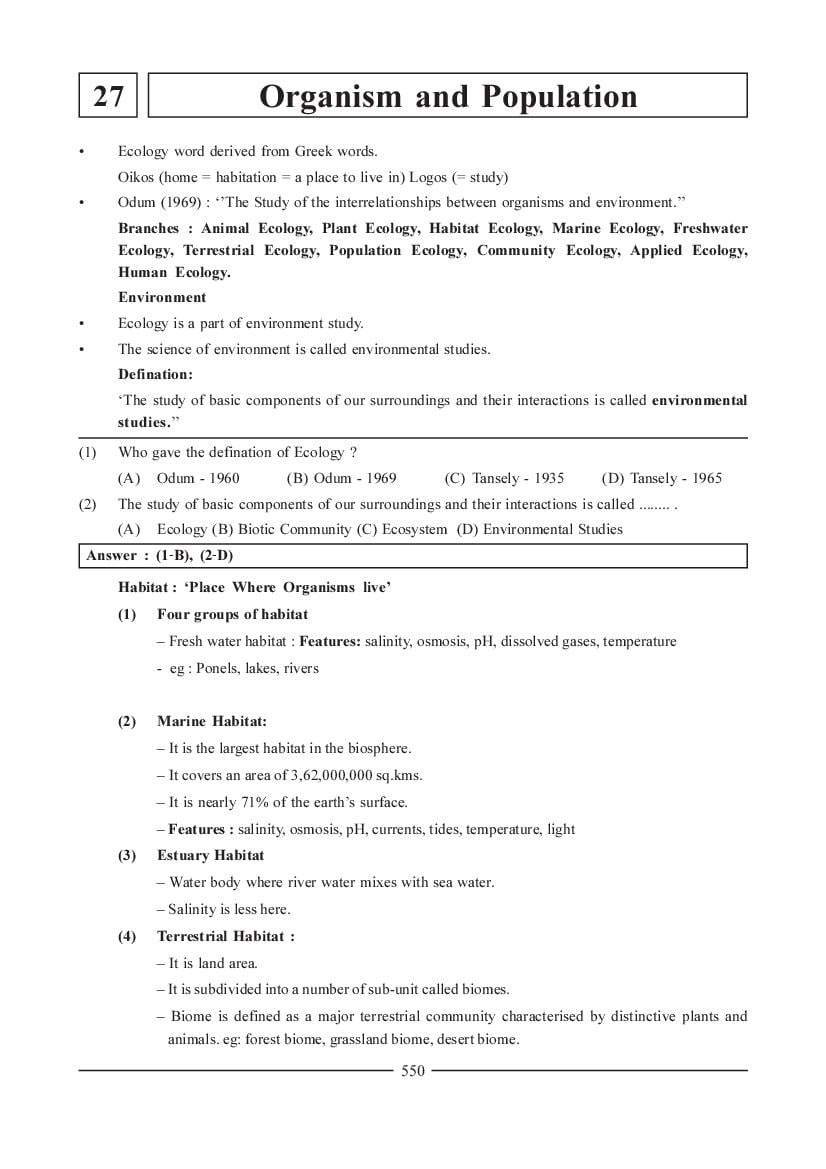
Ecology word derived from Greek words.
Oikos (home = habitation = a place to live in) Logos (= study)
Odum (1969) : The Study of the interrelationships between organisms and environment.
Branches : Animal Ecology, Plant Ecology, Habitat Ecology, Marine Ecology, Freshwater
Ecology, Terrestrial Ecology, Population Ecology, Community Ecology, Applied Ecology,
Human Ecology.
Environment
Ecology is a part of environment study.
The science of environment is called environmental studies.
Defination:
The study of basic components of our surroundings and their interactions is called environmental
studies.
(1) Who gave the defination of Ecology ?
(A) Odum - 1960 (B) Odum - 1969 (C) Tansely - 1935 (D) Tansely - 1965
(2) The study of basic components of our surroundings and their interactions is called ........ .
(A) Ecology (B) Biotic Community (C) Ecosystem (D) Environmental Studies
Answer : (1-B), (2-D)
Habitat : Place Where Organisms live
(1) Four groups of habitat
Fresh water habitat : Features: salinity, osmosis, pH, dissolved gases, temperature
- eg : Ponels, lakes, rivers
(2) Marine Habitat:
It is the largest habitat in the biosphere.
It covers an area of 3,62,000,000 sq.kms.
It is nearly 71% of the earths surface.
Features : salinity, osmosis, pH, currents, tides, temperature, light
(3) Estuary Habitat
Water body where river water mixes with sea water.
Salinity is less here.
(4) Terrestrial Habitat :
It is land area.
It is subdivided into a number of sub-unit called biomes.
Biome is defined as a major terrestrial community characterised by distinctive plants and
animals. eg: forest biome, grassland biome, desert biome.
550
Page 2
(A) Estuary (B) Terrestrial habitat (C) Marine habitat (D) All given
(4) Marine habitat occupies ........ of area of the earths surface.
(A) 17 % (B) 71 % (C) 75 % (D) 80 %
(5) Marine habitat covers ........ area of the earths surface.
(A) 36,20,000 sq.Kms. (B) 3,6,20,000 sq.kms.
(C) 36,20,00, 000 sq.kms. (D) 3,62,00,000 sq.kms.
(6) A waterbody where river water mixes with the sea water.
(A) Estuary (B) Mangroove (C) Creek (D) All given
(7) Osmoregulation is the major problem to living fauna of which habitat?
(A) Fresh water habitat (B) Marine water habitat
(C) Estuary habitat (D) All given
Answer : (3-C), (4-B), (5-C), (6-A), (7-D)
Basic concept of ecology
Series of levels of biological organisation: Macromolecules ® cells ®
tissues ® organs ® individual organisms ® population ® communities, ecosystems ® biomes
Population : A group of individual organisms of the same species in a given area.
Biotic community : A group of populations of different species in a given area.
Ecosystem : It is a whole biotic community with its abiotic environment in a given area.
(8) What does an area called that covers population of more than one species?
(A) Biotic community (B) Population (C) Biomes (D) Ecosystem
Answer : (8-A)
Major Abiotic Factors:
Environment : All the external factors, conditions and influences that affect an organism or
a biological community.
Environmental Factor : Any external force, substance or condition, which surrounds and
effects the life of an organism in any way becomes a factor of its environment.
Major abiotic factors : Light, temperature, water, soil.
Light :
The Sun is the important source of energy.
It is formed of electromagnetic waves.
It is a form of energy called radiant energy.
(1) Light in relation to plants :
® Chlorophyll production, photosynthesis, transpiration, distribution of plants etc. directly or
indirectly affected by light.
551
Page 3
affect water absorption also.
® Opening and closing of stomata is regulated by light.
® Total amount of radiation received by the earths surface differs with latitude.
(2) Light in relation to animals :
® The intensity of light influences metabolic rate in animals.
® Increased intensity of light results in increased enzyme activity.
® Light induces photochemical reactions, because of that cave animals are colourless.
® Light initiates breeding activities in birds.
® In some birds gonads become active with increased light intensity during summer.
Temperature :
All metabolic processes and chemical reactions are controlled by temperature.
(1) Temperature in relation to plants : It effects the rate of transpiration, photosynthesis, respiration
in plants.
® It is important factor in phenology of plants and affects distribution of plants.
® The division of earths vegetation are dependent on variation in temperature.
® Altitudinal zonation of vegetation is clearly seen on mountains.
(2) Temperature in relation to animals:
® In rotifers and daphnids like animals, sex-ratio is effected by temperature.
® Under normal condition daphnides give parthenogenetic eggs that develop into females.
® With increase in temperature they give sexual eggs which after fertilization develop either into
males or females.
® Some insects, birds and mammals in warm climatic bear dark pigments than the races of
same species present in cool and dry climate.
® Birds and Animals obtain greater body size in cold regions than in warm areas.
® Animals are two types with respect to maintenance their body temperature.
(i) Homoeothermic or warm blooded animals - birds, mammals
(ii) Poikilothermic or cold blooded animals - reptiles, fishes, amphibians.
Water :
It is the universal solvent.
It is the largest medium of life.
It exists in three forms : liquid, solid and vapour.
Liquid state exists in two forms: sea water and fresh water.
The special properties of water : solvancy, specific heat, latent heat, thermal conductivity,
viscosity surface tension, buoyancy, salinity, pressure, transparency, pH etc.
Temperature variation is much lesser in aquatic habitat than in terrestrial one.
Temperature variation in fresh water habitat is higher than marine habitat.
In deep fresh water habitat (lakes, ponds), there is gradual decrease in temperature from
the surface to bottom. As a result, different layer of waters with different temperatures are
noticed. This is called thermal stratification.
552
Page 4
(1) In fresh - water :
® Salinity is very low.
® Body fluid of fresh water animal is highly concentrated (hypertonic).
® Fresh water habitat is hypotonic.
® As a result endosmosis occurs.
® So water enters into the body constantly.
® Animal removes excess of water in the form of urine by kidney.
® Loss of salt is compensated by absorption of salts from fresh water by chloride cells present
in the gills.
® Crustacean Astacus removes excess water in form of urine by green glands.
® In Amoeba it is maintained by contractile vacuoles.
® Certain fresh water fishes develop accessory respiratory organs to utilise atmospheric air
when fresh water dries up.
® eg. Ophiocephalus, Clarias, Anabus.
(2) In sea water :
® Sea water has high salt contents.
® Sea water is hypertonic, body fluid is hypotonic.
® As a result exosmosis occurs.
® Body tends to lose water.
® To compensate for the loss of water marine animals drink sea water.
® Excess salt is exuded by chlorine secretory cells present in gills.
® In marine turtles excess of salt is removed by salt glands present near the eye.
(3) In terrestrial habitat :
® It is characterized by scarcity of water.
® The terrestrial animals are faced with two main problems. (a) getting water
(b) conserving water. They develop variety of water adaptations -
(1) Evaporation through body surface is prevented by developing spines, scales, scute, shields,...
(2) Certain animals become active during night.
(3) Kangaroo rat and protopterus aestivate durnig summer.
(4) The uromatrix lizard stores water in intestine.
(5) The exess water is stored in water cells of rumen and reticulum of stomach in camel.
(6) Mammals regulate their body temperature by producing sweat.
Soil :
It is an abiotic ecological factor.
It acts as suitable substratum and medium for plants and animals.
It is a bridge between inorganic and organic materials.
Soil : Any part of earths crust in which plants root.
Treshow (1970) : Soil is a complex physical - ecological system providing support, water,
nutrients and oxygen for plants.
Soil is formed of five major components : Mineral matter, organic matter, soil water, soil air
and biological system.
All organisms living in soil constitute soil community.
553
Page 5
(1) Microflora :
- Bacteria, fungi, blue green algae, algae
(2) Microfauna :
- Protozoans, nematodes, mites (Size 20 to 200 micron)
(3) Mesofauna :
- Mites, nematodes, spiders, insect larvae, molluscs (size between 200 micron to 1 cm)
(4) Macrofauna :
- Animals with size of more than 1 cm large size eg. earthworms, snakes, moles, rates
Nature and properties of soil in different places vary, dependent on climate.
Various characteristic of soil such as soil composition, grain size and aggregation determine
percolation and water holding capacity of soil.
Parameter such as pH, mineral composition and topography determine to a large extent vegetation
in any area.
Burrow living animals have special adaptations of digging burrowing, their bodies are spindle shaped
and tapering head, short tail, eyes and necks are reduced.
(9) Opening and closing of stomata regulated by ........ .
(A) water (B) soil (C) temperature (D) Light
(10) All chemichal reactions occur in living body are controlled by ........ .
(A) water (B) soil (C) temperature (D) Light
(11) Sexual eggs of daphnids develop as ........ .
(A) male (B) female (C) male or female (D) male and female
(12) ........ develop accessory respiratory organs to utilise atmospheric air when fresh water dries up.
(A) Ophiocephlus (B) Amphioxsus (C) Rohu (D) Katla
(13) The terrestrial animals are faced with which problems ?
(A) Getting water, conserving water. (B) conserving water, loss of salts.
(C) Getting water, loss of water. (D) Getting water, loss of salts.
(14) Its skin is hydroscopic ........ .
(A) Kangaroo rat (B) Spiny lizard (C) Protopterus (D) Uromatrix lizard
(15) Animal with size 200 micron to 1 cm are placed in which group.
(A) Microflora (B) Microfauna (C) Mesofauna (D) Macrofauna
Answers : (9-D), (10-C), (11-C), (12-A), (13-A), (14-B), (15-C)
Response to abiotic factors
Homeostasis : The organisms try to maintain the constancy of its internal environmental
conditions when the external environment changes.
554
Page 6
(1) To cope with unfavourable condition :
- Maintain homeastasis by physiological means
- eg. birds, mammals
(2) Conformsts :
- Majority of animals and nearly all plants cant maintain a constant internal environment.
(3) Migration :
- Organism can move away temporarily from stressful habitat to a more suitable area and
return when stressful period is over.
(4) Suspension :
- In bacteria, fungi, lower plants various kinds of thick walled spores are formed which help
them to survive in unfavourable conditions and germinate when suitable environment prevails.
- Animals show hibernation during winter and aestivation during summer.
(16) What is the process in which organisms try to maintain the constancy of its internal environment
despite varying external environmental conditions that tend to upset their equilibrium.
(A) Management (B) Adaptation (C) Heterostasis (D) Homeostasis
(17) They form thick walled spores in unfavourable condition ........ .
(A) Bacteria (B) Fungi (C) Lower plants (D) All the above
Answers : (16-D), (17-D)
* Adaptations *
The adjustments made by individuals in response to specific, environmental conditions.
- It is in the form of morphological, physiological behavioural.
- Kangaroo rat in desert is capable of meeting all its water requirements through its internal
lipid oxidation.
- In most animals, the metabolic reactions proceed optimally in a narrow temperature range
(370 C).
- Archae bacteria flourish in hot spring where temperature far exceeds 1000 C.
- Antartic fishes live in temperature below zero.
- A large variety of marine invertebrate fish live at great depths in ocean where pressure could
be > 100 times the normal atmospheric pressure.
(18) How does kangaroo rat meet its water requirement ?
(A) Oxidation of internal proteins. (B) Oxidation of internal carbohydrates.
(C) Oxidation of internal Lipids. (D) All the above
(19) Marine fishes are habituated to what pressure as compared to normal atmospheric pressure.
(A) < 100 times (B) > 100 times (C) > 50 times (D) < 50 times
Answers : (18-C), (19-B)
555
Page 7
Salient features of population :
(1) All individual of a population belong to one species.
(2) The individuals are morphologically and anatomically similar.
(3) The individuals are genetically related.
(4) The individuals are reproductively isolated from other species.
Characteristics of a population :
(1) Population density : It refers to total number of individuals in an unit area or unit volume in
a given time.
n/a
D D = Density , t = time
t
n = Number of individual
a = Area
(2) Natality or Birth rate : The average number of new individuals produced by a population in a
given time.
Number of births per unit time
Birth rate =
Average population
® Carrying capacity : The total number of individuals that can be accomodated in an area at a
particular time.
® There are two aspects of natality. (1) Realised natality (2) Potential natality (Maximum Natality)
(3) Mortality or Death rate : The number of individuals dying in a population at a given time.
Two aspects of mortality : (1) Realised mortality (2) Potential mortality
Number of deaths per unit time
Mortality rate =
Average population
- Vital index : Ratio between birth rate and death rate
- Vital index = Birth rate / death rate u 100
- When Birth rate = Death rate, the population becomes stable and reamains at equilibrium.
(4) Age Distribution : Three groups
(i) Pre-reproductive group ® Immature animals
(ii) Reproductive group ® Sexually mature animals
(iii) Post ® reproductive group ® Old animals (reproductive disability)
On basis of age groups, age, pyramid can be constructed.
Expanding population ® Triangular pyramid
Stable population ® Bell-shaped pyramid
Declining population ® Urn-shaped pyramid
(5) Population growth : The increase in size of population
N(t + 1) = Nt + [(B + I) (D + E)]
556
Page 8
(i) S - Shaped growth curve
(ii) J - Shaped growth curve
(i) S - Shaped growth curve (ii) J - Shaped growth curve
Equilibrium
Negative Acceleration phase
Number of Individuals
Number of Individuals
Logarithmic phase
Positive Acceleration phase
Time
Time
(7) Population Fluctuations : The increase and decrease in the number of individuals in a
population.
- It may be flat, cyclic or irruptive.
Factors affecting on population growth :
(i) Extrinsic factors : food, space, shelter, weather.
(ii) Intrinsic factors : competition, predation, diseases, emigration, reproductivity.
(8) Population interation :
Species A Species B Name of interaction General Results
(i) + + Mutualism Favourable to both
(ii) - - Competition Harmful to one another
(iii) + - Predation Favourable to A
(iv) + - Parasitism Favourable to A
(V) + 0 Commensalism Favourable to A
(Vi) - 0 Amensalism One species is affected
while other is unaffected
(20) The actual number of new individuals added to the population in a given time. It is always ......... than
the potential natality.
(A) more (B) lesser (C) equal (D) no relation
(21) Deaths, that occur at all ages is called ........ .
(A) potential mortality (B) realised mortality (C) minimum mortality (D) All the above
(22) The number of organisms increases in compound interest fashion in this growth curve.
(A) J - Growth curve. (B) S-Growth curve. (C) A and B both (D) None of these
(23) When the density increases the reproductive ability ........ .
(A) increases (B) decreases (C) No change (D) None of the above
557
Page 9
called ........ .
(A) parasitism (B) predation (C) A and B both (D) None of these
Answers : (20-B), (21-B), (22-A), (23-B), (24-C)
Mutualism : term means living together
Example : (1) Hermit Crab and Sea Anaemone
Crab lives inside the empty Gastropod shells.
Sea anemone is inhabited on the shell.
Stinging cells of sea anemone protect the crab.
Food acquired / captured by Sea Anaemone is shared by Crab.
Example : (2) Rhizobium bacteria and root nodules of leguminous plants.
Bacteria fix up atmospheric free N2 in the nodules in the form of nitrates.
Plants utilize these nitrates.
The bacteria, in turn, obtains shelter and nutrients from the plants.
Example : (3) Lichens ( algae and fungi)
Fungi provide moisture and minerals to algae.
Algae prepare food for both, by photosynthesis.
Competition :
The two partners may be harmed or only one willl be harmed.
Two types : Intraspecific competition : Occurs between members of same population.
Interspecific competition : Occurs between population of different species.
Predation :
- It controls the population.
- All animals and insectivorous plants are predatory.
- Two types : Herbivores and carnivores.
Perasitism :
- It is a one sided relationship.
- The pantner which is benefited is called parasite.
- The other partner is called host.
- Types of parasites.
(i) Temporary parasites : An animal spends only a part of its life cycle as a parasite.
eg. lawal form.
(ii) Permanent pararsites : An animal spends entire life as parasite. eg. Ascaris, Tapeworm.
(iii) Ectoparasites : The parasites which live on the outer surface of the host. eg. Mites, Leeches.
(iv) Endoparasites : The parasites live inside the body of the host. eg. Plasmodium, Ascaris.
Commensalism :
- Partners are called commensals.
It is a symbiotic interspecific relationship.
eg. (i) Sucker fish sucks on the body of shark.
(ii) Flagellates living inside the body of termites.
558
Page 10
- One species is harmed where as the other is unaffected.
- eg. Penicilium fungi, gram positive bacteria.
(25) The hermit crab lives inside. the empty ........ shell.
(A) Thoraxopod (B) Abdomenopod (C) Gastropod (D) All the above
(26) Rhizobium fixes free N2 into which form in root nodule. ?
(A) Nitrous (B) Nitrates (C) Nitrites (D) B and C Both
(27) Which type of competition occurs between Paramoecium caudatum and P. aurelia ?
(A) Intraspecific (B) Interspecific (C) Both (A,B) (D) None of these
(28) In this interaction one partner is harmed where as other is unaffected.
(A) Amensalism (B) Commensalism (C) Parasitism (D) All the above
Answers : (25-C), (26-C), (27-B), (28-A)
Biotic Community : A group of several species living in a particular area with mutual tolerance
(adjustment).
eg. (i) Pond community : All organisms living in a pond.
(ii) Forest community : trees, shrubs, insects, birds.
Characteristics of a biotic community :
(1) Species diversity : Each community has many varied organisms.
(2) Structure : It is formed of 3 groups of animals.
(i) Producers : The autotrophic green plants are producers autotrophs.
(ii) Consumers : They are heterotrophs.
Two types : Herbivores (Primary consumers) and carnivores (Secondary consumers)
(iii) Decomposers : They decompose the dead bodies of plants and animals and convert them into
micro and macro nutrients. These are utilised again by plants.
eg. Bacteria, fungi
559
Page 11
virtue of their number, size etc. These species are called community dominants.
- eg. Trees are community dominants in a forest community.
(4) Ecological Niche : It refers to the functional status of an organisms in its community.
According to Odum Niche is the profession of an organism in a community.
An organisms habitat is its residential address and niche is the profession of the organism.
eg. lion and deer live in the same habitat but lion is a carnivore (niche) and deer is a herbivore
(niche).
(29) A group of several species living together with mutual adjustment is called ........ .
(A) species (B) population (C) ecosystem (D) biotic community
(30) Biotic community is formed of how many groups of organisms ?
(A) 1 (B) 2 (C) 3 (D) 4
(31) They are community dominants in a forest community ........ .
(A) Trees (B) Shrubs (C) Herbs (D) Climbers.
(32) What is the profession of an organism in biotic community called ?
(A) Structure (B) Species diversity (C) dominants (D) Ecological niche.
Answer : (29-D), (30-C), (31-A), (32-D)
Ecological Succession : The process of development of a new community is called ecological
succession.
It is an orderly and progressive replacement of one community by another till the development of
a stable community in that area.
Succession is directional and predictable.
Structural complexity increases during succession.
560
Page 12
(1) Primary Succession : It starts from primitive substratum, where there was no living matter
previously.
- The first group of organisms establishing themselves is known as the pioneer.
(2) Secondary succession : It starts from previously built up substrates with already existing living
matter.
- General process of succession :
- The various developmental stages of a community are called seral stages.
- The first seral stage is called pioneer community.
- The final stable community is called climax community, which is determined by the total
environmental factors of the area in which it exists.
Pattern of succession : Three types
(1) Xerosere :
Begins from a dry place.
Lichens are the pioneer.
Mosses, herbs and shrubs develop afterword.
(2) Hydrosere :
Starts in water.
The first organisms to inhabit are planktons.
Then submerged and floating plants enrich the pond.
(3) Mesosere :
It is intermediate between xerosere and hychosere.
It occurs in moist places.
(33) The process of development of a new community is called ........ .
(A) evolution (B) revolution (C) succession (D) All the above
(34) If the pond is gradually filled with sand and mud then it gets converted into :
(A) Marshy (B) Forest (C) Grassland (D) All the above
(35) The structural complexity ........ during succession.
(A) decrease (B) increase (C) no change (D) fluctuate
(36) What are the stages called in succession ?
(A) Seral stages (B) Serial stages (C) Series stages (D) All the above
(37) The first seral stage is called ........ .
(A) Primary biotic community (B) Initial biotic community
(C) Pioneer community (D) All the above
561
Page 13
(A) seral stage (B) pioneer community (C) A and B both (D) climax community
(39) Which succession starts from rocks ?
(A) Xerosere (B) Hydrosere (C) Mesosere (D) All the above
(40) Which is the pioneer community in xerosere ?
(A) Algae (B) Fungi (C) Lichens (D) All the above
(41) The first organisms to inhabitat in pond succession are ........ .
(A) planktons (B) submerged plants (C) floating plants (D) All the above
Answers : (33-C), (34-A), (35-B), (36-B), (37-C), (38-D), (39-A), (40-C), (41-A)
A = Statement R = Reason, type questions :
Select answers of following questions from options given below.
(A) A and R both correct. R is explanation of A.
(B) A and R both correct but R is not explanation of A.
(C) A is correct, R false.
(D) A is false, R correct.
(42) Statement A : The study of basic components of our surroundings and their interactions is
called environmental studies.
Reason : Ecology is a part of environment study.
(A) (B) (C) (D)
(43) Statement A : Marine organisms are adopted to salinity, osmosis, dissolved gases.
Reason R : Fresh water organisms are adapted to salinity, osmosis, pH, temperature.
(A) (B) (C) (D)
(44) Statement A : Estuary water has less salinity.
Reason R : Here river water mixes with the sea water.
(A) (B) (C) (D)
(45) Statement A : Osmoregulation is the major problem to living fauna to aquatic habitat.
Reason R : The dynamic environment and organisms make ways for the development of
different kinds of organisms through succession.
(A) (B) (C) (D)
(46) Statement A : Any external force, substance or conditon, which surrounds and effects the life
of an organism in any way, becomes a factor of its environment.
Reason R : All external factors, conditions and effects which afffects organisms or biotic
community is called environmental study.
(A) (B) (C) (D)
(47) Statement A : There is difference in vegetation at poles and other parts of the earth.
Reason R : Total amount of radiation received by the earths surface differs with latitude.
(A) (B) (C) (D)
(48) Statement A : Cave animals are colourless.
Reason R : Light induces photochemical reactions resulting in the formation of colour pigment.
(A) (B) (C) (D)
(49) Statement A : In some birds gonads become active during summer.
Reason R : Light initiates the breeding activities in birds.
(A) (B) (C) (D)
562
Page 14
Reason R : Increased light intensity results into increased enzyme activity.
(A) (B) (C) (D)
(51) Statement A : All metabolic processes are influenced by temperature.
Reason R : Temperature regulates activity of enzymes.
(A) (B) (C) (D)
(52) Statement A : Light affects the plants life on chlorophyll production, photosynthesis,
transpiration, distribution of plants.
Reason R : Temperature effects transpiration, chlorophyll production, photosynthesis in plants.
(A) (B) (C) (D)
(53) Statement A : Altitudinal zonation of vegetation is clearly seen on mountains.
Reason R : Temperature is an important factor in phenology of plants.
(A) (B) (C) (D)
(54) Statement A : Under normal condition daphnids give parthenogenetic eggs that develop into females.
Reason R : In rotifers and daphnids sex - ratio is effected by temperature.
(A) (B) (C) (D)
(55) Statement A : Some insects, birds and mammals in warm humid climatic bear darker pigments
than the races of same species present in cool and dry climate.
Reason R : Birds and mammals obtain greater body size in cold regions than in warm areas,
but polkilotherms are smaller in cold region.
(A) (B) (C) (D)
(56) Statement A : Temperature variation is much lesser in aquatic habitat than in terrestrial habitat.
Reason R : Temperature variation is higher in fresh water than in marine water.
(A) (B) (C) (D)
(57) Statement A : Thermal stratification occurs in water reserviors.
Reason R : There is a gradual decrease in temperature from the surface to bottom in
aquatic habitat.
(A) (B) (C) (D)
(58) Statement A : Body fluid of fresh water animal is hypertonic.
Reason R : The salinity of fresh water is very low.
(A) (B) (C) (D)
(59) Statement A : Clarias is adapted to remove excess of water.
Reason R : It removes excess salt through chlorine secretory cells of gills.
(A) (B) (C) (D)
(60) Statement A : Crustacean Astacus, removes excess of water in the form of urine by the green glands.
Reason R : Amoeba has contractile vacuole for osmoregulation.
(A) (B) (C) (D)
(61) Statement A : In marine turtles the excess of salt is removed by salt glands present near the ear.
Reason R : Its body fluid is hypotonic.
(A) (B) (C) (D)
(62) Statement A : The lizard uromatrix stores water in the intestine.
Reason R : The terrestrial animals are faced with two main problems.
(A) (B) (C) (D)
563
Page 15
Reason R : Their body size is between 200 micron to 1 cm.
(A) (B) (C) (D)
(64) Statement A : Soil properties and another parameter determine to a large extent the vegetation
in any area.
Reason R : The nature and properties of soil in different places vary.
(A) (B) (C) (D)
(65) Statement A : The body of burrowing animals is spindle shaped and tapering head, short tail,
the eyes and necks are reduced.
Reason R : The majority of animals living in soil lead either burrowing or cursorial mode of life.
(A) (B) (C) (D)
(66) Statement A : Birds and mammals are able to fight against unfavorable condition.
Reason R : Some organisms maintain their homeostasis physiologically.
(A) (B) (C) (D)
(67) Statement A : The total number of individuals in an unit area or unit volume in a given time is
called population density.
Reason R : The total number of individuals that can be accomodated in an area at a
particular time is called carrying capacity.
(A) (B) (C) (D)
(68) Statement A : Salman fish produces 2.8 × 10 eggs in a season.
8
Reason R : The maximum possible rate of reproduction for a population under optimal
condition is called potential natality.
(A) (B) (C) (D)
(69) Statement A : The size of a population for any species is not a static parameter.
Reason R : The density of a population in a given habitat during a given period, fluctuates
due to changes in four basic processes.
(A) (B) (C) (D)
(70) Statement A : Growth curve of frog in monsoon is J type.
Reason R : In J growth curve number of organisms increases in compound interest fashion.
(A) (B) (C) (D)
(71) Statement A : Bird Population is affected by seasonal effect and migration.
Reason R : Factors are responsible for population fluctuation.
(A) (B) (C) (D)
(72) Statement A : Biological control methods adopted in agricultural pest control are based on
ability of the predator.
Reason R : Predator also helps in maintaining species diversity in biotic community.
(A) (B) (C) (D)
Answers : (42- B), (43 - D), (44 -A), (45 -B), (46 -C), (47 - A), (48 - A), (49 - A), (50 - A), (51 - A),
(52-C), (53-B), (54-A), (55-B), (56-D), (57-A), (58-A), (59-C), (60-B), (61-D), (62-A), (63-A),
(64-B), (65-A), (66-A), (67-B), (68-A), (69-A), (70-A), (71-A), (72-D)
564
Page 16
(73) (1) In xerosere succession mosses, lichens, fungi, herbs gradually develop.
(2) In hydrosere succession planktons. submerged and floating plan to enrich the pond.
(3) Mesosere succession occurs in moist places.
(4) Ecological succession is directional and predictable.
(A) F, T, T, T (B) T, T, T, T (C) F, F, T, T (D) F, T, T, F.
(74) (1) Primary succession starts where there was no living matter, previously.
(2) The various developmental stages of a community are called as seral stages.
(3) Formation of new biotic community is called speciation.
(4) If the pond is filled with sand and mud, grassland biotic community developer.
(A) T, F, F, T (B) F, T, T, F (C) T, F, F, F (D) T, T, F, F
(75) (1) Penicilium fungi, gram positive bacteria occupies Amensalism.
(2) Hermit crab and sea anemone live as commensalism.
(3) Competition between Paramoecium caudatum and P. aurelia is interspecific.
(4) In interaction if one species get benefited and another is not affected, it is called symbiosis.
(A) T, F, F, T (B) F, T, F, T (C) T, F, T, T (D) T, F, T, F.
(76) (1) Food, space, shelter, weather etc are the extrinsic factors on population growth.
(2) The density dependent factors are intrinsic, which arise within the population.
(3) Introducing goats on galapagos island is an example of immigration.
(4) Interaction between animals occurs mainly for food.
(A) T, T, F, F (B) T, T, F, T (C) T, F, T, F (D) T, F, F, T
(77) (1) Realised mortality refers to the number of deaths due to old age.
(2) Realised mortality is higher than potential mortality.
(3) The maximum possible rate of reproduction for a population under optimal codition is called
potential natality.
(4) Vital index = Death rate / Birth rate × 100
(A) F, F, T, T (B) F, T, F, F (C) F, T, T, F (D) F, T, T, T
(78) Select right option for salient features of population.
(1) All individuals of a population belong to one species.
(2) The individuals are genetically isolated.
(3) The individuals are morphologically similar.
(4) The individuals are reproductively isolated from other species.
(A) T, T, F, F (B) T, F, T, F (C) T, F, F, T (D) T, F, F, F
565
Page 17
oxidation.
(2) Archae bacteria flourish in hot spring where temperature far exceeds 1000 C.
(3) Homeostasis stabilizes the internal environment.
(4) In most animals, the metabolic reaction proceeds optimally in a narrow temperature range (350 C).
(A) T, T, F, F (B) F, T, T, F (C) T, T, T, F (D) F, T, T, T.
Answers : (73-A), (74-D), (75-C), (76- B), (77-C), (78-C), (79-B)
Column Based Questions
(80) Column - I Column - II Column - III
(I) Microflora (p) mites (w) Size less than 20 m
(ii) Microfauna (q) spider (x) Size more than 1 cm
(iii) Mesofauna (r) bacteria (y) Size 20 m to 200 m
(iv) Macrofauna (s) earthworms (z) 200 m to 1
I II III IV
(A) r-w p-z q-y s-x
(B) q-w p-y q-z s-x
(C) r-w q-y p-z s-x
(D) r-w s-x p-z q-y
(81) Column - I Column - II I II III IV
(i) Marine turtle (p) accessory respiratory orgam (A) r p s q
(ii) Clarias (q) green gland (B) p r s q
(iii) Crustacean Astacus (r) Salt gland (C) p r q s
(iv) Marine animals (s) Chlorine secretory cells (D) r p q s
(82) Column - I Column - II Column III
(i) +,+ (p) Predation (w) flagellates and termites
(ii) +,- (q) ammensalism (x) lichen
(iii) +,o (r) commensalism (y) gram positive bacteria
(iv) -, o (s) mutualism (z) leech and host
I II III IV
(A) s-z p-w r-y q-x
(B) s-x p-z r-w q-y
(C) q-x p-w s-z r-y
(D) r-y q-x s-w p-z
Answers : (80 - B), (81 - D), (82 - B)
Diagram based question
(83) Choose correct option for given diagram.
(A) It shows interactions between different species.
(B) It shows interactions between organisms of population.
(C) It shows interactions between ecosystem and biotic factors.
(D) It shows only interaction and interrelation.
566
Page 18
(A) Potantial natality
Density
(B) Environmental resistance
(C) Carrying capacity
Time
(D) Equilibrium
(85) Choose correct option for xgiven pyramid.
(A) a # b # c (B) a < b < c
(C) a < b # c (D) a > b > c
(86) Choose appropriate option for the given pyramid .
(A) It indicates expanding population.
(B) Pre-reproductive organisms are more in number.
(C) Pyramid is triangle.
(D) All the above
(87) Choose appropriate option for given graph.
(A) Growth occurs rapidly.
Number of Individuals
(B) Number of organisms increase in compound interest fashion.
(C) Growth suddenly decreases.
(D) All the above. Time
567
Page 19
(A) Seasonal effect on bird-population
Number of Individuals
(B) Bird-population affected by migration
(C) Annual effect on bird-population
(D) A and B both Month
(89) What does x indicates in given diagram.
(A) It provides moisture and minerals to the cells.
(B) It prepares food by photosynthesis.
(C) It absorbs moisture.
(D) B and C both.
(90) Choose correct option for given diagram.
yLkw¢of{ýsuccession
Trend ð÷ý
(A) x = Sedge meadow y = Floating
(B) x = Red swamp
y = Phytoplanktons
(C) x = Sedge-meadow
y = Rooted submerged
Dry Soil
(D) x = Red swamp
y = Sedge-meadow
Hydroseric Succession
Answers : (83-A), (84-B), (85-A), (86-D), (87-D), (88-D), (89-B), (90-C)
568
Page 20
(91) Intense competition for light, nutrients and habitat occurs between ?
(A) closely related organisms growing in different niches.
(B) closely related organisms growing in the same area / niche
(C) distantly related organisms growing in the same habitat.
(D) distantly related organisms growing in different niches.
(92) A Mutually beneficical association necessary for survival of both partners is ........ .
(A) mutualism/ symbiosis (B) commensalism (C) Amensalism (D) both A and B
(93) Homeostasis is ........ .
(A) tendency of biological systems to change with change in environment
(B) tendency of biological systems to resist change
(C) disturbance of self regulatory system and natural controls
(D) biotic materials used in homeopathic medicines
(94) Which one is true
(A) Commensalism when none of the interacting populations affect each other.
(B) Symbiosis when the interaction is useful to both the populations.
(C) Symbiosis when neither populations affect each other.
(D) Commensalism when the interaction is useful to both the populations.
(95) Soil particles determine its ........ .
(A) texture (B) field capacity (C) water holding capacity (D) soil flora
(96) The sum total of the populations of the same kind of organisms constitute.
(A) colony (B) genus (C) community (D) species.
(97) Association of animals when both partners are benefitted ........ .
(A) colony (B) mutualism (C) commensalism (D) amensalism
(98) xeric environment is charatcterised by ........ .
(A) precipitation (B) low atmospheric humidity
(C) extremes of temperature (D) high rate of vapourisation
(99) In a food chain, the largest population is that of ........ .
(A) producers (B) decomposers
(C) secondary consumers (D) primary consumers
(100) Sunken stomata is the characteristic feature of ........ .
(A) hydrophyte (B) mesophyte
(C) xerophyte (D) halophyte
(101) Which of the following pairs is coreectly matched ?
(A) uricotelism - aquatic habitat
(B) parasitism - intra - specific relationship
(C) excessive perspiration - xeric adaptation
(D) stream lined body - aquatic adaptation
(102) Human population growth in India ........ .
(A) tends to follow a sigmoid curve as in case of many other animal species.
(B) tends to reach a zero population growth as in case of some animal species.
(C) can be reduced by permitting natural calamities and enforcing birth control measures.
(D) can be regulated by following the national programme of family planning.
569
Page 21
(A) Population®species®community®ecosystem (B) Population®variety®species®ecosystem
(C) Population®ecosystem®species®community (D) Species®variety®ecosystem®community
(104) What is the most important factor for the success of animal population ?
(A) Natality (B) Unlimited food
(C) Adaptibility (D) Inter-species activity
(105) Whch part of the world has a high density of organisms ?
(A) Grasslands (B) Savanna (C) Deciduous forests (D) Tropical rain forests
(106) Two opposite forces operate in the growth and development of every population. One of them
relates to the ability to reproduce at a given rate. The force opposing it is called ........ .
(A) environmental resistance (B) morbidity
(C) fecundity (D) biotic potential
(107) Certain characteristic demographic features of developing countries are ........ .
(A) high fertility, low or rapidly falling mortality rate, rapid population growth and a very young age
distribution
(B) high fertility, high density, rapidly rising mortality rate and a very young age distribution
(C) high infant mortality, low fertility, unever population growth and a very young age distribution
(D) high mortality, high density, uneven population growth and a very old age distribution
(108) Niche overlap indicates ........ .
(A) two different parasites on the same host
(B) sharing of one or more resources between the two species
(C) mutualism between two species
(D) active cooperation between two species
(109) Geometric representation of age structure is a characteristrics of ........ .
(A) population (B) landscape (c) ecosystem (d) biotic community
(110) The population of an insect species shows an explosive increase in numbers during rainy season
followed by its disappearance at the end of the season. What does this show /
(A) The food plants mature and die at the end of the rainy season.
(B) Its population growth curve is of J-type.
(C) The population of its predators increases enormously.
(D) S - shaped or sigmoid growth of this insect.
(111) Two plants can be conclusively said to belong to the same speices if they ........ .
(A) have more than 90 % similar genes
(B) look similar and possess identical secondary metabolites
(C) have same number of chormosomes
(D) can reproduce freely with each other and form seeds
(112) A high density of elephant population in an area can result in ........ .
(A) intra specific competition (B) inter specific competition
(C) predation on one another (D) mutualism
570
Page 22
(A) Stratification
Post-reproductive
(B) Natality
Reproductive
(C) Mortality
(D) Sex ratio
Pre-reproductive
(114) What type of human population is represented by the following age pyramid ?
(A) Vanishing population (B) Stable population
(C) Declining population (D) Expanding population
(115) Which one of the following statements is correct for secondary succession ?
(A) It begins on a bare rock.
(B) It occures on a deforested site.
(C) It follows primary succession.
(D) It is similar to primary succession exept that it has a relatively fast pace.
(116) Column - I Column - II a b c d
(a) earthworm (i) pioneer species (A) (i) (ii) (iii) (iv)
(b) succession (ii) detritus (B) (iv) (i) (iii) (ii)
(c) ecological service (iii) natality (C) (iii) (ii) (iv) (i)
(d) population growth (iv) pollination (D) (ii) (i) (iv) (iii)
(117) What does a Niche show in ecosystem ?
(A) Funtion of an organism at its trophic level (B) Its presence
(C) Competitive ability (D) Centre of Origin
Answers : (91-B), (92-A), (93-B), (94-B), (95-A), (96-D), (97-B), (98-B), (99-A), (100-C), (101-
D), (102-A), (103-C), (104-D), (105-A), (106-A), (107-B), (108-A), (109-B), (110-D), (111-A),
(112-A), (113-C), (114-B), (115-D), (116-A), (117-B)
571
Page 23
Ecology
- Study of reciprocal relationship between ® - Light
- Temperature
organisms and their environment.
® Abiotic Factors ® - Wind
Organisms - Rain (Precipitation)
- Atmospheric
® - Basic unit of ecological hierarchy. humidity
- Interaction with physical environment comprised
of atmosphere, hydrosphere and lithosphere. Edaphic
- Mineral matter
- Adaptations enable them to survive and
Biotic factors
® - Organic matter
reproduce in their habitats.
® Bacteria, Algae, Fungi, - Soil
- Environmental factors (abiotic and biotic) Parasites,Saprophytes,
influence the form and functioning Symbionts, Animals Topographic
of organisms.
- Altitude
® Density
® - Steepness of slope
Population
® Natality - Direction of slope
Characteristics
of Population
® Organisms of the same kind form population. ®® Mortality
They are capable of interbreeding among ® Emigration
® Dispersal
themselves. ® Age distribution
Community ® Biotic potential ® Immigration
Population of different species occur- ® Growth form
® ring in a habitat. ® J Shaped(Exponential)
Ecosystem ® S-Shaped(Logistic)
® It includes biological community, Species composition
integrated with its physical environment. ® Different kinds of plants and other organisms
present in a community.
Biosphere Dominance
® - Only one or few species in a community
Features
® Includes all ecosystems on the earth.
dominate and influence other species in terms
Mutualism
¬ of numbers and biomass production.
Protocooperation ¬
Positive ¬
Species
Commensalism ¬ ¬ Stratification
interaction ®
Competition ¬ Negative ¬ - Vertical layering of vegetation in which different
-
Predation ¬ layers are occupied by different species.
Parasitism ¬
572
Document Details
| Board / Org | NTA |
| Exam | National Eligibility cum Entrance Test (Undergraduate) |
| Type | Question Bank |
| Pages | 23 |
| Updated | 22 Jul 2026 |