NEET Biology Question Bank - Transport in Plants
Finished viewing? Save it for later —
Download NEET Biology Question Bank - Transport in Plants (PDF · 19 pages)About NEET Biology Question Bank - Transport in Plants
NEET Biology Question Bank - Transport in Plants is available here for free download. Published by NTA for NEET UG, this question bank can be viewed online or downloaded as a PDF (19 pages). Candidates preparing for NEET UG can use NEET Biology Question Bank - Transport in Plants to understand the exam pattern, the type of questions asked, and the overall difficulty level.
Frequently Asked Questions
How can I download NEET Biology Question Bank - Transport in Plants?
Open this page and click the Download button to save NEET Biology Question Bank - Transport in Plants as a PDF. It is completely free on AglaSem Docs.
Is NEET Biology Question Bank - Transport in Plants free to download?
Yes. NEET Biology Question Bank - Transport in Plants can be viewed online and downloaded as a PDF free of cost on AglaSem Docs.
How many pages does NEET Biology Question Bank - Transport in Plants have?
NEET Biology Question Bank - Transport in Plants contains 19 pages, which you can read online or download together as a single PDF.
Where can I find more NEET UG study material?
You can find more NEET UG question papers, sample papers, syllabus, and answer keys on AglaSem Docs.
NEET Biology Question Bank - Transport in Plants – Text
Read the full text of this question bank below — useful to quickly search, copy and reference the content online without downloading the PDF.
📄 View text version (19 pages)
Page 1
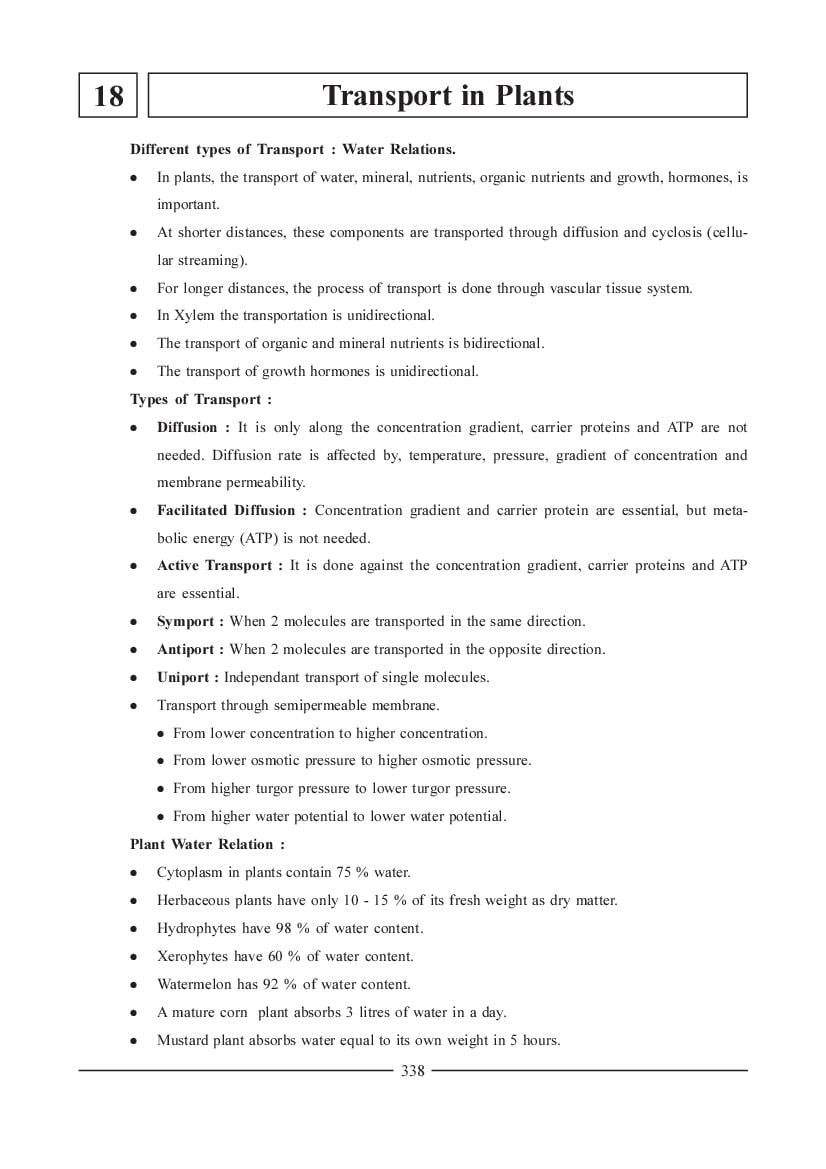
Different types of Transport : Water Relations.
In plants, the transport of water, mineral, nutrients, organic nutrients and growth, hormones, is
important.
At shorter distances, these components are transported through diffusion and cyclosis (cellu-
lar streaming).
For longer distances, the process of transport is done through vascular tissue system.
In Xylem the transportation is unidirectional.
The transport of organic and mineral nutrients is bidirectional.
The transport of growth hormones is unidirectional.
Types of Transport :
Diffusion : It is only along the concentration gradient, carrier proteins and ATP are not
needed. Diffusion rate is affected by, temperature, pressure, gradient of concentration and
membrane permeability.
Facilitated Diffusion : Concentration gradient and carrier protein are essential, but meta-
bolic energy (ATP) is not needed.
Active Transport : It is done against the concentration gradient, carrier proteins and ATP
are essential.
Symport : When 2 molecules are transported in the same direction.
Antiport : When 2 molecules are transported in the opposite direction.
Uniport : Independant transport of single molecules.
Transport through semipermeable membrane.
From lower concentration to higher concentration.
From lower osmotic pressure to higher osmotic pressure.
From higher turgor pressure to lower turgor pressure.
From higher water potential to lower water potential.
Plant Water Relation :
Cytoplasm in plants contain 75 % water.
Herbaceous plants have only 10 - 15 % of its fresh weight as dry matter.
Hydrophytes have 98 % of water content.
Xerophytes have 60 % of water content.
Watermelon has 92 % of water content.
A mature corn plant absorbs 3 litres of water in a day.
Mustard plant absorbs water equal to its own weight in 5 hours.
338
Page 2
(A) Cambial ring (B) Root hair (C) Leaf hair (D) Stem hair
(2) Long distance transport of sap is done by,
(A) Meristematic tissue (B) Cytoplasmic streaming (C) Vascular tissues (D) Diffusion
(3) What is the type of transportation in Xylem ?
(A) Amphibolic (B) Unidirectional (C) Descending (D) Bidirectional
(4) Organic matter synthesized in the leaves is transported to the stem and roots, for the purpose of,
(A) Upward transport (B) Usage (C) Storage (D) (B) & (C) both
(5) How are growth hormones transported in plants ?
(A) Bidirectional (B) Polar (C) Amphibolic (D) Bipolar
(6) What is incorrect for diffusion ?
(A) It is along with the concentration gradient. (B) It is an active transport.
(C) It is passive transport. (D) No energy is utilized.
(7) Facilitated diffusion requires,
(A) Saturation (B) Pressure (C) Energy (D) Gradient
(8) Facilitated Diffusion depends on,
(A) Molecular size (B) Pressure (C) Number of molecules (D) Concentration
(9) Plasma membrane has one of the following as the main component.
(A) Sugar (B) Protein (C) Lipid (D) Complex protein
(10) Which of the following solutes is transported rapidly across the plasma membrane ?
(A) That which is soluble in proteins. (B) That which is soluble both in lipids and proteins.
(C) That which is insoluble in lipids. (D) That which is soluble in lipids.
(11) What are porins made up of ? And what is their function ?
(A) Made up of lipids and passes solutes through the membrane.
(B) Made up of proteins and allows the passage of large sized protein like molecules.
(C) Made up of sugar and checks the passage of micromolecules.
(D) Made up of proteins and checks the passage of large sized protein like molecules.
(12) What helps in the passage of hydrophilic solutes through the plasma membrane ?
(A) Proteins in the membrane (B) Lipids in the membrane
(C) Sugars in the membrane (D) Inhibitors in the membrane
(13) What is helpful in active transport ?
(A) Lipid (B) Inhibitors
(C) Membrane proteins (D) ADP
(14) What is correct for active transport ?
(A) Takes place with the help of membrane proteins.
(B) Energy is not utilised.
(C) It is along the concentration gradient.
(D) None of the above
339
Page 3
(A) Transport rates becomes minimum (B) Transport rate is not affected
(C) Transport rate reaches maximum (D) Transport will stop
(16) Carrier proteins in the membrane are sensitive to......
(A) Catalysts (B) Inhibitors (C) Competitors (D) All of the above
(17) Membrane proteins are not helpful in......
(A) Active transport (B) Facilitated diffusion (C) Passive transport (D) Simple diffusion
(18) What is correct for carrier proteins ?
(A) They only transport negative ions across the membrane.
(B) They transport all types of ions across the membrane.
(C) They transport only selected solutes across the membrane.
(D) They transport only positive ions across the membranes.
(19) Which part of the plant cell contains 75% of water ?
(A) Mitochondria (B) Nucleus (C) Cytoplasm (D) Nucleolus
(20) In the cytoplasm of the plant cell, what is the percentage of dry matter, excluding water ?
(A) 75 % (B) 25 % (C) 52 % (D) 57 %
(21) Which plant has more than 92% water content ?
(A) Trapa (B) Mustard (C) Maize (D) Water Melon
Answers : (1-B), (2-C), (3-B), (4-D), (5-B), (6-B), (7-D), (8-A), (9-C), (10-D), (11-B), (12-A),
(13-C), (14-A), (15-D), (16-B), (17-D), (18-C), (19-C), (20-B), (21-D)
Water Potential and Osmosis :
The potential energy of water is called its water potential.
It is represented by Greek symbol Psi or y.
The water potential of any solution is represented by its 3 components.
ys : Solute potential, the amount of water potential.
yp : Pressure potential of water. (as the pressure increases, the water potential increases.
Its value is zero in pure water.)
yg : Gravitational component. It depends on water mass. In plant cells, yg is generally ignored.
Thus for plants, the equation for water potential is,
yw = ys + yp.
Osmosis :
When two solutions of unequal concentrations are separated by a semi-permeable membrane,
the solvent (water) diffuses from dilute solution, towards concentrated solutions. This process
is osmosis.
A parchment paper, frogs urinary bladder or an egg membrane from hens egg are semi
permeable membranes.
The pressure at which the entry of water across the semi permeable membrane stops is
called the osmotic pressure.
340
Page 4
(A) yw = ys + yg (B) yw = yp + ys + yg
(C) yw = ys + yp (D) yw = yp + yg
(23) Potential energy of water means...
(A) Kinetic energy (B) Water potential (C) Mechanical energy (D) Chemical energy
(24) Which factor does not affect the water potential ?
(A) Pressure (B) Concentration (C) Transpiration (D) Gravitational pull
(25) What is the unit for measuring water potential ?
(A) Density (B) Pascal (C) Meter (D) Hydrostatic pressure
(26) If the ys of solution, in a cell decreases,
(A) Water enters cell. (B) Water goes out of the cell.
(C) Water remains stable. (D) No inward or outward movement of water.
(27) In the chemical context, water potential means...
(A) Physical potential (B) Concentration potential
(C) Biological potential (D) Chemical potential
(28) If the concentration of solutes increases in a cell, then the value of ......... decreases.
(A) y g (B) y s (C) y p (D) y w
(29) Turgor pressure means...
(A) Positive value of ys (B) Negative value of yp (C) Positive value of yp (D) Negative value of ys
(30) With respect to water potential, the component dependant on the bulk of water is,
(A) y g (B) y p (C) y s (D) y w
(31) Water potential of pure water is,
(A) 100 (B) 10 (C) 0 (D) 1
(32) At which hydrostatic pressure does the water potential decreases ?
(A) When the value of yp is positive. (B) When the value of yp is constant.
(C) When the value of ys is positive. (D) When the value of yp is negative.
(33) By which process the root hair of plants absorb water from soil ?
(A) Diffusion (B) Osmosis (C) Imbibition (D) Adsorption
(34) In all living organisms the following acts as a barrier ......... .
(A) Cell wall (B) Nuclear membrane (C) Plasma membrane (D) All the above
(35) Under what circumstances does osmosis stop ?
(A) When the concentration of both the solutes becomes equal.
(B) When concentration of both the solvents becomes equal.
(C) When concentration of both the solutions becomes equal.
(D) None of the above
(36) The pressure at which the entry of water molecules is prevented across a semi-permeable
membrane, is
(A) Turgor pressure (B) Root pressure (C) Osmotic pressure (D) Diffusion pressure
Answers : (22-C), (23-B), (24-C), (25-B), (26-A), (27-D), (28-B), (29-C), (30-A), (31-C),
(32-D), (33-B), (34-A) (35 -B), (36-C )
341
Page 5
Hypertonic Solution : If external solution is more concentrated than cytoplasm it is called as
hypertonic solution.
Hypotonic Solution : If external solution is less concentrated then it is called as hypotonic
solution.
Isotonic Solution : If external solution having equal concentration than that of internal solution is
said to be isotonic solution.
Plasmolysis : When living plant cells are kept in salt water solution, water moves out of the cell.
The plasmamembrane gets separated from the cell wall and shrinks. Such a cell is called
plasmolysed cell and the event is called as plasmolysis.
If such a cell is put back in hypotonic solution, there can be a reversal of the above events.
This is called as deplasmolysis.
This pressure is called turgor pressure and the swollen cell is called its turgidity.
Imbibition :
Any colloidal system, absorbs a large amount of water from its surroundings. This is imbibition.
Starch, glucose, proteins and gum do this and swell as a result.
An imbibition pressure develops due to imbibition. This causes the germination of seeds.
Energy is released during Imbibition.
Long Distance Transport of Water :
Water moves through diffusion at shorter distances.
Long distance transport of water takes place through vascular tissues.
Absorption of Water in Plants :
Water is absorped by roots in plants. There are two ways of transport in plants :
(1) Apoplast Pathway (2) Symplast Pathway
(1) Apoplast Pathway : The movement of water which occurs only through the intercellular spaces
and walls of the cells is called as apoplastic pathway. Such water does not cross any
membranous structures. A major part of the water is transported through the apoplastic pathway,
by the vascular tissues.
(2) Symplast Pathway : When the water moves from one cell to the other through plasmodesmatic,
it is called symplast pathway.
Transmembrane Transport : Endodermal cells possess thickenings of casparian strips made up
of suberin which is impermeable to water. Water in this layer is pushed forcibly forward through
cellular membranes. Such a transport is called transmembrane transport.
Mycorrhiza : In some plants root system has symbiotic association with a fungus. It is known as
Mycorrhiza.
The fungus provides water and minerals to the roots while the roots provide sugar and
nitrogen containing compounds to the fungus.
Pinus seeds cannot germinate and establish without the presense of mycorrhiza.
342
Page 6
(A) Water comes out of the onion cells. (B) Salt enters the onion cells.
(C) Vacuolar fluid comes out from the onion cells. (D) The cell wall of the onion cells shrinks.
(38) If a square piece of beetroot is cut and put in cold water, the anthocynin pigment does not come
out. This indicates the fact that the plasma membrane.
(A) It is dead structure
(B) It is impervious to anthocyanin.
(C) It is pervious to anthocyanin.
(D) The membrane is selectively previous to anthocyanin.
(39) Which phenomenon becomes zero when a cell is fully turgid ?
(A) Turgor pressure (B) Osmotic pressure
(C) Suction pressure (D) Pressure exerted by cell wall
(40) If freshly cut potato chips are kept in salt water.
(A) It becomes turgid (B) It imbibes more starch
(C) It imbibe more sucrose (D) It bends
(41) The turgor pressure of a cell kept in hypotonic solution,
(A) Doesnot undergo a change (B) It decreases
(C) It increases (D) Changes a little bit
(42) No movement of water is seen when a cell is placed in this solution. The solution is
(A) Hypertonic (B) Isotonic (C) Hypotonic (D) Pure water
(43) Which type of solution makes the cell deplasmolysed ?
(A) Isotonic (B) Hypertonic (C) Pure water (D) Hypotonic
(44) Which compounds act like a colloidal system ?
(A) Cellulose (B) Starch (C) Protein (D) All of the above
(45) In the presence of which factors there is a considerable increase in cell size, due to absorption ?
(A) Gaseous form (B) Liquid form (C) Colloidal form (D) All of the above
(46) The force due to imbibition is called...
(A) Osmotic pressure (B) Imbibition pressure (C) Transpiration pull (D) Root pressure
(47) What is the system for long distance transport in plant ?
(A) Ionic channels (B) Transport system (C) Transport paths (D) Transport units
(48) Positive and negative hydrostatic pressure gradients can be obtained by,
(A) Long distance transport (B) Osmosis
(C) Active transport (D) Bulf flow
(49) In which pathway, the water movement doesnot face much barriers.
(A) Apoplastic pathway (B) Symplastic pathway (C) Both (A) and (B) (D) Vacuolar path
(50) Water can cross which of the following membranes in the transmembrane transport ?
(A) Cytoplasmic membrane (B) Tonoplast (vacuolar membrane)
(C) Both (A) and (B) (D) Cell wall
(51) Through which pathway is the least water transported ?
(A) Vacuolar path (B) Apoplastic pathway (C) Symplastic pathway (D) All of the above
Answers : (37-A), (38-B), (39-C), (40-D), (41-C), (42-B), (43-D), (44-D), (45-C), (46-B), (47-B),
(48-D), (49-A), (50-C), (51-A)
343
Page 7
Ascent of Sap : The movement of water and minerals dissolved in it, absorbed by the root
system of plants, towards the stem and the leaves is called the ascent of sap.
Theories for Ascent of Sap :
Root Pressure Theory : A hydrostatic pressure of water is developed inside roots due to the
movement of water from soil into root hairs and from there to cells of xylem, is called root
pressure. This pressure pushes the water upwards in the xylem vessels Root pressure is
responsible for the ascent of sap in very small plants. However it is not enough to raise water in
taller plants.
Water collected in the form of liquid around special openings of veins near the tips of grass
leaves and leaves of many herbaceous plants - these openings are called Hydathodes. Such
water loss is called guttation.
Less temperature at night and lower rate of transpiration results in guttation.
Root pressure is essential for ascent of sap.
Transpiration Pull Theory :
The ascent of sap is due to transpiration in leaves which creates a pull. So it is called as the
transpiration pull theory.
Water molecules tend to stick together due to cohesive forces. (Cohesion).
A strong adhesive force exists between the walls of xylem vessels and water.
When water moves out of leaves through transpiration as water vapour, the water potential in
the cells of the leaves is lowered. As a result, water from the leaf veins (xylem) moves into
leaf cells and xylem vessels of the main stem. This is called transpiration pull.
Transpiration : Very little of the total water absorbed from the roots is utilised by the plants.
Rest of the absorbed water is lost from the plant in the form of vapour or liquid. This loss of water in the
form of vapour is known as transpiration.
There are 3 main types of transpiration :
Cuticular Transpiration : It occurs from the surface of aerial organs of plants.
Lenticelar Transpiration : it occurs through lenticels present on stem of woody plants.
Stomatal Transpiration : It occurs through stoma of the leaves. Maximum transpiration
occurs through stomata.
Each stomata consists of a pore surrounded by two specialised epidermal cells called guard cells.
The turgidity of guard cells regulate the opening and closing of stomata.
When guard cells become turgid, the stomata open, when they loose turgidity, they close.
The process of transpiration is affected by external factors, like humidity, temperature, wind
speed and light.
Plant factors that affect transpiration include number and distribution of stomata, number of
stomata, water status in plants, canopy structure, etc.
Transpiration is important for ascent of sap, absorption of minerals and photosynthesis.
344
Page 8
(A) Transport of water and salts towards the root system and stem.
(B) Transport of food prepared in leaves towards the buds.
(C) Transport of water and mineral salts absorbed by the root system towards the stem and leaves.
(D) Transport of food from the leaves for the roots.
(53) What is correct about ascent of sap ?
(A) Passive transport (B) Utilizes energy
(C) Against the gravitational force (D) Both (B) and (C)
(54) Ascent of sap is the result of,
(A) Root pressure (B) Turgor pressure (C) Diffusion (D) None of the above
(55) Which of the following is involved in the ascent of sap ?
(A) Surface tension (B) Capillary action (C) Cohesive force (D) All the above
(56) How much water is used by plants to maintain its life ?
(A) More (B) Less (C) Very less (D) No water
(57) In which form does the excess water absorbed by the roots is lost ?
(A) Liquid form (B) Solid form (C) Gaseous form (D) Both (A) and (C)
(58) Which organs take part in the process of transpiration ?
(A) Roots (B) Only leaves (C) Stem and leaves (D) Only stem
(59) Which of the following shows the least water potential ?
(A) Root cells (B) Stem cells (C) Leaf cells (D) Cells of cortex
(60) The force present amongst water molecules is
(A) Friction force (B) Cohesive force (C) Adhesive force (D) Gravitational force
(61) In dicots, where are the stomata located in maximum numbers ?
(A) In leaf stalk (B) Dorsal surface of leaf
(C) Leaf margin (D) Ventral surface of leaf
(62) In monocots, which cells are associated with the stomata.
(A) Guard cells and accessory cells (B) Epidermal cells and guard cells
(C) Only guard cells (D) Epidermal cells and accessory cells
(63) The stomata closes under which circumstances ?
(A) When water collects in guard cells. (B) When the turgidity of guard cells decreases.
(C) When water enters guard cells. (D) When guard cells loose turgidity.
(64) What is the shape of the guard cells when they become turgid ?
(A) Crescent shaped (B) Triangular (C) Semicircular (D) Elliptical
345
Page 9
(A) Becomes narrow (B) Becomes broader (C) Gets closed (D) Becomes very narrow
Answers : (52-C), (53-D), (54-A), (55-D), (56-C), (57-D), (58-C), (59-C), (60-B), (61-D), (62-A),
(63-D), (64-C), (65-B)
Transport of mineral nutrients - Phloem transport :
Plants get CO2 and O2 from atmosphere.
Other minerals are obtained from soil water.
Mineral nutrients are absorbed actively.
The carrier proteins persent in the endodermal cells regulate this process.
The mineral ions are assimilated into organic compounds.
These organic compounds are redistributed to other parts through phloem.
Source means the site where the food is synthesized i.e. leaf.
Sink means the part that needs or stores food i.e. roots.
The direction of the movement of phloem sap in phloem is bidirectional.
Mass flow Hypothesis is accepted for the translocation of sugar from source to sink.
(66) Water absorption in roots takes place by which process ?
(A) Active (B) Active absorption
(C) Passive (D) Active and passive
(67) Why cant the mineral nutrients be absorbed passively ?
(A) They can pass from the plasma membrane.
(B) They are in ionic form. Plasma membrane is semi permeable. Their concentration is
less in roots.
(C) They are in ionic form Plasma membrane is permeable and their concentration in roots is more.
(D) None of the above
(68) Which cells in the roots behave as regulators ?
(A) Pericycle (B) Cortex (C) Endodermis (D) Epidermis
(69) The mineral nutrients reach the leaves through which path ?
(A) Phloem (B) Symplast pathway (C) Apoplast path (D) Transpiration path
(70) Source means,
(A) Place where food is digested. (B) Where food is synthesized.
(C) Where food is stored. (D) Where food is accepted.
(71) Sink means,
(A) Place where food is required. (B) Place where food is synthesized and stored.
(C) Place where food is stored. (D) None of these
(72) Food is stored in which form in the cells of the roots ?
(A) Protein (B) Sugar (C) Lipids (D) Mineral salts
Answers : (66-C), (67-B), (68-C), (69-D), (70-C), (71-A), (72-B)
346
Page 10
Answer the following from the options given below :
(A) Both A and R are correct and R is the correct explanation of A.
(B) A and R are both true, But R is not the correct explanation of A.
(C) A is correct, R is wrong.
(D) A is wrong, R is right.
(73) Assertion A : Mass flow hypothesis is responsible for the ascent of sap.
Reason R : The cohesive and adhesive forces play an important role in the ascent of sap.
(A) (B) (C) (D)
(74) Assertion A : Removal of water in liquid form in plants is called as guttation.
Reason R : Hydathodes through which guttation takes place, are present in leaves.
(A) (B) (C) (D)
(75) Assertion A : Some plants have symbiotic association with fungus.
Reason R : The fungus provides N containing compounds and sugar, while the roots provide
water and mineral nutrients.
(A) (B) (C) (D)
(76) Assertion A : Facilitated diffusion permits upward and downward movement of solute.
Reason R : Facilitated diffusion, goes against the concentration gradient.
(A) (B) (C) (D)
(77) Assertion A : Water molecules have motion.
Reason R : In gaseous form the motion is random and regular.
(A) (B) (C) (D)
(78) Assertion A : The value of osmotic pressure is dependent on the concentration gradient.
Reason R : When the concentration of the solution is low, the osmotic pressure is high and
when solution is concentrated, the osmotic pressure is low.
(A) (B) (C) (D)
(79) Assertion A : For the reversal of plasmolysis, cell must be kept in hypertonic solution.
Reason R : When the cell becomes turgid, this is called turgidity.
(A) (B) (C) (D)
(80) Assertion A : In the cortex, water is mostly transported through apoplastic pathway.
Reason R : Cortical cells are loosely arranged.
(A) (B) (C) (D)
(81) Assertion A : Endodermic cells are impervious to water.
Reason R : They possess thickening of casparian strips made up of suberin.
(A) (B) (C) (D)
347
Page 11
Reason R : Root pressure is responsible for the ascent of sap.
(A) (B) (C) (D)
(83) Assertion A : Pinus seeds can germinate in the absence of mycorrhiza.
Reason R : Root pressure can be seen in the early morning hours.
(A) (B) (C) (D)
(84) Assertion A : In the leaves of sunflower, the lower epidermis has more transpiration rate.
Reason R : In dicots, the lower epidermis has more number of stomata.
(A) (B) (C) (D)
(85) Assertion A : In the roots, the mineral nutrients are transported passively.
Reason R : Mineral nutrients cannot pass the cell wall.
(A) (B) (C) (D)
Answers : (73-D), (74-A), (75-C), (76-C), (77-B), (78-C), (79-D), (80-A), (81-A), (82-C), (83-D),
(84-A), (85-D)
True - False Types of Question :
Of the sentences given below, choose the correct True - False option :
(86) (1) It is because of the cohesive forces between the water molecules that a continuous column
of water is formed in xylem.
(2) In plants the cuticular transpiration occurs maximum.
(3) In the symplastic pathway, the water is transported through the cell wall.
(4) The concentration of solutes and the turger pressure affects the process of Osmosis.
(A) T T F F (B) F T T F (C) T F F F (D) T T F T
(87) (1) During monsoon, the doors and windows donot close due to the swelling by imbibition.
(2) For plasmolysis the cells must be placed in hypertonic solution.
(3) In plants, long distance transport of water is executed by the process of diffusion.
(4) The negative value of yp is referred as the turgor pressure.
(A) F T F T (B) T T F F (C) T T T F (D) F T T T
(88) (1) For the ascent of sap, the transpiration pull, cohesive and adhesive forces are responsible.
(2) Osmotic pressure depends on the atmospheric pressure.
(3) The urinary bladder of a frog, is used as a permeable membrane.
(4) The roots provide sugar and N-containing compounds to fungus.
(A) T F F T (B) T F T F (C) F T F T (D) T T F F
348
Page 12
(2) In osmosis the molecules move from lower concentration towards higher concentration.
(3) In osmosis selectively permeable membrane takes part.
(4) It is due to osmosis that the soil water enters the root cells.
(A) T F T F (B) T T F T (C) T T F F (D) F T F T
(90) (1) Osmosis is a type of Imbibition.
(2) A semipermeable membrane is involved in the osmotic process.
(3) In the osmotic process, the molecules of solvent move towards the concentrated solution.
(4) Osmosis depends on the concentration of solution and the transpiration pull.
(A) T F T F (B) T F F T (C) F T T F (D) T T F F
(91) (1) Maximum transpiration takes place through cuticular transpiration.
(2) The turgidity of the guard cells decides the opening and closing of stomata.
(3) The underground portions/organs of plants play an important role in transpiration.
(4) The lower surface of the leaves of Vinca rosea has more transpiration.
(A) F T F T (B) T F T F (C) F F T T (D) T T F F
(92) (1) Plants obtain carbon and oxygen from soil water.
(2) Transpiration is important for the ascent of sap and absorption of mineral nutrients.
(3) Turgidity is very important for the maintainence of the shape of plant cells.
(4) The mineral nutrients are absorbed by active transport.
(A) T T F T (B) F T T T (C) T F F T (D) F T T F
(93) (1) Porins allow protein sized molecules to pass.
(2) Hydrophilic moieties find it easier to cross the cell-membranes.
(3) The seed germinates due to imbibition pressure.
(4) Root pressure is responsible for the ascent of sap in tall trees.
(A) T F F T (B) T T T F (C) F T F T (D) T F T F
Answers : (86-C), (87-B), (88-A), (89-B), (90-C), (91-A), (92-B), (93-D)
(94) Match Column - I with Column II with the correct option :
Column - I Column - II
(i) Active transport (p) Transport of 2 types of molecules in (A) i - r, ii - s, iii - q, iv - p
opposite direction.
(ii) Symplast pathway (q) Absorbs 3 litres of water. (B) i - r, ii - p, iii - q, iv - s
(iii) Antiport (r) Use of metabolic energy. (C) i - r, ii - s, iii - p, iv - q
(iv) Maize (s) Transport through plasmodesmata. (D) i - r, ii - q, iii - p, iv - s
349
Page 13
Column - I Column - II
(i) Cohesive force (p) Facilitated diffusion (A) i - r, ii - t, iii - p, iv - q, v - s
(ii) Imbibition (q) Bidirectional transport (B) i - r, ii - t, iii - q, iv - p, v - s
(iii) Phloem (r) Ascent of sap (C) i - r, ii - t, iii - s, iv - p, v - q
(iv) Membrane protein (s) Guttation (D) i - r, ii - t, iii - s, iv - q, v - p,
(v) hydathodes (t) Cellulose
(96) Match Column - I with Column - II and choose the correct answers from the given options :
Column - I Column - II
(i) More transpiration (p) 60 % (A) i - r, ii - p, iii - s, iv - q
(ii) Xerophytes (q) Chemical potential (B) i - r, ii - s, iii - p, iv - q
(iii) Xylem (r) Stomata (C) i - r, ii - p, iii - q, iv - s
(iv) Water potential (s) Unidirectional transport (D) i - p, ii - s, iii - r, iv - q
(97) Match Column - I with Column - II and choose the correct option from the given answers :
Column - I Column - II
(i) Porins (p) Transpiration pull (A) i - r, ii - t, iii - s, iv - q, v - p
(ii) Transpiration (q) Guttation (B) i - r, ii - s, iii - t, iv - q, v - p
(iii) Sink (r) Mitochondrial membrane (C) i - r, ii - s, iii - q, iv - p, v - t
(iv) Ascent of sap (s) Turgidity of a cell (D) i - r, ii - s, iii - t, iv - p, v - q
(v) Hydathodes (t) Food storage
Answers : (94-C), (95-B), (96-A), (97-D)
(98) In the given figure I, what is present in the area marked M in Q.
(A) Concentrated salt solution
(B) Vacuolar sap
(C) Cytoplasm
(D) Dilute salt solution
Figure 1
(99) In the given figure I, which is the factor causing the entry of hypertonic solution in the region
marked as M.
(A) Plasma membrane (B) Vacuole (C) Cell wall (D) Cytoplasmic fibres
(100) In figure I, which envent does Q indicate.
(A) Incipient plasmolysis (B) Complete plasmolysis
(C) Initial stage of deplasmolysis (D) Intermediate stage of deplasmolysis
(101) In the given figure I, If the cell shown in Q, is kept in a hypotonic solution what is likely to happen ?
(A) Imbibition (B) Plasmolysis (C) Deplasmolysis (D) Exosmosis
350
Page 14
(A) Apoplast path (B) Symplast path
(C) Vacuolar path (D) (A) and (C) both
(103) What does Q indicate in figure 2 ?
(A) Vacuolar path (B) Phloem
(C) Symplastic path (D) Apoplastic path
(104) Which process is taking place at S in figure 2 ? P
(A) Symplastic path (B) Apoplastic path Q
S
(C) Transmembrane transport (D) Vacuolar path
(105) In figure 3, what will happen, if after osmosis, Figure 2
concentrated sugar solution is added in beaker.
(A) Water molecules from the beaker will stop
entering the thistle funnel.
(B) Water from beaker enters thistle funnel.
(C) Nothing will occur.
(D) Water will enter the beaker from the
thistle funnel.
(106) In the experiment depicted in figure 3, what
type of membrane is utilized ?
(A) Permeable
(B) Semipermeable
(C) Selectively permeable Figure 3
(D) Impermeable
(107) In the given figure 4, what does P indicate ?
(A) Apoplastic path (B) Vacuolar path
(C) Symplastic path (D) Transpiration path
Figure 4
(108) In the given figure 4, of the P, Q and R paths shown, water is transported maximally through
which path ?
(A) P (B) Q (C) R (D) None of the above
Answers : (98-A), (99-C), (100-B), (101-C), (102-B), (103-D), (104-C), (105-D), (106-B),
(107-B), (108-C)
351
Page 15
In imbibition, the forces of capillarity and surface tension are seen.
Temperature, pressure and concentration gradient are the forces which affect the diffusion rate.
Water Potential :
In fully turgid condition :
When the cell is fully turgid, water doesnt enter in.
In a fully turgid condition the ys and yp values are equal and opposite.
In a fully turgid condition, the OP (Osmotic Pressure) and TP (Turgor Pressure) values are equal.
In General Condition :
When the cell is not turgid, then TP (Turgor Pressure) = 0, but the ys value is negative.
Diffusion Pressure (DPD) (SP Suction Pressure) :
Water Potential Value is equal to DPD, but it is negative in value.
The DPD indicates the water absorption potential of any solution.
DPD = (OP - WP) (WP = TP)
DPD = (OP - TP)
K+ Ion Theory :
The solute concentration of the guard cells is due to the presence of the K+ ions, mainly.
These ions are acquired from the neighbouring cells. The guard cells push their H+ ions
outside and in turn, K+ ions move in (enter).
This process utilizes energy.
To maintain the ionic concentration of the guard cells, negatively charged Cl ions enter the
guard cells.
The size of the stomatal pore depends on the number of K+ which enter.
In the guard cells, due to the hydrolysis of the starch, there is an increase of mallate ion in
those guards cells which have open stomatal pores.
It is due to the splitting of the starch molecule the PEP (Phospho Enol Pyruvic acid) is
generated. It is the carboxylation and dehydrogenation of PEP that the mallate ions are
formed.
Plants absorb the capillary water present in the upper layers of the soil by the root hairs.
Questions for NEET :
(109) Transpiration is reduced under which circumstances ?
(A) In humid soil (B) When it is airy/windy
(C) In dry atmosphere (D) In humid atmosphere
(110) An airtight bottle filled with mustard seeds and water, bursts after half an hour. What is it due to ?
(A) Diffusion (B) Imbibition (C) Osmosis (D) DPD
(111) Which water is absorbed by the roots from the soil ?
(A) Gravitational water (B) Capiliary water (C) Bonded water (D) Free water
352
Page 16
(A) Turgor Pressure (T.P.) (B) Wall Pressure (W.P.)
(C) Diffusion Pressure Deficit (D.P.D.) (D) Plasmolysis
(113) Guttation is mainly due to,
(A) Root pressure (B) Osmosis (C) Transpiration (D) Imbibition
(114) What is created during the water loss which results in stomatal closure ?
(A) Ethylene (B) Abscisic acid (C) Fumaric acid (D) Comairin
(115) What is the difference in the active and passive transport by the plasma-membrane ?
(A) Passive transport is non-selective.
(B) Passive transport follows the concentration gradient, while active transport uses metabolic
energy.
(C) Active transport is more rapid.
(D) Passive transport follows anion, while active transport follows cations.
(116) When the water increases near the cell, there is an increase in its turgidity, due to this, the
pressure on the cell wall,
(A) Increases (B) Decreases
(C) Increases or decreases (D) No change in pressure
(117) If the plant is covered under water, it dies because ........ .
(A) Mineral nutrients of the soil become dilute.
(B) The roots cannot breathe.
(C) The ascent of sap in the plant cells becomes slow.
(D) The mineral nutrients dissociate / decomposed due to dilution.
(118) In a leaf, during which process the water potential is positive ?
(A) More transpiration (B) Less transpiration (C) More absorption (D) Guttation
(119) What is the water potential and osmotic pressure of pure water ?
(A) 0 and 0 (B) 100 and 100 (C) 0 and 100 (D) 100 and 0
(120) In cells absorbing water, the water potential is,
(A) Always positive (B) Always negative
(C) Always zero (D) Always greater than 1
(121) When water crosses a semipermeable membrane, then which of the following pressures develops ?
(A) O.P (B) S.P (C) T.P (D) W.P
(122) Cell A and Cell B are lying adjacent. The value of DPD is 3 in Cell A and 5 in Cell B.
What will be the result ?
(A) No movement of water (B) Both get balanced
(C) Water moves from Cell A to B (D) Water moves from Cell B to A
(123) If there is a damage due to friction or pressure or breakage in the xylem vessels, a continuous
column of water is not formed due to,
(A) The presence of lignified thick wall. (B) Cohesive and adhesive forces are opposite.
(C) Weak gravitational force. (D) Transpiration pull is not created.
353
Page 17
(A) Transpiration (B) Guttation
(C) Protection against injury (D) Protection against grazing
(125) It is cooler under a tree as compared to a metal shed due to,
(A) Transpiration (B) Guttation (C) Photosynthesis (D) Green leaves
(126) An example of selectively permeable membrane is...
(A) Cell wall (B) Mitochondrial membrane
(C) Chloroplast membrane (D) Plasma membrane
(127) In hypertonic solution, the water potential of the cell is,
(A) Increases (B) Decreases
(C) Initially increases then decreases (D) No change occurs
(128) When we put cell in sugar solution, then which is the correct sequence of processes ?
(A) Endosmosis, Plasmolysis, Mendetory and permanent flaccid
(B) Exosmosis, Plasmolysis, Mendetory and permanent flaccid
(C) Exosmosis, Deplasmolysis, Mendetory and permanent flaccid
(D) Exosmosis, Plasmolysis, Deplasmolysis, Mendetory and permanent flaccid
(129) Osmosis means,
(A) Movement of solute from lower concentration to higher concentration.
(B) Movement of solute from higher concentration to lower concentration.
(C) Movement of solvent from lower to higher concentration.
(D) Movement of solvent from higher to lower concentration.
(130) When a seed is placed in water, imbibition takes place because,
(A) The osmotic pressure inside the seed is less.
(B) The seed coat has lots of salts in it.
(C) The process of absorption takes place.
(D) There is ample amount of vacuolar fluid in the embryonic cells.
(131) Of the following, which pressure becomes zero (0), when the cell is fully turgid ?
(A) Osmotic pressure (B) Turgor pressure
(C) Wall pressure (D) Diffusion pressure deficit
(132) When a small branch is cut, then water oozes out. It indicates that .............
(A) Pressure on the water column. (B) Pull on the water column.
(C) Water column remains continuous. (D) All the above
(133) Of the following, which is the main reason for the increase in stomatal pore size ?
(A) Low temperature at night.
(B) Entry of water molecules in guard cells.
(C) The atmosphere outside the stomatal pores is less humid.
(D) The surrounding guard cells secret salts or salt molecules.
354
Page 18
(A) When soil is moist and the atmosphere is dry.
(B) When soil is dry and the atmosphere is humid.
(C) Soil is wet and atmosphere is dry.
(D) When soil is dry and atmosphere is dry.
(135) Which force is important in the stomatal opening process ?
(A) Shape of the Guard cell (B) The chlorophyll content of the cell
(C) The amount of hormones in the cell (D) The amount of proteins in the cell
(136) Why do leaves become flaccid in hot atmosphere ?
(A) Too much transpiration (B) More transpiration as compared to absorption
(C) More water absorption by roots (D) Decrease in water absorption
(137) Phloem transport is usually in which direction ?
(A) From source to sink (B) From sink to source
(C) From leaves to xylem and then phloem (D) From leaves to roots
(138) In a solution, the water potential is,
(A) Zero (B) Negative (C) Positive (D) Positive or Negative
(139) Which is the main layer which blocks the entry of a substance into a cell ?
(A) Cells outermost boundary - the cell wall. (B) Outermost layer of the plasma membrane.
(C) Innermost layer of the plasma membrane. (D) Innermost layer of the cell wall.
(140) What provides the maximum blockage to the process of transpiration ?
(A) Leaf stomata (B) Cuticles
(C) Pectin (D) All provide equal resistance
(141) The guard cells are different from epidermal cells because they possess ........ .
(A) Vacuole (B) Mitochondria (C) Chloroplast (D) Cell wall
(142) Osmotic pressure is expressed as.
(A) y p (B) y s (C) y w (D) y g
(143) In the thistle funnel experiment, the entry of water in the thistle funnel is blocked due to,
(A) Increase in the hydrostatic pressure in the thistle funnel.
(B) Diffusion of sugar out of the thistle funnel.
(C) The solutions inside and outside become isotonic.
(D) Hydrostatic pressure develops in the beaker.
Answers : (109-D), (110-B), (111-B), (112-C), (113-A), (114-B), (115-B), (116-A), (117-B),
(118-D), (119-A), (120-B), (121-A), (122-C), (123-D), (124-A), (125-A), (126-D), (127-B),
(128-B), (129-D), (130-C), (131-D), (132-B), (133-B), (134-A), (135-A), (136-B), (137-A),
(138-B), (139-B), (140-B), (141-C), (142-B), (143-A)
355
Page 19
® Carrier Proteins
Carry the molecules with them
® Transport proteins
® Channel Proteins
® Methods
of Remain at their place and make entry/exit channel for molecules, may
transport
be of two types : ion channels and porins
® Cotransport
® On the basis of direction of
molecular movement Simultaneous movement of two
molecules; Symport / antiport occur
® Uniport
® Types Only one molecule either enters / exits
the cell at a time
Transport in Plants
® On the basis of energy ® Diffusion
consumption and carriers
Movement of molecules among the concentration gradient
® Plant Water Relations
® Faciliated Diffusion
® Imbibition Movement same as diffusion
ÕþäëèíÞð_ CëÞ
Adsorption ÀHëù ¦ëßë
of liquid åùæHë
by solid Éõ ÄëäHë
particles ÚÞëTÝë
without
but requires transport proteins
forming solution
äÃß ×ëÝ Öõ ® Active Transport
® Water Potential Against concentration gradient and
åð© ÕëHëíÜë_
Difference ÕëHëíÞë
between free ±b±ùÞí Üð@Ömolecules
energy of water ¶½ý äEÇõinÞí required metabolic energy and transport
pure water and that in any other system
ìÛLÞÖë/ÖÎëäÖ ±Þõ ±LÝÖ_hëÜë_ Öõ ç½ýÝ Èõ. proteins
® ±ëV²ìÖ
Osmosis
±Ôý Õþäõåtype
Special åíáof Õ©ìÖ ¦ëßë
diffusion ÖõÜÞë ç_
of solvent ÀõLÄHë ÏëâÞí
molecules a their Apoplast
concentration gradient through semipermeable ® Movement through cell wall
ìØåëÜë_ ÄëäÀùÞð
membrane; can be_ ìÞÝÖ ÕþÀëßõ
two types ÕþçßHë ×ëÝ
Exosmosis and Èõ. Úõ
Symplast
ÕþEndosmosis
Àëßõ ×ëÝ. ±_ÖѱëV²ìÖ, Úìèó±ëV²ìÖ
® Movement through cell cytoplasm
® Plasmolysis
Shrinkage of protoplast after exosmosis
® Pathways of Water Movement
® Transpiration : Loss of water vapour from stomata
® Ascent of Sap : Sap consists of the mineral nutrients dissolved in water. Upward transport of sap through Xylem
against gravity sap is absorbed by root hairs.
® Phloem transport : Bidirectional transport of food from source to sink actively
356
Document Details
| Board / Org | NTA |
| Exam | NEET UG |
| Type | Question Bank |
| Pages | 19 |
| Updated | 22 Jul 2026 |