NEET Biology Question Bank - Biomolecules - II _Proteins, Nucleic Acids and Enzymes_
Finished viewing? Save it for later —
Download NEET Biology Question Bank - Biomolecules - II _Proteins, Nucleic Acids and Enzymes_ (PDF · 23 pages)About NEET Biology Question Bank - Biomolecules - II _Proteins, Nucleic Acids and Enzymes_
NEET Biology Question Bank - Biomolecules - II _Proteins, Nucleic Acids and Enzymes_ is available here for free download. Published by NTA for National Eligibility cum Entrance Test (Undergraduate), this question bank can be viewed online or downloaded as a PDF (23 pages). Candidates preparing for National Eligibility cum Entrance Test (Undergraduate) can use NEET Biology Question Bank - Biomolecules - II _Proteins, Nucleic Acids and Enzymes_ to understand the exam pattern, the type of questions asked, and the overall difficulty level.
Frequently Asked Questions
How can I download NEET Biology Question Bank - Biomolecules - II _Proteins, Nucleic Acids and Enzymes_?
Open this page and click the Download button to save NEET Biology Question Bank - Biomolecules - II _Proteins, Nucleic Acids and Enzymes_ as a PDF. It is completely free on AglaSem Docs.
Is NEET Biology Question Bank - Biomolecules - II _Proteins, Nucleic Acids and Enzymes_ free to download?
Yes. NEET Biology Question Bank - Biomolecules - II _Proteins, Nucleic Acids and Enzymes_ can be viewed online and downloaded as a PDF free of cost on AglaSem Docs.
How many pages does NEET Biology Question Bank - Biomolecules - II _Proteins, Nucleic Acids and Enzymes_ have?
NEET Biology Question Bank - Biomolecules - II _Proteins, Nucleic Acids and Enzymes_ contains 23 pages, which you can read online or download together as a single PDF.
Where can I find more National Eligibility cum Entrance Test (Undergraduate) study material?
You can find more National Eligibility cum Entrance Test (Undergraduate) question papers, sample papers, syllabus, and answer keys on AglaSem Docs.
NEET Biology Question Bank - Biomolecules - II _Proteins, Nucleic Acids and Enzymes_ – Text
Read the full text of this question bank below — useful to quickly search, copy and reference the content online without downloading the PDF.
📄 View text version (23 pages)
Page 1
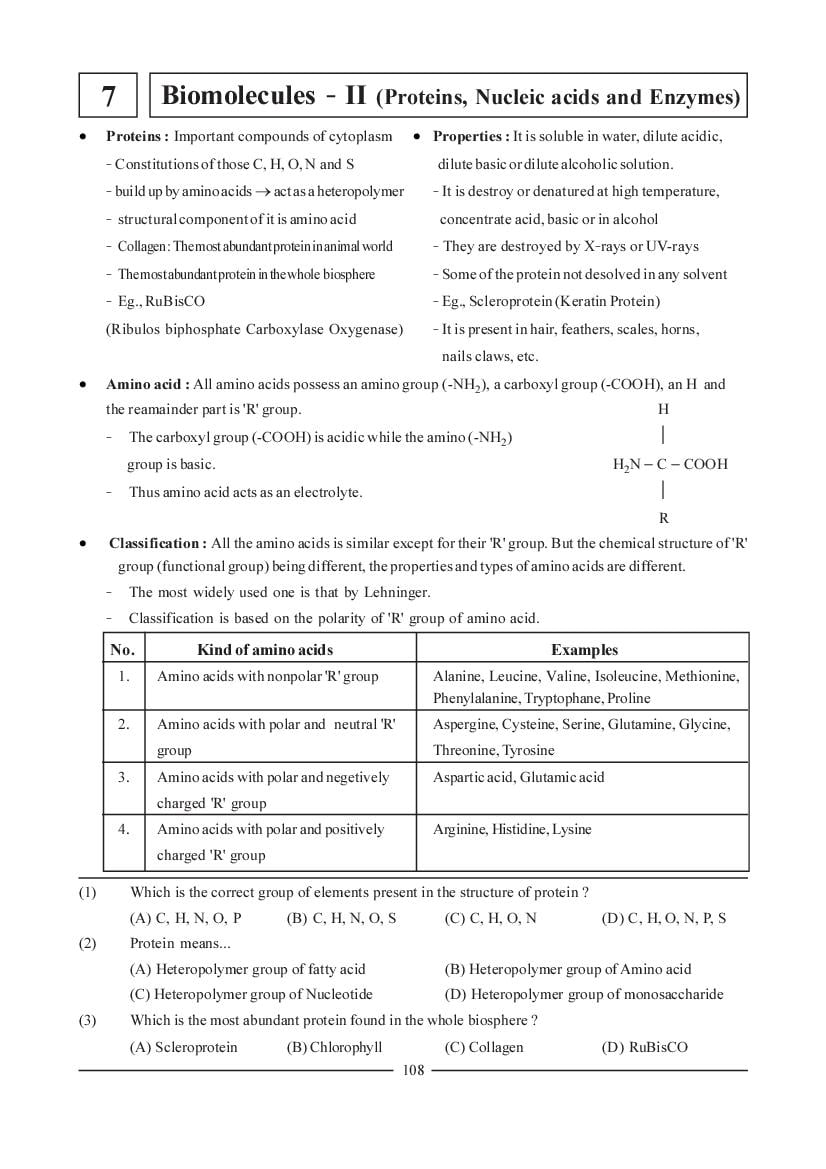
· Proteins : Important compounds of cytoplasm · Properties : It is soluble in water, dilute acidic,
- Constitutions of those C, H, O, N and S dilute basic or dilute alcoholic solution.
- build up by amino acids ® act as a heteropolymer - It is destroy or denatured at high temperature,
- structural component of it is amino acid concentrate acid, basic or in alcohol
- Collagen : The most abundant protein in animal world - They are destroyed by X-rays or UV-rays
- The most abundant protein in the whole biosphere - Some of the protein not desolved in any solvent
- Eg., RuBisCO - Eg., Scleroprotein (Keratin Protein)
(Ribulos biphosphate Carboxylase Oxygenase) - It is present in hair, feathers, scales, horns,
nails claws, etc.
· Amino acid : All amino acids possess an amino group (-NH2), a carboxyl group (-COOH), an H and
the reamainder part is 'R' group. H
- The carboxyl group (-COOH) is acidic while the amino (-NH2) ½
group is basic. H2N - C - COOH
- Thus amino acid acts as an electrolyte. ½
R
· Classification : All the amino acids is similar except for their 'R' group. But the chemical structure of 'R'
group (functional group) being different, the properties and types of amino acids are different.
- The most widely used one is that by Lehninger.
- Classification is based on the polarity of 'R' group of amino acid.
No. Kind of amino acids Examples
1. Amino acids with nonpolar 'R' group Alanine, Leucine, Valine, Isoleucine, Methionine,
Phenylalanine, Tryptophane, Proline
2. Amino acids with polar and neutral 'R' Aspergine, Cysteine, Serine, Glutamine, Glycine,
group Threonine, Tyrosine
3. Amino acids with polar and negetively Aspartic acid, Glutamic acid
charged 'R' group
4. Amino acids with polar and positively Arginine, Histidine, Lysine
charged 'R' group
(1) Which is the correct group of elements present in the structure of protein ?
(A) C, H, N, O, P (B) C, H, N, O, S (C) C, H, O, N (D) C, H, O, N, P, S
(2) Protein means...
(A) Heteropolymer group of fatty acid (B) Heteropolymer group of Amino acid
(C) Heteropolymer group of Nucleotide (D) Heteropolymer group of monosaccharide
(3) Which is the most abundant protein found in the whole biosphere ?
(A) Scleroprotein (B) Chlorophyll (C) Collagen (D) RuBisCO
108
Page 2
(A) Collagen (B) Myosin (C) Scleroprotein (D) Actin
(5) Full form of RuBisCO is ......... .
(A) Ribulose Bicarboxylase Oxygenase (B) Ribulose Biphosphate Carboxylase Oxygenase
(C) Ribulose phosphate carboxylase (D) Ribose Biphosphate Carboxylase Oxygenase
(6) Which factor is responsible for protein denaturation ?
(A) X-ray (B) UV-ray (C) Strong Acid (D) All of the above
(7) Which Biomolecule fight against infections organisms ?
(A) Carbohydrate (B) Enzyme (C) Nucleic Acid (D) Protein
(8) Which protein is present in the exoskeleton of an organism ?
(A) Keratin (B) Casein (C) Myosin (D) Melanin
(9) Which is the building block of Protein ?
(A) Peptide (B) Nucleotide (C) Amino Acid (D) Glucose
(10) Which group is correct for the structure of Amino Acids ?
(A) Carboxyl group, Amino group, Hydrogen group, Reactive 'R' group
(B) Ketone group, Amino group, Hydrogen group
(C) Hydroxyl group, Carboxyl group, Amino group
(D) Carboxyl group, Hydrogen group, Hydroxyl group
(11) There are twenty functional Amino Acids present in the structure of protein, because of...
(A) In every Amino Acid numbers of - COOH group differs.
(B) In every Amino Acid propotion of - NH2 group differs.
(C) Chemical structure of 'R' group is different in Amino Acid.
(D) All of the above
(12) Which of the following indicates the importance of 'R' group ?
(A) Amino Acids are classified on the basis of it (B) Electric charge of an Amino Acid is based upon it
(C) Protein synthesis is based on it (D) Peptide bond is based on it
(13) Which method is widely used for the classification on the basis of 'R' group ?
(A) Electroporesis (B) Reductive method (C) Lehninger (D) Whittekar method
(14) Long chain of protein is synthesized by ......... .
(A) Purine (B) Pyrimidine (C) Amino Acid (D) Sugar
(15) Which Amino Acid possesses polar and negatively charged 'R' group ?
(A) Aspartic Acid (B) Arginine (C) Methionine (D) Threonine
Answers : (1-B), (2-B), (3-D), (4-C), (5-B), (6-D), (7-D), (8-A), (9-C), (10-A), (11-C), (12-A),
(13-C), (14-C), (15-A)
109
Page 3
Dehydration
Dipeptide : A dipeptide is formed through the union of two similar or dissimilar amino acid molecules.
Amino acid (1) + Amino acid (2) Peptide bond Dipeptide
Peptide bond : The bond is formed between the - COOH group of one amino acid and - NH2
group of another amino acid molecule. A molecule of H2O is released in this process. Such a bond
is called peptide bond. O
H H
Amino acid - 1 Amino acid - 2 Peptide bond
Polypeptide bond :
- Many amino acids Peptide bond Protein C Terminal
Carboxyl
- One or more polypeptide chain ® Protein
- Protein exhibit two ends. (1) C-Terminal (2) N-Terminal
Structure of Protein : N Terminal
(Amino)
(1) Primary structure :
- On the basis of serial and types of amino acid.
- Gene regulation.
(2) Secondary structure :
- Structure is formed by hydrogen bond.
- Spiraly coiled or flat disc like.
(3) Tertiary structure :
- The three dimensional arrangement on the atoms within a single polypeptide chain.
(4) Quaternary structure : Haeme groups b chain
- A three dimensional form of a whole protein.
Bonds : Disulphide, hydrogen, hydrophobic, ionic bonds are involved in the
formation of it.
- Globular or fibrous form.
- E.g., Haemoglobin (Quatenary structure)
a Chain
- 4 polypeptide chains : 2 - a chain, 2 - b chain and 4 haeme groups.
Importance of Protein :
- Components of the membrane and organelles.
- In structure of an enzyme.
- In the structures of hormones of Pancreas, Pituitary and Parathyroid glands.
- In muscles ® Actin and Myosin; In Cilia and flagella ® It is responsible for locomotion by globular
contractile protein.
- In blood plasma ® Immunoglobulin ® For the immunity
110
Page 4
Conjugated protein : When proteins are associated with some materials other than amino acids or
protein they are known as conjugated protein.
eg., Haemoglobin - For the transportation of respiratory gases and chlorophyll - For the photosynthesis.
(16) The union of two dissimilar amino acid is called...
(A) peptide (B) polypeptide (C) dipeptide (D) protein
(17) Which groups are required for the formation of peptide bond ?
(A) COOH and - NH2 (B) COOH and - OH
(C) C = O and - NH2 (D) C = O and - NH2
(18) Which of the following indicates the peptide bond ?
(A) - C - O - O - C (B) - CO - NH (C) O - C - H (D) C - O - H
(19) Polypeptide means ......... .
(A) Chain of many Amino Acids joined through ester bond
(B) Chain of many Amino Acids joined through peptide bond
(C) Chain of many Amino Acids joined through polypeptide bond
(D) Chain of many Amino Acids joined through glycosidic bond
(20) Polypeptide chain of Amino Acid is ......... .
(A) Enzyme (B) Nucleic Acid (C) Hormone (D) Protein
(21) The primary structure of Protein is due to ......... .
(A) Peptide bond (B) S- S bond (C) Ionic bond (D) Hydrogen bond
(22) The primary structure of protein is controlled by ......... .
(A) Hormone (B) Chromosome (C) Amino Acid (D) Genes
(23) Secondary structure of protein is impossible in the absence of...
(A) S-S bond (B) Hydrogen bond (C) Ionic bond (D) Peptide bond
(24) Because of the presence of Hydrogen bond, which characteristic is considered ?
(A) Chain becomes spiral and complicated (B) Folds formed between the Amino Acid
(C) Formation of strong tubules (D) All of the above
(25) The secondary structure of protein is ......... .
(A) Interactions between the polypeptide chain (B) Three dimensional arrangement of polypeptide chain
(C) Complicated helical structure of polypeptide chain (D) Numbers of Amino Acid in the structure of polypeptide chain
(26) Three dimensional arrangement of one polypeptide chain means...
(A) Quaternary structure of protein (B) Secondary structure of protein
(C) Primary structure of protein (D) Teritary structure of protein
(27) Four polypeptide chains are observed in the structure of haemoglobin molecule under the microscope,
so what does it indicates from the following ?
(A) It is conjugated protein (B) It may carry out the exchange of gases
(C) It is the protein with quaterrary structure (D) It is found in the blood of vertebrates
111
Page 5
(A) Peptide bond (B) Ester bond (C) Phosphodiester bond (D) Disulphide bond
(29) Which bond is unnecessary for the formation of protein ?
(A) Ester bond (B) Hydrophobic bond (C) Peptide bond (D) Ionic bond
(30) Which sentence is wrong for the enzyme ?
(A) Enzymes are made up of protein (B) It is used in the biochemical reactions of a cell
(C) It regulates the different activities of a body (D) It acts as a electrolyte
(31) Which gland hormone is not made up of protein ?
(A) Pancreas (B) Parathyroid (C) Pituitary (D) Adrenal
(32) Which of the following protein does not have the characteristic of contractibility ?
(A) Myosin (B) Globulin (C) Globular (D) Actin
(33) Where does the Actin and Myosin proteins present in the body ?
(A) In a blood (B) In a muscle (C) In a plasma (D) In a skin
(34) Which of the following protein is having the characteristic of immunity ?
(A) Immunoglobulin (B) Albumin (C) Haemoglobin (D) Melanin
(35) Globular protein is found in the ......... .
(A) Muscle (B) Nails (C) Cillia (D) Scales
(36) Meena's skin colour is bright and Seeta's skin colour is dark which protein is responsible for it ?
(A) Melatonin (B) Melanin (C) Haemoglobin (D) Myoglobin
(37) Conjugate protein means ......... .
(A) protein + lipid (B) protein + carbohydrate (C) protein + ion (D) protein + non-protein
(38) Which kind of haemoglobin protein is ?
(A) conjugated protein with quaternary structure (B) conjugated protein with tertiary structure
(C) complex protein with quaternary structure (D) Immuno protein with quaternary structure
(39) Which bond is present in the hormone of parathyroid gland ?
(A) Peptide (B) Glycosidic (C) Ester (D) Phosphodiester
(40) Give one example of conjugate protein with quaternary structure ......... .
(A) Immunoglobulin (B) Myosin (C) Chlorophyll (D) Globular
(41) Which conjugate protein is found in plants ?
(A) Chlorophyll (B) Thylakoid (C) Pectin (D) All of the above
Answers : (16-C), (17-A), (18-B), (19-B), (20-D), (21-A), (22-D), (23-B), (24-D), (25-C), (26-D),
(27-C), (28-D), (29-A), (30-C), (31-D), (32-B), (33-B), (34-A), (35-C), (36-B), (37-D), (38-A),
(39-A), (40-C), (41-A)
· Nucleic acid :
- Isolation of DNA prepared by - Johannsen Friedrich Miescher.
112
Page 6
named this material "nuclein".
- Nuclein = Nucleic acid + Protein, Main component of chromosome in nucleic acid.
Chromosome : Small gene-carrying bodies in the nuclei of complex cells. They are responsible for
inheritance in all organisms.
- C, H, O, N and P are in it.
- It is two types (1) DNA and (2) RNA
- Nucleotides = Pentose sugar + Nitrogenous base + Phosphoric acid
- Pentose sugar :
Ribose Deoxyribose
- In structure of - In structure of
RNA DNA
Nitrogen bases : Purine - Two rings Pyrimidine - Single rings
Thymine Uracil Cytosine
Adenine Guanine - Not in structure - Not in structure
of RNA of DNA
O
Base
½½
- Phosphoric acid : HO - P - OH Sugar
½
OH Nucleotide
- Nucleoside = Pentose sugar + Nitrogen base Base
- Nucleotide = Nucleoside + Phosphate Sugar
- Dinucleotide = Nucleotide + Nucleotide
Nucleotide
Phosphodiester bond
Phosphodiester bond
Two sequential nucleotides join through a phosphodiester bond and form a
dinucleotide. Such union occurs between third carbon of sugar in one nucleotide and
Base
Sugar
Dinucleotide Base
Sugar
Nucleoside
(Pentose sugar + N - Base) Nucleotide
113
Page 7
structural bond is known as phosphodiester bond.
(Between the two sequential nucleotides phosphate linked that bond is phosphodiester)
Polynucleotides :
- Many nucleotide units unite, a polynucleotide chain is formed.
· DNA : (Deoxy ribose nucleic acid)
· Watson, Crick, Wilkins gave the model of it.
· Two polynucleotide chain is comprised.
· It is anti parallel to each others.
· Two chains are in a definite manner and spirally twisted. So it like a spiral ladder.
· The linkages between the two polynucleotide chains are such that a purine base of one chain is linked
with a pyrimidine base of the opposite chain.
A = T and G C (Uracil is not present in it)
0
· Length of complete spiral = 34 A
0
· Distance (width) between the two chain = 20 A
· RNA : (Ribo nucleic acid)
· It has single polynucleotide chain.
· Thymine is not present instead of it Uracil is present.
· Types of RNA :
(1) m - RNA (Messenger RNA) : Transport the genetical information.
(2) t - RNA (Transfer RNA) : It has 75 % nucleotides. It transport of amino acid.
(3) r - RNA (Ribosomal - RNA) : It is find in ribosomes. 80 to 85% of it in total RNA.
(42) Nucleic Acids shows the evolution of ......... .
(A) Nuclein (B) Protein (C) Nucleotide (D) Amino Acid
(43) Nuclein ...
(A) Weak Acid + Weak Protein (B) Nucleic Acid
(C) Nucleic Acid + Protein (D) Chromosome
(44) Nucleic Acid means...
(A) Major component of a chromosome (B) An ultrastructure which carry genes in the Nucleus
(C) A weak substance with unknown function (D) All of the above
(45) State the wrong sentence for the chromosome ......... .
(A) It is responsible for the heredity in all the organisms
(B) An ultrastructure which carry genes in the nucleus of a cell
(C) Main component of a Nucleic Acid
(D) All of the above
(46) Nucleic Acid is a Polymer of the following.
(A) Amino Acid (B) Protein (C) Nuclein (D) Nucleotide
114
Page 8
(A) Respiration (B) Photosynthesis (C) Heredity (D) Reproduction
(48) Which of the following molecules are showing different characteristics in different organism ?
(A) Protein (B) Lipid (C) Nucleic Acid (D) Carbohydrate
(49) Which pair is correct of purine nitrogen base ?
(A) Adenine, cytosine (B) Adenine, thymine
(C) Cytosine, thymine (D) Adenine, guanine
(50) Which pair of pyrimidine Nitrogen base is correct of the following ?
(A) Cytosine, thymine, uracil (B) Adenine, guanine, cytosine
(C) Cytosine, thymine (D) Thymine, Uracil
(51) Which element is not there in the Nitrogen base ?
(A) Carbon (B) Phosphorus (C) Hydrogen (D) Nitrogen
(52) Which of the following is an example of nitrogen base consisting two rings ?
(A) Cytosine (B) Thymine (C) Uracil (D) Guanine
(53) Nitrogen base is ......... kind of structure.
(A) Linear (B) Cyclic (C) Helical (D) Flat and sheet
(54) Nucleoside means ......... .
(A) Nucleic acid + Phosphate (B) Nucleotide + Phosphate
(C) Pentose sugar + Nitrogen base (D) Pentose sugar + Nitrogen base + Phosphate
(55) Nucleotide means...
(A) Nucleoside + Phosphate (B) Nitrogen base + Phosphate
(C) Nucleic acid + Protein (D) Protein + Nucleoside
(56) How the DNA and RNA differs from each other ?
(A) Only sugar (B) Sugar and purine
(C) Sugar and Purimidine (D) Sugar and phosphate
(57) Phosphodiester bond is between which two carbon number of nucleotide ?
(A) 3, 5 (B) 3, 3 (C) 2, 5 (D) 1, 5
(58) Which one is required in the structure of Nucleic Acid ?
(A) Ester bond (B) Phosphodiester bond (C) Peptide bond (D) Di-sulphide bond
(59) If a one chain of DNA have the nucleotide sequence like ACGGTTAA then, what should be the
opposite chain sequences ?
(A) TGCCAATT (B) GTAACCTT (C) CATTGGCC (D) TACCGGTT
(60) DNA's strands are Antiparallel to each other because of...
(A) Hydrogen bond (B) Di-sulphide bond (C) Phosphodiester bond (D) Glycosidic bond
(61) Which one of the following pair is attached by three weaker Hydrogen bond ?
(A) A,T (B) C,G (C) T,G (D) A,U
115
Page 9
(A) A,T (B) T,A (C) C,G (D) A and B both
(63) What is true for DNA structure ?
(A) A = T and C { G (B) A = C and T = G
(C) A = G and T = C (D) All of the above
(64) Which sequence of nucleotides possesses six pyrimidine nitrogen base ?
(A) GATCATCCT (B) TGCCTAACG
(C) GCUAGACAA (D) UAGCGGUAA
(65) What is the length of one complete spiral ?
0 0 0 0
(A) 34 A (B) 3.4 A (C) 20 A (D) 2.0 A
(66) What is the distance between two chains of DNA ?
0 0 0 0
(A) 30 A (B) 3.4 A (C) 2.0 A (D) 20 A
(67) DNA is not directly connected in the synthesis of the following.
(A) Another chain of DNA (B) t - RNA
(C) m - RNA (D) Protein
(68) In a DNA, which region of DNA is diversified ?
(A) Glycerol (B) Nitrogen base (C) Sugar (D) Phosphate
(69) Which base is found only in the RNA ?
(A) Uracil (B) Thymine (C) Guanine (D) Cytosine
(70) m - RNA is a polymer of ......... .
(A) DNA oxyribotide (B) Ribotide
(C) Riboside (D) Deoxyriboside
(71) Structure of ATP is very similar with.
(A) DNA Nucleotide (B) Amino acid (C) Fatty acid (D) RNA Nucleotide
(72) Find out the incorrect sentence for m- RNA.
(A) It is synthesis on the template strand of a DNA (B) Transfers the information for the protein synthesis
(C) It degrades after its functions over (D) Transfer the amino acids
(73) Find out the incorrect pair.
(A) m-RNA - genetic codon (B) t - RNA - anticodon
(C) r - RNA - Ribosome structure (D) DNA - Place for the protein synthesis
(74) Nucleoprotein means...
(A) r - RNA + protein (B) r - RNA + nucleic acid
(C) nucleotide + protein (D) t - RNA + protein
(75) Ribosomes provides the place for which reaction ?
(A) Protein synthesis (B) Respiration (C) DNA synthesis (D) m-RNA synthesis
Answers : (42-A), (43-C), (44-A), (45-C), (46-D), (47-C), (48-C), (49-D), (50-A), (51-B),
(52-D), (53-B), (54-C), (55-A), (56-C), (57-A), (58-B), (59-A), (60-C), (61-B), (62-D), (63-A),
(64-A), (65-A), (66-D), (67-D), (68-B), (69-A), (70-B), (71-D), (72-D), (73-D), (74-A), (75-A)
116
Page 10
- All these reactions occur very slowly at low temperature and atmospheric pressure the conditions
under which living cells carry on their life processes.
- In the living cells these reactions proceed at extremely high rates.
- Specific chemicals which act as biological catalysts are called enzymes which are available in the
body of living organisms.
- Enzymes are proteinaceous.
- Some enzymes behave of nucleic acids, which is known as ribozymes.
Properties of enzymes :
- Enzymes are amphoteric in nature.
- Each enzymes has an effect on a particular reaction only.
- An enzyme is effective for one reaction is not useful in another reaction.
E.g., Lipase can digest lipids only while sucrase can digest sucrose only.
- Effect of most enzymes is unidirectional.
- Some enzymes is bidirectional.
- Some enzyme is functional within a specific range.
- At high temperatures enzymes are denatured.
- At very low temperature they become inactive.
- After the complete the reaction enzyme gain in original form.
- Each enzyme is active at a specific pH.
Method :
- It has three dimentional structure.
- It has specific location as lock key linkage.
- For chemical reaction an essential enelgy level is called active energy level.
Equation :
Enzyme + Substrate ® Enzyme - Substrate complex ® Enzyme + Product
E + S ® E - S complex ® E + P
E P
S E
(E S)
(76) Under which physiological factor living organisms perform their activity ?
(A) At low temperature and atmosphere pressure (B) At high temperature and low atmospheric pressure
(C) At high temperature and atmospheric pressure (D) At low temperature and high atmospheic pressure
(77) Enzyme means ......... .
(A) Biological protein (B) Biological hormone (C) Biological catalyst (D) Biological chemical
(78) What is Ribozyme ?
(A) Ribosome + r - RNA (B) Enzymes made up of nucleic acid
(C) r - RNA + protein (D) r - RNA
117
Page 11
sequentially ?
(A) Denaturation and inactive (B) Inactive and denaturation
(C) Inactive and damage (D) Degerate and Inactive
Answers : (76-A), (77-C), (78-B), (79-A)
· Nomenclature and classification of Enzymes :
Nomenclature can be done in two ways :
(1) A suffix - ase can be attached to the name of the substrate on which it acts. e.g., The enzyme which
acts on sucrose is called sucrase.
(2) It is named after the reaction which it carries. e.g, Hydrolysis are called hydrolases.
Classification of Enzyme/Catagory Reaction Example
(1) Oxidoreductases Oxidation and reduction - Succinic dehydrogenase
- Cytochrom oxidase
(2) Transferases Except hydrogen from one substrate - Hexokinese one phosphate group of the
to another substrate link ATP to join with glucose
(3) Hydrolases Complex organic substance by - Maltase
adding a molecule of water (Maltose + H2O ® glucose + glucose)
(4) Lyases Cleavage of macromolecules into - Aldose
smaller molecules (Fructose 1, 6 biphosphate ® 2, triose phosphate)
(5) Isomerases Changes only in the molecular - Fructose isomerase
structure of the structure (Glucose-6 phosphate ® Fructose-6 phosphate)
(6) Ligases or Synthesize a new molecule by joining - Acetyl co-enzyme synthetase
Synthetases two molecules with the help of (Acetic acid + ATP + Co.A ®
energy obtained from phosphate Acetyl Co.A + AMP + H4 P2O7
bond of ATP (Pyrophosphate)
· Cofactors :
- Sometime a non-protein component of enzyme with the protein in enzyme structure is called cofactor.
- In which protein component is apoenzyme and non-protein component is called cofactor.
- Cofactor are two types :
+2 +2 + +2
(1) Inorganic : eg, = Fe , Ca , Na , Zn
(2) Organic : eg, NAD, FAD, NADP, FMN
(i) Co enzyme : Loosely bound with apoenzyme.
(ii) Prosthetic group : Tightly bound with apoenzyme.
- For the activation of carbonic anhydrase ® Zn
- In azatobacter bacteria - Nitrogen, for the N2 fixation and activation of Nitrogenase ® V
- For the activation of enolase ® Mg, Mn, Zn
- Activation of nitric oxide synthetase, protein phosphatase and adenyle kinase ® Ca+2
118
Page 12
(A) Its colloidal form (B) Its amphoteric property
(C) Its three dimensional structure (D) Activation energy level of a reaction
(81) What is essential for performing every biochemical reaction ?
(A) Three dimensional form (B) Activation energy level (C) Active site (D) All of the given
(82) What is dehydrogenation ?
(A) Joining of hydrogen (B) Donation of a hydrogen
(C) Duplication of hydrogen (D) Absence of hydrogen
(83) Succinic dehydrogenase is example of which type of enzyme ?
(A) Transferases (B) Hydrolysis (C) Oxido-reductases (D) Lyases
(84) What is called that join the phosphate to one substrate to another substrate ?
(A) Transferase (B) Hydrolysis (C) Isomerases (D) Synthetase
(85) Which type of enzyme Hexokinase is ?
(A) Transferases (B) Lyases (C) Isomerases (D) Ligases
(86) Find out incorrect pair :
(A) Maltase - hydrolases (B) Aldolase - lyases
(C) Haxokinase - isomerases (D) Acetyle co-A enzyme synthetase-ligases
(87) Form where Ligase enzyme gets energy in use ?
(A) From the pyrophosphate bond of GTP (B) From the pyrophosphate bond of ATP
(C) From the pyrophosphate bond of AMP (D) From the pyrophosphate bond of GDP
(88) Full form of FMN :
(A) Flavin mononucleotide (B) Flavin mononucleic acid
(C) Ferredoxin mononucleic acid (D) Ferredoxin mononitrite
(89) Find out the correct pair of the following.
(A) Apoenzyme - none protein part of enzyme (B) Prosthetic group - protein part of enzyme
(C) NADP - Co-enzyme (D) Ribozyme - Ribosome + r-RNA
(90) Apoenzyme group is made up of what ?
(A) Carbohydrate (B) Lipid (C) Protein (D) Nucleic acid
(91) Full form of NAD.
(A) Nicotinamide di-nucleotide (B) Nicotinamide Adenine di-nucleotide
(C) Nucleic acid di-nucleotide (D) Nitric acid di-nucleotide
(92) What is cofactor ?
(A) Apoenzyme (B) Inorganic substances
(C) Non protein part of the enzyme structure (D) All of these
(93) Zn is require for the activation of.
(A) Glucose phosphatase (B) Carbonic Anhydrase
(C) Nitrogenase (D) Hydrogenase
119
Page 13
(A) Mg, Ca, V (B) Mg, Zn, B (C) Cu, Zn, Mo (D) Mg, Mn, Zn
Answers : (80-C), (81-B), (82-B), (83-C), (84-A), (85-A), (86-C), (87-B), (88-A), (89-C), (90-C),
(91-B), (92-C), (93-B), (94-D)
· True - False (T - F) types questions :
Select the true-false statements from the following :
(95) (1) Protein is homopolymer of amino acid.
(2) Protein transports the nutrients through cytoplasmic membrane.
(3) Except 'R' group remaining is same in the amino acid.
(4) Two similar amino acids join to form dipeptide.
(A) T T T F (B) T F F T (C) T F T T (D) F T T F
(96) (1) Isoleucine is having polar and neutral 'R' group.
(2) One terminal of a polynucleotide is known as N - terminal.
(3) Primary structure of protein is decided from the amino acid units.
(4) Skin colour is based on the melanin protein.
(A) T T F T (B) F T T F (C) F F T T (D) T F F T
(97) (1) Dipeptide bond is formed between one carboxyl group and another -NH2 group.
(2) In the structure of haemoglobin there are two a and b polypeptide chains.
(3) Hormones of pituitary gland possesses the ester bonds.
(4) Nuclein were first isolated in human.
(A) T T F T (B) F F T T (C) F T F T (D) F F F T
(98) (1) Actin protein is responsible for the locomotion which is present in our muscles.
(2) There are two polynucleotide chains present in the structure of DNA and RNA.
(3) Pyrimidines are joined together by weak hydrogen bond.
(4) Nucleus is responsible for the heredity in all the organisms.
(A) T T T T (B) T T F T (C) T F F T (D) T F T F
(99) (1) Adenine and guanine joined by the 3 weak hydrogen bond and thymine and cytosine joined by the 2
weak hydrogen bond.
(2) In a every DNA, the proportion of purine and pyrimidine is same.
(3) There is absence of Uracil in Ribose Nucleotide.
(4) A strand of DNA which synthesize the m-RNA is known as Template strand.
(A) F T F T (B) T T F T (C) F T T F (D) F T T F
(100) (1) Enzyme degenerates after the reaction is complete.
(2) Some enzymes show irreversible effect.
(3) Enzyme take part in the intra cellular or extra cellular reaction at a body temperature.
(4) By the lowering of activation energy level, rate of reaction is increased at unexpected speed.
(A) T T F F (B) F T T F (C) F T T T (D) F T F T
120
Page 14
(2) Nitrogen fixed by the Azatobacter bacteria
(3) A protein which is found in the hair (collagen) is insoluble.
(4) Haemoglobin is the protein with 4 haem molecule.
(A) T T F T (B) T F F T (C) T T F F (D) F F F T
Answers : (95-D), (96-C), (97-C), (98-D), (99-A), (100-C), (101-A)
· A - Assertion and R - Reason type questions :
Which option is correct for given question ?
(A) A and R both are true, R is correct explanation of the A.
(B) A and R both true, R is not correct explanation of the A.
(C) A is true and R is false.
(D) A is false and R is true.
(102) Assertion A : For the photosynthesis essential chlorophyll is a conjugated protein.
Reason R : In enzyme if protein and non-protein part is joined then it is called prosthetic group.
(A) (B) (C) (D)
(103) Assertion A : Three dimensional structure of protein is indicated by tertiary structure.
Reason R : Disulphide, Hydrophobic bonds takes part in the quaternary structure of protein.
(A) (B) (C) (D)
(104) Assertion A : Hormones of pituitary gland shows the steroidal nature.
Reason R : Haemoglobin acts as a respiratory pigment.
(A) (B) (C) (D)
(105) Assertion A : Each Nucleotide is made up of 3 subunits.
Reason R : There are two rings in the pyrimidine
(A) (B) (C) (D)
(106) Assertion A : Ribose sugar and Nitrogen base joined to form Riboside
Reason R : Sugar and Nitrogen base joined to form Nucleoside
(A) (B) (C) (D)
(107) Assertion A : Ribonucleoside is phosphorylated to become deoxyribonucleotide.
Reason R : In the structure of DNA two chains of Nucleotide are arranged in a Antiparallel manner.
(A) (B) (C) (D)
(108) Assertion A : Enzymes are colloidal form of a catalyst.
Reason R : Enzymes are secreted in minute concentration by the living cells.
(A) (B) (C) (D)
(109) Assertion A : Enzyme binds to substrate to form enzyme substrate complex.
Reason R : Enzyme is active between fired temperature range.
(A) (B) (C) (D)
121
Page 15
Reason R : Enzyme plays an important role in the oxidative reaction at Kreb's cycle.
(A) (B) (C) (D)
(111) Assertion A : NADP acts as a co-enzyme.
Reason R : Co-enzymes are small in size compare to Apoenzyme
(A) (B) (C) (D)
Answers : (102-C), (103-D), (104-D), (105-C), (106-A), (107-D), (108-A), (109-B), (110-A), (111-A)
(112) Select the appropriate pair :
Column - I Column - II
(i) Polar positively charged 'R' group (p) Glutamine (A) i - r, ii - p, iii - q, iv - s
(ii) Polar, Neutral 'R' group (q) Valine (B) i - q, ii - s, iii - r, iv - p
(iii) Non-polar 'R' group (r) Histidine (C) i - q, ii - p, iii - s, iv - q
(iv) Polar, Negatively charged 'R' group (s) Aspartic Acid (D) i - r, ii - q, iii - s, iv - p
(113) Select the appropriate pair :
Column - I Column - II
(i) Haemoglobin (p) Amino Acid (A) i - q, ii - r, iii - s, iv - p
(ii) Globular (q) Immunity (B) i - q, ii - r, iii - p, iv - s
(iii) Immunoglobulin (r) Contractbility (C) i - s, ii - q, iii - p, iv - r
(iv) Glycine (s) Conjugate protein (D) i - s, ii - r, iii - q, iv - p
(114) Select the appropriate pair :
Column - I Column - II
(i) Nucleotide (p) Peptide bond (A) i - t, ii - r, iii - p, iv - q
(ii) Lipid (q) Glycosidic bond (B) i - r, ii - s, iii - p, iv - q
(iii) Protein (r) Phospho di-ester bond (C) i - t, ii - s, iii - p, iv - q
(iv) Carbohydrate (s) Ester bond (D) i - r, ii - s, iii - t, iv - q
(t) Di-sulphide bond
(115) Select the appropriate pair :
Column - I Column - II
(i) m-RNA (p) Brings Amino Acid on Ribosome
(ii) DNA (q) Transfer of genetic code into cytoplasm
(iii) t-RNA (r) Forms the structure of Ribosome
(iv) r-RNA (s) Synthesize m-RNA
(A) i - q, ii - s, iii - p, iv - r (B) i - s, ii - p, iii - q, iv - r
(C) i - p, ii - q, iii - s, iv - r (D) i - r, ii - s, iii - q, iv - p
122
Page 16
Column -I Column -II Column-III
(i) Lyases (p) Changes in the molecule structure (w) Aldolase
(ii) Isomerases (q) Addition of oxygen (x) H4 P2 O7
(iii) Ligases (r) Catalyse macro molecule (y) Fructose Isomerase
(iv) Oxido-reductase (s) Joining of two molecule (z) Cytochrome oxidase
(A) i - q - z, ii - p - y, iii - s-w, iv - r -x (B) i - r - y, ii - s - w, iii - p - x, iv - q -z
(C) i - r - x, ii - p - y, iii - s - w, iv - q - z (D) i - r - w, ii - p - y, iii - s - x, iv - q - z
Answers : (112-A), (113-D), (114-B), (115-A), (116-D)
(117) Find out the correct structure of Amino Acid from the following :
(A) (B)
H H O H2N - C - NH2
½ ½½
N-C-C O
½
H R OH
NH2 H NH2 O
(C) ½ ½ (D) ½
H3C - C - C - OH H3C - C
½ ½ ½
H H H OH
(118) The structure given below is of what ?
(A) Polynucleotide chain
(B) Polypeptide chain
(C) Polysaccharide chain
(D) Haemoglobin molecule
(119) Find out what is 'a' in the given figure : a
(A) Hydrophobic bond (B) H-H bond
(C) S-S bond (D) Peptide bond
(120) Indicate the a, b regions of the given structure :
b
(A) Haemoglobin, Haeme group
(B) Chlorophyll, Mg group
(C) Chlorophyll, Iron group
(D) Haemoglobin, Mg group a
123
Page 17
(A) (B)
(C) (D)
O O
H
O
(122) Given structure is of which sugar. (123) Indicates 'a' and 'b' in given diagram.
(A) Fructose (A) a = H, b = N - H
(B) Glucose (B) a = H2, b = N - H a
(C) Galactose (C) a = H, b = H
(D) Ribose (D) a = O, b = H b
(124) Indicates 'a' and 'b' in given diagram. (125) Which Nitrogen base is in the given structure ?
(A) a = N - H, b = N - H (A) Adenine
a
(B) a = H, b = N-H (B) Thymine
(C) a = N, b = N b (C) Cytosine
(D) a = n, b = N-H (D) Uracil
(126) Which is the correct structure of Cytosine ?
(A) (B) (C) (D)
H
H
(127) Which one of the following structure is absent in the DNA ?
(A) (B)
(C) (D)
124
Page 18
(A) OH (B) H
½ ½
HO - P - OH O-P=O
½ ½½
OH O
(C) O (D) H
½½ ½
HO - P - OH HO - P - H
½ ½
OH O
(129) Identify the given structure :
(A) Deoxyriboside
(B) Riboside
(C) Deoxyribotide
(D) Ribotide
(130) Identify the given structure :
(A) Phosphoribonucleotide
(B) Ribonucleotide
(C) Deoxyribonucleotide
(D) Phospho de-oxy ribonucleotide
5' end Bais
(131) Identify the given structure :
Sugar
(A) Dipeptide
(B) Disaccharide
(C) Dinucleotide
(D) Polynucleotide Bais
Sugar
(132) What is given structure ?
3' end
(A) Polynucleotide chain
(B) Polypeptide chain
(C) DNA helical structure
(D) DNA molecule structure
125
Page 19
E P
a c
b
(A) a = product, b = enzyme, c = substrate
(B) a = product, b = enzyme-substrate complex, c = substrate
(C) a = substrate, b = enzyme-substrate complex, c = enzyme
(D) a = substrate, b = enzyme-substrate complex, c = product
(134) E + S ® a ® E + b
(A) a = E - S complex, b = P (B) a = E - P complex, b = S
(C) a = E - S complex, b = S (D) a = P, b = S
Answers : (117-A), (118-B), (119-C), (120-A), (121-B), (122-D), (123-A), (124-D), (125-D),
(126-D), (127-A), (128-C), (129-B), (130-B), (131-C), (132-D), (133-D), (134-A)
· Questions for NEET :
(135) Pyrenoids are made up of...
(A) Central protein and starch layer (B) Lateral protein and surrounded by lipid layer
(C) Central starch and surrounded by protein layer (D) Central Nucleic acid surrounded by protein layer
(Hint : Pyrenoids are small globular proteins which is surrounded by starch it is found in the chloroplast
of Algae as well as bryophytes.)
(136) What enzymes do ?
(A) Decrease in the rate of reaction (B) Increase in the rate of reaction
(C) Increase in the energy level of reaction (D) Decrease in the energy level of reaction
(Hint : It reduces the energy level and enhance the rate of reaction.)
(137) By which bond two individual Ribonucleotide units are bind together ?
(A) Peptide bond (B) Co-valent bond
(C) Hydrogen bond (D) Phospho di-ester bond
(138) Physically and chemically in both the ways which biomolecule is majority differentiated in the cell ?
(A) Protein (B) Carbohydrate (C) Nucleic Acid (D) Lipid
(Hint : Proteins are heteropolymer of Amino Acid. Different 20 types of amino acids form different
protein by the arrangement of different sequences and in different numbers.)
(139) By which the gene is arranged in the bacterial chromosome ?
(A) Histones (B) Basic protein (C) Acidic protein (D) Actin
(Hint : Eukaryotic DNA's are attached to the histones. Which is incorporated in the structure of
chromatin, when bacterial chromosome is opened and unlist of double helical DNA then by the help of
RNA it folded into complex spherical structure. Where Non-histones polyamines carry positive ion ?)
126
Page 20
(A) Uracil (B) Adenine (C) Thymine (D) De-oxy ribose
(Hint : Rate of DNA synthesis is decided by Thymine)
(141) During protein synthesis, in a cytoplasm ribosome gets a appropriate amino acids from the flow of it,
which RNA is further get there amino acid ?
(A) m - RNA (B) t - RNA (C) r - RNA (D) DNA
(Hint : The RNA which transfer the Amino Acid into the ribosome in the cytoplasm is known as t - RNA)
(142) Mutations takes place at the gene positions by.
(A) Point Mutation (B) Chromosomal Mutation
(C) Reverse Mutation (D) Forward Mutation
(Hint : Mutation which differes the sequence and numbers of Nucleotide is a kind of genetic mutation
known as forward mutation which further convert into wild type reverse mutation. If the numbers and
structure of chromosome differs it is known as chromosomal mutation.)
(143) In a human cells, when a new DNA synthesis take place, the surrounding medium is filled with the
Radioactive thymine. Now which type of the following chromatid will become radioactive when comes
in contact with thymine in the S-phase ?
(A) Hetrochromatin (B) Euchrometin (C) A and B both (D) Non of these
(Hint : Euchromatin is the region which is lightly stained during interphase and in the initial stage
of S-phase during DNA replication. Where Heterochromatin is rigid and complex and stained
brightly of the chromosome)
(144) Amino Acids structure forms ......... .
(A) Protein (B) Fatty Acid (C) Essential Oil (D) a - Keto Acid
(Hint : Amino Acid contain - NH2 , - COOH group - H Molecule and R - group.)
(145) A small fragment of DNA consisting 120 Adenine and 120 Cytosine base so the total base pairs are
present in this fragment is ......... .
(A) 120 (B) 240 (C) 60 (D) 480
(Hint : A + G = T + C 120 + 120 = 120 + 120 = 480)
(146) Which units are repeated in the structure of DNA ?
(A) Ribonucleoside (B) De-oxy ribonucleoside
(C) De-oxy ribonucleotide (D) Ribonucleotide
(147) What does it called an enzymes which have the different molecule structures but the same functions ?
(A) Holoenzyme (B) Isoenzyme (C) Apoenzyme (D) Co-enzyme
(Hint : Apoenzyme is the protein part of an enzyme. Co-enzyme is the non-protein part of an enzyme.
Both binds together form a Holoenzyme, where Isoenzyme is having the same functions but different
structures.)
(148) What is wrong for the Nucleic Acid ?
(A) Few viruses are having one strand of DNA (B) Sometimes RNA is double stranded
0
(C) Length of the one spiral of b-DNA is 45 A (D) 12-base are present in the turn of Z-DNA
0
(Hint : Length of the b-DNA is 34 A )
127
Page 21
(A) Final product (B) Substrate (C) Enzyme (D) Increase in temperature
(Hint : Glucose + ATP Hexokinase Glucose 6 - phosphate + ADP (Final product)
(If inhibitor is present then no final product is formed.)
(150) With the structure of clover leaf which RNA is incorporated ?
(A) r-RNA (B) hn-RNA (C) m-RNA (D) t-RNA
(Hint : hn RNA is a heterogenetic cellular RNA. r-RNA is present in the Ribosome, m-RNA transfer
the information. Where it binds as at t-RNA.)
(151) Which sentences is right from the following ?
(A) In general only 20 enzymes are found
(B) In general there are so many proteins
(C) In general four types of DNA molecules are found
(D) In general only 80 types of chromosomes are found
(152) Enzymes are mainly...
(A) Globular protein (B) Fibrous protein (C) Structural protein (D) Nucleo protein
(153) Which is the most abundant organic substance on the earth ?
(A) protein (B) cellulose (C) lipid (D) steroid
(Hint : Most abundantly organic substance found is polysaccharide.)
(154) Match the following pairs :
Column-I Column-II
(i) RNA (p) Storage product
(ii) Haemoglobin (q) Protein synthesis
(iii) Steroid (r) Transport of gases
(iv) Starch (s) Sexual Hormone
(A) i - q, ii - r, iii - s, iv - p (B) i - s, ii - r, iii - p, iv - q
(C) i - r, ii - s, iii - p, iv - q (D) i - q, ii - s, iii - r, iv - p
(155) In the DNA, Nucleotides are joined by.
(A) Hydrogen bond (B) Co-valent bond (C) Van-der-vals (D) Electro-valent bond
(156) What is collagen ?
(A) Globular protein (B) Carbohydrate (C) Lipid (D) Fibrous protein
(Hint : Collagen is made up of Fibers)
(157) Collagen is full of ......... .
(A) Glycine (B) Serine (C) Glutamic Acid (D) Aspartic Acid
(158) In 1980's RNA term were used as a result of evolution on the basis of...
(A) Genetic material is RNA in the viruses
(B) Because of the importance of m-RNA, t-RNA, r-RNA in the protein synthesis
(C) Because of the enzymatic property of RNA
(D) All the cells does not having RNA
(Hint : RNA is showing the evolution from abiotic substances to biotic system. Active by enzymatically.)
128
Page 22
(A) 3.4 nm (B) 0.34 nm (C) 34 nm (D) 0.034 nm
0 0
-1 -1
(Hint :1 A = 10 nm, 34 A = 10 x 34 = 3.4 nm)
(160) In the structure of DNA.
(A) Now the chain is Anti parallel where one strand is 3' ® 5' and another is 3' ® 5'
(B) Both are in the direction of 5' ® 3'
(C) Proportion of Adenine is different then thymin in different organisms.
(D) Total purine Nucleotide and Pyrimidine Necleotide are not same.
(161) The given graph shows the curve of enzymatic activity with related to three conditions. (pH temperature
and substrate concentration) So what does it indicates of x-axis and y-axis ?
(A) x-Activated enzyme, y-pH
y-axis
(B) x-Temperature, y-Activated enzyme
(C) x-Concentration, y-Activated enzyme
(D) x-Activated enzyme, y-Temperature
x-axis
(Hint : Gradient indicates the Relation between temperature and enzymatically activity)
(162) Which is the inhibitor of succinate dehydrogenase ?
(A) Melonate (B) Malate (C) Succinate (D) Oxaloacetate
(Hint : Melonate is inhibitor for the respiration CH2 - CH2 is absense so dehydrogenation does not take
place. So the reaction will stops.)
(163) Which Amino Acid is very common ?
(A) Alanine (B) Aspergine (C) Glycine (D) Tyrosine
Hint : NH O NH NH OH
3 2 3
½ C ½ ½
H - C - COO- ½ H - C - COO-
½ CH ½ ½
2
CH ½ H CH
3 C 2
H2N ½ COOH Glycine ½
Alanine C
H H2N ½ COOH
Aspergine H
Tyrosine
(164) How it appears in the 3D structure of transfer - RNA ?
(A) Y - shape (B) S - shape (C) E - shape (D) L - shape
(Hint : By t - RNA model)
(165) In the Nucleus, how many types of RNA polymerase is required for the synthesis of RNA ?
(A) 1 (B) 2 (C) 3 (D) 4
(Hint : For r - RNA synthesis in one nucleus. For synthesis in nucleoplasma for synthesis of m- RNA,
For synthesis of t - RNA which is present in Nucleoplasma.)
Answers : (135-A), (136-B and D), (137-D), (138-A), (139-B), (140-C), (141-B), (142-A), (143-B),
(144-A), (145-B), (146-C), (147-B), (148-C), (149-D), (150-D), (151-B), (152-A), (153-B), (154-A),
(155-B), (156-D), (157-A), (158-C), (159-A), (160-A), (161-B), (162-A), (163-C), (164-D), (165-C)
129
Page 23
Carbohydrates ® Proteins
Hydrates of Carbon, Units are linked ® - Most abundant bio macromolecules
by glycosidic bond
- Synthesized from amino acids linked by
peptide bonds
- 20 amino acids
Monosaccharides Primary Structure
® Simple sugars, ® Sequence of amino acids linked by
All reducing sugars peptide bonds
Secondary Structure
Oligosaccharides
Condensation of 2-9 ® Stable arrangement to form structural
® monosaccharides. patterns D - helix and E - pleated
Disaccharides are the sheets
common oligosaccharides
Polysaccharides Tertiary Structure
Made by joining of many ®
® 3D folding of polypeptide
monosaccharides
® e.g., Homopolysaccharides
starch, cellulose, glycogen
Quaternary Structure
® Heteropolysaccharides ® 3D Molecule of protein formed
e.g., chitin, pectin, hemicellulose by two or more polypeptides
®
Nucleic Acids Lipids
- Genetic material of all living organisms ® Water insoluble carboxyl group
- Deoxy ribonucleic acid (DNA)
attached to R-group
- Ribonucleic acid (RAN)
Sugar (Pentose) ® Simple lipids (homolipids)
® Ribose in RNA, Deoxyribose in DNA ® Tryglycerides and waxes
® Compound lipids (heterolipids)
Nitrogenous base Phospho lipids, Glycolipids, lipoproteins
® Purines (Adenine and Guanine)
Pyrimidines (Cytosine and Thymine / Uracil) ® Derived lipids, Steroids, glycezol, fatty acid
Enzymes
- Proteinaceous substances; Holoenzyme is made up
Phosphoric acid
® of apoenzyme (protein part) and cofactor (non-
Forms ester linkage during
condensation with sugar ® protein part)
- Cofactors are of 3 types : Inorganic ions (Zn, Mg),
Prosthetic group (haem, biotin) and coenzyme
(NAD+, NADP+)
¯ ¯ ¯ ¯
Competitive inhibition Non-competitive inhibition Uncompetitive inhibition Feedback inhibition
- Reversible - Inhibitor forms a complex - Inhibitor binds to ES - End product or
- Due to substrate or with enzyme other than complex intermediates
enzyme analogue the active site - V max and Km functions as
- K m is increased but - Vmax decreases decrease temporary inhibitor
V max remains the which combines with
same Where, Km = the regulatory site of
Michaelis - Menten the enzyme and thus
constant V max = functions as negative
Maximum velocity · modulator
130
Document Details
| Board / Org | NTA |
| Exam | National Eligibility cum Entrance Test (Undergraduate) |
| Type | Question Bank |
| Pages | 23 |
| Updated | 30 Apr 2026 |