SEBA Class 9 Class 10 Syllabus 2024 Home Science
Finished viewing? Save it for later —
Download SEBA Class 9 Class 10 Syllabus 2024 Home Science (PDF · 7 pages)About SEBA Class 9 Class 10 Syllabus 2024 Home Science
SEBA Class 9 Class 10 Syllabus 2024 Home Science is available here for free download. Published by Assam Board for Class 10, this syllabus can be viewed online or downloaded as a PDF (7 pages). Candidates preparing for Class 10 can use SEBA Class 9 Class 10 Syllabus 2024 Home Science to understand the exam pattern, the type of questions asked, and the overall difficulty level.
Frequently Asked Questions
How can I download SEBA Class 9 Class 10 Syllabus 2024 Home Science?
Open this page and click the Download button to save SEBA Class 9 Class 10 Syllabus 2024 Home Science as a PDF. It is completely free on AglaSem Docs.
Is SEBA Class 9 Class 10 Syllabus 2024 Home Science free to download?
Yes. SEBA Class 9 Class 10 Syllabus 2024 Home Science can be viewed online and downloaded as a PDF free of cost on AglaSem Docs.
How many pages does SEBA Class 9 Class 10 Syllabus 2024 Home Science have?
SEBA Class 9 Class 10 Syllabus 2024 Home Science contains 7 pages, which you can read online or download together as a single PDF.
Where can I find more Class 10 study material?
You can find more Class 10 question papers, sample papers, syllabus, and answer keys on AglaSem Docs.
SEBA Class 9 Class 10 Syllabus 2024 Home Science – Text
Read the full text of this syllabus below — useful to quickly search, copy and reference the content online without downloading the PDF.
📄 View text version (7 pages)
Page 1
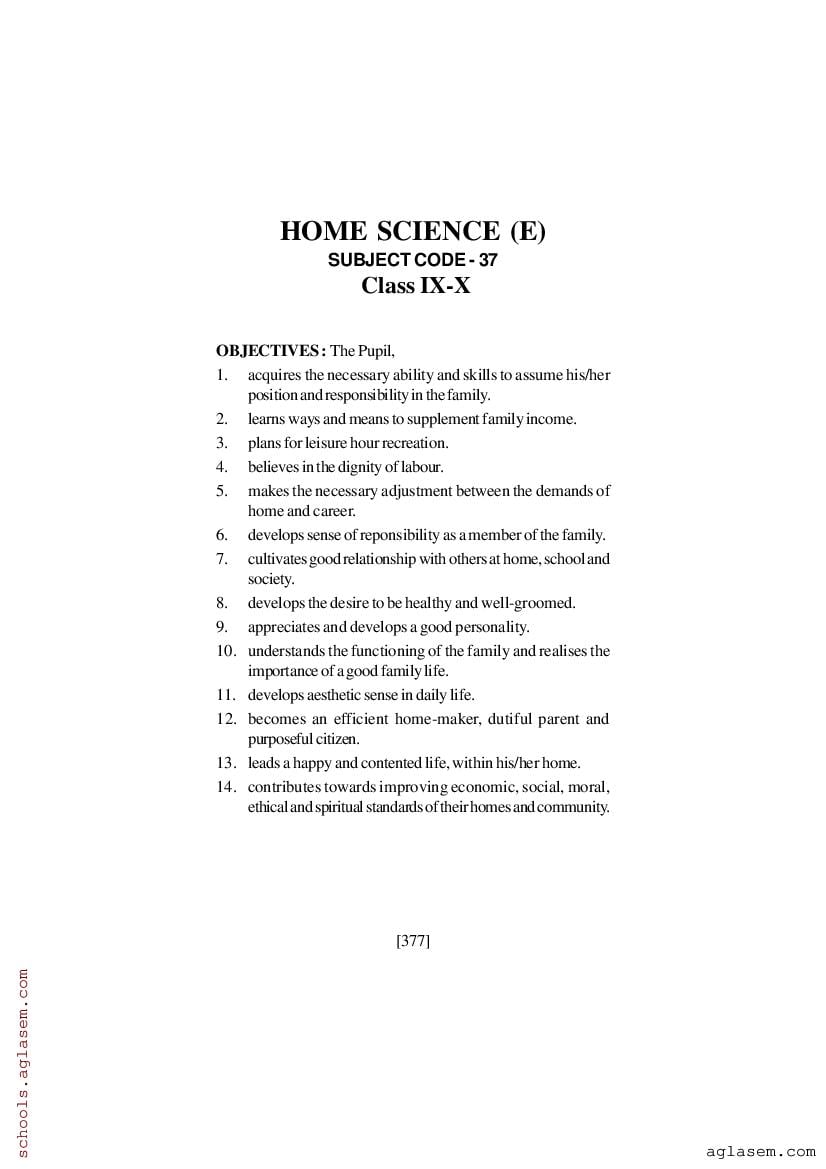
SUBJECT CODE - 37
Class IX-X
OBJECTIVES : The Pupil,
1. acquires the necessary ability and skills to assume his/her
position and responsibility in the family.
2. learns ways and means to supplement family income.
3. plans for leisure hour recreation.
4. believes in the dignity of labour.
5. makes the necessary adjustment between the demands of
home and career.
6. develops sense of reponsibility as a member of the family.
7. cultivates good relationship with others at home, school and
society.
8. develops the desire to be healthy and well-groomed.
9. appreciates and develops a good personality.
10. understands the functioning of the family and realises the
importance of a good family life.
11. develops aesthetic sense in daily life.
12. becomes an efficient home-maker, dutiful parent and
purposeful citizen.
13. leads a happy and contented life, within his/her home.
14. contributes towards improving economic, social, moral,
ethical and spiritual standards of their homes and community.
[377]
Page 2
SUBJECT CODE - 37
Class-IX Pass Marks : 21
Theory Paper, Marks-70 Time : 2 hours
Practical Paper Marks-30 Pass Marks : 9
THEORY
Chapter I : Introduction to Home Science Education : 10
1.01 : Meaning and importance of Home Science.
1.02 : History of Home Science Education in India.
1.03 : Objectives of Home Science Education.
1.04 : Different components of Home Science.
Chapter 2 : Food and Nutrition : 15
2.01 : Meaning and importance of Food and Nutrition. Study
of classification of food– Body building, Energy, giving,
protective and regulatory food. Functions of food.
2.02 : Introduction to different Nutrients Carbohydrate Protein,
Fats, Vitamins, Minerals and Water.
2.03 : Introduction to common food stuffs : cereals, pulses,
green leafy vegetables, fruits, meat, fish and eggs, milk
and milk products, spices and condiments etc.
2.04 : Introduction to cooking : Objectives of cooking, different
methods of cooking food - boiling, frying, deep frying,
shallow frying, roasting, baking, steaming, pressure
cooking, microwave cooking, solar cooking etc.
Chapter 3 : Child Development and Family studies : 15
3.01 : Introduction to child Development - Concept of growth
and development, principles of growth and development.
3.02 : Different phases of life - Prenatal, infancy, babyhood,
pre-school age, school age, adolescence-adulthood, old
[378]
Page 3
3.03 : Various aspects of growth and Development Physical,
Motor, Intellectual, Emotional, Social, Moral and
Language Development.
Chapter : 4 Clothing and Textile : 15
4.01 : Clothing and its importance
4.02 : Introduction to Textile fiber and their Classification -
Vegetable, Animal, and Mineral fibers, Man-made fibers.
4.03 : Study of Natural and Mineral-made fiber and its
properties.
4.04 : Common methods of fiber identification (Visual,
Microscopic and burning method.)
4.05 : Stain Removal (Principles and method of removing stains,
equipments and reagents required for stain removal).
Chapter : 5 . Family Resource Management : 15
5.01 : Introduction to Home management Meaning and
importance.
5.02 : Resource- Human and Non-Human.
5.03 : Study of common household equipment and their uses.
Refrigerator, Washing Machine, Mixer Grinder, Pressure
Cooker, Vacuum Cleaner, Microwave etc.
5.04 : Work simpification- its meaning and different ways of
work simplification.
5.05 : Household pest and their control- (mosquitoes,
cockroaches, bedbugs, rats, and flies.)
[379]
Page 4
1. Preparation of Khichari 15
Chana Dal
Veg. Curry
Pokoras - from vegetables/eatable
green leaves or flowers
Fruit juice
2. Preparation of project report on 5
topics related to course.
}
3. Common methods of fibre
identification - visual microscopic,
burning.
or
4. Removal of common stains - grease, 5
curry, blood, perspiration, mud,
lipstics, tea, ink etc.
or
5. Cleaning and polishing of - Brass,
silverware, copper, steel aluminium etc.
6. Practical note book 5
30
Marks Distribution of Practical :
Marks
Unit SUB-UNITS Half
Final
Yearly
1. Cookery 15 15
2. Project report/chart 5 5
3. Clothing & Textile
4.
Or
Home Management
} 5 5
5. Practical note book 5 5
Total : 30 30
[380]
Page 5
SUBJECT CODE - 37
Class-X Time : 3 hours
Theory Paper, Marks-70 Pass Marks : 21
Practical Paper Marks-30 Pass Marks : 9
Time : 2 hours
THEORY
Chapter-1 Food and Nutrition (Marks : 20)
1:01 Balance diet– meaning and its importance, Factors
to be considered in formulation of balanced diet,
age, sex, ocupation, income, family size, climatic
condition, activities, special condition.
1:02 Meal-planning–meaning, objectives and principles.
1:03 Deficiency diseases – Anaemia, Goitre, Scurvy,
Rickets, Beriberi, Pellegra, Nightblindness,
Kwashiorkor, Marasmus, Karatomalacia and their
preventive measures.
Chapter -2 Child-Development and Family Studies
(Marks: 20)
2:01 Beginning of life – conception, growth during
prenatal life.
2:02 Care of the pregnant mother and preparation for
child birth.
2:03 Care of the child – feeding, bathing, toilating,
weaning, supplementary food, clothing,
immunization, sleep and rest etc.
2:04 Breast milk – Advantages and disadvantages of
breast milk.
2:05 Child in the family – Role of parents in the family,
[381]
Page 6
emotional needs of the children.
Chapter-3 Clothing and Textile : (Marks: 15)
3:01 Laundering– Principles to be followed in laundering
of different textiles/articles. Im-portance of soft
water in laundering, methods of making hard water
soft.
3:02 Equipment for laundering, Soap and Detergents,
Bleaching, Stiffening agents.
3:03 Storage of cloths and its importance.
Chapter-4 Home Management (Marks: 15)
4:01 Principles of design– applicable to Interior
Decoration- Proportion, Balance, Rhythm,
Emphasis, Harmony
4:02 Colour Scheme– Primary colour, Secondary colour,
Intermediate or tertiary colour etc. Use of colours
in different rooms.
4:03 Selection, Care and Arrangement of furniture for
different rooms.
4:04 Principle and types of flower arrangement. The main
principles of flower arrangement, type of flower
arrangement.
4:05 Budget– meaning and its importance factors to be
considered for planning a budget, types of budget.
4:06 Savings and investment : Definition, differences
between one's earnings and expenditure. Income–
Expenditure, savings.
[382]
Page 7
Subject Code - 37 (P)
PRACTICAL
CLASS - X Marks: 30
1. Preparation of– (i) Pulao (ii) Paratha (iii) Poories (iv) Ghuguni
(v) Egg curry (vi) Vegetable chop/cutlet (vii) Jam/Jelly (viii)
Pud-ding/Halwa (Carrot or Suji)
2. Preparation of project report on topics related to the course
content of child development and family studies.
3. Preparation of samples of constructive/basic stitches– like–
Tuking, Running, Hemming, Back stitch.
Decorative Stitches like– Chain, Shadow, Feather, Heming,
Bone, Cross, Blanket, Bullion knot, French knot, Applique
etc. Mending, Patching, Darning, Stitching of Button and
Button holes, Hooks etc.
Demonstation on laundering and finishing of cotton silk,
woolen and Embroidered articles.
4. Drawing a colour wheel.
5. Arrangement of flowers– line arrangement, Mass arrangement
and combination of line and mass arrangement for different purpose.
6. Practical note book.
Marks Distribution of Practical :
Marks
Unit SUB-UNITS Half
Final
Yearly
1. Cookery 15 15
2. project report/chart 5 5
3.
4.
Clothing & Textile
Or
Home Management
} 5 5
5. Practical note book 5 5
Total : 30 30
Textbook : Griha Vigyan for class X, ASTPPC, Guwahati-1
[383]
Document Details
| Board / Org | Assam Board |
| Exam | Class 10 |
| Type | Syllabus |
| Pages | 7 |
| Updated | 22 Jul 2026 |