NEET Biology Question Bank - Cell Cycle and Cell Divisions
Finished viewing? Save it for later —
Download NEET Biology Question Bank - Cell Cycle and Cell Divisions (PDF · 18 pages)About NEET Biology Question Bank - Cell Cycle and Cell Divisions
NEET Biology Question Bank - Cell Cycle and Cell Divisions is available here for free download. Published by NTA for National Eligibility cum Entrance Test (Undergraduate), this question bank can be viewed online or downloaded as a PDF (18 pages). Candidates preparing for National Eligibility cum Entrance Test (Undergraduate) can use NEET Biology Question Bank - Cell Cycle and Cell Divisions to understand the exam pattern, the type of questions asked, and the overall difficulty level.
Frequently Asked Questions
How can I download NEET Biology Question Bank - Cell Cycle and Cell Divisions?
Open this page and click the Download button to save NEET Biology Question Bank - Cell Cycle and Cell Divisions as a PDF. It is completely free on AglaSem Docs.
Is NEET Biology Question Bank - Cell Cycle and Cell Divisions free to download?
Yes. NEET Biology Question Bank - Cell Cycle and Cell Divisions can be viewed online and downloaded as a PDF free of cost on AglaSem Docs.
How many pages does NEET Biology Question Bank - Cell Cycle and Cell Divisions have?
NEET Biology Question Bank - Cell Cycle and Cell Divisions contains 18 pages, which you can read online or download together as a single PDF.
Where can I find more National Eligibility cum Entrance Test (Undergraduate) study material?
You can find more National Eligibility cum Entrance Test (Undergraduate) question papers, sample papers, syllabus, and answer keys on AglaSem Docs.
NEET Biology Question Bank - Cell Cycle and Cell Divisions – Text
Read the full text of this question bank below — useful to quickly search, copy and reference the content online without downloading the PDF.
📄 View text version (18 pages)
Page 1
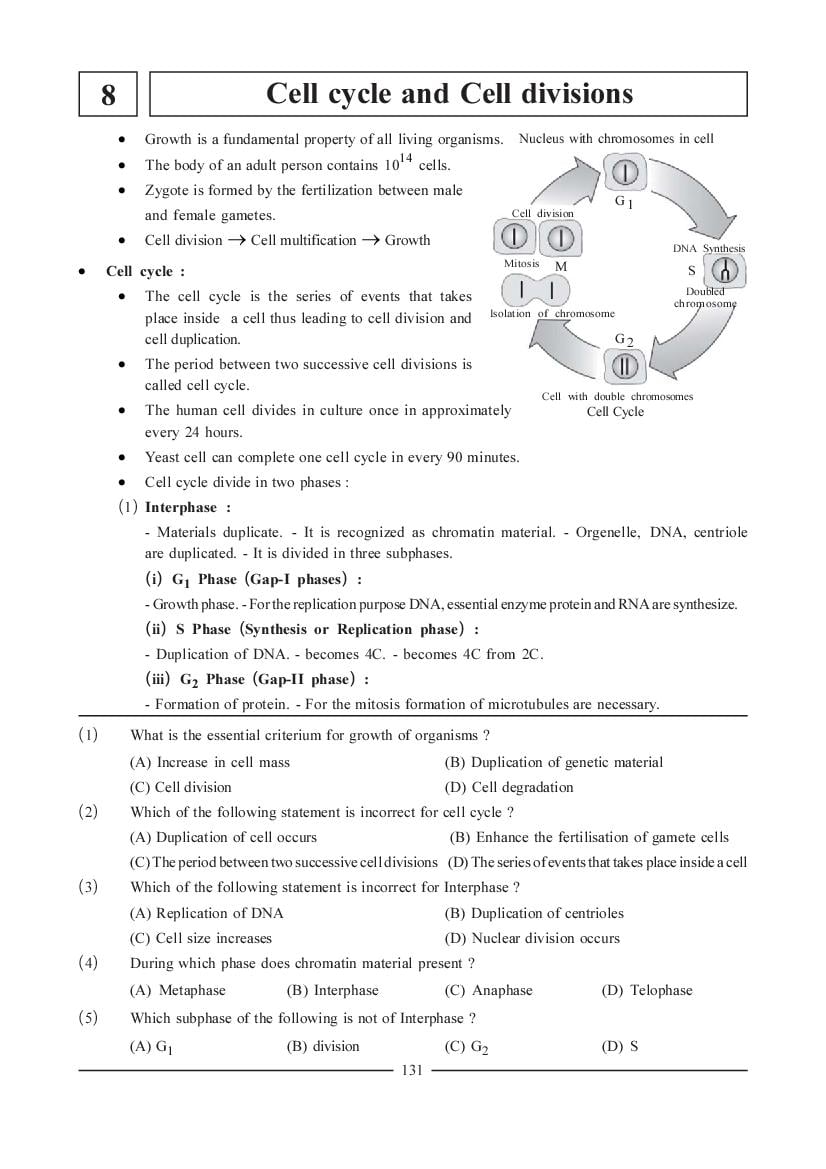
· Growth is a fundamental property of all living organisms. Nucleus with chromosomes in cell
14
· The body of an adult person contains 10 cells.
· Zygote is formed by the fertilization between male
G1
and female gametes. Cell division
· Cell division ® Cell multification ® Growth DNA Synthesis
Mitosis M
· Cell cycle : S
Doubled
· The cell cycle is the series of events that takes chromosome
place inside a cell thus leading to cell division and Isolation of chromosome
cell duplication. G2
· The period between two successive cell divisions is
called cell cycle.
Cell with double chromosomes
· The human cell divides in culture once in approximately Cell Cycle
every 24 hours.
· Yeast cell can complete one cell cycle in every 90 minutes.
· Cell cycle divide in two phases :
(1) Interphase :
- Materials duplicate. - It is recognized as chromatin material. - Orgenelle, DNA, centriole
are duplicated. - It is divided in three subphases.
(i) G1 Phase (Gap-I phases) :
- Growth phase. - For the replication purpose DNA, essential enzyme protein and RNA are synthesize.
(ii) S Phase (Synthesis or Replication phase) :
- Duplication of DNA. - becomes 4C. - becomes 4C from 2C.
(iii) G2 Phase (Gap-II phase) :
- Formation of protein. - For the mitosis formation of microtubules are necessary.
(1) What is the essential criterium for growth of organisms ?
(A) Increase in cell mass (B) Duplication of genetic material
(C) Cell division (D) Cell degradation
(2) Which of the following statement is incorrect for cell cycle ?
(A) Duplication of cell occurs (B) Enhance the fertilisation of gamete cells
(C) The period between two successive cell divisions (D) The series of events that takes place inside a cell
(3) Which of the following statement is incorrect for Interphase ?
(A) Replication of DNA (B) Duplication of centrioles
(C) Cell size increases (D) Nuclear division occurs
(4) During which phase does chromatin material present ?
(A) Metaphase (B) Interphase (C) Anaphase (D) Telophase
(5) Which subphase of the following is not of Interphase ?
(A) G1 (B) division (C) G2 (D) S
131
Page 2
(A) DNA synthesis (B) Production of micro tubules
(C) Enzyme, RNA, Protein synthesis (D) All of these
Answers : (1-C), (2-B), (3-D), (4-B), (5-B), (6-C)
· Mitosis :
· It is continuous process.
· But meant for easy understanding it is divided into four phases.
(1) Prophase :
- Condensation of chromosomes along their lengths.
- Nuclear membrane and nucleolus disintegrate.
(2) Metaphase :
- Chromosome is clearly observed under the microscope. - Structure of kinetochores are found.
- The line is referred as the equatorial plate or metaphase plate.
(3) Anaphase :
- The spindle fibers shorten. - Equal number of chromosomes on both polar ends.
- Division of centromere occur.
(4) Telophase :
- Formation of chromatin material. - Organelles are reestablished.
- Formation of new nucleus.
Cytokinesis :
· It is not a part of mitosis but it is a separate process that completes the entire process of cell division.
· In an animal cell it takes place from the peripheral region.
· In plant cell it take place from the centre to peripheral region.
· In plant cell middle lamella made up of pectin and cell wall develops around it.
· In some organisms karyokinesis does not take place as a result multinucleate condition arises
leading to the formation of syncytium.
· Significance of Mitosis :
(a) Inter phase (G2) (b) Early prophase (c) Late prophase (d) Metaphase
· Multicellular body is developed. Centriole Centriole Kinetochore
· Occurrence of asexual reproduction
two daughter organisms arises.
· The number of chromosomes Grand
daughter
is maintained in all cells. chromatids
(e) Anaphase (f) Telophate (g) Inter phase (G1)
· Cells are made available
for growth and development.
· A very significant contribution
of mitosis is cell repair Cleavage
· Mitotic divisions in the apical furrow
and lateral meristem result in
continuous growth in the plants.
132
Page 3
(A) G1 - S - G2 - G2 - M
(B) Prophase - metaphase - anaphase - telophase
(C) anaphase - metaphase - telophase
(D) leptotene - zygotene - pachytene - diplotene
(8) Which of the following process is not involved in prophase ?
(A) the condensation of chromosomes along their lengths (B) bipolar spindle is developed
(C) nuclear membrane and nucleolus disintegrate (D) production of equatorial plate
(9) During which phase condensation of chromosomes is completed and they can be seen clearly ?
(A) Anaphase (B) Prophase (C) Metaphase (D) Telophase
(10) Structures serve as the site of attachment of spindle fibers to the centromere of the chromosomes.
(A) Kinetochores (B) Centromere (C) Metaphase plate (D) All of these
(11) Which of the following process is involved in anaphase ?
(A) Chromosome produces equatorial plate.
(B) Chromosome converts into chromatin.
(C) Centromere splits, will separate and start moving to the opposite poles of the cell.
(D) Chromosomes spread in the entire cell area.
(12) How does the metaphase differ from anaphase ?
(A) Chromatids having centromere (B) For chromatin
(C) Condensation of spindle fibres and the centromere splits and will separate
(D) All of the above.
(13) During which phase of mitosis chromatin network is observed ?
(A) Anaphase (B) Metaphase (C) Prophase (D) Telophase
(14) Cytokinesis means ......... .
(A) Last stage of cell division
(B) Stage of duplication of cellular material
(C) a separate process that completes the entire process of cell division
(D) All of these
(15) Syncytium means ......... .
(A) Cytokinesis (B) Multinucleate condition (C) Metaphase plate (D) Kinetochores
(16) How does cytokinesis begin in higher plants ?
(A) Separation of the cytoplasm from the centre to the periphery
(B) Separation of the cytoplasm from the periphery to centre region
(C) At any plate (D) All of these
(17) Select incorrect pair :
(A) Prophase : Chromosome made up of two charomatids and a centromere holding them together.
(B) Metaphase : Chromosome can be seen clearly.
(C) Anaphase : Chromosome are arranged at the equatorial plate in the middle of the cell.
(D) Telophase : Nuclear membrane, golgi complex are reformed.
(18) Select the correct pair :
(A) Syncytium - nuclear cell division (B) Metaphase plate - telophase
(C) Recombination - anaphase (D) Bipolar spindle - metaphase
(19) A very significant contribution of mitosis is cell repair. Because...
(A) The number of chromosomes is maintained in all cells.
(B) By asexual reproduction produce two new progeny cells.
(C) The cells of lining of the gut and blood cells are constantly replaced.
(D) Cells can maintain their efficient size.
133
Page 4
(A) Meristematic tissue (B) Complex tissue (C) Permanent tissue (D) All of these
(21) Mitotic divisions in ........ result in continuous growth in the plants.
(A) simple permanent tissue (B) apical meristematic tissue
(C) lateral meristematic tissue (D) B and C
(22) By which process the number of chromosomes is maintained in cells ?
(A) Mitosis (B) Amitosis (C) Meiosis (D) Meiotic division
(23) During cytokinesis middle lamellae is made up of ........ in Sequoia.
(A) cellulose (B) lignin (C) chitin (D) pectin
(24) What is formed on both the sides of middle lamella in angiosperm plants ?
(A) Cytoplasm membrane (B) Tonoplast (C) Cell wall (D) Lipid layer
(25) The formation of syncytium leading because...
(A) Nuclear cytokinesis is not followed. (B) Absence of telophase
(C) Karyokinesis is not followed by cytokinesis (D) Multinucleate condition arises
(26) How many animal cells are reproduced at the end of mitosis ?
(A) 2 (B) 4 (C) 3 (D) 1
Answers : (7-B), (8-D), (9-C), (10-A), (11-C), (12-C), (13-D), (14-C), (15-B), (16-A), (17-C),
(18-A), (19-C), (20-A), (21-D), (22-A), (23-D), (24-C), (25-C), (26-A)
· Meiosis : Meiosis
· During formation of reproductive cells meiotic cell
devision occurs.
Replication of
· During meiosis the genetic material is replicated once, Meiotic DNA and
whereas the cell divides twice. division-I Recombination
( 1 ) Meiosis-I (Reduction phase) :
- First division
Cell
- Half the number of chromosomes
division-I
( 2 ) Homotypic division-II (Equational phase) :
Meiotic
- Second division division-II
- Maintain the number of chromosome
Cell
· Meiosis-I (Reduction phase) : It has four phases : division-II
(i) Prophase-I It is divided into five substages.
(a) Leptotene :
- Initial stage
- Condensed chromosome
- Two chromatids and a centromere
(b) Zygotene : (c) Pachytene :
- Synapsis occur - Appear as tetravalent
- Process progress in a zipper fashion - Formation of recombination nodules (Chiasmata)
- Structure can be understood by electron micrographs - Where as exchange of genes occur it is known as crossing over
134
Page 5
- Homologous chromosomes start moving - Condensation complete
away from one another - Bipolar spindle fibreforms
- The number of chiasmata depends - Nucleolus and Nuclear membrane
on the length of chromosomes. disappears
(ii) Metaphase-I : Pairs of homologous chromosomes become arranged at the equatorial plane.
(iii) Anaphase-I : Chromosomes of a homologous pair move away towards their respective pole.
Thus, at the end of this phase, half the number of total chromosomes are collected at each pole.
(iv) Telophase-I : Nuclear membrane and nucleolus are reformed.
· The stage between two meiotic stages is called interkinesis.
· Meiosis-II (Equational division)
· Replication of genetic material does not occur.
· Divided in four stages.
(1) Prophase-II : Reformation of bipolar spindle fibres. The chromosomes again become compact.
(2) Metaphase-II : Formation of equatorial plane.
(3) Anaphase-II : Centromere splits..
- Centromere of two chromatids of a chromosome migrate towards opposite poles.
- Same as the number of chromosomes in parent cell.
(4) Telophase-II : Reformation of nucleolus, nuclear membrane.
· Significance of meiosis :
· Definite number of chromosomes is maintained in organisms from generation to generation.
· Due to crossing over, meiosis provides an opportunity for the exchange of genes and thus
causes the genetic variations among species.
· It is important process for evolution.
(27) How many times cell divides in meiosis ?
(A) 1 (B) 2 (C) 3 (D) 4
(28) Meiosis division means....
(A) the cells must be half in numbers.
(B) the number of chromosomes in the new cells are half at time of cell division.
(C) size of the cells are half. (D) All of these
(29) Mitosis means...
(A) the cells must be half in numbers.
(B) the number of chromosomes is maintained the same in new cells.
(C) the number of nucleus is maintained the same in new cells.
(D) the number of bipolar spindles is maintained the same in new cells.
(30) How many cells are produced at the end of meiosis ?
(A) 2 (B) 1 (C) 8 (D) 4
(31) How many stages are there in Meiosis - I ?
(A) 4 (B) 9 (C) 8 (D) 2
135
Page 6
(A) appearance of recombination nodules.
(B) chromatids clearly appears as tetrads.
(C) gene exchange occurs at the location of Chiasmata.
(D) chromosomes start pairing together along their length.
(33) At what phase the process progresses in a zipper fashion ?
(A) Pachytene (B) Diplotene (C) Zygotene (D) Dikinesis
(34) During pachytene stage...
(A) chromatids of chromosomes are twined around one another.
(B) appearance of Chiasmata.
(C) exchange of genes, occurs at various places along their length due to crossing over.
(D) All of these
(35) The chronological sequence of stages in prophase-I of meiosis is...
(A) Leptotene ® Pachytene ® Zygotene ® Diplotene ® Dikinesis
(B) Leptotene ® Zygotene ® Pachytene ® Diplotene ® Dikinesis
(C) Zygotene ® Leptotene ® Pachytene ® Dikinesis
(D) Leptotene ® Pachytene ® Zygotene ® Diplotene ® Dikinesis
(36) In which of the following stage chromosome appears filamentous ?
(A) Leptotene (B) Dikinesis (C) Diplotene (D) Pachytene
(37) Interkinesis means ...
(A) The period between two cell cycle.
(B) The stage between interphase and mitosis stage.
(C) The stage between two meiotic stage.
(D) The stage between mitosis and cell cycle.
(38) Intrameiotic interphase means...
(A) Synapsis (B) Crossing over (C) Interkinesis (D) Syncytium
(39) During meiosis chiasmata are observed at ....
(A) Zygotene (B) Pachytene C) Diplotene (D) Dikinesis
(40) The number of chiasmata depends upon....
(A) length of chromosome. (B) numbers of chromosome.
(C) numbers of gene. (D) exchange of gene.
(41) Which is the specific place for gene exchange ?
(A) Zipper (B) Chiasmata (C) Bipolar spindle (D) Equatorial plate
(42) Crossing over means...
(A) duplication of gene. (B) distribution of gene. (C) exchange of gene. (D) division of gene.
(43) During which phase condensation of chromosome is completed ?
(A) Metaphase - I (B) Prophase - I (C) Dikinesis (D) Diplotene
136
Page 7
(A) Exchange of gene (B) Complete condensation of chromosome
(C) Chromosome changes place (D) Nucleolus disappears and nuclear membrane
(45) In which direction centromere of chromosome is located at equatorial plate ?
(A) Poles of a cell (B) North pole (C) South pole (D) None of these
(46) At which stage the half the number of chromosomes than parent cell are collected ?
(A) Metaphase-II (B) Metaphase-I
(C) Anaphase-II (D) Anaphase-I
(47) Which of the following stage is not proper for prophase-I ?
(A) Leptotene (B) Diplotene (C) Dikinesis (D) Interkinesis
Answers : (27-B), (28-B), (29-B), (30-D), (31-A), (32-D), (33-C), (34-D), (35-B), (36-A), (37-C),
(38-C), (39-B), (40-A), (41-B), (42-C), (43-A), (44-D), (45-D), (46-D), (47-D)
· Differences between Mitosis and Meiosis :
Mitosis Meiosis
(1) It occurs in somatic cell It occurs in formation of reproductive cells
(2) End of the division two daughter cells are formed End of the division 4 daughter cells formed
(3) A mitotic mother cell can either be haploid or diploid A meiotic mother cell is always diploid
(4) Number of chromosomes per nucleus remains the same Number of chromosomes are half than the original mother cell
(5) No pairing of homalogous chromosomes Pairing of all homologous chromosomes take place
(6) No crossing over take place Occurrence of crossing over
(7) Centromere spits during anaphase The centromeres do separate during
anaphase-II, but not during anaphase-I
(8) The genotype of the daughter cells is identical to Meiotic products differ in their genotype from
that of the mother cells the mother cell
(48) Which of the following statement is true for meiosis ?
(A) Formation of two new daughter cells at the end of the process.
(B) Prophase is short and easy.
(C) Once duplication of genetic material and twice cell division.
(D) Cells are made available for growth and development.
(49) Mitosis differs from meiosis in :
(A) based on number of chromosomes (B) based on number of cells
(C) based on stages of divisions (D) All of these
(50) Which type of gametes are produced by meiosis of diploid mother cell ?
(A) 2n (B) n (C) 3n (D) 4n
(51) Find out, incorrect statement for meiosis.
(A) A meiotic mother cell is always haploid.
(B) The genotype of the daughter cells is identical to that of the mother cells.
(C) In a meiotic daughter cell, chromosome is always haploid.
(D) Each daughter cell has exactly same DNA strands.
137
Page 8
(A) During prophase homologous chromosomes start pairing.
(B) A mother cell can either be haploid or diploid.
(C) At anaphase stage centromere of each chromosome divides.
(D) The genotype of the daughter cells is identical.
(53) For which of the following mitosis and meiosis are similar ?
(A) For number of chromosomes in daughter cell
(B) For the genotype of daughter cells
(C) For the amount of DNA which becomes double in synthesis phase
(D) For pairing of homologous chromosomes
Answers : (48-C), (49-D), (50-B), (51-A), (52-A), (53-C)
· True - False (T - F) type questions :
Choose the correct option for true-false :
(54) (1) The number of chiasmata depends on the number of chromosomes.
(2) In telophase-I, Each nucleus contains half as many chromosomes as were present in the
parental cell.
(3) Cytokinesis connects each nucleus from the other.
(4) Similarity of the gene occurs at the location of chiasmata.
(A) F, F, T, T (B) F, T, F, F (C) F, T, T, F (D) T, T, T, F
(55) (1) Electron micrographs of this stage indicate that chromosome synapsis is accompanied by the
formation of complex structure called synaptonemal complex.
(2) Dikinesis is the first stage of the homologous pair move away from each other.
(3) Pachytene stage is characterized by apperance of recombination nodules (Chiasmata).
(4) In the period between two meiotic divisions no replication occurs.
(A) T, F, T, T (B) T, T, T, T (C) T, F, F, F (D) F, T, T, F
(56) (1) In meiosis meiotic product is idnetical to that of the mother cells.
(2) After mitosis, each daughter cell has exactly same DNA strands.
(3) Homologous chromosomes are responsible at crossing over.
(4) A meiotic mother cell can either be haploid or diploid.
(A) F, T, F, T (B) T, F, F, T (C) F, T, T, F (D) T, F, T, F
(57) (1) Haploid gemetes are produced by meiosis.
(2) The cells of upper layer of epidermis are replaced in Meiotic division.
(3) Prophase-I of Meiosis is long and complex.
(4) An organism beginning as a single cell develops its multicellular body.
(A) F, T, T, F (B) F, T, T, T (C) T, F, F, T (D) T, F, T, T
(58) (1) Asexual reproduction is indication of Mitosis.
(2) In animal cell constriction of cytoplasm begins from the peripheral region at the cell.
(3) When the centromere splits, the paired chromosomes will separate.
(4) Condensation of chromosomes is completed and it cannot be seen clearly under the microscope.
(A) T, T, F, F (B) F, F, T, T (C) T, T, T, F (D) F, T, F, T
138
Page 9
(2) In S-phase proportion of DNA is 4C.
(3) The mitosis process is a continuous one.
(4) In the G1 phase DNA replication occurs.
(A) F, T, T, F (B) T, T, F, F (C) T, T, T, F (D) T, F, F, T
(60) (1) In interphase chromosomes can not be observed as they are highly dispersed.
(2) Yeast cell can complete one cycle in 60 minutes.
(3) Cell cycle is the time period between Interpase and cell division.
(4) A nucleous develops on the nucleolar organizer region of a specific chromosome.
(A) T, F, F, T (B) F, T, F, T (C) F, T, T, T (D) T, F, T, T
Answers : (54-B), (55-A), (56-C), (57-D), (58-A), (59-C), (60-A)
· A - Assertion, R - Reason types questions :
Choose the correct option from following for each questions.
(A) Both A and R are true and R is correct explanation of A.
(B) Both A and R are true and R is not correct explanation of A.
(C) A is true and R is wrong.
(D) A is wrong and R is true.
(61) Assertion A : Meiotic products differ in their genotype from the mother cell.
Reason R : In pachytene stage crossing over that is exchange of genes, occurs.
(A) (B) (C) (D)
(62) Assertion A : In meiosis, only meiosis-I is preceded by a S-phase.
Reason R : During meiosis the DNA is replicated once, whereas the cell divides twice.
(A) (B) (C) (D)
(63) Assertion A : A meiotic mother cell is always haploid.
Reason R : In mitotic, there is no pairing of homologous chromosomes.
(A) (B) (C) (D)
(64) Assertion A : One single division of the mother cell results in two daughter cells.
Reason R : In meiosis, the cell divides twice.
(A) (B) (C) (D)
(65) Assertion A : Meiosis cause the genetic variation among species.
Reason R : Gene exchange occurs at the location of chiasmata.
(A) (B) (C) (D)
(66) Assertion A : Meiosis is important process for evolution.
Reason R : Meiosis maintains the genotype of the daughter cells identical to that of the
mother cells
(A) (B) (C) (D)
139
Page 10
Reason R : The process of synapsis progresses in a zipper fashion.
(A) (B) (C) (D)
(68) Assertion A : Anaphase, anaphase-I, and anaphase-II are similar process.
Reason R : Equatorial plate means the spindle fibres attach themselves to the centromere of
the chromosomes and align them along the middle of the cell.
(A) (B) (C) (D)
(69) Assertion A : Meiosis follows interphase.
Reason R : In heterotypic division, the chromosomes are distributed in two cells in half, their
number.
(A) (B) (C) (D)
(70) Assertion A : Very significant contribution of mitosis is cell repair.
Reason R : Blood cells must be replaced constantly.
(A) (B) (C) (D)
(71) Assertion A : In animal cells, a plate called middle lamella, gradually develops from centre
towards periphery of the cell.
Reason R : Middle lamella is made up of pectin.
(A) (B) (C) (D)
(72) Assertion A : In telophase-I the chromosomes are not seen as chromatin.
Reason R : Chromosomes can be observed as they are highly dispersed during interphase.
(A) (B) (C) (D)
(73) Assertion A : During S stage of interphase centrosome duplicates.
Reason R : Bipolar spindle is made up of cytoplasmic fibres of proteins.
(A) (B) (C) (D)
Answers : (61-A), (62-A), (63-D), (64-B), (65-A), (66-C), (67-B), (68-D), (69-A), (70-A), (71-D),
(72-A), (73-B)
(74) Match the following :
Column - I Column - II
(i) Mitosis (p) Synapsis (A) i - r, ii - s, iii - q, iv - p
(ii) Reduction division (q) Meiosis-II (B) i - r, ii - q, iii - p, iv - s
(iii) Equational division (r) asexual reproduction (C) i - q, ii - s, iii - r, iv - p
(iv) Zygotene (s) heterotypic division (D) i - q, ii - r, iii - p, iv - s
(75) Match the following :
Column - I Column - II
(i) Prophase (p) the spindle fibres shorten (A) i - p, ii - s, iii - r, iv - q
(ii) Mitosis (q) organelles reforms (B) i - r, ii - s, iii - p, iv - q
(iii) Metaphase (r) bipolar spindle develops (C) i - r, ii - p, iii - q, iv - s
(iv) Telophase (s) formation or equatorial plate (D) i - p, ii - q, iii - r, iv - s
140
Page 11
Column - I Column - II
(i) Zygotene (p) bivalent chromosomes appears tetravalent
(ii) Pachytene (q) nucleolus disappears
(iii) Dikinesis (r) chromosomes start pairing together along their length
(iv) Diplotene (s) chromosomes start moving away from one another
(A) i - p, ii - r, iii - q, iv - s (B) i - p, ii - q, iii - r, iv - s
(C) i - r, ii - p, iii - q, iv - s (D) i - r, ii - q, iii - s, iv - p
(77) Match the following :
Column - I Column - II
(i) Anaphase - II (p) chromosomes expands
(ii) Anaphase - I (q) chromosome is made up of two chromatids
held together by a centromere
(iii) Telophase - II (r) each chromatid has independent centrosome
(iv) Telophase - I (s) chromosomes of a homologous pair move away
towards their respective poles
(A) i - s, ii - r, iii - q, iv - p (B) i - r, ii - s, iii - q, iv - p
(C) i - s, ii - r, iii - p, iv - q (D) i - r, ii - s, iii - p, iv - q
(78) Match the following :
Column - I Column - II
(i) Prophase - I (p) takes place within somatic cells
(ii) Anaphase - II (q) takes place within gametic cells
(iii) Meiosis (r) pairs of homologous chromosomes arranged
(iv) Mitosis (s) centromere divides
(A) i - r, ii - s, iii - q, iv - p (B) i - s, ii - r, iii - q, iv - p
(C) i - s, ii - q, iii - r, iv - p (D) i - p, ii - r, iii - s, iv - q
(79) Match the following :
Column - I Column - II
(i) G2 phase (p) consists two distinct but integrated activities
(ii) S stage (q) biosynthetic stage
(iii) G1 stage (r) Later the cell enters mitosis
(iv) M stage (s) chromosomes replicated and they all have
two sister chromatids
(A) i - q, ii - s, iii - p, iv - r (B) i - r, ii - s, iii - q, iv - p
(C) i - r, ii - p, iii - q, iv - s (D) i - p, ii - r, iii - s, iv - q
(80) Match the following :
Column - I Column - II
14
(i) Yeast cell division (p) 10 (A) i - r, ii - s, iii - p, iv - q
(ii) Human cell division (q) 5 (B) i - r, ii - p, iii - s, iv - q
(iii) Human cell number (r) 90 min (C) i - p, ii - r, iii - s, iv - q
(iv) Substages of prophase (s) 1440 min (D) i - p, ii - s, iii - r, iv - q
Answers : (74-A), (75-B), (76-C), (77-D), (78-A), (79-B), (80-A)
141
Page 12
(A) cell division, isolation of chromosomes
b G1
(B) duplication of chromosomes, isolation of chromosomes
M (C) cell division, n
S
(D) replication of DNA, cell division
a
G2
(82) What indicates 'a', 'b' and 'c' ? G1
(A) DNA synthesis, cell having duplicated chromosome, a
M S
isolation of chromosome
(B) Duplication of chromosome, cell division, isolation of chromosome
G2
(C) DNA Synthesis, RNA Synthesis, Mitosis
c
(D) S stage, cell division, isolation of chromosome b
(83) Identify the given figure ?
(A) Stages of cell division
(B) Stages of cell cycle
(C) Stages of interphases
(D) Stages of meiosis
a
(84) What indicates a, b and c ?
(A) Cycle begins, cell grows, cell devides whether to continue
(B) Resting phase, cell devides whether to continue, cell prepares to devide
(C) Cell grows, cell devides whether to continue, DNA replication
b
c
(D) Cycle begins, cell grows, DNA replication
(85) Which stage is shown by given figure ? (86) Which stage is shown by given figure ?
(A) Interphase (A) Metaphase
(B) Prophase (B) Interphase
(C) Late Prophase (C) Late prophase
(D) Early Prophase (D) Early prophase
(87) What indicates 'a' in figure ? (88) What indicates 'a' in figure ?
(A) Kinetochores (A) Centrosome
(B) Centrosome a (B) Kinetochores a
(C) Sister chromatids (C) Sister chromatids
(D) Spindle poles (D) Spindle poles
142
Page 13
(A) transeverse furrow
(B) longitudinal furrow
(C) cleavage furrow a
(D) divisional furrow
(90) Which stage is shown by given figure ?
(A) Interphase
(B) Metaphase
(C) Late prophase
(D) Early prophase
(91) Which stage is shown by given figure ?
(A) G1
(B) G2
(C) Anaphase
(D) Telophase
(92) Which stage is shown by given figure ?
(A) G2
(B) G1
(C) Metaphase
(D) Telophase
(93) Which stage is shown by given figure ?
(A) G1
(B) G2
(C) Early prophase
(D) Telophase
(94) Which of the following figure indicates late phase of prophase ?
(A) (B) (C) (D)
(95) Which of the following figure indicates telophase ?
(A) (B) (C) (D)
143
Page 14
a
(A) Meiosis-II, Cell division-II
b
(B) Meiosis-I, Cell division-I
(C) Meiosis, DNA replication
(D) Meiosis-II, Recombination of DNA
(97) Which substage of prophase-I is shown in given diagram ?
(A) Zygotene (B) Pachytene
(C) Diplotene (D) Leptotene
(98) Choose the diagram which correctly shows the pachytene substage ?
(A) (B) (C) (D)
(99) Choose the diagram which correctly shows the zygotene substage ?
(A) (B) (C) (D)
(100) Which substage is indicated in given diagram ?
(A) dikinesis (B) diplotene
(C) leptotene (D) pachytene
Answers : (81-D), (82-A), (83-B), (84-C), (85-A), (86-D), (87-C), (88-A), (89-C), (90-B), (91-C),
(92-D), (93-A), (94-B), (95-A), (96-A), (97-D), (98-C), (99-A), (100-D)
· Questions for NEET :
(101) Meiosis-II Shows...
(A) Isolation of sex chromosomes (B) Synthesis of DNA and centromere
(C) Isolation of homologous chromosome (D) Separation of chromatids
(Hint: To maintain the haploid number chromatids are separated.)
(102) Which is the best stage for observing number of chromosomes, size and shape ?
(A) Interphase (B) Metaphase (C) Prophase (D) Anaphase
(103) Meiosis is important for evolution, what is true for its result ?
(A) The genotype of the daughter cells is identical. (B) Mother cells results in four daughter cells.
(C) Ovules and sperms are produced. (D) Recombination occurs.
(Hint : During meiosis crossing over that is exchange of genes occurs)
144
Page 15
What is it called ?
(A) Transformation (B) Chiasmata (C) Crossing over (D) Synapsis
(105) In which stage DNA replication occurs in cytoplasm ?
(A) G1 (B) G2 (C) Metaphase (D) S Stage
(106) During which stage lempbrush chromosomes are formed ?
(A) Prophase (B) Diplotene (C) Metaphase-I (D) Interphase
(Hint : Lemp brush chromosomes are long dimicrotic chromosomes formed during diplotene stage,
which are joined by chiasmata.)
(107) What happens when colchicine is added in haploid cell during diploid condition ?
(A) Inhibits mitosis (B) Inhibits formation of mitotic spindles
(C) DNA duplicates (D) Inhibits formation of centromere
(Hint : Colchicine stops the spindles)
(108) Which of the following organelle is absent in mitotic cells of higher plants ?
(A) Cell plate (B) Centrosome (C) Centromere (D) Spindle fibre
(Hint : Centromere is absent in plant cell.)
(109) Meiosis-I is heterotypic division and Meiosis-II is homotypic division why ?
(A) Pairing of homologous chromosomes (B) Crossing over occurs
(C) Separation of chromatids (D) It is the process of separation of homologous chromosomes
(Hint : Meiosis-II is equational division in which separation of chromatids of cromosome.)
(110) In which stage mendlian factor (Aa) is segregrated ?
(A) Diplotene (B) Anaphase-I
(C) Zygotene (D) Anaphase-II
(Hint : Mendelian segregration means separation of homologous chromosomes and only one
chromosome from homologous chromosome enters in zygote.)
(111) How mother cells differ from daughter cells ?
(A) Segregration, independent, dominance, crossing over (B) Segregration, crossing over
(C) Independent, dominance, crossing over (D) Segregration and independent dominance
(Hint : Due to independent assortment and crossing over in meiosis diversity occurs)
(112) What is the number of chromatids in mitosis ?
(A) two in both meiosis and mitosis (B) two in mitosis and one in meiosis
(C) two in mitosis and four in meiosis (D) one in mitosis and two in meiosis
(113) How anaphase differs from methaphase in mitosis ?
(A) Same numbers of chromosomes and chromatids.
(B) Half the numbers of chromosomes and chromatids.
(C) Half the numbers of chromosomes and same the numbers of chromatids.
(D) Same number of chromosomes and half the numbers of chromatids.
(Hint: In anamephase of mitosis chromatids of chromosome are separated to each other and
move at opposite polar region.)
145
Page 16
(A) 7 (B) 14 (C) 28 (D) 64
(Hint : During mitosis from one mother cell results in two daughter cells)
(115) During cell division nucleus of apical meristem tissue are seen ?
(A) Metaphase (B) Anaphase (C) Telophase (D) Cytokinesis
(Hint : During the telophase organelles are formed.)
(116) Role of microtubules...
(A) Cell division (B) Muscle contraction (C) Membrane structure (D) To decide DNA
(Hint : Spindle fibres responsible for cell division are made up of microtubules)
(117) If there are 105 cells / ml in a medium in which 175 cells grow in every 35 minutes, How many
cells will be there after 175 minutes ?
(A) 5 ´ 105 cells (B) 35 ´ 105 cells (C) 32 ´ 105 cells (D) 175 ´ 105 cells
(Hint : 175 / 35 minutes = number of cells which divides = (2)5 ´ 105 = 32 ´ 105 )
(118) Give the name of the structure serve as the sites of attachment of spindle fibers during cell division.
(A) Chromocentre (B) Kinetochore (C) Centriole (D) Chromomere
(Hint : Kinetochore is protein coated layers which is connected with spindle fibre.)
(119) Which is the best material to study mitosis in laboratory ?
(A) Anther (B) Root apex (C) Leaf apex (D) Ovary
(120) What will happen if diploid cell is treated with colcichine ?
(A) Triploid (B) Tetraploid (C) Diploid (D) Haploid
(Hint : Colcichine stops formation of spindles when colcichine is given to diploid cell it duplicates.)
(121) In somatic cell cycle...
(A) DNA duplicates than that of mother cell in G1 phase.
(B) DNA synthesis occurs in S stage.
(C) Interphase shortened.
(D) Interphase duplicates.
(122) If you have given a root apex of onion and it is said to count chromosomes. Which is the best
stage to observe them ?
(A) Metaphase (B) Telophase (C) Anaphase (D) Prophase
(123) At which stage synthesis of histone protein occurs in eukaryotic cell ?
(A) G2 phase (B) S phase (C) Prophase (D) Telophase
(Hint : During S stage DNA synthesis occurs it is also known as histone protein synthesis.)
(124) Which of the following is related with the formation of nuclear membrane during M-Phase of
cell cycle ?
(A) Thickness of chromosomes decreases and formation of nuclear membrane.
(B) Transcription of chromosomes and formation of nuclear membrane.
(C) Formation of contractile ring and nuclear membrane.
(D) Formation of contractile ring and transcription of chromosomes.
(Hint : In telophase nuclear membrane formation occurs through transcription of chromosomes)
146
Page 17
(A) C - Nuclear division (B) D - Synthesize stage
(C) A - Cytoplasm division (D) B - Metaphase
(126) Space is present between...
(A) m - RNA and ribosomes (B) Two homologous chromosomes
(C) Spindle fibre and centromere (D) Male and Female gametes
(127) At which stage of mitosis nucleolus and endoplasmic recticulum starts to disappear ?
(A) Late prophase (B) Early metaphase (C) Late metaphase (D) Early prophase
(128) What is indicated by 'a' and 'b' in given figure of cell division ?
a b
(A) metaphase, telophase (B) telophase, metaphase
(C) Early prophase, Telophase (D) prophase, anaphase
(129) Choose the correct option for mitosis.
(A) In anaphase, chromatids are independent or arranged in the centre of the cell.
(B) In telophase chromatids move towards their respective pole.
(C) At the end of prophase golgibody and endoplasmic reticulum appears.
(D) In metaphase spindle fibres are removed from chromosomes by imaging line.
(Hint : During mitosis chromosomes moves towards equatorial region and during metaphase
arranges on equatorial plate.)
(130) During which stage of meiosis homologous pair of chromosomes separates and chromatids are
attached with centromere ?
(A) Metaphase-I (B) Metaphase-II
(C) Anaphase-I (D) Anaphase-II
(Hint : In anaphase-I along with condensation of bipolar spindle chromosomes of homologous pair
move towards their respective poles and chromatids are attached with centromere.
Answers : (101-D), (102-B), (103-D), (104-C), (105-D), (106-B), (107-B), (108-B), (109-C),
(110-B), (111-A), (112-A), (113-D), (114-A), (115-C), (116-A), (117-C), (118-B), (119-B), (120-B),
(121-B), (122-A), (123-B), (124-B), (125-B), (126-C), (127-D), (128-C), (129-D), (130-C)
147
Page 18
- Non dividing phase / Preparatory phase / Energy phase
® - Also called intermitosis
(G1 Phase)
® - Period of maximum growth At the end of this phase, cell reaches antephase (Bullough,
- Take place at the end of all division 1952) where it will divide under unfavourable conditions
- RNA and Protein synthesis having abundant storage of energy in the form of ATP.
- Duration varies from cell to cell
(S-Phase)
After duplication, chromosome of a pair is called
® - Also called synthetic phase chromatids. Pairs are joined by the centromere.
- DNA Replication
- Duration 7 hours
(G2 Phase) ® Karyokinesis
Cell Cycle
- DNA synthesis stops (Nuclear division)
® - Macromolecules synthesis occurs in
® Prophase After division
- Nuclear volume increases 4 main ® Metaphase daughter
- Duration : 2 to 5 hours steps ® Anaphase cells enter
® Telophase
Involves two ¯ ¯
(M-Phase) types of ® Cytokinesis Eithter in Or in
® (Cytoplasmic
Actual dividing phase divisions G1 phase G0 phase
division) (stage when
ell cyele is
arrested)
Mammalian cartilage Occurs in ® Plant cell by cleavage
diseased cells ® (M-Phase)
and cell plate formation
Paramlecium, etc. Mitosis
It is an equational Animal cell by cleavage
® Somatic ® division in which parent ® and cell plate formation
¯ cells cell divides into 2
identical daughter cells
Amitosis
¯
Meiosis - Lajtha, 1963 introduced the
- Also called direct cell
It is reduction division in term G0 phase.
division - Cell which attain G0 phase
which diploid parent cell
- Occurs without formation ® Germ cells ® divides into 4 haploid does not divide further due
of spindle and appearance daughter cells to activation of certain
genes.
of chromosomes.
- Now cell grow in size and
- No differentiation become differentiated
·
148
Document Details
| Board / Org | NTA |
| Exam | National Eligibility cum Entrance Test (Undergraduate) |
| Type | Question Bank |
| Pages | 18 |
| Updated | 22 Jul 2026 |