MAHA SET 2019 Question Paper 2 Sociology
Finished viewing? Save it for later —
Download MAHA SET 2019 Question Paper 2 Sociology (PDF · 32 pages)About MAHA SET 2019 Question Paper 2 Sociology
MAHA SET 2019 Question Paper 2 Sociology is available here for free download. Published by Maharashtra Exams for Maharashtra State Eligibility Test, this question paper can be viewed online or downloaded as a PDF (32 pages). Candidates preparing for Maharashtra State Eligibility Test can use MAHA SET 2019 Question Paper 2 Sociology to understand the exam pattern, the type of questions asked, and the overall difficulty level.
Frequently Asked Questions
How can I download MAHA SET 2019 Question Paper 2 Sociology?
Open this page and click the Download button to save MAHA SET 2019 Question Paper 2 Sociology as a PDF. It is completely free on AglaSem Docs.
Is MAHA SET 2019 Question Paper 2 Sociology free to download?
Yes. MAHA SET 2019 Question Paper 2 Sociology can be viewed online and downloaded as a PDF free of cost on AglaSem Docs.
How many pages does MAHA SET 2019 Question Paper 2 Sociology have?
MAHA SET 2019 Question Paper 2 Sociology contains 32 pages, which you can read online or download together as a single PDF.
Where can I find more Maharashtra State Eligibility Test study material?
You can find more Maharashtra State Eligibility Test question papers, sample papers, syllabus, and answer keys on AglaSem Docs.
MAHA SET 2019 Question Paper 2 Sociology – Text
Read the full text of this question paper below — useful to quickly search, copy and reference the content online without downloading the PDF.
📄 View text version (32 pages)
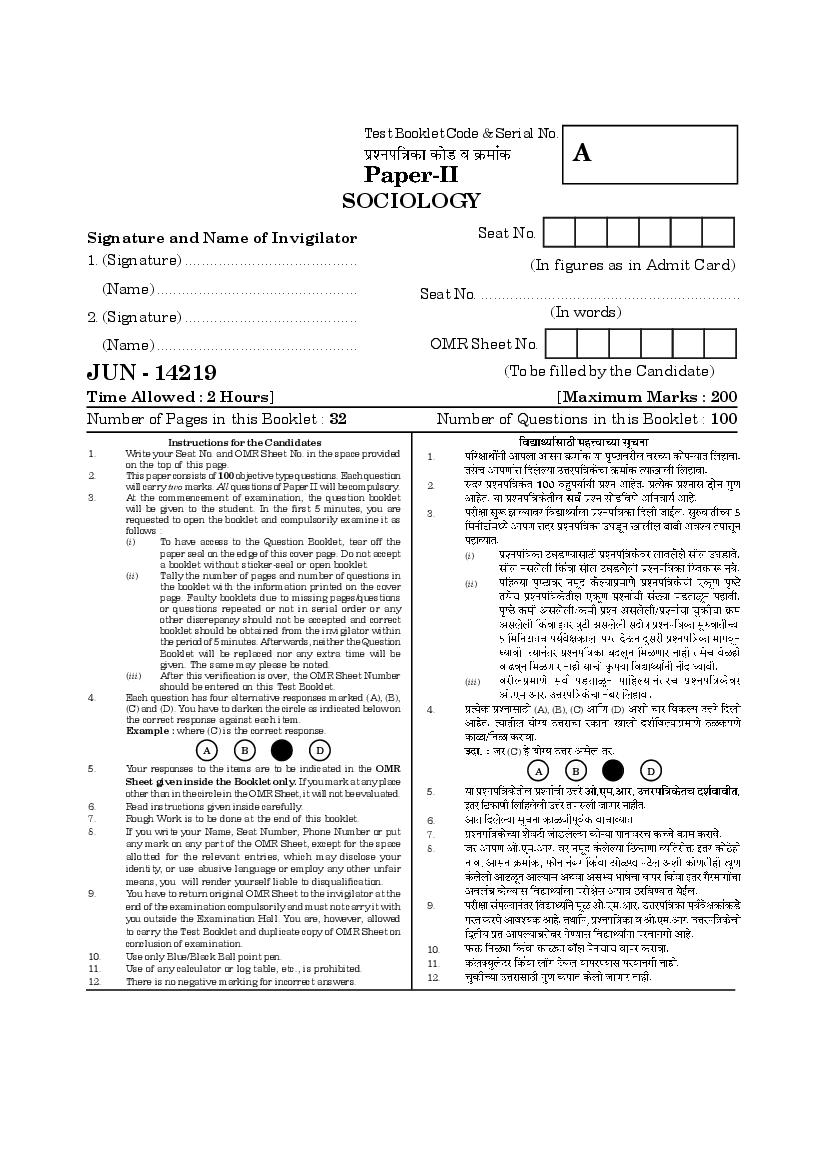
Page 1
A
SOCIOLOGY
Signature and Name of Invigilator Seat No.
1. (Signature) ......................................... (In figures as in Admit Card)
(Name) ................................................ Seat No. ..............................................................
2. (Signature) ......................................... (In words)
(Name) ................................................ OMR Sheet No.
JUN - 14219 (To be filled by the Candidate)
Time Allowed : 2 Hours] [Maximum Marks : 200
Number of Pages in this Booklet : 32 Number of Questions in this Booklet : 100
Instructions for the Candidates
1. Write your Seat No. and OMR Sheet No. in the space provided 1.
on the top of this page.
2. This paper consists of 100 objective type questions. Each question
will carry two marks. All questions of Paper II will be compulsory. 2.
3. At the commencement of examination, the question booklet
will be given to the student. In the first 5 minutes, you are 3.
requested to open the booklet and compulsorily examine it as
follows :
(i) To have access to the Question Booklet, tear off the
paper seal on the edge of this cover page. Do not accept (i)
a booklet without sticker-seal or open booklet.
(ii) Tally the number of pages and number of questions in
the booklet with the information printed on the cover (ii)
page. Faulty booklets due to missing pages/questions
or questions repeated or not in serial order or any
other discrepancy should not be accepted and correct
booklet should be obtained from the invigilator within
the period of 5 minutes. Afterwards, neither the Question
Booklet will be replaced nor any extra time will be
given. The same may please be noted.
(iii) After this verification is over, the OMR Sheet Number
(iii)
should be entered on this Test Booklet.
4. Each question has four alternative responses marked (A), (B),
(C) and (D). You have to darken the circle as indicated below on 4. (A), (B), (C) (D)
the correct response against each item.
Example : where (C) is the correct response.
A B D (C)
5. Your responses to the items are to be indicated in the OMR A B D
Sheet given inside the Booklet only. If you mark at any place
other than in the circle in the OMR Sheet, it will not be evaluated. 5.
6. Read instructions given inside carefully.
7. Rough Work is to be done at the end of this booklet. 6.
8. If you write your Name, Seat Number, Phone Number or put 7.
any mark on any part of the OMR Sheet, except for the space
8.
allotted for the relevant entries, which may disclose your
identity, or use abusive language or employ any other unfair
means, you will render yourself liable to disqualification.
9. You have to return original OMR Sheet to the invigilator at the
end of the examination compulsorily and must not carry it with 9.
you outside the Examination Hall. You are, however, allowed
to carry the Test Booklet and duplicate copy of OMR Sheet on
conclusion of examination.
10.
10. Use only Blue/Black Ball point pen.
11.
11. Use of any calculator or log table, etc., is prohibited.
12. There is no negative marking for incorrect answers. 12.
Page 2
Page 3
Paper II
II
Time Allowed : 120 Minutes] [Maximum Marks : 200
Note : This Paper contains Hundred (100) multiple choice questions. Each question
carrying Two (2) marks. Attempt All questions.
(100) (2)
1. An Epistemological position that 1.
privileges study of the subjective
position and analysis of context is
called ................... .
(A)
(A) Interpretivism
(B)
(B) Positivism
(C)
(C) Negativism
(D)
(D) Objectivism
2. Gandhi as a thinker gives equal 2.
importance to ................... .
(A) Technological and spiritual
development
(A)
(B) Social reforms and political
freedom (B)
(C) Social, political and economic
development (C)
(D) Spiritual development and
(D)
swaraj
3 [P.T.O.
Page 4
theory what constitutes the
‘structure’ ?
(A)
(A) Values and Norms
(B)
(B) Statuses and Roles
(C) Actors and Interactions (C)
(D) Rules and Resources (D)
4. Which five year plan document gave 4.
primacy to the empowerment of
women ?
(A) (B)
(A) Fourth (B) Sixth
(C) Ninth (D) Tenth (C) (D)
5. The societies that are founded on 5.
extensive gathering of recording,
storage, analysis and application of
information on individuals and
groups to monitor their activities are
called ..................... . (A)
(A) Surveillance societies (B)
(B) Controlling society
(C)
(C) Subservient society
(D)
(D) Closed society
6. Who stated, “Property is theft” ? 6.
(A) K. Marx (B) Saint Simon
(A) (B)
(C) P. Proudhon (D) A. Smith (C) (D)
7. Reconstituted family is also known 7.
as .................. .
(A)
(A) Blended family
(B) Bi-nuclear family (B)
(C) Stem family (C)
(D) Extended family (D)
4
Page 5
characteristic of a census town ?
(A) A minimum population of 5000 (A) 5000
(B) At least 75% of male main (B)
working population engaged in 75%
non-agricultural pursuits
(C) A urban local body (C)
(D) A density of population at least (D) 400
400 persons per sq. km.
9. The changes in material culture take 9.
place .................. .
(A)
(A) At a faster rate than the non-
material culture (B)
(B) Slower rate than non-material
culture (C)
(C) Simultaneously in material and
non-material culture
(D)
(D) At a faster in traditional society
and at slower rate than the
advanced society
10. According to whom, in modern 10.
societies the ‘life world’ is
increasingly colonized ?
(A) A. Giddens (B) J. Habermas (A) (B)
(C) H. Marcuse (D) T. Adorno (C) (D)
11. Who is closely associated with the 11.
concept ‘Mortification of self’ ?
(A) T. Parsons (B) E. Goffman (A) (B)
(C) H. Blumer (D) G. H. Mead (C) (D)
5 [P.T.O.
Page 6
Welfarism in ................ .
(A) Private ownership (A)
(B) Flow of capital (B)
(C) Free market (C)
(D) Free labour (D)
13. Match List I with the List II and 13. I II
mark the correct answer from the
codes given below the lists :
List I I
(a) Indian agriculture (a)
(b) Farmer’s suicide (b)
(c) Decline in farm prices (c)
(d) McKinsey model of development (d)
List II II
(1) World Bank model of (1)
agriculture
(2)
(2) Economic reform policies driven
by agri-business corporations
(3)
(3) Small farm character
(4)
(4) Neo-liberal agenda
Codes :
(a) (b) (c) (d) (a) (b) (c) (d)
(A) (3) (4) (2) (1) (A) (3) (4) (2) (1)
(B) (2) (3) (4) (1) (B) (2) (3) (4) (1)
(C) (1) (3) (2) (4) (C) (1) (3) (2) (4)
(D) (4) (3) (2) (1) (D) (4) (3) (2) (1)
14. Alfred Schutz attempted the critique 14.
of whose theory of Social Action ?
(A) Max Weber (B) T. Parsons (A) (B)
(C) G. H. Mead (D) V. Pareto (C) (D)
6
Page 7
distinguished between two distinct
forms of patriarchy, namely, private
patriarchy and public patriarchy ?
(A) Shulamith Firestone (A)
(B) Sylvia Walby (B)
(C) Bell Hooks (C)
(D) R. W. Connell (D)
16. Who has been the prime mover in 16.
the formation of the Indian
Sociological Society ?
(A)
(A) Radha Kamal Mukerjee
(B)
(B) Irawati Karve
(C) G. S. Ghurye (C)
(D) M. N. Srinivas (D)
17. Match List I with List II and select 17. I II
the correct answer from the codes
given below : I
List I (Author) (a)
(a) Edward Said
(b)
(b) Anthony Giddens
(c)
(c) Manuel Castells
(d)
(d) Jurgen Habermas
List II (Books) II
(1) The Rise of the Network Society (1)
(2) The Theory of Communicative (2)
Action (3)
(3) The Constitution of Society (4)
(4) Orientalism
Codes :
(a) (b) (c) (d)
(a) (b) (c) (d)
(A) (4) (3) (1) (2)
(A) (4) (3) (1) (2)
(B) (1) (2) (3) (4) (B) (1) (2) (3) (4)
(C) (2) (1) (4) (3) (C) (2) (1) (4) (3)
(D) (3) (4) (2) (1) (D) (3) (4) (2) (1)
7 [P.T.O.
Page 8
Global Environmental Performance
Index in 2018 ?
(A) 141 (B) 177 (A) 141 (B) 177
(C) 147 (D) 167 (C) 147 (D) 167
19. Who developed the concept of 19.
‘generalised others’ in symbolic
interactionism ?
(A) Herbert Blumer (A)
(B) G. H. Mead (B)
(C) Alfred Schutz (C)
(D) Erving Goffman (D)
20. According to Weber, Verstehen 20.
means .................. .
(A)
(A) Understanding
(B)
(B) Causality
(C)
(C) Explanation
(D) Analysis (D)
21. When a political party or an ideology 21.
hegemonize every aspect of society—
social, cultural, political, economic,
it may appropriately be termed
as .................... .
(A) Authoritarian (A)
(B) Totalitarian (B)
(C) Democratic (C)
(D) Despotic (D)
8
Page 9
judgement scrapped section 497 of 497
IPC dealing with .................. .
(A) Honour killings (A)
(B) Adultery (B)
(C) Child sexual abuse (C)
(D) Harassment at workplace (D)
23. “Large scale bureaucratized 23.
production of cultural products for
masses” is termed as .................. .
(A) Mass culture (A)
(B) Global culture (B)
(C) Digital culture (C)
(D) Culture industry (D)
24. Which of the following perspectives 24.
views family structure as patriarchal ?
(A) Marxist feminism (A)
(B) Liberal feminism (B)
(C) Radical feminism (C)
(D) Cultural feminism (D)
25. According to Durkheim which of the 25.
following is the earliest form of
religion ?
(A)
(A) Naturism
(B)
(B) Animism
(C) Environmentalism (C)
(D) Totemism (D)
9 [P.T.O.
Page 10
laws govern all areas of human
thought ?
(A)
(A) Structuralism
(B)
(B) Functionalism
(C)
(C) Post-modernism
(D) Post-structuralism (D)
27. Which among the following is not 27.
specifically associated with the
‘rural’ ?
(A) Low density of population (A)
(B) Local self Government (B)
(C) More self reliance (C)
(D) Predominance of primary group
contact (D)
28. Almond and Verba classify political 28.
culture into three types. Select the
correct answer from the following :
(A) Parochial, Subject and
Participant (A)
(B) Participant, Active and Civic (B)
(C) Local, Regional and National
(C)
(D) Parochial, Regional and
Universal (D)
29. Which one of the following is not 29.
Particularly Vulnerable Tribe in
Maharashtra ?
(A)
(A) Katkaria (Kathodia)
(B)
(B) Kolam
(C) Manner Warlu (C)
(D) Maria Gond (D)
10
Page 11
capitalist mode of production ?
(A) Production for use rather than
for an exchange (A)
(B) Rent in kind rather than in
money (B)
(C) Petty production
(C)
(D) Generalised commodity
production (D)
31. Given below are two statements, one 31.
is labelled as Assertion (A) and other
(A) (R)
as Reason (R) :
Assertion (A) : In traditional
societies, sexuality (A) :
was tightly tied to
the process of
reproduction,
where- as in
modern societies,
it has been
separated from
reproduction.
Reason (R) : Historically, notions (R) :
of gender have
always remained
static.
Select the correct answer from the
codes given below :
Codes :
(A) Both (A) and (R) are true, and (A) (A) (R)
(R) is correct explanation (R) (A)
of (A)
(B) Both (A) and (R) are true, but (B) (A) (R)
(R) is not correct explanation (R) (A)
of (A)
(C) (A) is true, but (R) is false (C) (A) (R)
(D) (A) is false, but (R) is true (D) (A) (R)
11 [P.T.O.
Page 12
is articulated in the context of :
(A) Feudalism (A)
(B) Space age (B)
(C) Industrialism (C)
(D) Post-industrialism (D)
33. According to Max Weber Hinduism 33.
was unable to produce rational
capitalism because of its emphasis
on ..................... .
(A) This worldly asceticism (A)
(B) Other worldly asceticism (B)
(C) Rational calculation on food (C)
expenditure
(D) Emphasis on agriculture (D)
34. In which two forms A. R. Radcliffe 34.
Brown has divided joking relations ?
(A) Symbolic and Instrumental
(B) Cultural and Social (A)
(C) Symmetrical and Asymmetrical (B)
(D) Functional and Non-functional (C)
35. Panopticon in Foucault’s analysis of (D)
surveillance focusses on ............... . 35.
(A) Corporal punishment
(B) Self-discipline (A)
(B)
(C) Disciplinary society
(C)
(D) Confinement (D)
36. According to whom, the public 36.
sphere was a place in which people
could meet and have critical debates
about public matters ?
(A) Jurgen Habermas (A)
(B) Anthony Giddens (B)
(C) Manuel Castells (C)
(D) Michel Foucault (D)
12
Page 13
collection in which information
cannot be gathered through ?
(A) Oral questions
(A)
(B) Written questions
(B)
(C) Combination of oral and written
questions (C)
(D) Observation (D)
38. Given below are two statements, one 38.
is labelled as Assertion (A) and other (A) (R)
as the Reason (R) :
Assertion (A) : Service sector in (A) :
India is known as
the economic
growth engine.
(R) :
Reason (R) : Service sector’s
contribution to
economy is higher
than the other
sectors.
Select the correct answer from the
codes given below :
(A) (A) (R)
Codes :
(R) (A)
(A) Both (A) and (R) are true and
(R) is correct explanation
of (A) (B) (A) (R)
(R) (A)
(B) Both (A) and (R) are true, but
(R) is not correct explanation (C) (A) (R)
of (A)
(C) (A) is true, but (R) is false (D) (A) (R)
(D) (A) is false, but (R) is true
13 [P.T.O.
Page 14
activity is conducted by ............... .
(A) Individuals (A)
(B) Individuals and companies (B)
(C) Caste groups (C)
(D) Government (D)
40. Match the List I with List II and 40. I II
select the correct answer from the
codes given below :
List I (Author) I
(a) Radcliffe Brown (a)
(b) Levi-Strauss
(b)
(c) Robert Merton
(c)
(d) Malinoswki
(d)
List II (Book)
II
(1) Social Theory and Social
Structure (1)
(2) Structure and Function in (2)
Primitive Society
(3) The Elementary Structures of (3)
Kinship
(4)
(4) A Scientific Theory of Culture
and other Essays
Select the correct answer from the
codes given below.
Codes :
(a) (b) (c) (d) (a) (b) (c) (d)
(A) (2) (3) (4) (1) (A) (2) (3) (4) (1)
(B) (3) (4) (2) (1) (B) (3) (4) (2) (1)
(C) (2) (3) (1) (4) (C) (2) (3) (1) (4)
(D) (1) (4) (3) (2) (D) (1) (4) (3) (2)
14
Page 15
with ................. .
(A) Tree plantation (A)
(B) Agriculture (B)
(C) Cutting down of trees (C)
(D) Horticulture (D)
42. Which one of the following is a 42.
characteristic of quantitative
research ?
(A)
(A) Value bound inquiry
(B) Inductive (B)
(C) Deductive (C)
(D) Interactive (D)
43. Who is associated with the book 43.
entitled ‘The German Ideology’ ?
(A) M. Weber (A)
(B) E. Durkheim (B)
(C) K. Marx and F. Engels (C)
(D) G. H. Mead (D)
44. If unequal development in a region 44.
leads to mass movement for political
autonomy in the region, what can
it be appropriately called in Merton’s
paradigm of functionalism ?
(A) Latent function (A)
(B) Latent dysfunction (B)
(C) Functional alternative (C)
(D) Manifest function (D)
15 [P.T.O.
Page 16
Second Media Age” ?
(A) Mark Poster (A)
(B) David Holmes (B)
(C) Mc Luhan (C)
(D) Daniel Learner (D)
46. Transnational corporations are 46.
not ................ .
(A)
(A) Companies that operate in more
than one country
(B) Regional in nature
(B)
(C) At the heart of economic
globalization (C)
(D) Instrumental in diffusion of new
(D)
technologies
47. Which of the following statements 47.
is incorrect ?
(A)
(A) Sample cannot be used as a
complete coverage of the
population for research
(B) Studies based on sample require (B)
less time and produce quick
answers
(C) Samples offer less detailed (C)
information and low degree of
accuracy
(D) A sample is studied for drawing (D)
conclusions about the
population or universe
16
Page 17
48.
is labelled as Assertion (A) and the
other as Reason (R). (A) (R)
Assertion (A) : Divorce rates are
(A) :
on the rise.
Reason (R) : People are loosing (R) :
faith in the
institution of
marriage.
Select the correct answer from the
codes given below.
Codes :
(A) (A) (R)
(A) Both (A) and (R) are true and
(R) is correct explanation (R) (A)
of (A)
(B) (A) (R)
(B) Both (A) and (R) are true but
(R) is not correct explanation (R) (A)
of (A)
(C) (A) (R)
(C) (A) is true, but (R) is false
(D) (A) is false, but (R) is true (D) (A) (R)
49. ‘Cybernetic hierarchy’ has been used 49.
by .................. .
(A) R. K. Merton (A)
(B) T. Parsons (B)
(C) M. Foucault (C)
(D) A. Giddens (D)
17 [P.T.O.
Page 18
Belly of the River : Tribal Conflicts
Over Development in Narmada
Valley” ?
(A)
(A) Patrick McCully
(B)
(B) Ramchandra Guha
(C) Medha Patkar (C)
(D) Amita Baviskar (D)
51. Which one of the following is not a 51.
feature of power according to
Foucault ?
(A)
(A) Productive
(B)
(B) Capillary nature
(C) Zero-sum (C)
(D) Constitutive (D)
52. ................. is the mental acceptance 52.
that certain things are true or real.
(A) Value (B) Belief
(A) (B)
(C) Moral (D) Ethic
(C) (D)
53. Depeasantization refers to ............. .
53.
(A) A shift towards commercial
agriculture (A)
(B) Migration from rural to urban (B)
(C) Rural industrialization (C)
(D) A shift from agricultural
(D)
occupation to non-agricultural
occupation
18
Page 19
(A) Morality
(A)
(B) Ethical codes of research
(B)
(C) Objectivity
(C)
(D) Religion and ethics (D)
55. Who used metaphorical investigations 55.
to study everyday life of people ?
(A) Erving Goffman (A)
(B) Harold Garfinkel (B)
(C) Thomas Luckman (C)
(D) Jeffrey Alexander (D)
56. Which one of the following is not a 56. 2011
Mega City as per census 2011 ?
(A) Greater Mumbai Urban
(A)
Agglomeration
(B)
(B) Delhi Urban Agglomeration
(C) Bengaluru Urban Agglomeration (C)
(D) Kolkata Urban Agglomeration (D)
57. ‘Broken Men Theory’ argued that 57.
Buddhists became untouchables,
who proposed this theory ?
(A)
(A) Irawati Karve
(B)
(B) S. V. Ketkar
(C) G. S. Ghurye (C)
(D) B. R. Ambedkar (D)
19 [P.T.O.
Page 20
Ethnography is .................. .
(A) Camera (A)
(B) Field Diary (B)
(C) Interview Schedule (C)
(D) Coding Manuel (D)
59. Ethnopharmacology is at the 59.
intersection of ................... .
(A) The ethnology, biology and (A)
pharmacy
(B) The ethnology, physiology and (B)
pharmacy
(C) Anthropology, biology and (C)
pharmacy
(D) The medical, natural sciences (D)
and social sciences
60. What should the researcher avoid 60.
while framing the questions ?
(A) Use of simple words (A)
(B) Specific questions (B)
(C) Words with emotional
(C)
connotations
(D)
(D) Symbols for reply
61. Select the incorrect pair : 61.
(A) Cluster Sampling — Probability
Sampling (A)
(B) Quota Sampling — Probability
Sampling (B)
(C) Convenience Sampling — Non-
Probability Sampling (C)
(D) Purposive Sampling — Non-
Probability Sampling (D)
20
Page 21
structuration, primacy is granted
to ................... .
(A)
(A) Structure
(B)
(B) Agency
(C) Habitus (C)
(D) Structure and Agency (D)
63. The new economic system based on 63.
flexibility, specialisation and tailor-
made goods is known as ............... .
(A) Fordism (A)
(B) Post-Fordism (B)
(C) Socialism (C)
(D) Post-capitalism (D)
64. According to whom, the ‘nuclear 64.
family is merely a stage in the joint
family cycle’ ?
(A)
(A) G. S. Ghurye
(B)
(B) I. P. Desai
(C) M. N. Srinivas (C)
(D) A. R. Desai (D)
65. ‘Sweatshop’ is the term used 65.
for .................. .
(A) Bonded labour (A)
(B) Agricultural labour (B)
(C) Secure working conditions (C)
(D) Subcontracting system of labour (D)
21 [P.T.O.
Page 22
‘relativism’ and ‘relationism’ ?
(A) A. Schutz (A)
(B) K. Mannheim (B)
(C) H. Garifinkel (C)
(D) E. Goffman (D)
67. Sustainable development means : 67.
(A) Frugal living (A)
(B) Growth (B)
(C) Elimination of inequalities (C)
(D) Renewable and equitable use of (D)
resources
68. Which one of the following is not a 68.
probability sampling ?
(A)
(A) Simple random sampling
(B)
(B) Optimum allocation sampling
(C) Judgement sampling (C)
(D) Area sampling (D)
69. Most people marry within their own, 69.
race, class, level of education,
religions affiliation etc. This is
known as ................... .
(A) Endogamy (B) Hypogamy (A) (B)
(C) Homogamy (D) Hypergamy (C) (D)
70. What is the rank of India according 70.
to Inequality Index ?
(A) 147 (B) 115 (A) 147 (B) 115
(C) 103 (D) 130 (C) 103 (D) 130
22
Page 23
performed for which of the following
reasons ?
(A)
(A) To capture brides
(B)
(B) To find grooms
(C)
(C) To give societal acceptance to
children (D)
(D) To hunt food for the family
72. ‘India has missed the industrial 72.
revolution, but can’t afford to miss
the knowledge revolution, has been
asserted by :
(A) Education Commission of India (A)
(B) Knowledge Commission of India (B)
(C) Industrial Commission of India
(C)
(D) Agricultural Commission of
India (D)
73. Who gave the term “The Culture of 73.
Poverty” ?
(A) Louis Dumont (A)
(B) Robert Merton (B)
(C) H. Spencer (C)
(D) Oscar Lewis (D)
74. For which type of research 74.
hypothesis building is not
mandatory ?
(A) Quantitative Research (A)
(B) Qualitative Research (B)
(C) Survey based Research (C)
(D) Research based on large data (D)
23 [P.T.O.
Page 24
“Affinity as a Value : Marriage
Alliance in South India, with
Comparative Essays on Australia” ?
(A) Claude Levi-Strauss (A)
(B) Rodney Needham (B)
(C) Louis Dumont (C)
(D) A. R. Radcliffe Brown (D)
76. Match the List I with List II and 76. I II
select the correct answer from the
codes given below :
List I (Concepts) I
(a) Folkways (a)
(b) Abstract Norms (b)
(c) Ascribed and Achieved Status (c)
(d) Law (d)
List II (Authors) II
(1) Kingsley Davis (1)
(2) Ralph Linton (2)
(3) Harry Johnson (3)
(4) W. G. Sumner (4)
Select the correct answer from the
codes given below :
(a) (b) (c) (d) (a) (b) (c) (d)
(A) (4) (2) (1) (3) (A) (4) (2) (1) (3)
(B) (4) (3) (2) (1) (B) (4) (3) (2) (1)
(C) (2) (3) (1) (4) (C) (2) (3) (1) (4)
(D) (3) (1) (4) (2) (D) (3) (1) (4) (2)
24
Page 25
world are in India out of top ten ?
(A) 6 (B) 7
(A) 6 (B) 7
(C) 9 (D) 5 (C) 9 (D) 5
78. A model which looks at power as 78.
dispersed among many competing
groups is known as .................. .
(A) Power elite model (A)
(B) Pluralistic model (B)
(C) Marxist model (C)
(D) Democratic model (D)
79. Which of the following sociologists 79.
has worked on the idea of networks (Networks) (Flows)
and flows ?
(A) Beck (B) Ritzer (A) (B)
(C) Giddens (D) Castells (C) (D)
80. Functionalist perspective to power is 80.
put forth by ..................... .
(A) R. Merton (B) T. Parsons (A) (B)
(C) K. Marx (D) M. Weber (C) (D)
81. Which one of the following is true 81.
about observation as a tool of data
collection ?
(A) quantitative generalizations on
the results (A)
(B) information about past and (B)
future
(C)
(C) provides information when
other methods fail
(D) quite essay and a time-saving (D)
method
25 [P.T.O.
Page 26
bodies and subjected minds”. Who
stated this ?
(A) (B)
(A) Lyotard (B) Berger
(C) (D)
(C) Mannhein (D) Foucault
83. Diaspora by definition share : 83.
(A) Language (B) Region
(A) (B)
(C) Homeland (D) Religion (C) (D)
84. Who stated that, “Community is not 84.
list of tools and customs, it is an
integrated whole” ?
(A) Zimmerman (A)
(B) Robert Redfield (B)
(C) Miltan Singer (C)
(D) George Simmel (D)
85. Which of the following does not refer 85.
to sociological understanding of
‘status’ ?
(A) (B)
(A) Rank (B) Prestige
(C) Ego (D) Lifestyle (C) (D)
86. Ingrained habits, skills and 86.
dispositions by an individual is
called :
(A) Agency (B) Habitus (A) (B)
(C) Growth (D) Development (C) (D)
26
Page 27
extremely useful in correlation
analysis is .................. .
(A)
(A) Range
(B)
(B) Interquartile range
(C) Mean deviation (C)
(D) Standard deviation (D)
88. Identify the place that caters to users 88.
with commonality of interest and
showcases one’s own interest.
(A) Network (B) Niche (A) (B)
(C) Gateway (D) Bill-board (C) (D)
89. Which one of the following is not a 89.
characteristic of lineage ?
(A) Consists of several families (A)
(B) Common residence (B)
(C) Totem (C)
(D) A known ancestor (D)
90. In his study of religion, Weber 90.
focuses on which type of ethics for
the rise of capitalism in the Western
Europe ?
(A) Calvinism (B) Pietism (A) (B)
(C) Methodism (D) Spiritualism (C) (D)
91. Who was of the view that the Indian 91.
tribes were like backward Hindus ?
(A) M. N. Srinivas (A)
(B) A. M. Shah (B)
(C) G. S. Ghurye (C)
(D) Y. Singh (D)
27 [P.T.O.
Page 28
feature of caste system ?
(A) Exogamy
(A)
(B) Ritual hierarchy
(B)
(C) Purity and pollution
(C)
(D) Division of labour based on
ascription (D)
93. Match List I with List II and select 93. I II
the correct answer from the codes
given below :
I
List I (Author)
(a)
(a) Maria Mies
(b)
(b) Leela Dube
(c)
(c) Aileen Ross
(d) Prem Chowdhary (d)
List II (Books) II
(1) The Hindu Family in Urban (1)
Setting (2)
(2) The Veiled Woman
(3)
(3) Lace Makers of Narsapur
(4)
(4) Women and Kinship
Codes :
(a) (b) (c) (d)
(a) (b) (c) (d)
(A) (3) (4) (1) (2)
(A) (3) (4) (1) (2)
(B) (1) (2) (3) (4)
(B) (1) (2) (3) (4)
(C) (4) (1) (2) (3) (C) (4) (1) (2) (3)
(D) (2) (3) (4) (1) (D) (2) (3) (4) (1)
28
Page 29
in which of the following years ?
(A) 1981 (B) 1991 (A) 1981 (B) 1991
(C) 2001 (D) 2011 (C) 2001 (D) 2011
95. Given below are two statements, one 95.
is labelled as Assertion (A) and the
(A) (R)
other as Reason (R).
Assertion (A) : The process of (A) :
Globalization
leads to increase
in inequality.
Reason (R) : Developed nations (R) :
are exploiting the
less developed
nations.
Select the correct answer from the
codes given below.
Codes :
(A) Both (A) and (R) are true and
(A) (A) (R)
(R) is correct explanation
of (A) (R) (A)
(B) Both (A) and (R) are true, but (B) (A) (R)
(R) is not correct explanation
(R) (A)
of (A)
(C) (A) (R)
(C) (A) is true, but (R) is false
(D) (A) is false, but (R) is true (D) (A) (R)
29 [P.T.O.
Page 30
is labelled as Assertion (A) and other
(A) (R)
as Reason (R).
Assertion (A) : Green revolution
in Punjab has (A) :
resulted in many
ecological problems.
Reason (R) : Ill effects of green
(R) :
revolution are due
to overuse of land,
water, pesticides
and fertilizers.
Select the correct answer from the
codes given below.
Codes :
(A) Both (A) and (R) are correct and
(R) is correct explanation (A) (A) (R)
of (A) (R) (A)
(B) Both (A) and (R) are correct but
(B) (A) (R)
(R) is not correct explanation
(R) (A)
of (A)
(C) (A) is true, but (R) is false (C) (A) (R)
(D) (A) is false, but (R) is true (D) (A) (R)
97. In which of the following decades, 97.
total increase in urban population
was more than the total increase in
rural population in India ?
(A) 1971-1981 (B) 2001-2011 (A) 1971-1981 (B) 2001-2011
(C) 1991-2001 (D) 1981-1991 (C) 1991-2001 (D) 1981-1991
30
Page 31
India defines scheduled areas ?
(A) Clause (1) of Article 244 (A) 244 (1)
(B) Clause (2) of Article 244 (B) 244 (2)
(C) Clause (3) of Article 244 (C) 244 (3)
(D) Clause (4) of Article 244 (D) 244 (4)
99. Which theoretical perspective argues 99.
that social stratification is a device
by which society ensures that the
most important positions are filled by
the most qualified persons ?
(A) Functionalist (A)
(B) Conflict (B)
(C) Interactionist (C)
(D) Phenomenologist (D)
100. In his functional analysis who has 100.
given the postulate of the functional
unity of social systems ?
(A) Robert Merton (A)
(B) Emile Durkheim (B)
(C) Radcliffe Brown (C)
(D) Talcott Parsons (D)
31 [P.T.O.
Page 32
32
Document Details
| Board / Org | Maharashtra Exams |
| Exam | Maharashtra State Eligibility Test |
| Type | Question Paper |
| Pages | 32 |
| Updated | 30 Apr 2026 |