MAHA SET 2025 Paper II Education Set A Question Paper
Finished viewing? Save it for later —
Download MAHA SET 2025 Paper II Education Set A Question Paper (PDF · 36 pages)About MAHA SET 2025 Paper II Education Set A Question Paper
MAHA SET 2025 Paper II Education Set A Question Paper is available here for free download. Published by Maharashtra Exams for MAHA SET, this question paper can be viewed online or downloaded as a PDF (36 pages). Candidates preparing for MAHA SET can use MAHA SET 2025 Paper II Education Set A Question Paper to understand the exam pattern, the type of questions asked, and the overall difficulty level.
Frequently Asked Questions
How can I download MAHA SET 2025 Paper II Education Set A Question Paper?
Open this page and click the Download button to save MAHA SET 2025 Paper II Education Set A Question Paper as a PDF. It is completely free on AglaSem Docs.
Is MAHA SET 2025 Paper II Education Set A Question Paper free to download?
Yes. MAHA SET 2025 Paper II Education Set A Question Paper can be viewed online and downloaded as a PDF free of cost on AglaSem Docs.
How many pages does MAHA SET 2025 Paper II Education Set A Question Paper have?
MAHA SET 2025 Paper II Education Set A Question Paper contains 36 pages, which you can read online or download together as a single PDF.
Where can I find more MAHA SET study material?
You can find more MAHA SET question papers, sample papers, syllabus, and answer keys on AglaSem Docs.
MAHA SET 2025 Paper II Education Set A Question Paper – Text
Read the full text of this question paper below — useful to quickly search, copy and reference the content online without downloading the PDF.
📄 View text version (37 pages)
Page 1
MAHA SET 2025
Paper II Education
Set A Question Paper
EXAM YEAR TYPE
MAHA SET 2025 Question Paper
Notes · Sample Papers · Previous Year Papers · Mock Tests
Page 2
m .co s e m
l a
ag
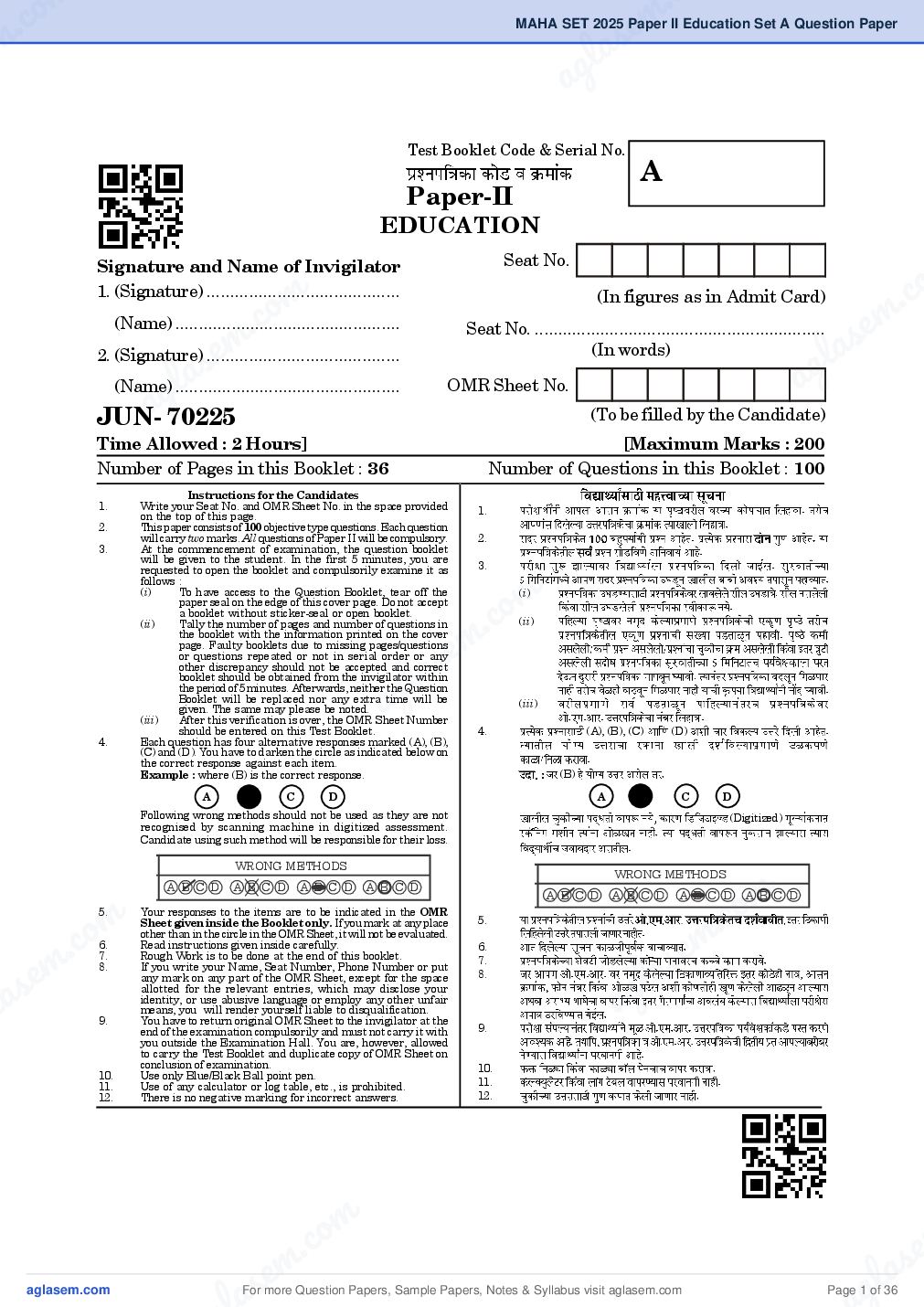
Test Booklet Code & Serial No.
A
Paper-II
EDUCATION
Signature and Name of Invigilator Seat No.
m
1. (Signature) .........................................
. co
c. o
(In figures as in Admit Card)
e m
(Name) ................................................
em
Seat No. ..............................................................
l as
s
2. (Signature) .........................................
la
(In words)
ag
JUN-
g
(Name) ................................................
a 70225
OMR Sheet No.
(To be filled by the Candidate)
Time Allowed : 2 Hours] [Maximum Marks : 200
Number of Pages in this Booklet : 36 Number of Questions in this Booklet : 100
Instructions for the Candidates
1. Write your Seat No. and OMR Sheet No. in the space provided 1.
on the top of this page.
2. This paper consists of 100 objective type questions. Each question
will carry two marks. All questions of Paper II will be compulsory. 2.
3. At the commencement of examination, the question booklet
will be given to the student. In the first 5 minutes, you are
requested to open the booklet and compulsorily examine it as 3.
m
follows :
c. o
(i) To have access to the Question Booklet, tear off the (i)
paper seal on the edge of this cover page. Do not accept
a booklet without sticker-seal or open booklet.
(ii)
m
(ii) Tally the number of pages and number of questions in
e
the booklet with the information printed on the cover
s
page. Faulty booklets due to missing pages/questions
a
or questions repeated or not in serial order or any
l
other discrepancy should not be accepted and correct
ag
booklet should be obtained from the invigilator within
the period of 5 minutes. Afterwards, neither the Question
Booklet will be replaced nor any extra time will be (iii)
given. The same may please be noted.
(iii) After this verification is over, the OMR Sheet Number
should be entered on this Test Booklet. 4. (A), (B), (C) (D)
4. Each question has four alternative responses marked (A), (B),
(C) and (D). You have to darken the circle as indicated below on
the correct response against each item.
Example : where (B) is the correct response. (B)
A C D A C D
Following wrong methods should not be used as they are not (Digitized)
recognised by scanning machine in digitized assessment.
Candidate using such method will be responsible for their loss.
CORRECT METHOD WRONG METHODS
CORRECT METHOD WRONG METHODS
C D A B C D A B C D A B C D A B C D
m
c. o
C D A B C D A B C D A B C D A B C D
m
5. Your responses to the items are to be indicated in the OMR
.co
5.
m
Sheet given inside the Booklet only. If you mark at any place
e
other than in the circle in the OMR Sheet, it will not be evaluated.
s
6. Read instructions given inside carefully. 6.
e m 7.
8.
Rough Work is to be done at the end of this booklet.
If you write your Name, Seat Number, Phone Number or put
7.
la
s g
any mark on any part of the OMR Sheet, except for the space 8.
la a
allotted for the relevant entries, which may disclose your
identity, or use abusive language or employ any other unfair
means, you will render yourself liable to disqualification.
9. You have to return original OMR Sheet to the invigilator at the
end of the examination compulsorily and must not carry it with 9.
you outside the Examination Hall. You are, however, allowed
to carry the Test Booklet and duplicate copy of OMR Sheet on
conclusion of examination. 10.
10. Use only Blue/Black Ball point pen.
11. Use of any calculator or log table, etc., is prohibited. 11.
12. There is no negative marking for incorrect answers. 12.
m
.co s e
s em
For more Question Papers, Sample Papers, Notes & Syllabus visit
gl a
Page 1 of 36
Page 3
For more Question Papers, Sample Papers, Notes & Syllabus visit Page 2 of 36
Page 4
m .co s e m
l a
ag
Education
Paper II
om . co
. c II e m
e m l as
l as
Time Allowed : 120 Minutes] [Maximum Marks : 200
Note : This paper contains Hundred (100) multiple choice questions. Each question
ag
ag
carrying Two (2) marks. Attempt All questions.
(100) (2)
1. Sankhya Dharshan was originally 1.
proposed by ............... (A)
(A) Kanad
(B)
(B) Patanjali
m (C)
(C) Kapil
c. o(D)
(D) Vyas
e m
s 2.
2. Pranayam is the .............. step ain
l
Patanjali’s Ashtangyoga. ag
(A) First (A)
(B) Second (B)
(C) Third (C)
(D) Fourth (D)
m
.co
3. The original written work on 3.
m Vedanta is :
m .co (A)
s e m
e la
(A) Shankarbhashya
las (B) Brahmasutra
(B)
ag
(C)
(C) Anubhashya
(D) Vedanta Saurabha (D)
3 [P.T.O.
m
.co s e
s em
For more Question Papers, Sample Papers, Notes & Syllabus visit
gl a
Page 3 of 36
Page 5
Tripitakas are ................... .
(A)
(A) Abhidhammapitak, Samyak-
pitak, Aryasattyapitak
(B) Samyakpitak, Suttapitak,
Karmapitak (B)
(C) Abhidhammapitak, Vinaypitak,
(C)
Suttapitak
(D) Karmapitak, Vinaypitak, (D)
Panchasheelpitak
5. Which of the following is true about 5.
Jain religion ?
(A) Jain religion is realistic and it (A)
does not acknowledge Vedas
(B) Jain religion is idealistic and it (B)
acknowledges Vedas
(C) Jain religion is naturalistic and (C)
it acknowledges only Rigveda
(D) Jain religion is pragmatic and (D)
it acknowledges only Yajurveda
6. Indian spiritualism is very much 6.
similar to Western .................
(A) Idealism (A)
(B) Realism (B)
(C) Naturalism (C)
(D) Pragmatism (D)
4
For more Question Papers, Sample Papers, Notes & Syllabus visit Page 4 of 36
Page 6
m .co s e m
l a
ag
7. Naturalism declares that ............... 7.
(A) Our soul is the source of all
knowledge
om
(A)
. co
. c e m
(B) Nature is the source of all
e m (B)
l as
s
knowledge
a ag
(C)gl
a Knowledge
thoughts
is the outcome of (C)
(D) Knowledge comes out of (D)
creativity
8. Pragmatism is also known as ......... . 8.
(A) Logical philosophy (A)
(B) Spiritual philosophy
o m
(B)
c. (C)
(C) Experimental philosophy
e m (D)
(D) Technical philosophy
l as
a g for 9.
9. Realism recommends ...............
learning.
(A) Play way method (A)
(B) Dignostic method (B)
(C) Inductive method (C)
(D) Deductive method (D)
m
m
10. Swami Vivekananda’s philosophy 10.
.co
m .co can be described as ............. .
s e m
s e (A) Spiritual Vedanta (A)
g la
la (B) Intellectual Vedanta (B) a
(C) Sociological Vedanta
(C)
(D) Practical Vedanta
(D)
5 [P.T.O.
m
.co s e
s em
For more Question Papers, Sample Papers, Notes & Syllabus visit
gl a
Page 5 of 36
Page 7
approved by authority, the role of
governance is to :
(A) Implement to the details as far (A)
as possible
(B) Try out on a sample, before (B)
implementing
(C) Implement only after taking (C)
stakeholder feedback
(D) Critically think, test (D)
practicability, assess and
implement
12. According to Secondary Education 12.
Commission, which of the following
is not a part to be considered as the
base for reorienting the aims of
education :
(A)
(A) Improvement of vocational
education (B)
(B) Development of personality
(C)
(C) Education for leadership
(D)
(D) Constructive learning
13. Which one of the following is the 13.
educational structure recommended
by the Mudaliar Commission for
school education ?
(A) 5 + 3 + 4
(A) 5 + 3 + 4
(B) 7 + 3 + 2 (B) 7 + 3 + 2
(C) 8 + 2 + 2 (C) 8 + 2 + 2
(D) 5 + 3 + 2 + 1 (D) 5 + 3 + 2 + 1
6
For more Question Papers, Sample Papers, Notes & Syllabus visit Page 6 of 36
Page 8
m .co s e m
l a
ag
14. The suggested model of school 14.
complex by Indian Education
Commission 1964-66 is :
o mof schools with (A) . co
c
.and University
(A) Integration
e m
e m
colleges
l as
a s
lseparateandoutUniversity
(B) Colleges should (B)
ag
ag but assist the
secondary schools
(C) Dissociate the lower grades
(C)
from secondary education
(D)
(D) Enrich secondary schools with
facilities and isolate
15. Education Commission 1964-66 is 15.
m
also known as :
m .co
(A) Radhakrishnan Commission
s e (A)
(B) Kothari Commission
g l a (B)
(C) Mudaliar Commission
a (C)
(D) Justice Verma Commission (D)
16. Yashpal Commission critically 16.
observed the existence of
undesirability of :
(A) Repented interference of Court
m
.co
decisions (A)
m (B) Corrupt bureaucratic structure
m .co (B)
s e m
s e in the university
g la
la (C) Too many regulatory bodies
leading to inefficiency
(C) a
(D) Poor assessment and testing
practices (D)
7 [P.T.O.
m
.co s e
s em
For more Question Papers, Sample Papers, Notes & Syllabus visit
gl a
Page 7 of 36
Page 9
recommended with reference to
Primary School Teacher Education :
(A) to close existing institutes (A)
(B) make them part of higher (B)
education system
(C) support academically to enrich
institutes (C)
(D) to recognise B.Ed as (D)
qualification for primary schools
teachers
18. The term EMIS refers to : 18.
(A) Educational management and (A)
information system
(B) Educational manpower
(B)
planning and information
system
(C) Educational manpower (C)
investment system
(D)
(D) Education material and
innovation system
19. Justice Verma Commission 19.
recommends for teacher education
colleges to be :
(A) Interdisciplinary and multi- (A)
disciplinary setting as far as
possible
(B)
(B) In DIET
(C) In Regional Colleges only (C)
(D) Close if not in interdisciplinary (D)
or multidisciplinary formats
8
For more Question Papers, Sample Papers, Notes & Syllabus visit Page 8 of 36
Page 10
m .co s e m
l a
ag
20. As per National Policy of Education 20.
86 the important three aspects of
elementary stages are :
o m tongue, state . co
(A) Learning cmother
. and national (A)
e m
e m
language
l as
a s
lImportance of teacher, learner
language
ag
ag
(B) (B)
and environment
(C) Discipline of body, mind and
heart (C)
(D) Universal accesses universal (D)
attainment and quality of
education
m
21. According to Thorndike and
m .co
21.
Thurstone, speed of development of
s e
capacity of sense organs is more at
l a
ag
the ................ stage of development.
(A)
(A) Infancy
(B)
(B) Pre-childhood
(C) Post-childhood (C)
(D) Adult (D)
22. ‘Ramesh can count objects and he 22.
m
.co
knows only 1500 to 1900 words’.
m
.co
Then Ramesh may be in the stage
e m
e m
of ....................
(A)
las
las (A) Infancy
(B) ag
(B) Pre-childhood
(C) Post-childhood (C)
(D) Adolescent (D)
9 [P.T.O.
m
.co s e
s em
For more Question Papers, Sample Papers, Notes & Syllabus visit
gl a
Page 9 of 36
Page 11
learn proper gender-social role at the
stage of ..............
(A) Pre-childhood (A)
(B) Post-childhood (B)
(C) Adolescent (C)
(D) Adult (D)
24. As per Piaget’s theory, ‘Child can 24.
imagine, formulate hypothesis and
do abstract thinking at ........ stage.
(A) Concrete operational (7 to 11
(A)
years)
(B) Formal operational (12 to 15 (B)
years)
(C)
(C) Pre-conceptual (2 to 7 years)
(D)
(D) Sensori-motor – (0 to 2 years)
25. According to Sternberg’s theory of 25.
intelligence ............... is the first step
in information processing.
(A) Response (A)
(B) Encoding (B)
(C) Mapping (C)
(D) Application (D)
10
For more Question Papers, Sample Papers, Notes & Syllabus visit Page 10 of 36
Page 12
m .co s e m
l a
ag
26. ................ given by Gardner, not fully 26.
accepted by experts.
om
(A) Linguistic intelligence (A) . co
. c e m
m
(B) Logical-Mathematical intelligence
e
(B)
l as
l as
(C) Spatial Intelligence (C)
ag
(D)
g
a Inter-personal intelligence (D)
27. Thomas’s chronological age is 10 27. 10
years. He successfully solved all 10
questions from the Kamat’s test for 12
the year 10; then he solved 4
4
questions from the test for year 12
o m
14 3
and 3 questions from the test for the
c.
year 14.
e m
Then his I.Q. will be ..........
l as
ag
(A) 105
(A) 105
(B) 110
(B) 110
(C) 115
(C) 115
(D) 120 (D) 120
28. As per Gagne’s hierarchical theory 28.
m
.co
of learning ................ is the last level
m of learning.
m .co (A)
s e m
s e (A) Chain-learning
g la
la a
(B)
(B) Signal-learning
(C)
(C) Concept-learning
(D) Problem-solving (D)
11 [P.T.O.
m
.co s e
s em
For more Question Papers, Sample Papers, Notes & Syllabus visit
gl a
Page 11 of 36
Page 13
punishment from the teacher. This
type of learning is known as ........
(A) Punishment learning (A)
(B) Escape learning (B)
(C) Omission learning (C)
(D) Reward learning (D)
30. Which of the following statements 30.
is wrong ?
(A)
(A) Guidance is a process and not
the product
(B)
(B) Guidance is a part of counselling
(C) Guidance is a continuous (C)
process
(D) Guidance is a part of education (D)
31. Rashtriya Madhyamik Shiksha 31. RMSA
Abhiyan (RMSA) scheme was
launched in .............
(A) 2009
(A) March 2009
(B) 2008
(B) March 2008
(C) 2007
(C) March 2007
(D) March 2006 (D) 2006
32. Who established the Regional 32.
College of Education in India ?
(A) NCERT (A) NCERT
(B) NCTE (B) NCTE
(C) UGC (C) UGC
(D) NIEPA (D) NIEPA
12
For more Question Papers, Sample Papers, Notes & Syllabus visit Page 12 of 36
Page 14
m .co s e m
l a
ag
33. Who has prepared the National 33. 2009
Curriculum Framework for Teacher
Education in 2009 ?
(A) NCERT om
(A) NCERT . co
. c e m
(B) NCTEm
(B) NCTE
as
(C) l ase (C) UGC
ag l
agNUEPA
UGC
(D) (D) NUEPA
34. In the state of Maharashtra, the 34.
activity ‘My Innovative Activity’ is
implemented through SCERT, Pune
for which level of teachers ?
(A) Primary and Secondary (A)
(B) Pre-Primary and Primary
o m
(B)
(C) Secondary and Higher Secondary c.
e m (C)
a
(D) Primary, Secondary and Higher
l s (D)
Secondary
a g
35. Which of the following major three 35. NCFTE 2009
components suggested NCFTE
Framework 2009 on teacher
education ?
(A) Pedagogical theory, Professional (A)
Skill, Teaching Skill
(B) Professional Skill, Teaching
m
.co
(B)
m Skill, EPC
.co m
EPC
m
(C) Foundations of Education,
s e
s e Curriculum and Pedagogy, (C)
g la
la School Internship a
(D) Pedagogical theory, Teaching
(D)
Skill, School Internship
13 [P.T.O.
m
.co s e
s em
For more Question Papers, Sample Papers, Notes & Syllabus visit
gl a
Page 13 of 36
Page 15
recommended by D.S. Kothari
Commission for teacher education ?
(A) Research subject should be
(A) B.Ed. M.Ed.
included in B.Ed. and M.Ed.
syllabus
(B) The pre-service training (B)
program for primary teachers
H.S.C.
should be two years after H.S.C.
(C) Grants should be given to (C)
co-operating schools for B.Ed.
training
(D)
(D) Fees should not be charged from
trainees undergoing pre-service
training
37. If Abraham Maslow Hierarchical 37.
Classification of Needs is the basic
foundation of teacher education,
then what approach to teacher
education would it be ? (A)
(A) Behaviouristic approach
(B)
(B) Humanistic approach
(C)
(C) System approach
(D) Affective approach (D)
14
For more Question Papers, Sample Papers, Notes & Syllabus visit Page 14 of 36
Page 16
m .co s e m
l a
ag
38. In which state the first Advanced 38.
Studies Education Centre was
m the standard of
started by the University Grants
o . co
Commission tocraise
. ? e m
e m
teacher education
l as
(A) l as (A)
ag
a g Madhya Pradesh
(B)
(B) Haryana
(C)
(C) Rajasthan
(D) Gujarat (D)
39. Which of the following organization 39.
implemented ICT integration ‘Teach ICT
To The Future’ innovative m
.co
‘Teach To The Future’
programme for pre-service and in-
e m
service training in teacher
l as
ag
education ?
(A) CDAC
(A) CDAC
(B) Intel
(B) Intel
(C) Infosys
(C) Infosys
(D) Microsoft (D) Microsoft
40. Which of the following is not the part 40.
m
.co
of career dimension of Dimensions
m of Professional teachers ?
m .co (A)
s e m
s e (A) Competency
g la
la a
(B)
(B) Leadership
(C) Accomplishment (C)
(D) Professional values (D)
15 [P.T.O.
m
.co s e
s em
For more Question Papers, Sample Papers, Notes & Syllabus visit
gl a
Page 15 of 36
Page 17
in the school to keep the curriculum
in tune with need of the time and
of the students ?
(A) Baseline survey (A)
(B) Review committee (B)
(C) Revision of Curriculum
(C)
(D) Diagnosis in curriculum
(D)
development
42. Which of the following broad 42.
expectation of the school it may be
considered as ideals ?
(A) Reflective thinking
(A)
(B) The appreciation of beauty in
Literature (B)
(C) The development of saleable
(C)
skills
(D)
(D) Democratic citizenship
43. Who is the theorist of curriculum 43.
synthesis ?
(A) Daniel Tanner (A)
(B) Hilda Taba (B)
(C) Ralph W. Tyler (C)
(D) Parker Francis W. (D)
16
For more Question Papers, Sample Papers, Notes & Syllabus visit Page 16 of 36
Page 18
m .co s e m
l a
ag
44. Which of the following type of 44.
curriculum is most effective in
co
elementary schools ?
. c om
(A) Disciplinary curriculum
(A)
e m .
e m
(B) Core curriculum (B)
l as
as
lBroad fields curriculum
(C) Activity curriculum (C)
ag
a
(D)g (D)
45. Match the following List of 45.
Analyzing Levels with Performance :
Analyzing Levels
(1) Level-I
(1) I
(2) Level-II
(2) II
(3) Level-III m
(4) Level-IV c. o(3) III
e m (4) IV
(5) Level-V
l as (5) V
(i)
Performance
Discovering
ag
(i)
(ii) Illustrating
(ii)
(iii) Repeating
(iii)
(iv) Classifying
(iv)
(v) Justifying
(v)
Choose the most appropriate answer
m
m from options given below :
.co
m .co (1) (2) (3) (4) (5) (1) (2)
s e(4)m (5)
(3)
s e (A) (iv) (i) (iii) (ii) (v)
g la (ii) (v)
(A) (iv) (i) (iii)
la (B) (ii) (iii) (i) (iv) (v) a (i) (iv) (v)
(B) (ii) (iii)
(C) (iii) (iv) (ii) (v) (i) (C) (iii) (iv) (ii) (v) (i)
(D) (i) (ii) (iv) (iii) (v) (D) (i) (ii) (iv) (iii) (v)
17 [P.T.O.
m
.co s e
s em
For more Question Papers, Sample Papers, Notes & Syllabus visit
gl a
Page 17 of 36
Page 19
development in order to appropriate
sequence :
(i) Organization of learning (i)
experiences (ii)
(ii) Organization of content (iii)
(iii) Formulation of objectives
(iv)
(iv) Diagnosis of needs
(v) Selection of content (v)
(vi) Evaluation system (vi)
(vii) Selection of Learning
(vii)
experiences
Choose the correct answer from the
options given below : (A) (iii) (iv) (i) (ii) (v) (vii) (vi)
(A) (iii) (iv) (i) (ii) (v) (vii) (vi) (B) (iii) (ii) (i) (iv) (vii) (v) (vi)
(B) (iii) (ii) (i) (iv) (vii) (v) (vi)
(C) (iv) (ii) (vii) (iii) (i) (v) (vi)
(C) (iv) (ii) (vii) (iii) (i) (v) (vi)
(D) (iv) (iii) (v) (ii) (vii) (i) (vi) (D) (iv) (iii) (v) (ii) (vii) (i) (vi)
47. Arrange the stages in Moral 47.
Development in a sequence :
(i)
(i) Principle Orientation
(ii) O b e d i e n c e - P u n i s h m e n t (ii)
Orientation
(iii)
(iii) Authority and Social order
Orientation (iv)
(iv) Naively egoistic orientation
(v)
(v) C o n t r a c t u a l - l e g a l i s t i c
Orientation (vi)
(vi) Interpersonal Concordance
Orientation
Choose the correct answer from (A) (i) (vi) (v) (ii) (iv) (iii)
options given below :
(A) (i) (vi) (v) (ii) (iv) (iii) (B) (v) (iv) (vi) (i) (iii) (ii)
(B) (v) (iv) (vi) (i) (iii) (ii) (C) (ii) (iv) (vi) (iii) (v) (i)
(C) (ii) (iv) (vi) (iii) (v) (i)
(D) (vi) (v) (iii) (i) (iv) (ii) (D) (vi) (v) (iii) (i) (iv) (ii)
18
For more Question Papers, Sample Papers, Notes & Syllabus visit Page 18 of 36
Page 20
m .co s e m
l a
ag
48. According to Tyler Ralph W. what 48.
are the organizing structural
elements of learning experience ?
m . co
c. o
(i)
(i) Specific subjects
e m
emfields (ii)
l as
s
(ii) Broad
a curriculum ag
(iii) l
a g Core (iii)
(iv) Syllabus (iv)
(v) Course modules (v)
Choose the correct answer from the
options given below :
(A) (i), (ii) (iii)
(A) (i), (ii) and (iii) only
om
(B) (iii), (iv) (v)
(B) (iii), (iv) and (v) only
(C) (ii), (iii) and (iv) only
m .c (C) (ii), (iii) (iv)
s e (D) (i), (iv)
(D) (i), (iv) and (v) only
l a (v)
agform 49.
49. Stating objectives in a specific
are helpful in .......... .
(i) Selecting learning experiences (i)
(ii) Guiding teaching (ii)
(iii) Decreasing drop out rate (iii)
(iv) Formative evaluation (iv)
m
m Choose the correct options given
.co
m .co below :
s em
e la (iv)
(A) (i), (ii) (iii)
las (A) (i), (ii) and (iii) only
a
(B) (ii), (iii) g
(B) (ii), (iii) and (iv) only
(C) (iii), (iv) (i)
(C) (iii), (iv) and (i) only
(D) (i), (ii) and (iv) only (D) (i), (ii) (iv)
19 [P.T.O.
m
.co s e
s em
For more Question Papers, Sample Papers, Notes & Syllabus visit
gl a
Page 19 of 36
Page 21
factors affecting curriculum
changes ?
(i)
(i) Changes in social values
(ii) Technological development (ii)
(iii) Beliefs and expectations (iii)
(iv) Changes in Government (iv)
(v) Capacity of Teachers. (v)
Choose the correct answer from the
given options :
(A) (i), (ii) (iii)
(A) (i), (ii) and (iii) only
(B) (ii), (iii) and (iv) only (B) (ii), (iii) (iv)
(C) (iii), (iv) and (v) only (C) (iii), (iv) (v)
(D) (iv), (v) and (i) only (D) (iv), (v) (i)
51. The ............... to research is concerned 51.
with subjective assessment of
attitudes, opinions and behaviors.
(A)
(A) Qualitative approach
(B)
(B) Mixed method approach
(C) Action research (C)
(D) Quantitative approach (D)
52. According to Yin ............. is not the 52.
component of a case study design.
(A) Study question
(A)
(B) Writing references
(C) The criteria for interpreting the (B)
findings
(C)
(D) Identification of the units of
analysis (D)
20
For more Question Papers, Sample Papers, Notes & Syllabus visit Page 20 of 36
Page 22
m .co s e m
l a
ag
53. The .................. are the conditions or 53.
characteristics that the
om
experimenter manipulates, controls . co
. c e m
or observes.
e m l as
l as
(A) Variables
(A)
ag
g
a Validity (B)
(B)
(C)
(C) Hypothesis
(D) Variability (D)
54. The .................. variables are those 54.
uncontrolled variables that may
m
have a significant influence on the
m .co
result of a study.
s e
l a
ag
(A)
(A) independent
(B)
(B) dependent
(C) extraneous (C)
(D) intervening (D)
55. The .............. scales are absolute or 55.
m
.co
true zero measurement.
m (A) nominal
m .co (A)
s e m
s e g la
la a
(B) ratio (B)
(C) interval (C)
(D) ordinal (D)
21 [P.T.O.
m
.co s e
s em
For more Question Papers, Sample Papers, Notes & Syllabus visit
gl a
Page 21 of 36
Page 23
measure of central tendency.
(A) mean (A)
(B) median (B)
(C) mode (C)
(D) percentage (D)
57. The difference between the highest 57.
and lowest scores is called .......... .
(A) standard deviation (A)
(B) percentage (B)
(C) median (C)
(D) range (D)
58. When an alternative hypothesis H1 58. H1
may be accepted and H0 is rejected. H0
This is ............... type of error.
(A) Type I error (A) I
(B) Type II error (B) II
(C) Type III error (C) III
(D) Type IV error (D) IV
59. The Emerging Design is the type of 59.
.................. research design.
(A) Narrative Research Design (A)
(B) Grounded Theory Design (B) (Ground
Theory Design)
(C) Mixed Method Design
(C)
(D) Case Study
(D)
22
For more Question Papers, Sample Papers, Notes & Syllabus visit Page 22 of 36
Page 24
m .co s e m
l a
ag
60. A sequence of actions and 60.
interactions among people and
m
events pertaining to a topic is
. co
c. o .
called ....................
s e m
s
(A) processemapproach (A)
g l a
(B)gl
a (B) a
a theoretical sampling
(C)
(C) core category
(D) theory generation (D)
61. Observation provides .............. data. 61. data
(A) qualitative
(A)
(B) statistical
m
c. o(B)
(C) qualitative and quantitative
e m (C)
(D) quantitative
l as (D)
g
a valid 62.
62. Most appropriate tools for
assessment of student prepared
products are ................. .
(i)
(i) rating scales
(ii)
(ii) check lists
(iii)
(iii) questionnaire
m
m (iv) interview schedule (iv)
.co
m .co s e m
s e (A) (i) and (iii) (A) (i) and (iii)
g l a
la (B) (i) and (ii) (B) (i) anda(ii)
(C) (ii) and (iv) (C) (ii) and (iv)
(D) (iii) and (iv) (D) (iii) and (iv)
23 [P.T.O.
m
.co s e
s em
For more Question Papers, Sample Papers, Notes & Syllabus visit
gl a
Page 23 of 36
Page 25
‘portfolio assessment’ ?
(A) To compare students’ to a (A)
national norm
(B)
(B) To measure students’ progress
over the time
(C)
(C) To diagnose individual learning
needs (D)
(D) To assign grades for a course
64. Which of the following is NOT a 64.
characteristic of a reliable
assessment ?
(A)
(A) Consistency
(B)
(B) Objectivity
(C)
(C) Validity
(D) Subjectivity (D)
65. A ‘Rubric’ has three essential 65.
features .................. .
(i) evaluative criteria (i)
(ii) graph (ii)
(iii) quality definitions (iii)
(iv) scoring strategy. (iv)
(A) (i), (ii) and (iii) (A) (i), (ii) (iii)
(B) (ii), (iii) and (iv) (B) (ii), (iii) (iv)
(C) (i), (iii) and (iv) (C) (i), (iii) (iv)
(D) (i), (ii) and (iv)
(D) (i), (ii) (iv)
24
For more Question Papers, Sample Papers, Notes & Syllabus visit Page 24 of 36
Page 26
m .co s e m
l a
ag
66. .................. carries much potential for 66.
transforming teaching and learning
co
process in ways that enhance
learning outcomes.
. c om (A)
e m .
e m
(A) Assessment of learning
l as
as
lAssessment as learning
(B) Assessment in learning (B)
ag
ag
(C) (C)
(D) Assessment for learning (D)
67. Instruction needs to focus more on 67.
the process and less on the content
being taught, is the principle of .......
(A) Anthropology (A)
(B) Methodology
m (B)
(C) Androgogy c. o(C)
e m (D)
as
(D) Pedagogy
68. The appropriate sequence ofglfive 68.
steps of Morrison TeachingaModel
(Understanding Level) is ............... .
(A) Exploration, Presentation, (A)
Assimilation, Organisation,
Recitation
(B) Organisation, Presentation, (B)
Exploration, Assimilation,
m
m (C) Recitation,
Recitation
.co
m .co Exploration, (C)
s e m
s e Presentation, Assimilation,
g la
la Organisation
a
(D) Assimilation, Presentation, (D)
Exploration, Organisation,
Recitation
25 [P.T.O.
m
.co s e
s em
For more Question Papers, Sample Papers, Notes & Syllabus visit
gl a
Page 25 of 36
Page 27
used to calculate ‘Indirect’ and
‘Direct’ ratio (I/D) of teacher’s talk I/D
in Flander’s interaction analysis ?
C1 C 2 C 3 C 4 C 5 C1 C 2 C 3 C 4 C 5
(A) 100 (A) 100
C 6 C7 C 8 C 6 C7 C 8
C1 C 2 C 3 C 4 C1 C 2 C 3 C 4
(B) 100 (B) 100
C 5 C 6 C7 C 5 C 6 C7
C1 C2 C3 C4 C5 C6 C7 C1 C2 C3 C4 C5 C6 C7
(C) 100 (C) 100
N N
C 5 C6 C7 C 5 C6 C7
(D) 100 (D) 100
N N
70. Which of the following is highest 70.
cognitive process as per Anderson/
Krathwohl’s revised taxonomy ?
(A) Evaluating (A)
(B) Applying (B)
(C) Creating (C)
(D) Analysing (D)
71. The origin of ................ technology is 71.
based upon psychological laboratory
experiments.
(A)
(A) teaching
(B)
(B) instructional
(C) behavioural (C)
(D) media (D)
26
For more Question Papers, Sample Papers, Notes & Syllabus visit Page 26 of 36
Page 28
m .co s e m
l a
ag
72. ‘A boy learns through social 72.
interactions’ this sentence is related
with .............. constructivist learning
om . co
principle.
. c (A) e m
e
(A) Piaget m l as
l as
(B) Bruner
(B)
ag
g
a Vygotsky
(C)
(C)
(D) Glaserfield (D)
73. Teaching technology is an 73.
application of ................. knowledge
to teaching for achieving some
specific learning objectives.
m (i)
c. o(ii)
(i) Philosophical
(ii) Sociological
e m
(iii) Scientific
l as (iii)
(iv) Individual. ag (iv)
(A) (i), (ii) and (iv) (A) (i), (ii) (iv)
(B) (ii), (iii) and (iv) (B) (ii), (iii) (iv)
(C) (iii), (iv) and (i) (C) (iii), (iv) (i)
(D) (i), (ii) and (iii) (D) (i), (ii) (iii)
74. Which of the following portal is 74. m
m related to Massive open online
.co
m .co courses ?
s e m
e la
(A)
las (A) HRDC–UGC
(B) ag
(B) e–Pathshala
(C) SWAYAM (C) SWAYAM
(D) INFLIBNET (D) INFLIBNET
27 [P.T.O.
m
.co s e
s em
For more Question Papers, Sample Papers, Notes & Syllabus visit
gl a
Page 27 of 36
Page 29
way facilities that are user
participation to democratic and type
of interaction for user is two-way.
(A) 1.0
(A) Web 1.0
(B) Web 2.0 (B) 2.0
(C) Web 1 K (C) 1 K
(D) Web 2 K (D) 2 K
76. The main purpose of assistive 76.
technology is to help student so they
can ................ .
(i)
(i) learn
(ii) communicate (ii)
(iii) function better (iii)
(A) Only (i) (A) (i)
(B) Only (iii) (B) (iii)
(C) (i) and (iii) (C) (i) (iii)
(D) (i), (ii) and (iii) (D) (i), (ii) (iii)
77. Generally ................ these three types 77. CAI
of technologies are involved in
Computer Assisted Instruction
(CAI). (i)
(i) Hardware (ii)
(ii) Software (iii)
(iii) Courseware
(iv)
(iv) Contentware
(A) (i), (ii) (iv)
(A) (i), (ii) and (iv)
(B) (i), (iii) (iv)
(B) (i), (iii) and (iv)
(C) (i), (ii) and (iii) (C) (i), (ii) (iii)
(D) (ii), (iii) and (iv) (D) (ii), (iii) (iv)
28
For more Question Papers, Sample Papers, Notes & Syllabus visit Page 28 of 36
Page 30
m .co s e m
l a
ag
78. The five phases of ADDIE model is 78. ADDIE
represent a dynamic, flexible
m
guideline for building effective ........ .
. co
(A) teachingc. oand performance s e m
s emtools
support (A)
g l a
(B)gl
a
teaching and counselling a
a
(C) training and performance
(B)
support tools (C)
(D) instruction and performance
support tools (D)
79. Which of the following portal has 79.
been made available by the UGC to
m
facilitate open access of Indian
m .co
s e
M.Phil dessertations and Ph.D thesis
l a
ag
to the academic community
worldwide ? (A)
(A) Shodhganga
(B)
(B) Shodhgangotri
(C)
(C) Shodhsindhu
(D) PG Pathshala (D)
m
.co
80. ................ is not an online survey tool 80.
m or App.
m .co s e m
s e (A) Google doc (A)
g la
la (B) Typeform (B) a
(C) Hubspot (C)
(D) Surveymonkey (D)
29 [P.T.O.
m
.co s e
s em
For more Question Papers, Sample Papers, Notes & Syllabus visit
gl a
Page 29 of 36
Page 31
educational administration ?
(A)
(A) To evaluate students’
performance (B)
(B) To teach students
(C)
(C) To ensure the efficient and
effective operation of an
educational institution
(D) To develop curriculum (D)
82. What does total quality 82.
management emphasize in
organisations ?
(1)
(1) Maximizing profits through cost
cutting measures.
(2) Focusing only on product (2)
quality without considering
process improvements.
(3)
(3) Outsourcing critical business
functions to third party vendors.
(4) Achieving excellence in all (4)
aspects of an organisation’s
activities.
(A) (1) (2)
(A) (1) and (2) only
(B) (4) only (B) (4)
(C) (1), (2) and (3) only (C) (1), (2) (3)
(D) (2), (3) and (4) only (D) (2), (3) (4)
30
For more Question Papers, Sample Papers, Notes & Syllabus visit Page 30 of 36
Page 32
m .co s e m
l a
ag
83. What role does feedback play in 83.
classroom communication ?
om
(A) Make the communication
. co
. c
process one way (A)
e m
e
(B) Assess mstudents’ understanding l as
l a
ands provide guidance for
(B)
ag
agimprovement
(C) Create barriers in (C)
communication
(D)
(D) Discourage students from
participation
84. In a team of researchers conducting 84.
a scientific experiment, which
m
leadership style from Lewin, Lippet
m .co
and White’s 1939 experiment would
s e
likely be most effective ?
l a
(A) Laissez faire ag (A)
(B) Democratic (B)
(C) Authoritarian
(C)
(D) A mix of Laissez faire and
democratic (D)
85. Planning in educational 85.
m
.co
management should be ............
m (A) Continuous, dynamic and rigid
m .co (A)
s e m
e la
(B) Discontinuous, static and rigid
las (C) Continuous, dynamic and
(B)
ag
flexible (C)
(D) Discontinuous, dynamic and
(D)
flexible
31 [P.T.O.
m
.co s e
s em
For more Question Papers, Sample Papers, Notes & Syllabus visit
gl a
Page 31 of 36
Page 33
individuals to behave in ways that
are acceptable to a group ?
(A) Indoctrination (A)
(B) Socialisation (B)
(C) Brainwashing (C)
(D) Propaganda (D)
87. Who has formalised the concept of 87.
Poka-Yoke ?
(A) Shigeo Shingo (A)
(B) Deming (B)
(C) Crosby (C)
(D) Juran (D)
88. In 2016, a group of institutions 88.
invested in enhancing student
learning outcomes. Which analysis
should be conducted to assess if the
investment achieved the intended
results ?
(A)
(A) Cost-Benefit Analysis
(B) Intangible Benefit Analysis (B)
(C) Cost-effective Analysis (C)
(D) Tangible Benefit Analysis (D)
89. International Network for Quality 89.
Assurance Agencies in Higher INQAAHE
Education (INQAAHE) established
in .................
(A) 1991
(A) 1991
(B) 2000 (B) 2000
(C) 1985 (C) 1985
(D) 2009 (D) 2009
32
For more Question Papers, Sample Papers, Notes & Syllabus visit Page 32 of 36
Page 34
m .co s e m
l a
ag
90. Which of the following is not a 90.
criteria of quality assessment
followed by NAAC ?
o mOutreach Activity (A) . co
c
. and Leadership
(A) Research and
e m
e m
(B) Governance
l as
l as
(C) Teaching-Learning and (B)
ag
a gEvaluation (C)
(D) Recruitment of Teaching and
Non-teaching post (D)
91. The basic philosophy of inclusion 91.
is ..................
(A)
(A) learn together, learn to live
together (B)
m
c. o(C)
(B) live together, live to learn
together
e m
(C) learn together, live to learn
l as
ag all
together (D)
(D) learn together, live to learn
together
92. Gifted students are .................. 92.
(A) introvert in nature (A)
(B) non-assertive of their needs (B)
(C) independent from teachers (C)
(D) independent for taking decision (D)
m
m the visually impaired is located
93. National Institute of Education for 93.
.co
m .co s e m
s e at ..........................
(A)
g la
la (A) Haridwar
(B) Kanpur
(B) a
(C) Agra (C)
(D) Dehradun (D)
33 [P.T.O.
m
.co s e
s em
For more Question Papers, Sample Papers, Notes & Syllabus visit
gl a
Page 33 of 36
Page 35
the central and state government in
respect of DPED project is ........
(A) 80 : 20 (A) 80 : 20
(B) 85 : 15 (B) 85 : 15
(C) 75 : 25 (C) 75 : 25
(D) 70 : 30 (D) 70 : 30
95. Which of the following is not a 95.
characteristic of learning disabled
child ?
(A)
(A) Unstable attention
(B) Lack of transactional (B)
knowledge
(C)
(C) Does not understand sequence
(D)
(D) Lack of social interaction
96. FM transmission-amplification 96.
devices and audio loops, these
devices are used for :
(A) Mentally retarded children (A)
(B) Visually impaired children (B)
(C) Hearing impaired children (C)
(D) Orthopedic impaired children (D)
34
For more Question Papers, Sample Papers, Notes & Syllabus visit Page 34 of 36
Page 36
m .co s e m
l a
ag
97. Which of the following association 97.
is associated with language
disorder ?
m . co
(A) Americanc. oSpeech Language (A)
s e m
s em Association (ASHA)
Hearing
g l a
(B) l
g a
International Reading a
a Association (IRA) (B)
(C) International Literacy (C)
Association (ILA)
(D)
(D) American Psychological
Association (APA)
98. Children and young adults can 98.
m
c. o(A) 1000
generally hear sound ranging from :
20,000
em
(A) 1000 to 20000 hertz
(B) 200 to 2000 hertz
l as (B) 200 2000
(C) 20 to 2000 hertz
(D) 20 to 20000 hertz
ag (C) 20
(D) 20
2000
20,000
99. Which of the following is type of an 99.
intellectual disability ?
(A) ADHD (A)
(B) Mental retardation (B)
(C) Autistic spectrum disorders (C)
m
.co
(D) Dyslexia (D)
m
c. o100. Orientation and mobility instruction 100.
s e m
e m is must for .............
la
las (A) Severely impaired children (A)
ag
(B) Orthopedic impaired children (B)
(C) Speech defective children (C)
(D) Hearing impaired children (D)
35 [P.T.O.
m
.co s e
s em
For more Question Papers, Sample Papers, Notes & Syllabus visit
gl a
Page 35 of 36
Page 37
36
For more Question Papers, Sample Papers, Notes & Syllabus visit Page 36 of 36
Document Details
| Board / Org | Maharashtra Exams |
| Exam | MAHA SET |
| Type | Question Paper |
| Pages | 36 |
| Updated | 17 Nov 2026 |