ISC Class 12 Sample Paper 2023 Accounts
Finished viewing? Save it for later —
Download ISC Class 12 Sample Paper 2023 Accounts (PDF · 17 pages)About ISC Class 12 Sample Paper 2023 Accounts
ISC Class 12 Sample Paper 2023 Accounts is available here for free download. Published by CISCE for Class 12, this sample paper can be viewed online or downloaded as a PDF (17 pages). Candidates preparing for Class 12 can use ISC Class 12 Sample Paper 2023 Accounts to understand the exam pattern, the type of questions asked, and the overall difficulty level.
Frequently Asked Questions
How can I download ISC Class 12 Sample Paper 2023 Accounts?
Open this page and click the Download button to save ISC Class 12 Sample Paper 2023 Accounts as a PDF. It is completely free on AglaSem Docs.
Is ISC Class 12 Sample Paper 2023 Accounts free to download?
Yes. ISC Class 12 Sample Paper 2023 Accounts can be viewed online and downloaded as a PDF free of cost on AglaSem Docs.
How many pages does ISC Class 12 Sample Paper 2023 Accounts have?
ISC Class 12 Sample Paper 2023 Accounts contains 17 pages, which you can read online or download together as a single PDF.
Where can I find more Class 12 study material?
You can find more Class 12 question papers, sample papers, syllabus, and answer keys on AglaSem Docs.
ISC Class 12 Sample Paper 2023 Accounts – Text
Read the full text of this sample paper below — useful to quickly search, copy and reference the content online without downloading the PDF.
📄 View text version (17 pages)
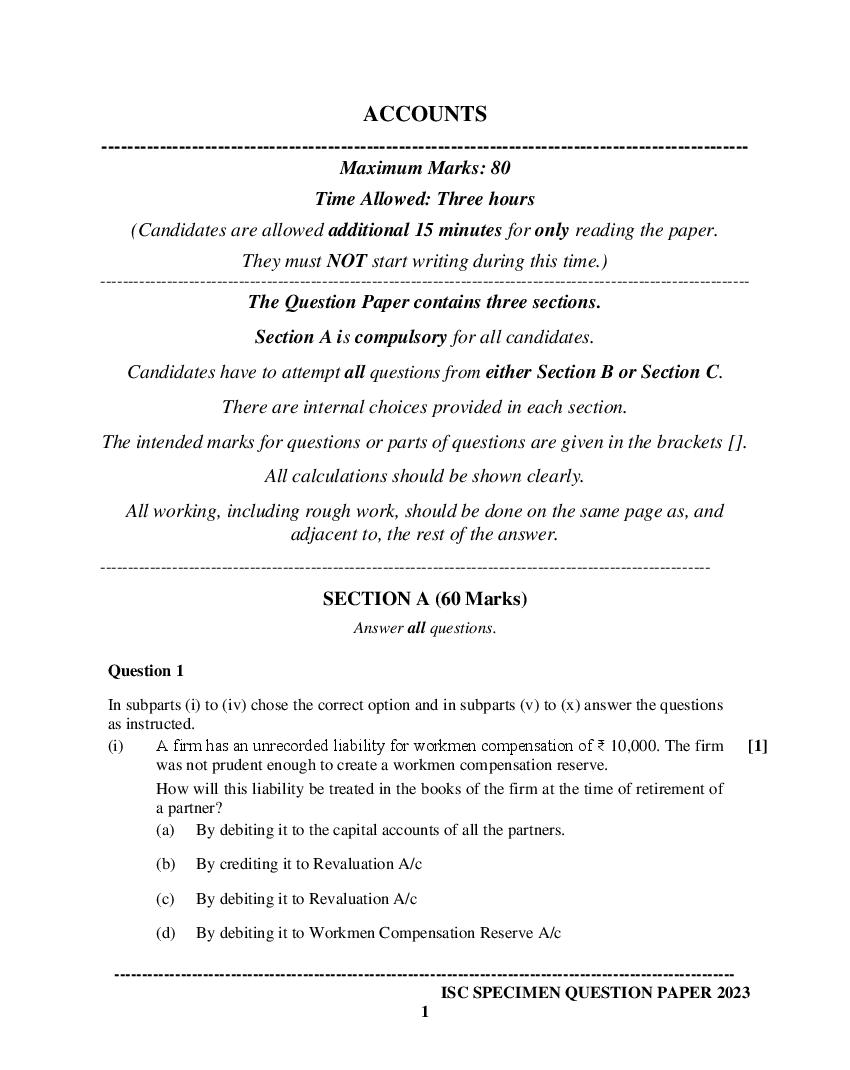
Page 1
----------------------------------------------------------------------------------------------------
Maximum Marks: 80
Time Allowed: Three hours
(Candidates are allowed additional 15 minutes for only reading the paper.
They must NOT start writing during this time.)
---------------------------------------------------------------------------------------------------------------------
The Question Paper contains three sections.
Section A is compulsory for all candidates.
Candidates have to attempt all questions from either Section B or Section C.
There are internal choices provided in each section.
The intended marks for questions or parts of questions are given in the brackets [].
All calculations should be shown clearly.
All working, including rough work, should be done on the same page as, and
adjacent to, the rest of the answer.
--------------------------------------------------------------------------------------------------------------
SECTION A (60 Marks)
Answer all questions.
Question 1
In subparts (i) to (iv) chose the correct option and in subparts (v) to (x) answer the questions
as instructed.
(i) A firm has an unrecorded liability for workmen compensation of ₹ 10,000. The firm [1]
was not prudent enough to create a workmen compensation reserve.
How will this liability be treated in the books of the firm at the time of retirement of
a partner?
(a) By debiting it to the capital accounts of all the partners.
(b) By crediting it to Revaluation A/c
(c) By debiting it to Revaluation A/c
(d) By debiting it to Workmen Compensation Reserve A/c
1
Page 2
Debentures of ₹ 100 each on 30th September, 2022.
As per the provisions of the Companies Act, 2013, on which date should the
company invest in specified securities?
(a) On or before 30th September, 2021
(b) On or before 30th September, 2022
(c) On or before 30th April, 2021
(d) On or before 30th April, 2022
(iii) When a partnership firm dissolves, its losses including deficiencies of capital are to [1]
be paid first out of:
(a) The profits of the firm
(b) The capitals of the partners
(c) From the partners individually in their profit-sharing ratio
(d) From the proceeds from sale of assets
(iv) A company forfeits 1,000 shares of ₹ 10 each. It had received ₹ 6,000 on these shares. [1]
What is the maximum discount that can be allowed by the company on the reissue of
400 shares?
(a) ₹ 4,000
(b) ₹ 400
(c) ₹ 1,600
(d) ₹ 2,400
(v) What is the accounting treatment of Employees Provident Fund appearing in the [1]
Balance Sheet of a partnership firm at the time of dissolution of the firm?
(vi) Give any one important feature of non- purchased goodwill. [1]
(vii) Mention the heading and sub-heading under which Calls-in Arrears and Calls-in [1]
Advance are shown in the Balance Sheet of a company prepared as per Schedule III
of the Companies Act,2013.
(viii) Give any one difference between Securities Premium Reserve and Premium on [1]
Redemption of Debentures.
2
Page 3
Gopi into partnership for 1⁄5 share. At the time of Gopi’s admission, Furniture (book
value ₹ 2,50,000) was reduced by 40% and Machinery (book value ₹ 1,50,000) was
reduced to 40%
What was the net decrease in value of assets?
(x) Gabby Ltd. (a listed NBFC) has 30,000, 5% Debentures of ₹100 each due for [1]
redemption at par on 31st March, 2022.
The Debenture Redemption Investment which was purchased on 30th April, 2021, was
realized on the date of redemption at 102% less 0·5% brokerage, and the debentures
were redeemed.
You are required to calculate the sale price of the Debenture Redemption
Investment.
Question 2 [3]
Kavi, Dhruv and Parth are partners in a firm sharing profits and losses in the ratio of 3:1:1.
Balance Sheet of Kavi, Dhruv and Parth (extract)
As at 31st March, 2022
Liabilities (₹) Assets (₹)
Bank 5,000
On Kavi’s retirement from the firm on 1st April, 2022, the amount due to him is determined
at ₹ 20,000.
The firm took sufficient loan from the bank to pay the amount due to Kavi.
You are required to pass the necessary journal entries to pay the amount due to Kavi.
OR
Gita, Sita and Meena were partners in a firm sharing profits and losses in the ratio of 2: 2:1.
Gita died on 30th June, 2022.
The firm closes its books on 31st March every year.
According to their Partnership Deed, the representatives of the deceased partner would be
entitled to get Gita’s share in the interim profits of the firm calculated on sales basis.
Sales for the year 2020-21 were ₹ 6,00,000 and in the year 2021-22, till the date of her death,
sales amounted to ₹ 1,20,000.
The profits of the firm for the year 2020-21 were ₹ 1,80,000.
You are required to:
(i) Calculate Gita’s share of interim profit.
(ii) Pass the necessary journal entry for giving Gita’s representative her share of
interim profit.
3
Page 4
Veena and Soma are partners in a firm. They admit Sara on 1st April, 2022, for 1⁄4 share in
the profits of the firm.
On an average, the profits earned by Veena and Soma are ₹ 21,000. The average capital
employed by the firm is ₹ 1,50,000.
The normal rate of return in the industry is 10%.
It is decided to value goodwill on the basis of four years’ purchase of profits in excess of
profits @ 10% on the money invested.
You are required to:
(i) Calculate the goodwill of the firm.
(ii) Pass the journal entries in the books of the firm if Sara brings into the firm her
share of goodwill in cash.
Question 4 [3]
On 31st March, 2021, the books of Pragya Ltd. (an unlisted manufacturing company) showed
the following closing balances:
7% Debentures (redeemable on 30th September, 2022) ₹ 60,00,000
Debenture Redemption Reserve ₹ 2,00,000
In order to meet the provisions of the Companies Act, 2013, the company transferred the
required balance amount to Debenture Redemption Reserve Account on 31st March, 2022.
It met the requirements of Debenture Redemption Investment.
You are required to prepare the Debenture Redemption Reserve Account for the years
2021-22, 2022-23.
OR
Barua Ltd. (a listed NBFC) redeems its 9,000, 10% Debentures of ₹ 100 each in instalments
as follows
Date of Redemption Debentures to be redeemed
31st March, 2020 3,000
st
31 March, 2021 5,000
31st March, 2022 1,000
You are required to prepare the Debenture Redemption Investment Account for the
years 2020-21, 2021-22.
4
Page 5
On 1st February, 2022, Swadesh Ltd. issued to the public 12,000, 10% Debentures of ₹ 100
each at a discount of 3% payable:
₹ 20 on application.
The balance on allotment being made on 1st May, 2022.
The public applied for 20,000 debentures. Pro-rata allotment was made on 15,000
debentures.
The debentures were to be redeemed at par after four years.
You are required to pass journal entries for the year 2021-2022.
Question 6 [6]
The Balance Sheet of Ravi and Kamal as at 31st March, 2022, was as follows:
Balance Sheet of Ravi and Kamal
As at 31st March, 2022
Liabilities (₹) Assets (₹)
Creditors 5,000 Cash 1,400
Investment Fluctuation 300 Debtors 4,700
Fund Stock 2,300
Capital Accounts: 3,500 Furniture 50
Ravi 2,750 Property 2,000
Kamal Investment 1,100
11,550 11,550
The partners shared profits in the ratio of 9:7.
The partnership firm was dissolved on the date of the Balance Sheet subject to the
following adjustments:
(i) Property realized 75%.
(ii) Bad debts and discount amounted to ₹ 500.
(iii) Stock realized ₹ 2,525.
(iv) Creditors allowed a discount of 2%.
(v) Expenses of dissolution amounted to ₹ 75 which were paid by Ravi.
You are required to prepare the Realisation Account.
5
Page 6
Amit and Barun are partners sharing profits in the ratio of 4:1. Their Balance Sheet as at
31st March, 2022, was as under:
Balance Sheet of Amit and Barun
As at 31st March, 2022
Liabilities (₹) Assets (₹)
Sundry Creditors 51,000 Furniture 4,000
Capital Accounts: Building 45,000
Amit 20,000 Goodwill 1,000
Barun 15,000 35,000 Debtors 9,400
Less Prov. for
Doubtful debts 400 9,000
Cash 27,000
86,000 86,000
On 1st April, 2022, Charan is admitted as a new partner on the following terms:
(i) The new profit-sharing ratio of the partners to be 2:1:1.
(ii) Charan to bring in ₹ 16,000 as his capital but would be unable to bring his share
of goodwill in cash.
(iii) The value of the goodwill of the firm to be calculated on the basis of Charan’s
share in the profits and the capital contributed by him.
(iv) Furniture, which had been undervalued by ₹ 600 to be brought up to its revised
value.
(v) Out of the total insurance premium paid, ₹ 3,400 to be treated as prepaid
insurance. The amount was earlier debited to Profit & Loss Account.
You are required to prepare:
(i) Revaluation Account.
(ii) Partners’ Capital Accounts.
OR
6
Page 7
admit Shrey for 𝟏⁄𝟑 share in the profits.
On the date of Shrey’s admission:
(a) The capitals of Karan and Vijay are: ₹ 40,000 and ₹ 30,000 respectively.
(b) Profit and Loss Account has a debit balance of ₹ 7,000.
(c) General Reserve shows a balance of ₹ 21,000 which is not to be disturbed.
(d) Goodwill of the firm is valued at ₹ 42,000.
(e) The cash at bank is ₹ 15,000.
(f) Shrey brings in proportionate capital and his share of goodwill in cash.
You are required to prepare:
(i) Partners’ Capital Accounts.
(ii) Cash at Bank Account of the reconstituted firm on the date of Shrey’s
admission.
Question 8 [6]
From the information of Prudence Ltd. given below, you are required to show how the
relevant items will appear in the company’s Balance Sheet (an extract) as at
31st March 2022.
The authorised capital of Prudence Ltd. consisted of 3,000, 10% Preference Shares of
₹ 100 each and 8,000 Equity Shares of ₹100 each, out of which:
(a) 1,000, 6% Preference shares were issued to the public, fully called and paid up
(b) 3,000 Equity shares were issued which were fully called up.
(c) There were arrears of ₹ 20 per share on 400 Equity shares.
Particulars (₹)
Mortgage Debentures 50,000
Bank Overdraft 25,000
Balance in Statement of P/L (Dr) 76,000
Freehold Property 50,000
7
Page 8
Ajay and Vijay are in partnership sharing profits and losses in the ratio of 3:1.
On 1st April, 2021, their capitals were ₹ 1,00,000 and ₹ 90,000.
The terms of their partnership are as follows:
(i) Interest on capital to be allowed at @ 6% per annum.
(ii) Interest on drawings to be charged @ 4% per annum.
(iii) Partners to get a salary of ₹1,000 each per month.
(iv) Vijay to get a commission of 2% on the correct net profit.
(v) Any partner taking a loan from the firm to be charged interest on it @ 8% per annum.
Ajay had borrowed ₹ 10,000 from the firm on 1st October, 2021.
Vijay had withdrawn ₹ 8,000 on 1st July, 2021.
During the year ending 31st March, 2022, the firm earned a net profit of ₹ 60,000 before
any of the provisions mentioned in the partnership deed.
You are required to prepare for the year ending 31st March, 2022:
(i) Profit and Loss Appropriation Account.
(ii) Ajay’s Capital Account.
OR
The partnership agreement of Rohit, Ali and Sneh provides that:
(i) Profits will be shared by them in the ratio of 2:2:1.
(ii) Interest on capital to be allowed at the rate of 6% per annum.
(iii) Interest on drawings to be charged at the rate of 3% per annum.
(iv) Ali to be given a salary of ₹ 500 per month.
(v) Ali’s guarantee to the firm that the firm would earn a net profit of at least ₹ 80,000 per
annum and any shortfall in these profits would be personally met by him.
The capitals of the partners on 1st April, 2021, were:
Rohit – ₹ 1,20,000; Ali- ₹ 1,00,000; Sneh- ₹ 1,00,000.
All the three partners withdrew ₹1,000 each at the beginning of every month.
The net profit for the year 2021-22 was ₹ 70,000.
You are required to prepare for the year 2021- 2022:
(i) Profit and Loss Appropriation Account.
(ii) Ali’s Capital Account.
8
Page 9
In the year 2021-22, Yamuna Limited Co. was registered with an authorized capital of
₹ 1,00,000 in ₹ 10 per Equity share.
Of these, 4,000 equity shares were issued as fully paid to vendor for the purchase of Plant
and Machinery and 6,000 shares were subscribed for by the public.
During the first year, ₹ 6 per Equity share was called up, payable:
₹ 3 on Application
₹ 1 on Allotment
₹ 2 on the First Call
The amounts received in respect of these shares were as follows:
On 5,000 shares the full amount called
On 600 shares ₹ 4 per Equity share
On 400 shares ₹ 3 per Equity share.
The company forfeited all those shares on which only ₹ 3 had been received and reissued
them at ₹ 4 per share.
You are required to:
(i) Pass journal entries to record the above transactions in the books of the
company.
(ii) Prepare the Calls-in Arrears Account.
OR
Tapsi Ltd. invited applications from the public for the issue of 55,000 Equity shares of ₹ 10
each payable as:
₹ 3 on Application
₹ 5 on Allotment
Balance on Call
The public applied for 50,000 shares which were duly allotted by the company.
₹ 2,49,000 were received by the company on allotment and ₹ 99,400 on call.
The company forfeited those shares on which both, allotment and call money was not
received.
70% of the forfeited shares were reissued at ₹ 7 per share, fully called up.
The company paid share issue expenses of ₹ 20,000 which were completely written off at
the end of the year.
The company had ₹ 15,000 in its Securities Premium Reserve Account.
You are required to pass journal entries to record the above transactions in the
books of the company.
9
Page 10
Answer all questions
Question 11
In subparts (i) and (ii) chose the correct option and in subparts (iii) to (v) answer the questions
as instructed.
(i) What will be the Operating Ratio of Zenia Ltd. from the particulars given below? [1]
Revenue from Operations: ₹ 9,00,000
Gross Profit: 20% on cost
Operating Expenses: ₹ 60,000
(a) 86·67%
(b) 90%
(c) 76·67%
(d) 20%
(ii) How is interest paid on debentures considered in a Cash Flow Statement? [1]
(a) As an Operating Activity
(b) As a Financing Activity
(c) As an Investing Activity
(d) Both as an Operating Activity and a Financing Activity
(iii) State the objective of calculating Liquidity Ratios. [1]
(iv) Mention the accounting basis on which a Cash Flow Statement is prepared. [1]
(v) What is Gross Profit + Cost of Materials consumed? [1]
10
Page 11
From the following particulars of Bharti Ltd., you are required to prepare a
Common-size Balance Sheet as at 31st March, 2022.
Particulars 31.03.2022 (₹)
Shareholders’ Funds 14,00,000
Current Liabilities 2,00,000
Total Equity & Liabilities 20,00,000
Non-current Assets 15,00,000
Question 13 [6]
From the following extracts of a company’s Balance Sheets, you are required to
calculate:
(i) Cash from Investing Activities.
(ii) Cash from Financing Activities
Particulars 31.3.2022 (₹) 31.3.2021 (₹)
Equity Share Capital 15,00,000 12,00,000
5% Debentures 10,00,000 8,00,000
Securities Premium Reserve 50,000 10,000
Plant & Machinery (at cost) 10,90,000 9,00,000
Accumulated Depreciation 3,00,000 4,00,000
10% Investments 60,000 50,000
Goodwill 1,00,000 70,000
Note: Dividend proposed in the years 2020-21 and 2021-22 were ₹ 42,000 and ₹ 40,000
respectively.
Additional information:
During the year 2021-22, the company:
(i) Issued the 5% Debentures at a discount of 10% on 1st April, 2021. The discount on
issue of Debentures was written off from Securities Premium Reserve.
(ii) Provided depreciation of ₹ 1,00,000 on Plant and Machinery.
(iii) Sold Plant and Machinery, the book value of which was ₹ 5,00,000 for ₹ 4,50,000.
11
Page 12
You are required to prepare a Cash Flow Statement of Bruno Ltd. (as per AS 3) for
the year 2021-22 from the following Balance Sheets.
Balance Sheets of Bruno Ltd.
As at 31st March, 2022 and 31st March, 2021
Particulars N. No. 31.3.2022 31.3.2021
(₹) (₹)
I EQUITY AND LIABILITIES
1. Shareholders’ Funds
(a) Share Capital (Equity) 5,00,000 3,50,000
(b) Reserves and Surplus 1,20,000 88,000
(Statement of Profit & Loss)
2. Non- Current Liabilities
Long-term Borrowings 1,50,000 2,10,000
(7% Debentures)
3. Current Liabilities
(a) Short-term Borrowings 39,000 46,000
(Bank Overdraft)
(b) Short term Provision 40,000 30,000
(Provision for Tax)
TOTAL 8,49,000 7,24,000
II ASSETS
1. Non- Current Assets
(a) Property, Plant & Equipment &
Intangible Assets
(i)Property, Plant & Equipment 3,80,000 3,30,000
(Plant & Machinery)
2. Current Assets
(a) Cash & Bank Balances (Cash at Bank) 4,69,000 3,94,000
TOTAL 8,49,000 7,24,000
12
Page 13
Particulars 31.3.2022 (₹) 31.3.2021 (₹)
1. Contingent Liability
Proposed Dividend 30,000 ----
Additional information:
During the year 2021-22:
(i) Plant & Machinery of ₹ 1,20,000 was purchased and some machinery was sold at a
loss of ₹ 12,000.
(ii) The company charged ₹ 38,000 as depreciation on its Plant and Machinery.
(iii) Interest of ₹ 18,000 was paid on all borrowings
(iv) Tax paid was ₹ 25,000.
13
Page 14
From the following Statement of Profit and Loss of Swatantra Ltd. for the year
2020-21, calculate any three ratios (up-to two decimal places):
(i) Gross Profit Ratio
(ii) Net Profit Ratio
(iii) Operating Profit Ratio
(iv) Inventory Turnover Ratio
Statement of Profit and Loss of Swatantra Ltd.
For the year ending 31st March, 2022
Particulars Note No. (₹)
Revenue from operations 5,00,000
Other Income (Profit on Sale of Machinery) 40,000
Total Revenue 5,40,000
Expenses:
Purchases 2,50,000
Changes in inventories 1 (10,000)
Employee Benefit Expenses 2 26,000
Depreciation 14,000
Finance Cost (Interest on Debentures) 30,000
Other Expenses 3 20,000
Total Expenses 3,30,000
Profit before Tax 2,10,000
Provision for Tax (84,000)
Profit after Tax 1,26,000
Notes to Accounts:
Particulars (₹)
1. Changes in Inventories
Opening Inventory 40,000
Closing Inventory 50,000
2. Employee Benefit Expenses
Wages 16,000
Salaries 10,000
3. Other expenses
Carriage inward 8,000
Loss on sale of Furniture 12,000
14
Page 15
Answer all questions
Question 15
In subparts (i) and (ii) chose the correct option and in subparts (iii) to (v) answer the questions
as instructed.
(i) In Excel, the drag and drop method is used to: [1]
(a) Copy cell contents
(b) Move cell contents
(c) Add cell contents
(d) (a) and (b)
(ii) Which one of the following fields would not make a suitable primary key? [1]
(a) A date field
(b) An invoice number
(c) An autoNumber field
(d) A customer’s social security number.
(iii) Mention any two types of charts available in a spreadsheet. [1]
(iv) What is meant by sorting of records in an Excel sheet? [1]
(v) How can the name of default Sheet 1 be changed to any other name? [1]
Question 16 [3]
(i) What is a Database Transaction in DBMS?
(ii) Give an example of a Database transaction.
15
Page 16
ABC & Sons run an ice cream parlour. They sell ice creams in cups and cones in four
flavours, Vanilla, Butter Scotch, Chocolate and Badaam Pista. The ice cream is purchased
in the form of ice cream bricks of 1 litre size and served to the customer in a cup or cone as
per his/her preference, by cutting each ice cream brick into ten smaller pieces of 100 ml
each.
The ice cream is purchased from the supplier of a well-known brand who as per the sales
arrangement, also supplies the cups, cones, spoons and paper napkins in adequate quantity,
at no extra cost.
The firm has prepared a summary of its Purchase, Sales and Unsold Stock for the month of
March, 2022, in spreadsheet form. It did not have any unsold stock on the last day of
February, 2022.
A B C D E F G H I J K L
Cost Unit Sale Cost of
1 Ice No. of Total Equivalent No. of Total Cost of
Price cost of Price of unsold Profit
Cream Bricks Cost Number of Cups/Cones Sales cups/cones
per cup/cone cup/cone cups/cones (₹)
Flavours purchased (₹) cups/cones Sold (₹) sold
Brick (₹) (₹) (₹)
(₹)
(₹)
2 Vanilla 400 200 80,000 4,000 20 3,500 35 1,22,500 ?? ?? 52,500
3 Butter
100 250 25,000 1,000 25 900 35 31,500 22,500 ?? 9,000
Scotch
4 Chocolate 200 300 60,000 2,000 30 1,900 40 ?? 57,000 3,000
19,000
5 Badaam
300 300 90,000 3,000 30 2,500 40 1,00,000 75,000 15,000
Pista ??
6 Total 1,000 2,55,000 10,000 8,800 3,30,000 2,24,500 30,500
1,05,500
Based on the information and spreadsheet given above, write the formula, for any three, to
calculate for the month of March, 2022:
(i) Value of unsold stock of Butter Scotch Ice Cream in cell K3. [2]
(ii) Total Sales of Chocolate Ice Cream in cell I4. [2]
(iii) Profit made on the sales of Badaam Pista Ice Cream in cell L5. [2]
(iv) Percentage of total profit on cost made by ABC & Sons on all the flavours of the [2]
Ice Cream.
16
Page 17
Answer any three of the following questions.
(i) Give the meaning of Database design.
(ii) List any two attributes to be stored in Payroll Data base.
(iii) Give any two differences between Generic Software and Specific Software.
(iv) The syntax of the PMT function is
= PMT (rate, nper, pv, [fv], [type])
What do the following stand for in this syntax:
• Rate
• Nper
• Pv
• Type
17
Document Details
| Board / Org | CISCE |
| Exam | Class 12 |
| Type | Sample Paper |
| Pages | 17 |
| Updated | 30 Apr 2026 |