MBOSE Class 10 Question Paper 2018 for Computer Science
Finished viewing? Save it for later —
Download MBOSE Class 10 Question Paper 2018 for Computer Science (PDF · 16 pages)About MBOSE Class 10 Question Paper 2018 for Computer Science
MBOSE Class 10 Question Paper 2018 for Computer Science is available here for free download. Published by Meghalaya Board for Class 10, this question paper can be viewed online or downloaded as a PDF (16 pages). Candidates preparing for Class 10 can use MBOSE Class 10 Question Paper 2018 for Computer Science to understand the exam pattern, the type of questions asked, and the overall difficulty level.
Frequently Asked Questions
How can I download MBOSE Class 10 Question Paper 2018 for Computer Science?
Open this page and click the Download button to save MBOSE Class 10 Question Paper 2018 for Computer Science as a PDF. It is completely free on AglaSem Docs.
Is MBOSE Class 10 Question Paper 2018 for Computer Science free to download?
Yes. MBOSE Class 10 Question Paper 2018 for Computer Science can be viewed online and downloaded as a PDF free of cost on AglaSem Docs.
How many pages does MBOSE Class 10 Question Paper 2018 for Computer Science have?
MBOSE Class 10 Question Paper 2018 for Computer Science contains 16 pages, which you can read online or download together as a single PDF.
Where can I find more Class 10 study material?
You can find more Class 10 question papers, sample papers, syllabus, and answer keys on AglaSem Docs.
MBOSE Class 10 Question Paper 2018 for Computer Science – Text
Read the full text of this question paper below — useful to quickly search, copy and reference the content online without downloading the PDF.
📄 View text version (16 pages)
Page 1
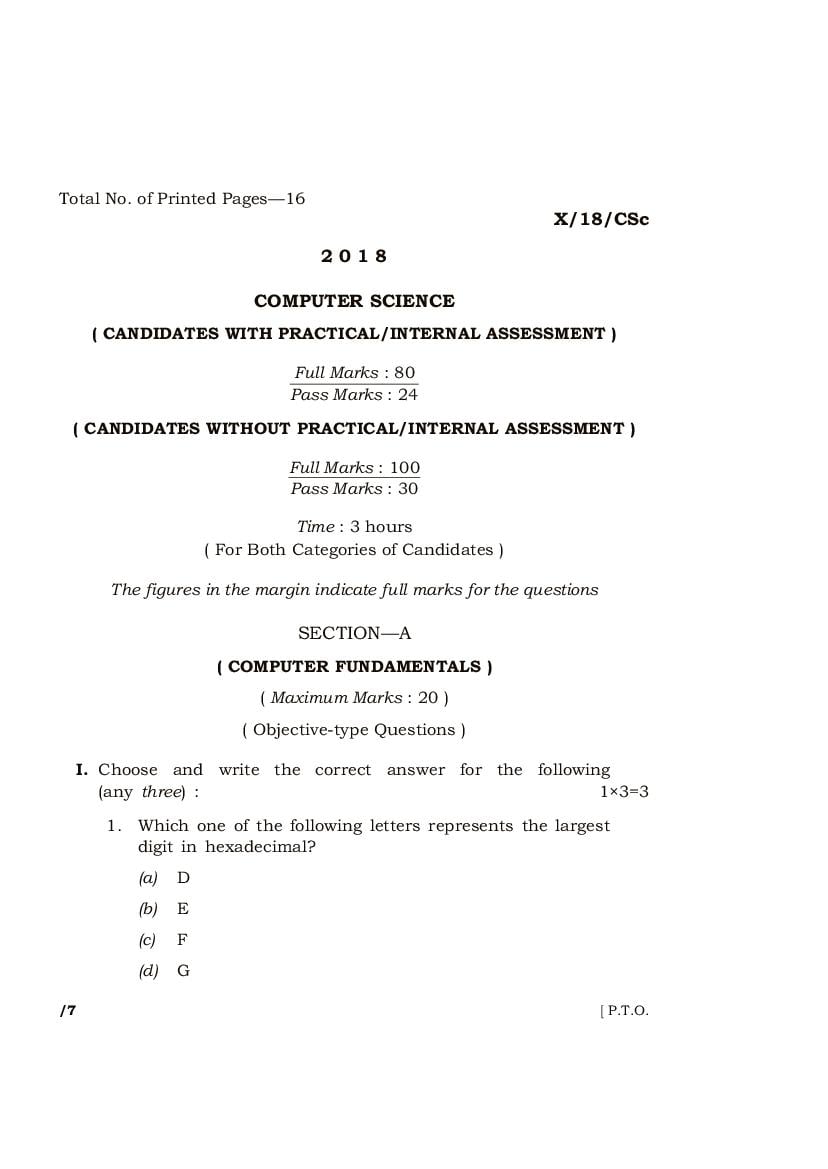
X/18/CSc
2018
COMPUTER SCIENCE
( CANDIDATES WITH PRACTICAL/INTERNAL ASSESSMENT )
Full Marks : 80
Pass Marks : 24
( CANDIDATES WITHOUT PRACTICAL/INTERNAL ASSESSMENT )
Full Marks : 100
Pass Marks : 30
Time : 3 hours
( For Both Categories of Candidates )
The figures in the margin indicate full marks for the questions
SECTION—A
( COMPUTER FUNDAMENTALS )
( Maximum Marks : 20 )
( Objective-type Questions )
I. Choose and write the correct answer for the following
(any three) : 1×3=3
1. Which one of the following letters represents the largest
digit in hexadecimal?
(a) D
(b) E
(c) F
(d) G
/7 [ P.T.O.
Page 2
2. In general for a number N of n digits with base p, the
( p -1’s
) compliment is calculated as
(a) pn + N (b) ( p n - 1) + N
(c) pn - N (d) ( p n - 1) - N
3. Using BCD-4 bit coding scheme, the decimal number 369
is represented by
(a) 001101101101
(b) 001101001001
(c) 001101101001
(d) 011101101001
4. According to binary arithmetic, the result of the addition
(10110)2 + (10101)2 is
(a) (101111)2 (b) (101011)2
(c) (100011) 2 (d) (101001)2
5. In Boolean algebra, if X = 0 and Y = 1, then X + Y is
equal to
(a) 0 (b) 1
(c) 10 (d) 11
6. Which of the following operations performs the last when
a logical expression contains a combination of AND, OR
and NOT operations?
(a) NOT
(b) OR
(c) AND
(d) None of the above
X/18/CSc/7 [ Contd.
Page 3
II. State whether the following statements are True or False
(any two) : 1×2=2
1. The division is actually implemented in a digital computer
by repetitive subtraction.
2. The continuous data that we need to provide to the
computer must be encoded into discrete.
3. The truth table deals only with the truth values and not
the falsity of the compound proposition.
4. The number 110 belongs to only binary number system.
III. Fill in the blanks in the following sentences (any two) : 1×2=2
1. Clubbing of 4 bits into a unit is called the _____.
2. NOT operation is also known as _____.
3. If the subtrahend is (100100)2 , then its 2’s compliment
will be _____.
4. Octal Number System consists of _____ digits.
( Short Answer-type Questions )
IV. Answer the following : 1×3=3
1. Define the term ‘bit’.
2. Give the full form of the abbreviation EBCDIC.
3. Convert (0 × 25)10 = (?)2
X/18/CSc/7 [ P.T.O.
Page 4
( Descriptive-type Questions )
V. Either
(a) (i) Write down the maximum number of codes allowed
in EBCDIC, ASCII and BCD. 1+1+1=3
(ii) Convert the following : 2
(1234)8 = (?)16
Or
(b) (i) Subtract (11010)2 - (10101)2 using 1’s compliment
method. 2
(ii) Give the truth table for the expression Y = A + B × C . 3
VI. Either
(a) (i) Give one example each of positional and
non-positional number systems. 2
(ii) Draw the logic circuit for the Boolean expression
Y = (A × B ) × (A + B ) × (C + D ) 3
[ For the Visually Handicapped (Blind) Students only
in lieu of Question No. VI(a)(ii) above ]
(ii) State three rules for subtraction using 2’s
compliment method. 1+1+1=3
Or
(b) (i) Explain briefly the NAND gate. Give its Boolean
expression with two inputs. 1+1=2
X/18/CSc/7 [ Contd.
Page 5
(ii) Give the Boolean expression of the following logic
circuit : 3
P
Q
R
Y
[ For the Visually Handicapped (Blind) Students only
in lieu of Question No. VI(b)(ii) above ]
(ii) What are Logic gates? Name the gate which has only
one input signal going into it. Write its Boolean
expression. 1+1+1=3
SECTION—B
( OPERATING SYSTEMS )
( Maximum Marks : 20 )
( Objective-type Questions )
I. Choose and write the correct answer for the following
(any two) : 1×2=2
1. Which of the following is an external DOS command?
(a) VOL
(b) COPY
(c) DEL
(d) EDIT
X/18/CSc/7 [ P.T.O.
Page 6
2. Which of the following files in DOS is called the command
processor ?
(a) COMMAND.COM
(b) IO.SYS
(c) MSDOS.SYS
(d) All of the above
3. The purpose of CHKDSK command is to check and
display
(a) the status of the selected disk
(b) the status of the computer’s memory
(c) the specified file for fragmentation
(d) All of the above
4. Which one of the following commands in Linux is used to
copy one or more files?
(a) chmod (b) cp
(c) cal (d) mv
II. State whether the following statements are True or False
(any two) : 1×2=2
1. A switch allows some additional features to the command.
2. The process in which files are written on a disk in parts is
known as ‘defragmentation’.
3. MEM command displays important information about the
disk.
4. Linux is an open source operating system released by
Linus Torvalds in 1991.
X/18/CSc/7 [ Contd.
Page 7
III. Fill in the blanks in the following sentences (any two) : 1×2=2
1. _____ command is used to arrange the data of a file in a
particular order (A–Z, 0–9) or reverse order.
2. _____ DOS command is used to change/modify the name
of a file or files.
3. _____ command is used to view the list of directories and
subdirectories present on the disk in graphical form.
4. To create directory in Linux, one must have _____
permission within the parent directory.
( Short Answer-type Questions )
IV. Write the commands and their switches (or options) for the
following (any two) : 2×2=4
1. Format the C drive and put the volume label TEST.
2. Copy all the files from A:\MYDIR to C: and its
subdirectories having the same file name.
3. Redirect all the commands presently stored in the buffer
to a file ‘computer.txt’.
4. Delete the file old.file in Linux with a prompt for
confirmation.
( Descriptive-type Questions )
V. Either
(a) (i) Differentiate between DEL and DELTREE commands
with their syntaxes. 2+2=4
(ii) What is the purpose of MKDIR command? 1
X/18/CSc/7 [ P.T.O.
Page 8
Or
(b) (i) Explain the purpose of ls command in Linux. Explain
the options -r and -c used with ls command.
2+1+1=4
(ii) What is the purpose of pwd command? 1
VI. Either
(a) Explain the purpose of FIND command with its syntax.
Briefly explain all the switches available with this
command. 1+1+3=5
Or
(b) (i) Differentiate between a proprietary software and an
open source software. 2+2=4
(ii) Name any two common distributions of Linux. ½+½=1
SECTION—C
( QBASIC )
( Maximum Marks : 28 )
( Objective-type Questions )
I. Choose and write the correct answer for the following
(any two) : 1×2=2
1. The string length falls within the range of
(a) -32,768 to 32,767
(b) 0 to 32,767
(c) 1 to 32,767
(d) 1 to 40
X/18/CSc/7 [ Contd.
Page 9
2. Which one of the following is not a relational operator?
(a) > (b) <
(c) ^ (d) =
3. Which one of the following statements is correct in case of
FOR-NEXT loop?
(a) The arguments counter, start, end and increment are
all string.
(b) It is indeterminate loop.
(c) It is determinate loop.
(d) None of the above
4. PRINT LEN (num%) will give the output as
(a) -1 (b) 0
(c) 1 (d) 2
II. State whether the following statements are True or False
(any two) : 1×2=2
1. The INPUT$(✗) function displays the number of keys
pressed from the keyboard.
2. The WHILE...WEND loop is used for backward
compatibility.
3. In a TAB (column) function, the least value of column can
be 0.
4. Argument variables in a subroutine are always passed by
reference by default.
X/18/CSc/7 [ P.T.O.
Page 10
III. Fill in the blanks in the following sentences (any two) : 1×2=2
1. _____ are used as place holders that can change its value
during the program execution.
2. If a = 10 × 45 and b = 2 × 61, the result of a \ b is _____.
3. Writing of _____ is an intermediary step between your
flowchart and the actual source code.
4. A _____ is used to identify a particular line/statement in
the program. It can be a string or a number.
IV. Answer the following questions : 1×3=3
1. Write QBasic expression for
Q
P -
2
P
+Q
2
2. When is LINE INPUT statement valuable in a program?
3. Write the output of the following QBasic statement :
PRINT USING ''**$####.##''; 123·4567
( Short Answer-type Questions )
V. Answer the following questions within 2 or 3 sentences or
steps (any two) : 2×2=4
1. What are the different forms the expression lists can have
in SELECT-CASE structure? 2
2. Give the summary of XOR operator and write its truth
table. 1+1=2
X/18/CSc/7 [ Contd.
Page 11
3. Distinguish between INT and CINT functions with
examples. 1+1=2
4. Explain the difference between a comma and a semicolon
as separators in PRINT statement. 1+1=2
( Descriptive-type Questions )
VI. Answer the following questions : 5×3=15
1. Either
(a) Explain the hierarchy of QBasic operators. 5
Or
(b) Enumerate the rules for READ-DATA statements. 5
2. Either
(a) Develop QBasic code to generate the following
output : 5
6 5 4 3 2 1
5 4 3 2 1
4 3 2 1
3 2 1
2 1
1
Or
(b) Write a QBasic program to calculate the sum and
average of a set of numbers given by the user. The
user should be allowed to input numbers as long as
he/she wants. 5
X/18/CSc/7 [ P.T.O.
Page 12
3. Either
(a) (i) Distinguish between the scope and lifetime of a
variable. 2+2=4
(ii) How can you extend the lifetime of a local
variable declared within a subprogram or
function? 1
Or
(b) Write a QBasic program to store 10 integer numbers
in a one-dimensional array, sort and display them in
descending order of their values. 5
SECTION—D
( JAVA CONCEPTS )
( Maximum Marks : 12 )
( Objective-type Questions )
I. Choose and write the correct answer for the following
(any two) : 1×2=2
1. A class declaration is enclosed within
(a) ( and )
(b) [ and ]
(c) { and }
(d) < and >
X/18/CSc/7 [ Contd.
Page 13
2. Which of the following operators is used to access data
member through an object of the class?
(a) . (dot)
(b) ; (semicolon)
(c) : (colon)
(d) = (assignment)
3. A ‘short’ data type variable occupies
(a) 1 byte
(b) 2 bytes
(c) 4 bytes
(d) 8 bytes
4. Which of the following visibility modifiers make the data
members and methods of a class visible and accessible to
every other classes?
(a) Private
(b) Protected
(c) Public
(d) None of the above
X/18/CSc/7 [ P.T.O.
Page 14
II. State whether the following statements are True or False
(any two) : 1×2=2
1. The process of creating an object from a class is called
instantiation.
2. A method in Java defines the operations that an object of
a class can execute.
3. The package ‘java.awt’ contains classes for designing GUI
applications.
4. A constant in Java is declared by the keyword final.
III. Fill in the blanks in the following sentences (any two) : 1×2=2
1. The _____ method reads a string as input terminated by
white space.
2. A _____ is a special purpose method in a class which
initializes the data members of an object on instantiation.
3. In Java, to declare a 10 element array of integers named
score, we have to write _____.
4. Comparison operator ‘equality’ is represented by the
symbol _____.
IV. Answer the following questions : 1×3=3
1. List two tools in Java Development Toolkit which are used
to compile and execute programs. ½+½=1
2. In declaring objects, what is the purpose of ‘new’
keyword? 1
3. What are the two main data type categories in Java?
½+½=1
X/18/CSc/7 [ Contd.
Page 15
V. Either
(a) (i) What is a class and how is it different from an object?
1+1=2
(ii) What is the main difference between the while loop
and the do-while loop? 1
Or
(b) (i) What do you understand by method overloading? 2
(ii) Define encapsulation. 1
[ For Private Candidates only (without Practical) ]
( Maximum Marks : 20 )
I. Answer the following questions within 2 or 3 sentences each
(any five) : 2×5=10
1. What do you understand by the character set of a
language? 2
2. What are reserved words? 2
3. What do you mean by relational operators? How do they
differ from arithmetic operators? 1+1=2
4. Explain LOCATE statement with its syntax. 1+1=2
5. Differentiate between a subprogram and a function. 1+1=2
6. What are the full forms of JSL and JDK? 2
7. In Java what are attributes and operations known as? 2
X/18/CSc/7 [ P.T.O.
Page 16
II. Answer the following questions : 5×2=10
1. Either
(a) Write a program to enter the radius of a circle and
calculate its area. 5
Or
(b) Enumerate the points to be remembered while
writing expressions in QBasic. 5
2. Either
(a) Write a program to calculate the factorial of any given
positive integer : 5
Example : Factorial of 5 is calculated as
5 ! = 5 ´ 4 ´ 3 ´ 2 ´ 1 = 120
Or
(b) What do you mean by branching statement?
Distinguish between conditional branching and
unconditional branching with examples. 1+2+2=5
HHH
8K—2360/7 X/18/CSc/7
Document Details
| Board / Org | Meghalaya Board |
| Exam | Class 10 |
| Type | Question Paper |
| Pages | 16 |
| Updated | 30 Apr 2026 |