TN 11th Model Question Paper Economics
Finished viewing? Save it for later —
Download TN 11th Model Question Paper Economics (PDF · 5 pages)About TN 11th Model Question Paper Economics
TN 11th Model Question Paper Economics is available here for free download. Published by Tamil Nadu Board for Class 11, this sample paper can be viewed online or downloaded as a PDF (5 pages). Candidates preparing for Class 11 can use TN 11th Model Question Paper Economics to understand the exam pattern, the type of questions asked, and the overall difficulty level.
Frequently Asked Questions
How can I download TN 11th Model Question Paper Economics?
Open this page and click the Download button to save TN 11th Model Question Paper Economics as a PDF. It is completely free on AglaSem Docs.
Is TN 11th Model Question Paper Economics free to download?
Yes. TN 11th Model Question Paper Economics can be viewed online and downloaded as a PDF free of cost on AglaSem Docs.
How many pages does TN 11th Model Question Paper Economics have?
TN 11th Model Question Paper Economics contains 5 pages, which you can read online or download together as a single PDF.
Where can I find more Class 11 study material?
You can find more Class 11 question papers, sample papers, syllabus, and answer keys on AglaSem Docs.
TN 11th Model Question Paper Economics – Text
Read the full text of this sample paper below — useful to quickly search, copy and reference the content online without downloading the PDF.
📄 View text version (5 pages)
Page 1
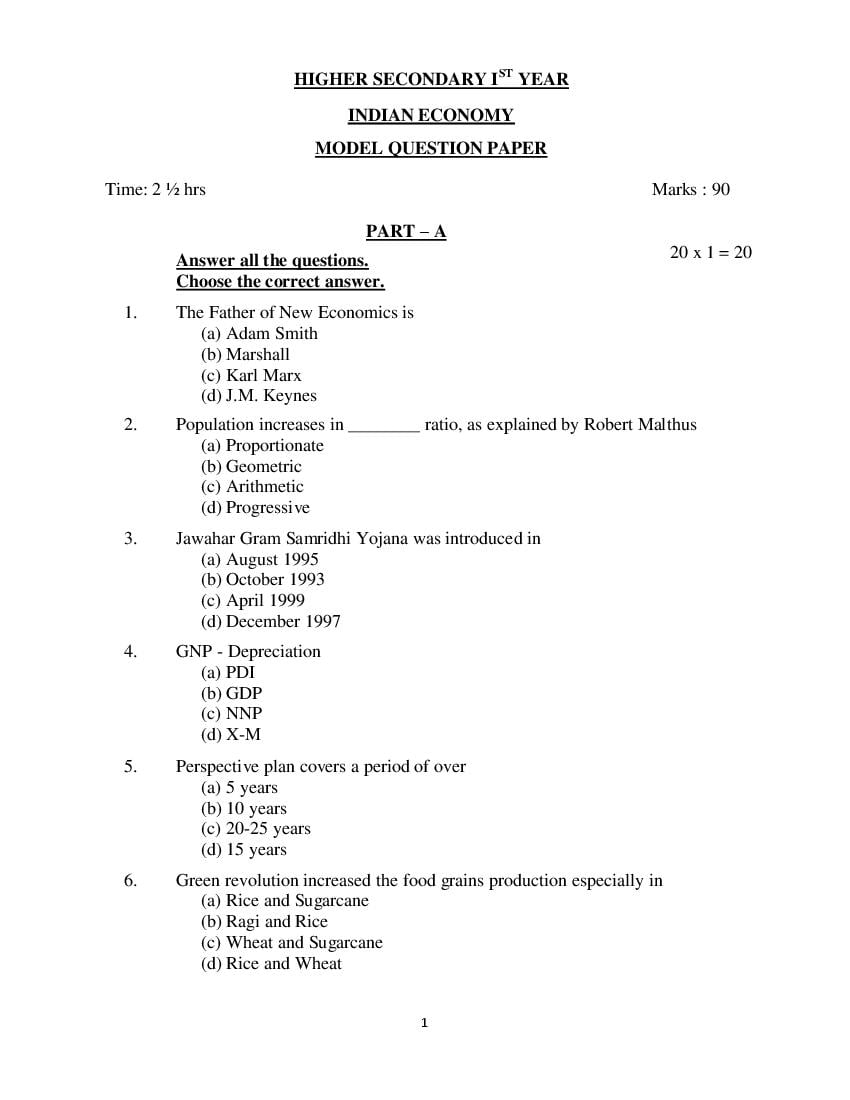
INDIAN ECONOMY
MODEL QUESTION PAPER
Time: 2 ½ hrs www.tnschools.co.in Marks : 90
PART – A
Answer all the questions. 20 x 1 = 20
Choose the correct answer.
1. The Father of New Economics is
(a) Adam Smith
(b) Marshall
(c) Karl Marx
(d) J.M. Keynes
2. Population increases in ________ ratio, as explained by Robert Malthus
(a) Proportionate
(b) Geometric
(c) Arithmetic
(d) Progressive
3. Jawahar Gram Samridhi Yojana was introduced in
(a) August 1995
(b) October 1993
(c) April 1999
(d) December 1997
4. GNP - Depreciation
(a) PDI
(b) GDP
(c) NNP
(d) X-M
5. Perspective plan covers a period of over
(a) 5 years
(b) 10 years
(c) 20-25 years
(d) 15 years
6. Green revolution increased the food grains production especially in
(a) Rice and Sugarcane
(b) Ragi and Rice
(c) Wheat and Sugarcane
(d) Rice and Wheat
1
Page 2
(a) Making loans and advances to the public
(b) Accepting deposits
(c) Issue of paper money
(d) Participating in the inter bank borrowing
8. OPEC Countries
(a) Germany, Romania, Russia
(b) Africa, Latin America, Asia
(c) Belgium, France, Germany
(d) Iran, Iraq, Kuwait
9. The most stable measure of variability is
(a) Variance
(b) Mean
(c) Median
(d) Mode
10. Which of the following is called as an important agro based industry
(a) Steel
(b) Cement
(c) Sugar
(d) Jute
11. Which of the following is an intermediate good
(a) Cement
(b) Television
(c) Soft drinks
(d) Bikes
12. World Bank was set up in
(a) 1983
(b) 1844
(c) 1948
(d) 1944
13. The Planning Commission of India defined poverty on the basis of
(a) Income
(b) Consumption
(c) Calorie intake of food
(d) Employment
2
Page 3
(a) Adam Smith
(b) David Ricardo
(c) J.S. Mill
(d) Karl Marx
15. The latin word Status represents
(a) Logic
(b) Science
(c) Economics
(d) Statistics
16. Mode is the
(a) common item of a series
(b) middle item
(c) largest value
(d) smallest value
17. The first five year plan of India was launched in
(a) 1947
(b) 1951
(c) 1956
(d) 1961
18. Agricultural productivity can be measured in terms of
(a) Consumption of fertilizer
(b) Irrigational facilities
(c) Land and Labour productivity
(d) Mechanization
19. The main inconvenience of barter system was
(a) Transactions were many and complex
(b) Lack of double coincidence of wants
(c) The intermediate commodity need not be familiar
(d) Prevalence of domestic system
20. Education is a
(a) Consumption Good
(b) Investments
(c) None
(d) Both
3
Page 4
Answer any seven in which Question No. 30 is compulsory.
21. Mention the Rostow stages of economic growth
22. How can unemployment among educated people solved in India?
23. What is Mahalanobis Strategy?
24. Mention the contribution of agriculture to economic growth
25. Classify the use based industries.
26. What is meant by Open Market Operation? Which bank does this operation in
India?
27. What is Money? Give any two functions.
28. How is the composite index of HRD constructed?
29. Find out the range for the marks scored by Mala in five subjects
68, 42, 86, 38, 40
30. What are the indicators of a country’s economic development?
PART – C (7 x 3 = 21)
Answer any seven question in which Question No.40 is
compulsory.
31. How is economic backwardness reflected in our country?
32. Explain demographic transition with diagram.
33. Mention the estimates of unemployment.
34. Write a note on the sectoral composition of National Income
35. What is rolling plan?
36. What is the importance of agricultural marketing.
37. a) Write a note on Textile industry.
b) Mention the problems faced by Textile industry.
38. What are the qualitative credit control methods of RBI?
39. The marks of 10 students in a class is given below. Calculate Arithmetic mean
& median
Marks : 45, 60, 45, 60, 50, 30, 55, 20, 10, 25
40. Malthus has given two checks to correct the imbalance in population. Explain.
4
Page 5
PART – D
Answer all the questions
41. Explain any five characteristics of underdeveloped countries.
(or)
What are the measures to achieve stable population?
42. Distinguish rural poverty and urban poverty.
(or)
What is National Income. Explain the calculation of national income through
income method
43. What are the problems of planning in underdeveloped count
(or)
Suggest and explain any four measures to solve the various problems of
Indian Agriculture.
44. Discuss the importance of Small Scale Industries.
(or)
Distinguish between central bank and commercial bank
45. What are the parameters of Globalisation?
(or)
Explain Vazhvoli Thittam and how can it be implemented in schools.
46. (a) The daily earnings(in rupees) of employees working in a daily basis in a
firm are
Daily 90-110 110- 130- 150- 170- 190- 210-
Earning 130 150 170 190 210 230
(Rs.)
No. of 3 6 10 15 24 42 75
Employees
Calculate the average daily earning for all employees
(or)
(b) What is index number and what are its uses?
47. (a) Briefly explain the problems in calculating national income.
(or)
(b) Explain the following functions of central bank.
i. Creation of money or credit
ii. Agency functions
-------
5
Powered by TCPDF (www.tcpdf.org)
Document Details
| Board / Org | Tamil Nadu Board |
| Exam | Class 11 |
| Type | Sample Paper |
| Pages | 5 |
| Language | english |
| Updated | 09 Jun 2026 |