JAM 2026 Question Paper Economics (EN)
Finished viewing? Save it for later —
Download JAM 2026 Question Paper Economics (EN) (PDF · 34 pages)About JAM 2026 Question Paper Economics (EN)
JAM 2026 Question Paper Economics (EN) is available here for free download. Published by IIT for Joint Admission Test for M.Sc, this question paper can be viewed online or downloaded as a PDF (34 pages). Candidates preparing for Joint Admission Test for M.Sc can use JAM 2026 Question Paper Economics (EN) to understand the exam pattern, the type of questions asked, and the overall difficulty level.
Frequently Asked Questions
How can I download JAM 2026 Question Paper Economics (EN)?
Open this page and click the Download button to save JAM 2026 Question Paper Economics (EN) as a PDF. It is completely free on AglaSem Docs.
Is JAM 2026 Question Paper Economics (EN) free to download?
Yes. JAM 2026 Question Paper Economics (EN) can be viewed online and downloaded as a PDF free of cost on AglaSem Docs.
How many pages does JAM 2026 Question Paper Economics (EN) have?
JAM 2026 Question Paper Economics (EN) contains 34 pages, which you can read online or download together as a single PDF.
Where can I find more Joint Admission Test for M.Sc study material?
You can find more Joint Admission Test for M.Sc question papers, sample papers, syllabus, and answer keys on AglaSem Docs.
JAM 2026 Question Paper Economics (EN) – Text
Read the full text of this question paper below — useful to quickly search, copy and reference the content online without downloading the PDF.
📄 View text version (34 pages)
Page 1
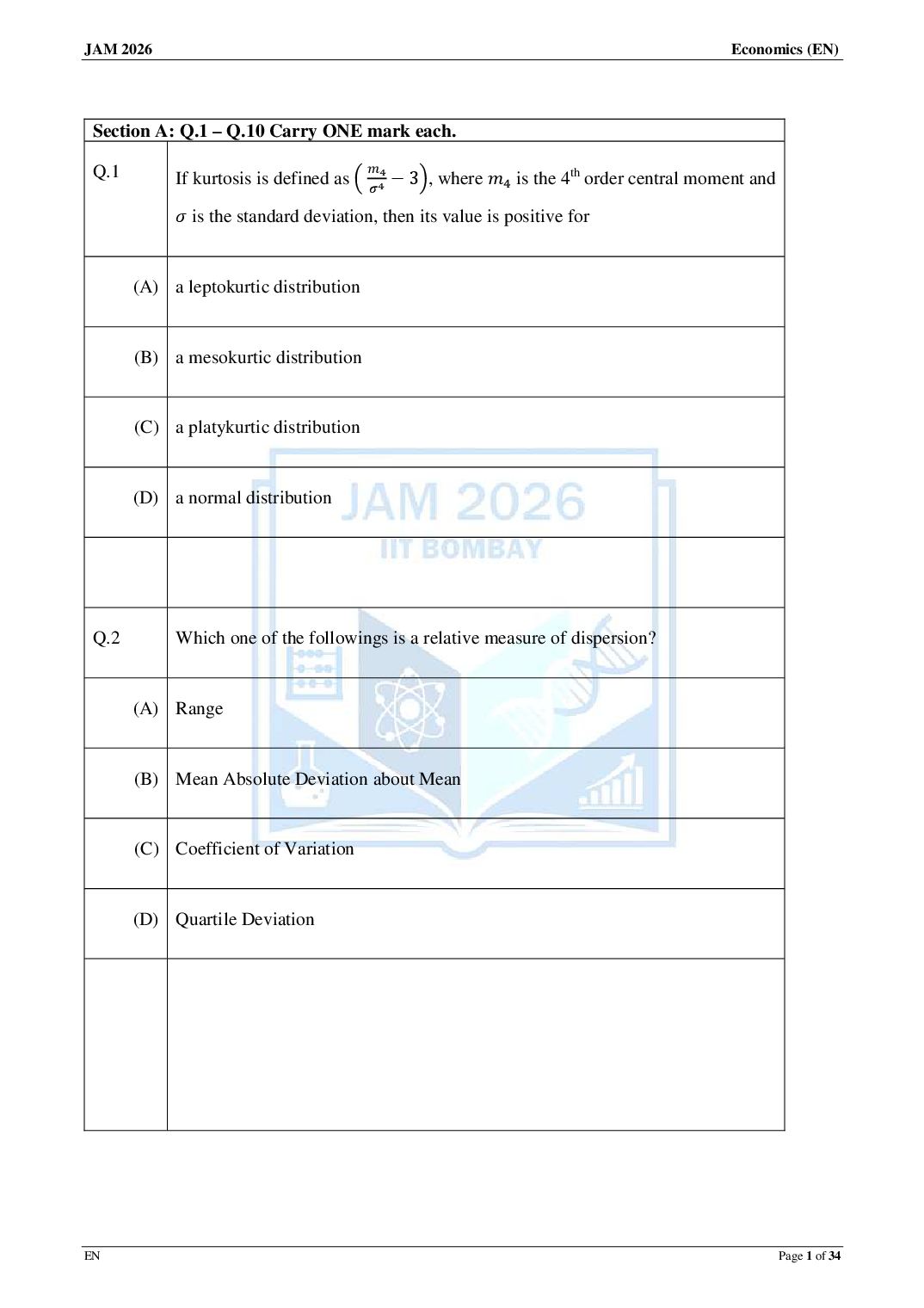
Section A: Q.1 – Q.10 Carry ONE mark each.
Q.1 If kurtosis is defined as − 3 , where is the 4th order central moment and
is the standard deviation, then its value is positive for
(A) a leptokurtic distribution
(B) a mesokurtic distribution
(C) a platykurtic distribution
(D) a normal distribution
Q.2 Which one of the followings is a relative measure of dispersion?
(A) Range
(B) Mean Absolute Deviation about Mean
(C) Coefficient of Variation
(D) Quartile Deviation
EN Page 1 of 34
Page 2
Q.3 Which one of the followings was NOT part of India’s economic reforms in 1991?
(A) Abolition of ‘License Raj’
(B) Encouragement of foreign investment
(C) Devaluation of Rupee
(D) Nationalisation of banks
Q.4 India’s Second Five-Year Plan (1956-61) was developed based on
(A) Harrod-Domar Model
(B) Mahalanobis Model
(C) Gadgil Formula
(D) Solow Model
EN Page 2 of 34
Page 3
Q.5 Let , , and represent own price elasticity of demand, total revenue, and price,
∂
respectively for a good. If ∂ < 0, then
(A) | | > 1
(B) | | = 1
(C) | | < 1
(D) | | = 0
Q.6 Which one of the following statements is CORRECT for the general equilibrium
analysis for a two-person and two-good pure exchange economy?
(A) Some points on the contract curve may not be Pareto optimal.
(B) Endowment point cannot be on the boundary of the Edgeworth Box.
(C) Equilibrium prices are endogenously determined.
(D) In equilibrium, net demand for a good is either positive or negative but cannot
be zero.
EN Page 3 of 34
Page 4
Q.7 Which one of the following statements is CORRECT in the context of
Gross Domestic Product (GDP) calculation?
(A) GDP includes unpaid domestic work.
(B) GDP includes government consumption expenditure.
(C) GDP excludes rent on owner-occupied houses.
(D) GDP excludes self-consumption of production by the producer.
Q.8 The relationship between tax revenue and tax rate is represented by ________.
(A) J-Curve
(B) Laffer Curve
(C) Phillips Curve
(D) IS Curve
EN Page 4 of 34
Page 5
Q.9 The Permanent Settlement Act of 1793 primarily aimed at
(A) abolition of the ryotwari system
(B) establishment of peasant ownership of land
(C) securing land revenue for British Government
(D) abolition of the zamindari system
Q.10 The area under the curve = between = 1 and = 2 is
(A) 1
3
(B) 4
3
(C) 5
3
(D) 7
3
EN Page 5 of 34
Page 6
Section A: Q.11 – Q.30 Carry TWO marks each.
Q.11 In a year of 366 days, what is the chance that three persons have different
birthdays?
(A) 1
366 × 366 × 366
(B) 1
366 × 365 × 364
(C) 365 × 364
366 × 366
(D) 365 × 364
1−
366 × 366
EN Page 6 of 34
Page 7
Q.12 Let $% be the value of $ in year &. The natural logarithmic value of $% is regressed
on &. A simple linear regression yields the statistically significant estimates of
intercept and slope coefficient as 12 and 0.1512, respectively. The calculated
compound annual growth rate of $ is
(A) 15.12%
(B) 1.16%
(C) 16.32%
(D) 116%
EN Page 7 of 34
Page 8
Q.13 For a sample of employees participating in an annual appraisal, the effect of the
participants’ performance on their wages is studied. Information are collected,
and variables of interest are defined below:
'() * = wage of the employee +
1, if the employee + passes in the annual appraisal
,(--* = .
0, if the employee + fails in the annual appraisal
1, if the employee + fails in the annual appraisal
?(+@* = .
0, if the employee + passes in the annual appraisal
Based on the above information, which one of the following regression models
cannot be estimated?
(A) '() * = A + C,(--* + D?(+@* + EF* ;
where, A, C, and D are the model parameters and EF* is the error term
(B) '() * = C,(--* + D?(+@* + EG* ;
where, C and D are the model parameters and EG* is the error term
(C) '() * = A + D?(+@* + EH* ;
where, A and D are the model parameters and EH* is the error term
(D) '() * = A + C,(--* + E * ;
where, A and C are the model parameters and E * is the error term
EN Page 8 of 34
Page 9
Q.14 A monopolist sells different units of output for different prices, but every
individual who buys the same quantity of the good pays the same price. It is
known as _________ price discrimination.
(A) first degree
(B) third degree
(C) perfect
(D) second degree
EN Page 9 of 34
Page 10
Q.15 Consider a social welfare function (SWF) defined as I'? = JF , JG , … , J ,
where J* is the utility function of the + %L person, given that there are people in
the society. Identify which one of the following statements is CORRECT.
(A) Jeremy Bentham and John Stuart Mill proposed
I'? = ∑*OF N* J* , where N* is the weight assigned to individual + for their
unique characteristics and NF ≠ NG ≠ ⋯ ≠ N .
(B) Since SWF reflects value judgements, interpersonal comparisons can be made on
scientific grounds.
(C) John Rawls proposed I'? = ( + E {JF , JG , … , J }.
(D) If I'? = ∑*OF J* , it is referred as the utilitarian function.
Q.16 The Taylor rule is used by the Central Banks mainly
(A) to set exchange rate based on inflation gap and output gap
(B) to set nominal interest rate based on inflation gap and output gap
(C) to set nominal interest rate based on exchange rate and inflation gap
(D) to forecast future economic growth
EN Page 10 of 34
Page 11
Q.17 Which one of the following statements regarding Romer’s Endogenous Growth
model and Solow’s Growth model is CORRECT?
(A) Romer’s Endogenous Growth model assumes constant returns to scale whereas
Solow’s Growth model assumes increasing returns to scale.
(B) Capital accumulation is exogenous in Solow’s Growth model and endogenous in
Romer’s Endogenous Growth model.
(C) Romer’s Endogenous Growth model explains technological progress but
Solow’s Growth model does not.
(D) Capital accumulation is exogenous in both models.
Q.18 In the context of Reserve Bank of India’s monetary policy, which one of the
following options represents the CORRECT order of magnitude?
(A) Marginal Standing Facility rate > Repo rate > Reverse Repo rate
(B) Marginal Standing Facility rate > Reverse Repo rate > Repo rate
(C) Repo rate > Reverse Repo rate > Marginal Standing Facility rate
(D) Repo rate > Marginal Standing Facility rate > Reverse Repo rate
EN Page 11 of 34
Page 12
Q.19 Which one of the following statements is CORRECT in the context of positive
consumption externality?
(A) Marginal private benefit is higher than marginal social benefit.
(B) Marginal social cost is lower than marginal private cost.
(C) Marginal private cost is lower than marginal social cost.
(D) Marginal social benefit is higher than marginal private benefit.
Q.20 Consider a case of negative production externality, where TIU is marginal social
cost, T,U is marginal private cost, and T,V is marginal private benefit. Assume
that the property rights belong to the polluter. As per the Coase theorem, payment
will be acceptable to both parties (i.e., polluter and the affected party) when
(A) TIU − T,U > > T,V − T,U
(B) T,V − T,U > > TIU − T,U
(C) T,U − TIU > > T,V − T,U
(D) T,U − T,V > > TIU − T,U
EN Page 12 of 34
Page 13
Q.21 Which one of the following statements is CORRECT in the context of price
indices?
(A) A weighted average of prices of raw materials and semifinished goods, relative
to a base-year is known as the Consumer Price Index.
(B) A weighted average of prices of consumer goods, relative to a base-year is known
as the Producer Price Index.
(C) The price index that considers the quantity of goods in the base-year as weight is
known as the Laspeyres Index.
(D) The price index that considers the quantity of goods in the base-year as weight is
known as the Paasche Index.
Q.22 Which one of the following statements is CORRECT in the context of the
Keynesian Absolute Income Hypothesis?
(A) The marginal propensity to consume increases as the income increases.
(B) The average propensity to consume increases as the income increases.
(C) The average propensity to save decreases as the income increases.
(D) The average propensity to consume approaches the marginal propensity to
consume as the income increases.
EN Page 13 of 34
Page 14
Q.23 Consider a closed economy IS-LM model with downward sloping IS curve.
If there is an increase in government spending, then which one of the following
statements is CORRECT?
(A) If LM curve is horizontal, then the equilibrium level of income remains
unchanged.
(B) If LM curve is horizontal, then the equilibrium interest rate increases.
(C) If LM curve is vertical, then the equilibrium level of income remains unchanged.
(D) If LM curve is vertical, then the equilibrium interest rate decreases.
Q.24 Consider the Mundell-Fleming model with flexible exchange rate for a small
open economy characterised by a downward sloping IS curve and a vertical LM
curve. If the risk premium of the country increases, then which one of the
following options is CORRECT?
(A) income increases
(B) exchange rate appreciates
(C) domestic interest rate declines
(D) both IS and LM curve shift to the left
EN Page 14 of 34
Page 15
Q.25 In India, plan-holiday was declared between
(A) Second and Third Five-Year Plan
(B) Third and Fourth Five-Year Plan
(C) Sixth and Seventh Five-Year Plan
(D) Ninth and Tenth Five-Year Plan
EN Page 15 of 34
Page 16
Q.26 Let us consider a simultaneous game involving two players W and $. W has two
strategies, namely ‘Top’ and ‘Bottom’, and $ has two strategies, namely ‘Left’
and ‘Right’. The payoff matrix is as given below:
$
Left Right
Top (1, 2) (4, 1)
W
Bottom (2, 3) (3, 4)
In payoff (+, X , + and X refer to payoffs of W and $, respectively.
Then, which one of the following statements is CORRECT?
(A) Pure strategy Nash equilibria are hidden here.
(B) Nash equilibrium is reached when each of them purely randomises their behavior.
(C) The game is similar to a Matching Pennies game.
(D) The game is similar to a Battle of Sexes game.
EN Page 16 of 34
Page 17
Y YG
A 2×2 matrix Y = Z F [ has the following properties:
Q.27
YH Y
(i) Y* ∈ for all + = 1, 2, 3, 4;
(ii) Y* ≠ 0 for some + = 1, 2, 3, 4; and
(iii) Y = YG = YH = ⋯
Which one of the following options is CORRECT?
(A) Y ]F does not exist for all Y
(B) Y%^_`abcad ≠ Y ]F for all Y
(C) Y = Y ]F for some Y
(D) For all Y, ℎ%^_`abcad Yℎ > 0 for all possible non-zero vector ℎ with real
elements
EN Page 17 of 34
Page 18
Q.28 A single-input production function is given by
f = gh.G
where, f > 0 and g > 0 denote output and the single input, respectively.
The unit price of g is N > 0 . The cost is UF when no output is produced.
Which one of the following statements is CORRECT?
(A) The cost function is concave and the production function is convex.
(B) The cost function is convex and the production function is concave.
(C) The cost function and the production function are both differentiable and convex.
(D) The cost function and the production function are both differentiable and
concave.
EN Page 18 of 34
Page 19
Q.29 Consider the statements I, II, and III:
I. Income elasticity of demand for a normal good is positive.
II. Income elasticity of demand for an inferior good is negative.
III. Income elasticity of demand for a luxury good is less than 1.
Which one of the following options is CORRECT?
(A) Both II and III are NOT CORRECT, but I is CORRECT
(B) Both II and III are CORRECT, but I is NOT CORRECT
(C) Both I and III are CORRECT, but II is NOT CORRECT
(D) Both I and II are CORRECT, but III is NOT CORRECT
Q.30 Consider a demand curve represented as j _ k = l, where j is the quantity
demanded, is the per unit price, and (, m, and l are all positive constants. The
absolute value of the own price elasticity of demand is
(A) m/(
(B) (/m
(C) m
(D) (
EN Page 19 of 34
Page 20
Section B: Q.31 – Q.40 Carry TWO marks each.
Q.31 Identify the CORRECT relationship(s) between the average product of labour
o,p and marginal product of labour T,p in the short-run.
(A) If T,p > o,p , then ro,g
>0
rg
(B) If T,p < o,p , then ro,g
>0
rg
(C) If T,p > o,p , then ro,g
rg
<0
(D) If T,p < o,p , then ro,g
<0
rg
EN Page 20 of 34
Page 21
Q.32 Consider the following demand and supply functions:
Demand Function: s = 400 − 8
Supply Function: I = 2
where, s , I , and represent quantity demanded, quantity supplied, and
unit price, respectively; and the choke price is Rupees 50.
Identify which of the following statement(s) is/are CORRECT.
(A) The choke price is equal to the market clearing price.
(B) If a 25% ad valorem tax is imposed by the government, then the new market
clearing price is equal to the choke price.
(C) If a 100% ad valorem tax is imposed by the government, then the choke price
still exists.
(D) If a flat-rate tax of Rupees 10 per unit is imposed by the government, then the
new market clearing price is equal to the choke price.
EN Page 21 of 34
Page 22
Q.33 Consider the following goods and money market equations:
Goods market Money market
$ =U+u+v T a = Tx
U = 20 + 0.75 $ − w Tx = 0.2$ − 15+
w = −40 + 0.2$ T a = 200
u = 240 − 8+
v = 300
where $ is output, U is consumption expenditure, u is investment expenditure,
v is government expenditure, w is tax, + is interest rate, T a is money supply, and
Tx is money demand.
Identify the CORRECT option(s).
(A) The IS equation is + = 73.75 − 0.05$
(B) The LM equation is + = 0.0133$ − 13.33
(C) The equilibrium + = 7 and $ = 1400
(D) If v decreases to 200, then new equilibrium + = 4 and $ = 1200
EN Page 22 of 34
Page 23
Q.34 Identify the CORRECT statement(s) in the context of an open economy.
(A) When domestic currency appreciates, foreign goods become more expensive to
domestic buyers.
(B) When domestic currency appreciates, domestic goods become more expensive to
foreign buyers.
(C) When domestic currency depreciates, foreign goods become less expensive to
domestic buyers.
(D) When domestic currency depreciates, domestic goods become more expensive to
foreign buyers.
Q.35 In the context of Keynesian money demand, ceteris paribus, the real demand for
money increases when
(A) interest rate decreases
(B) income increases
(C) price level decreases
(D) interest rate increases
EN Page 23 of 34
Page 24
Q.36 Which of the following statement(s) is/are CORRECT regarding Skill
Development in India as highlighted in the Economic Survey 2024-25?
(A) Between 2018-19 and 2023-24, there is a significant improvement in the
proportion of skilled people across all socio-economic classifications.
(B) The Union Budget of 2024-25 announced the PM Internship Scheme.
(C) Out of the total beneficiaries in the Jan Shikshan Sansthan Scheme, majority are
male.
(D) Out of the total beneficiaries in the Jan Shikshan Sansthan Scheme, majority are
female.
EN Page 24 of 34
Page 25
Q.37 Consider the following Cobb-Douglas production function:
f y, g = oy h. gh. ; o>0
where, f is the quantity produced using two inputs, capital y and labour g .
Assuming that y is a positive constant, identify the CORRECT statement(s).
{|
(A) increases as g increases.
{p
{|
(B)
{p
decreases as g increases.
(C) As g increases, f increases but at a slower rate.
(D) As g increases, f decreases but at a slower rate.
Q.38 Identify the CORRECT feature(s) of the Indian labour market since the year
2000.
(A) A shift in employment from low-productive agriculture sector to relatively high-
productive non-agriculture sector.
(B) The construction sector has high employment elasticity.
(C) The production process has become more labour-intensive.
(D) The service sector has been the primary driver of India’s growth.
EN Page 25 of 34
Page 26
Q.39 Which of the following indicator(s) is/are used by the NITI Aayog’s Sustainable
Development Goal (SDG) India Index 2023-24 report to measure India’s
performance towards SDG 10 (Reduced Inequalities)?
(A) Percentage of seats held by women in Panchayati Raj Institutions (PRIs)
(B) Income inequality using Gini coefficient
(C) Unemployment rate in the age group of 15-59 years
(D) Annual growth rate of GDP per-capita at constant prices
Q.40 Identify the regulatory institution(s) in India.
(A) Securities and Exchange Board of India (SEBI)
(B) Insurance Regulatory and Development Authority of India (IRDAI)
(C) Small Industries Development Bank of India (SIDBI)
(D) Central Electricity Regulatory Commission (CERC)
EN Page 26 of 34
Page 27
Section C: Q.41 – Q.50 Carry ONE mark each.
Q.41 Harmonic mean of the following twelve observations: 15, 20, 20, 5, 20, 20, 15,
20, 15, 20, 20, and 20 is _________ (rounded off to one decimal place).
Q.42 It is given that the Prob −1 ≤ € ≤ 1 = 0.683, Prob −2 ≤ € ≤ 2 = 0.954,
and Prob −3 ≤ € ≤ 3 = 0.997, when € follows a standard normal
distribution. If W follows a normal distribution with mean and variance as 5 and
4, respectively, then Prob 1 ≤ W ≤ 7 = _________ (rounded off to three
decimal places).
Q.43 The arithmetic mean of consumption expenditures for 5 members is Rupees 40,
with standard deviation of Rupees 7. Three new members are added in the group,
and their consumption expenditures (in Rupees) are 30, 35, and 40. Then, the
standard deviation of consumption expenditures of these 8 members is
_________ (rounded off to two decimal places).
EN Page 27 of 34
Page 28
Q.44 Consider a game of coexistence where everyone exhibits two kinds of behaviour:
‘Hawk’ and ‘Dove’. The possible set of payoffs is given as follows:
Hawk Dove
Hawk (−2, −2) (4, 0)
Dove (0, 4) (2, 2)
Suppose that the population fraction exhibiting ‘Hawkish’ behaviour is , then
the value of at the Nash equilibrium is _________ (rounded off to one decimal
place).
Q.45 The utility function of a consumer in a two-good world is given by
E F, G = +ƒ+ E { F , G }, where F and G are the quantities consumed of
the two goods WF and WG, respectively. The market prices of WF and WG are
Rupee 1 and Rupees 2 per unit, respectively. Assuming income is measured on
the vertical axis, the slope of the Engel curve for WG is _________ (in integer).
EN Page 28 of 34
Page 29
Q.46 Consider the following information for a country:
Category Amount
Gross Domestic Product (GDP) 7500
Receipts of factor income from the rest of the world 200
Payments of factor income to the rest of the world 220
Depreciation 800
The Net National Product (NNP) of the country is _________ (in integer).
Q.47 Let us consider an AK growth model where the growth rate of per-capita output,
population growth rate, and depreciation rate are 4%, 2%, and 4%, respectively.
If productivity parameter (A) is 0.5, then savings rate (in %) is _________ (in
integer).
Q.48 In an expectations-augmented Phillips curve equation, expected inflation rate and
natural rate of unemployment are 5% and 4%, respectively. The responsiveness
of inflation to unemployment gap is 0.5. If actual unemployment rate is 5%, then
the actual inflation rate (in %) is _________ (rounded off to one decimal place).
Q.49 The maximum value of the objective function + „ subject to the constraint
G
+ „ G = 2 is _________ (in integer).
EN Page 29 of 34
Page 30
Q.50 The value of the first derivative of = 3 H+2 G+ + 1 G evaluated at
= 2 is _________ (in integer).
Section C: Q.51 – Q.60 Carry TWO marks each.
Q.51 It is given that the variance of a population is 4, but its mean … is unknown.
A sample of size 25 is drawn randomly from this population to test the null
hypothesis †h : … = 4.8. The sample elements are F, G, … , G such that
∑G*OF * = 150 and ∑G*OF *G = 1116.
Based on the above information, the calculated value of &-statistic is _________
(in integer).
Q.52 Consider a firm is having monopoly in production of two goods W and $. The
markets for the two goods do not interact. The profit function is given by
ˆ , „ = 25 + 13„ − 2.5 G − „ G + „ − 10
where, and „ are quantities of goods W and $, respectively.
The maximum profit is _________ (rounded off to one decimal place).
EN Page 30 of 34
Page 31
Q.53 The chance of rain on a day when an outdoor picnic is arranged is 40%. If it rains,
the chance that the picnic will be ‘good and enjoyable’ is 30%. However, if it
does not rain, the chance that the picnic will be ‘good and enjoyable’ is 80%. The
chance (in %) that it was raining on the day of picnic, given that the picnic was
indeed ‘good and enjoyable’ is _________ (in integer).
Q.54 Consider the following information in the context of negative production
externality:
Supply curve: , = 15 + 0.08f
Demand curve: , = 40 − 0.15f
where, , is price per unit and f is quantity.
If marginal external cost is 0.06f, then the socially efficient equilibrium price is
_________ (rounded off to two decimal places).
Q.55 In a two-good world, the utility function of a consumer is given by
E F, G = F G , where F and G are the quantities consumed of the two goods
WF and WG, respectively. The market price of each of the goods is Rupee 1 and
consumer’s disposable income is Rupees 100. If the price of WG is doubled
keeping the price of WF unchanged, then the associated Compensating Variation
is Rupees _________ (rounded off to one decimal place).
EN Page 31 of 34
Page 32
Q.56 Let us consider a duopoly market with the following market demand and firm-
specific cost functions:
, = 120 − 0.6f, where f = fF + fG
UF = 6fF and UG = 0.5fGG
where, , is unit price of the product. U* is the cost function and f* is the output
of firm + (+ = 1, 2 .
The total output (f) produced by the duopolists ignoring their interdependence is
_________ (rounded off to two decimal places).
Q.57 Consider the following equations for a closed economy:
I% = ($%
u% = ) $% − $%]F
where I% , $% , and u% represent savings, income, and investment, respectively in
period &; and ( and ) are two positive constants.
For $h = 100, ( = 0.5 and ) = 0.6, the value of $G is _________ (in integer).
EN Page 32 of 34
Page 33
Q.58 Consider the following equation:
$ = U $x + u Š + v + ‹W Œ ; $x = $ − w
where $ is income, U is consumption expenditure, $x is disposable income, w is
tax amount, u is investment expenditure, Š is real interest rate, v is government
expenditure, ‹W is net export, and Œ is real exchange rate.
It is given that $ = 5000, v = 1000, w = 1000, U = 250 + 0.75$x ,
u = 1000 − 50Š, ‹W = 500 − 500Œ, and Š = 5.
If v decreases to 750, then the national savings increase by _________ (in
integer).
Q.59 Consider a Solow model with the production function: $ = y • gF]• , where $,
y, and g are output, capital, and labour, respectively. A is a positive constant.
The savings rate, depreciation rate, and labour growth rates are 20%, 7%, and
3%, respectively. If A = 0.5, then the steady-state capital-labour ratio is
_________ (in integer).
EN Page 33 of 34
Page 34
Q.60 Consider the following population regression equation:
$* = A + CW* + E*
where, $ and W are dependent and independent variables, respectively; and E is
the error term. The parameters A and C are estimated using the ordinary least
squares method.
It is given that, the sample size is 100, ∑Fhh G
*OF W* = 4,60,000,
∑Fhh
*OF $* = 3,20,000, ∑*OF W* = 6,000, ∑*OF $* = 500, and ∑*OF W* $* = 40,000.
G Fhh Fhh Fhh
Then the estimated value of A is _________ (in integer).
END OF THE QUESTION PAPER
EN Page 34 of 34
Document Details
| Board / Org | IIT |
| Exam | Joint Admission Test for M.Sc |
| Type | Question Paper |
| Pages | 34 |
| Updated | 24 Sep 2026 |