ISC Class 12 Sample Paper Electricity and Electronics
Finished viewing? Save it for later —
Download ISC Class 12 Sample Paper Electricity and Electronics (PDF · 7 pages)About ISC Class 12 Sample Paper Electricity and Electronics
ISC Class 12 Sample Paper Electricity and Electronics is available here for free download. Published by CISCE for Class 12, this sample paper can be viewed online or downloaded as a PDF (7 pages). Candidates preparing for Class 12 can use ISC Class 12 Sample Paper Electricity and Electronics to understand the exam pattern, the type of questions asked, and the overall difficulty level.
Frequently Asked Questions
How can I download ISC Class 12 Sample Paper Electricity and Electronics?
Open this page and click the Download button to save ISC Class 12 Sample Paper Electricity and Electronics as a PDF. It is completely free on AglaSem Docs.
Is ISC Class 12 Sample Paper Electricity and Electronics free to download?
Yes. ISC Class 12 Sample Paper Electricity and Electronics can be viewed online and downloaded as a PDF free of cost on AglaSem Docs.
How many pages does ISC Class 12 Sample Paper Electricity and Electronics have?
ISC Class 12 Sample Paper Electricity and Electronics contains 7 pages, which you can read online or download together as a single PDF.
Where can I find more Class 12 study material?
You can find more Class 12 question papers, sample papers, syllabus, and answer keys on AglaSem Docs.
ISC Class 12 Sample Paper Electricity and Electronics – Text
Read the full text of this sample paper below — useful to quickly search, copy and reference the content online without downloading the PDF.
📄 View text version (7 pages)
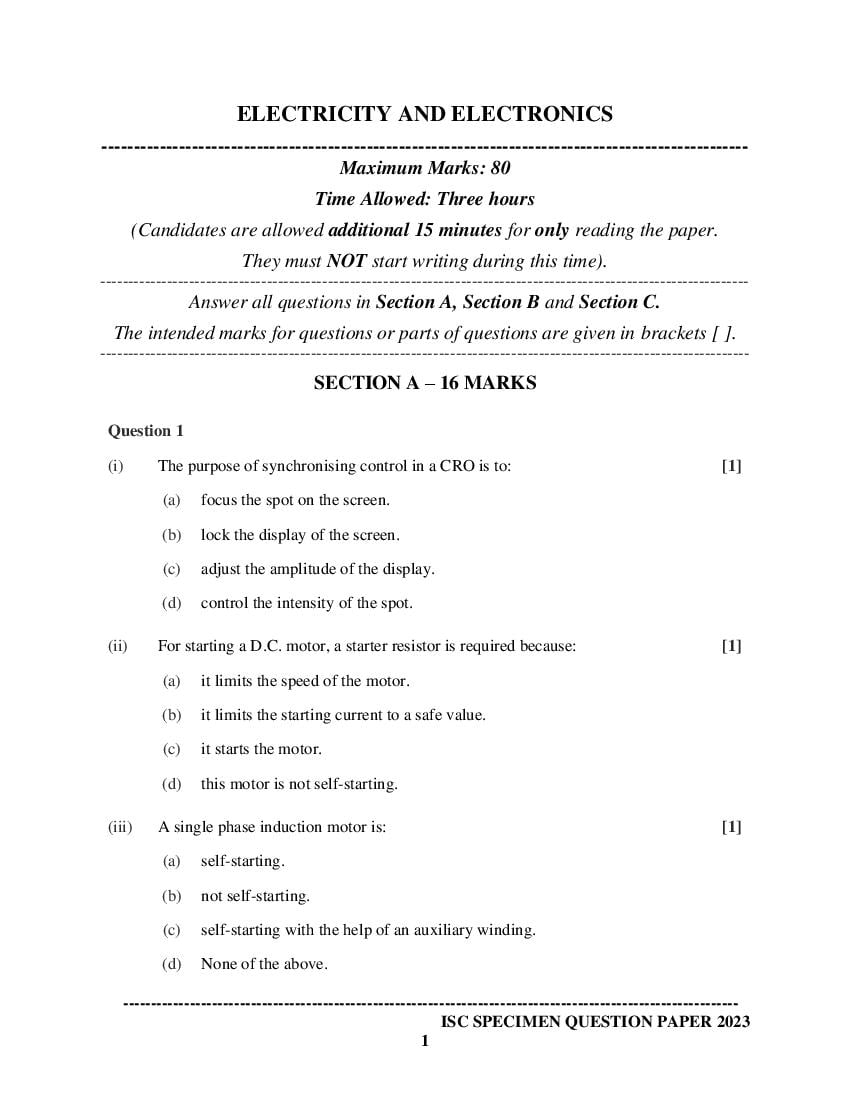
Page 1
----------------------------------------------------------------------------------------------------
Maximum Marks: 80
Time Allowed: Three hours
(Candidates are allowed additional 15 minutes for only reading the paper.
They must NOT start writing during this time).
---------------------------------------------------------------------------------------------------------------------
Answer all questions in Section A, Section B and Section C.
The intended marks for questions or parts of questions are given in brackets [ ].
---------------------------------------------------------------------------------------------------------------------
SECTION A – 16 MARKS
Question 1
(i) The purpose of synchronising control in a CRO is to: [1]
(a) focus the spot on the screen.
(b) lock the display of the screen.
(c) adjust the amplitude of the display.
(d) control the intensity of the spot.
(ii) For starting a D.C. motor, a starter resistor is required because: [1]
(a) it limits the speed of the motor.
(b) it limits the starting current to a safe value.
(c) it starts the motor.
(d) this motor is not self-starting.
(iii) A single phase induction motor is: [1]
(a) self-starting.
(b) not self-starting.
(c) self-starting with the help of an auxiliary winding.
(d) None of the above.
1
Page 2
(a) free electrons
(b) donor ions
(c) acceptor ions
(d) holes
(v) A semiconductor diode has __________________. [1]
(a) one p-n junction
(b) two p-n junctions
(c) three p-n junctions
(d) four p-n junctions
(vi) The material used for making the stator of an induction motor is ______________ [1]
(copper, silicon steel).
(vii) A multimeter cannot measure _____________. (Capacitance, resistance) [1]
(viii) Inductors are _________ devices. (active, passive). [1]
(ix) An earphone converts __________________. (sound energy to electrical energy, [1]
electrical energy to sound energy)
(x) What happens to the speed of a D.C shunt motor if the load is increased? [1]
(reduces slightly, increases slightly)
(xi) Match the following: [4]
(a) DC generator (1) Voltage regulator
(b) Zener diode (2) Centrifugal switch
(c) Induction motor (3) Transducers
(d) Microphone (4) Split rings
(xii) State whether the following statements are True or False: [2]
(a) The insulation colour used for ‘Live’ wire is yellow.
(b) Minority charge carriers in a p type semiconductor are electrons.
2
Page 3
Question 2
(i) Explain why a single phase induction motor is not a ‘self starting’ machine. [2]
(ii) Answer the following questions with reference to the circuit diagram shown in
Figure 1 below.
MAIN WINDING
I IM
IS
•
S
V
C
ROTOR
STARTING WINDING
Figure 1
(a) What is the use of the centrifugal switch ‘S’? [1]
(b) State the function of the capacitor ‘C’ in this circuit. [1]
Question 3 [4]
A diagram of a semiconductor diode is shown below. Label the parts from 1 to 4 by using
technical terms/names.
3
Page 4
(i) Which one of the graphs given below, shows that the semiconductor diode is a
forward biased?
(a)
(b)
(c)
(d)
(ii) Name the three terminals of vacuum triode.
4
Page 5
Name the triode parameter which can be obtained from the ratio of each of the following:
(i) Change in plate current (∆𝐼𝑝 ) against change in grid voltage (∆𝑉𝑔 ) at constant plate
voltage.
(ii) Change in plate voltage (∆𝑉𝑝 ) against change in plate current (∆𝐼𝑝 ) at constant grid
voltage.
(iii) Change in plate voltage (∆𝑉𝑝 ) against change in grid voltage (∆𝑉𝑔 ) at constant plate
current.
(iv) write the relationship between all the three triode parameters
Question 6 [4]
(i) Draw a neat circuit diagram of a full wave rectifier. Also, sketch the input and
output graphs.
(ii) Draw a neat, labelled diagram of a crystal microphone.
Question 7 [4]
Name the material used in the making of the following:
(i) Filament of an electric bulb.
(ii) Brushes for generators and motors.
(iii) Core of a transformer.
(iv) connecting wires
Question 8 [4]
(i) (a) What is the use of a lamp holder? Mention any two types of lamp holders.
(b) Write a short note on junction box.
OR
5
Page 6
plug.
(b) Write a short note on ceiling rose.
Question 9 [4]
(i) Draw a neat circuit diagram of a transistorised voltmeter.
OR
(ii) Draw a neat diagram of a cathode ray tube.
SECTION C - 32 MARKS
Question 10
(i) With the help of a neat diagram, explain how A.C. electrical power is distributed [4]
in a 3 phase 4 wire system.
(ii) Write a short note on any one type of insulation used for copper wires. [2]
(iii) Draw two separate diagrams to show how a dual switch can be used to turn ‘on’ [2]
and ‘off’ a lamp from two different places.
Question 11
(i) Draw a neat, labelled circuit diagram of a transistor (NPN or PNP) as an amplifier. [4]
(ii) Obtain the relationship between α and β (symbols have their usual meaning). [2]
(iii) What is the difference between active and passive circuits elements? Name any [2]
one active circuit elements.
6
Page 7
(i) Explain how ‘self excitation’ is achieved in a shunt generator. [4]
(ii) A 441V shunt wound D.C. motor has armature current (𝐼𝑎 ) = 60A. If armature [4]
resistance (𝑅𝑎 ) = 0·8Ω, calculate:
(a) back emf.
(b) power supplied to the armature.
OR
(i) State two effects of armature reaction. [2]
(ii) What is meant by commutation in a D.C. motor? [2]
(iii) Name the two types of generators based on ‘excitations.’ [2]
(iv) State the function of the following parts of a generator: [2]
(a) Poles
(b) Brushes
Question 13 [8]
(i) With the help of a neat circuit diagram, explain the filtering action of a 𝜋 −section
filter.
(ii) Draw a neat circuit diagram of a power amplifier.
7
Document Details
| Board / Org | CISCE |
| Exam | Class 12 |
| Type | Sample Paper |
| Pages | 7 |
| Updated | 29 Aug 2026 |