MBOSE Class 10 Question Paper 2018 for Social Studies
Finished viewing? Save it for later —
Download MBOSE Class 10 Question Paper 2018 for Social Studies (PDF · 15 pages)About MBOSE Class 10 Question Paper 2018 for Social Studies
MBOSE Class 10 Question Paper 2018 for Social Studies is available here for free download. Published by Meghalaya Board for Class 10, this question paper can be viewed online or downloaded as a PDF (15 pages). Candidates preparing for Class 10 can use MBOSE Class 10 Question Paper 2018 for Social Studies to understand the exam pattern, the type of questions asked, and the overall difficulty level.
Frequently Asked Questions
How can I download MBOSE Class 10 Question Paper 2018 for Social Studies?
Open this page and click the Download button to save MBOSE Class 10 Question Paper 2018 for Social Studies as a PDF. It is completely free on AglaSem Docs.
Is MBOSE Class 10 Question Paper 2018 for Social Studies free to download?
Yes. MBOSE Class 10 Question Paper 2018 for Social Studies can be viewed online and downloaded as a PDF free of cost on AglaSem Docs.
How many pages does MBOSE Class 10 Question Paper 2018 for Social Studies have?
MBOSE Class 10 Question Paper 2018 for Social Studies contains 15 pages, which you can read online or download together as a single PDF.
Where can I find more Class 10 study material?
You can find more Class 10 question papers, sample papers, syllabus, and answer keys on AglaSem Docs.
MBOSE Class 10 Question Paper 2018 for Social Studies – Text
Read the full text of this question paper below — useful to quickly search, copy and reference the content online without downloading the PDF.
📄 View text version (15 pages)
Page 1
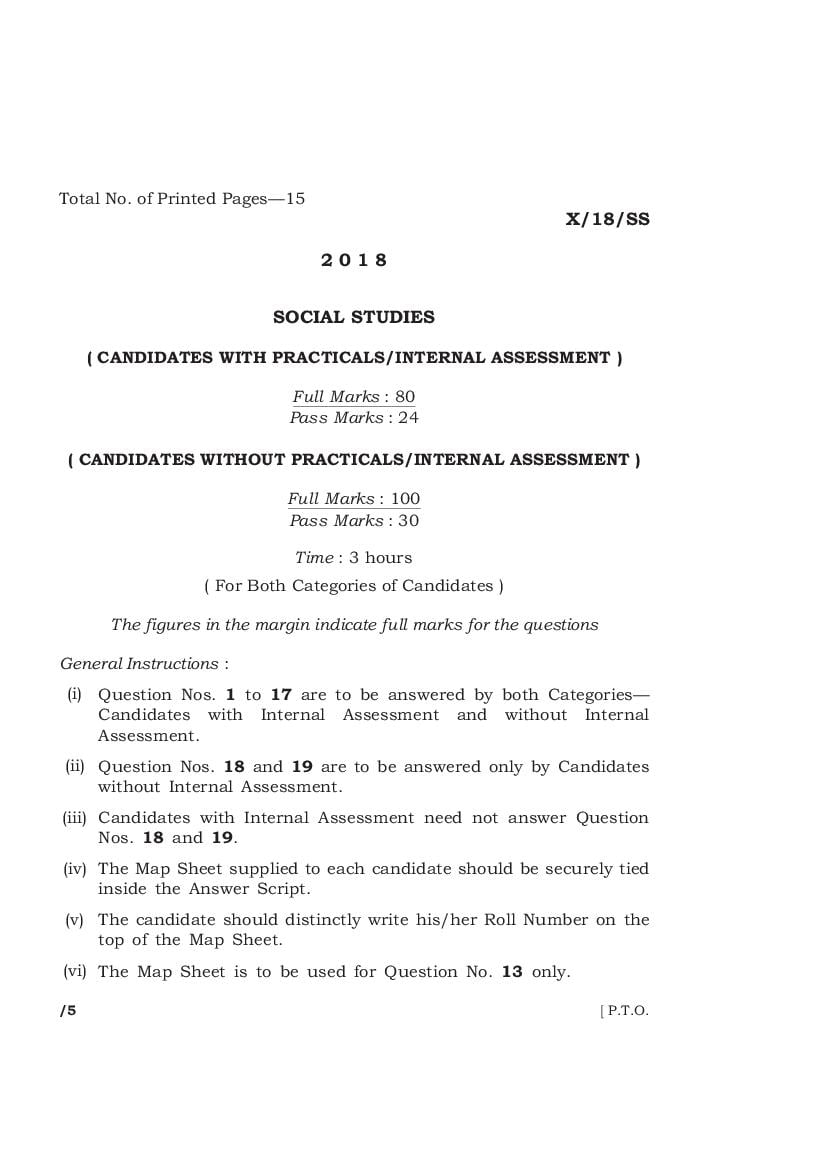
X/18/SS
2018
SOCIAL STUDIES
( CANDIDATES WITH PRACTICALS/INTERNAL ASSESSMENT )
Full Marks : 80
Pass Marks : 24
( CANDIDATES WITHOUT PRACTICALS/INTERNAL ASSESSMENT )
Full Marks : 100
Pass Marks : 30
Time : 3 hours
( For Both Categories of Candidates )
The figures in the margin indicate full marks for the questions
General Instructions :
(i) Question Nos. 1 to 17 are to be answered by both Categories—
Candidates with Internal Assessment and without Internal
Assessment.
(ii) Question Nos. 18 and 19 are to be answered only by Candidates
without Internal Assessment.
(iii) Candidates with Internal Assessment need not answer Question
Nos. 18 and 19.
(iv) The Map Sheet supplied to each candidate should be securely tied
inside the Answer Script.
(v) The candidate should distinctly write his/her Roll Number on the
top of the Map Sheet.
(vi) The Map Sheet is to be used for Question No. 13 only.
/5 [ P.T.O.
Page 2
SECTION—I
( History )
( Marks : 14 )
1. Rewrite the following statements by choosing the right option
from those given below (any two) : 1×2=2
(a) Gandhiji’s first experiment on Indian soil with Satyagraha
came in Champaran in the year _____.
(i) 1917
(ii) 1918
(iii) 1919
(b) Lack of tariff protections and laissez-faire policy of the
British adversely affected India’s
(i) agricultural sector
(ii) industrial sector
(iii) services sector
(c) Who was given the title of ‘Liberator of the Indian Press’?
(i) Charles Metcalf
(ii) Charles Darwin
(iii) Charles Babbage
2. Fill in the blanks (any two ) : 1×2=2
(a) The official transfer of funds from India to the United
Kingdom by the colonial government is called _____.
(b) Shillong practically dates from _____, when the district
headquarter was transferred from Cherrapunjee.
(c) Hand-printed technology started in _____ in 768 AD.
X/18/SS/5 [ Contd.
Page 3
3. Answer any three of the following questions in not more than
30 words each : 2×3=6
(a) Why did the people of the conquered regions in Europe feel
oppress and turn hostile towards Napoleon? 2
(b) Why did Gandhiji stress the significance of wearing Khadi?
What social evils did Gandhiji try to eradicate from Indian
society? (Mention any two) 1+½+½=2
(c) What is industrialization? 2
(d) Differentiate between planned and unplanned patterns of
urbanization. 1+1=2
(e) What does print culture consist of? Who brought the first
printing press to India? 1½+½=2
(f) What is in-migration? Give any two factors which
encourage migration. 1+½+½=2
4. Answer any one of the following questions in not more than
80 words : 4
(a) Which countries’ representatives met at Vienna Congress
in 1815 and why? Who hosted the Congress? Which
dynasty was reinstalled in France by the Congress? Who
overthrew this dynasty? 2+1+½+½=4
(b) Name the British Brigadier who was responsible for
the massacre at Jallianwala Bagh (1919). Describe the
incident that took place at the Bagh. 1+3=4
(c) What was the Protestant Reformation? Who was Martin
Luther? How did he make use of the printed materials to
challenge the church authority? 1+1+2=4
X/18/SS/5 [ P.T.O.
Page 4
SECTION—II
( Civics )
( Marks : 24 )
5. Rewrite the following statements by choosing the right option
from those given below (any three) : 1×3=3
(a) He believed in the fundamental truth of all great religions
of the world. Who was he?
(i) M. G. Ranade
(ii) M. K. Gandhi
(iii) Kanshi Ram
(b) In 2011, the Election Commission of India initiated the
practice of celebrating the National Voters’ Day on
(i) 25th January
(ii) 25th June
(iii) 25th July
(c) In which Schedule are powers, authority and
responsibilities of Municipalities listed?
(i) First Schedule
(ii) Sixth Schedule
(iii) Twelfth Schedule
(d) The first party that came into being after the Indian
National Congress was the
(i) Swaraj Party
(ii) Communist Party
(iii) Congress Socialist Party
X/18/SS/5 [ Contd.
Page 5
(e) Sarpanch is the president of the
(i) Gram Panchayat
(ii) Gram Sabha
(iii) Gram Sevak
(f) Under Article 169(1) the Parliament of India has the power
to create or abolish a _____ in any state.
(i) State Legislative Assembly
(ii) State Legislative Council
(iii) State Legislative Party
6. Fill in the blanks (any three) : 1×3=3
(a) The Mandal Commission (1978) has listed _____ backward
classes in India.
(b) The United Nations passed the Universal Declaration of
Human Rights on _____.
(c) _____ is a better form of government as compared
to dictatorship.
(d) As a result of amendments to India’s Constitution, there
is a _____ revolution in India’s governance at local
municipal and rural levels.
(e) An unending ethnic civil war has hindered the growth of
democracy in _____.
X/18/SS/5 [ P.T.O.
Page 6
7. Answer any three of the following questions in not more than
30 words each : 2×3=6
(a) Gandhiji used to say that religion can never be separated
from politics. What did he mean by religion? 2
(b) Who appoints the Comptroller and Auditor General of
India? What is his responsibility? 1+1=2
(c) What are the functions of Nyaya Panchayat? 2
(d) What is one-party system? Write any one positive side of
this system. 1+1=2
(e) Name any four notable social reformers of India. 2
(f) Write any four criteria or grounds on which democracy
can be judged. ½×4=2
8. Answer any three of the following questions in about 80 words
each : 4×3=12
(a) What is voter education? What is the role of civic
education in electoral education? 1+3=4
(b) What was the name of the first human rights group
founded in India? How has the Human Rights Commission
strengthened democracy in India? 1+3=4
(c) During the proclamation of financial emergency, who
can suspend the provisions relating to the divisions
of taxes between the Union and the States? What
directions can the Union Government give to the State
during such emergency? 1+3=4
(d) Mention any four functions of the Block Samiti. 4
(e) How has our Constitution supported social justice? 4
X/18/SS/5 [ Contd.
Page 7
SECTION—III
( Economics )
( Marks : 14 )
9. Rewrite the following statements by choosing the right option
from those given below (any two) : 1×2=2
(a) The total income of the country for a particular year is
called
(i) National Income
(ii) Per Capita Income
(iii) Gross Domestic Income
(b) With intense focus on child welfare and better maternal
care, there has been _____ in infant mortality rate.
(i) increase
(ii) reduction
(iii) constancy
(c) A typical Self-Help Group has _____ members.
(i) 10–15
(ii) 15–20
(iii) 20–25
10. Fill in the blanks (any two) : 1×2=2
(a) A major impediment to progress in human development is
the very fast growth of _____ in India.
(b) Pradhan Mantri Jan Dhan Yojana is a scheme launched
by _____ in 2014.
(c) Public investment means investment made by _____
agencies.
X/18/SS/5 [ P.T.O.
Page 8
11. Answer any three of the following questions in not more than
30 words each : 2×3=6
(a) Which agency prepares the Human Development Index
(HDI) for all countries of the world? What does HDI
indicate? 1+1=2
(b) Mention any four constituents of the services sector. ½×4=2
(c) Differentiate between scheduled and non-scheduled banks
of India. 1+1=2
(d) Why did India adopt the New Economic Policy in 1991?
Mention the three main elements of this policy. ½+1½=2
(e) What logo or identification mark would you look for while
purchasing the following items? ½×4=2
(i) A tin of frozen fish
(ii) A pressure cooker
(iii) A gold chain
(iv) A woollen sweater
(f) Define tertiary sector or service sector. Give two examples.
1+1=2
12. Answer any one of the following questions in not more than
80 words : 4
(a) What is human development as described by the UNDP?
What are the essential choices highly valued by many
people? 2+2=4
(b) What had been the strategy adopted prior to 1991 by the
government for the development of India? (Any four points) 4
(c) What are consumer rights? Mention any four rights that
consumers should have and explain one of them in detail.
1+2+1=4
X/18/SS/5 [ Contd.
Page 9
SECTION—IV
( Geography )
( Marks : 28 )
13. Locate the following items with proper symbols and name
the places of location in the Outline Map of India supplied
to you (any four) : 1×4=4
(a) One area having forest soil
(b) One major sugarcane-producing State
(c) The first port developed after Independence
(d) One area of biosphere reserve in Meghalaya
(e) One coal mining unit in Jharkhand
(f) One major iron and steel industry in Tamil Nadu
[ For Visually Handicapped (Blind) Candidates only,
in lieu of the above question ]
Answer the following questions (any four) : 1×4=4
(a) Name one area having forest soil.
(b) Name one major sugar-producing State.
(c) Name the first port developed after Independence.
(d) Name one area of biosphere reserve in Meghalaya.
(e) Name one coal mining unit in Jharkhand.
(f) Name one site of iron and steel industry in Tamil Nadu.
X/18/SS/5 [ P.T.O.
Page 10
14. Rewrite the following statements by choosing the right option
from those given below (any three) : 1×3=3
(a) The realistic planning on which an action can be taken
easily is called
(i) preparation of inventory of resources
(ii) examination of resources
(iii) action-oriented planning
(b) Which of the following is far ahead of other Indian states
in water harvesting?
(i) Kerala
(ii) Karnataka
(iii) Kanpur
(c) Which of the following is one of the largest iron mining
units in the world?
(i) Badampahar mines
(ii) Kudremukh mines
(iii) Ratnagiri mines
(d) Industries where the maximum investment is between
R 1 crore and R 10 crores are called
(i) cottage or small-scale industries
(ii) medium-scale industries
(iii) large-scale industries
X/18/SS/5 [ Contd.
Page 11
(e) The average rainfall of Meghalaya is
(i) 10000 mm
(ii) 11200 mm
(iii) 12000 mm
15. Fill in the blanks (any three) : 1×3=3
(a) _____ is the third agricultural season and is practised
during summer in areas having proper irrigation.
(b) Punjab and Haryana are referred to as the _____ basket
of India.
(c) _____ is the major source of water all over the world.
(d) _____ is present in the monazite sands of Kerala.
(e) _____ connecting Varanasi and Kanyakumari is the longest
National Highway in India.
16. Answer any three of the following questions in not more than
30 words each : 2×3=6
(a) Which soil is also known as mountainous soil? How is this
type of soil formed? ½+1½=2
(b) List any four physical factors affecting agriculture. ½×4=2
(c) How is biogas produced? In which regions of India is it
commonly used? 1+1=2
X/18/SS/5 [ P.T.O.
Page 12
(d) Mention any four challenges faced by iron and steel
industry in India. ½×4=2
(e) What is international trade? Name two components
of trade. 1+1=2
(f) What are the objectives of soil and water conservation?
(Any two points) 2
17. Answer any three of the following questions in not more than
80 words each : 4×3=12
(a) What is land degradation? What is the consequence of
land degradation in India? What steps have been taken to
conserve land in hilly and plain areas? 1+1+2=4
(b) Which country is the largest producer of oilseeds in the
world? During which seasons oilseeds are mainly grown
here? Name some important oilseeds produced here and
mention their uses. ½+½+3=4
(c) What is India’s rank in the world in terms of water
availability per person per annum? What is water crisis?
Identify two major reasons for water shortages in India.
1+1+2=4
(d) How is hydroelectricity generated? Mention two of its
advantages. Name the first two hydel projects set up in
India. 2+1+1=4
(e) What are the signs and symptoms of electrocution? What
should the first aider do during electrocution? What is the
best way to treat an electrocuted person? 1+1+2=4
(f) What is resource conservation? Why do we need to have
conservation of forest resources? 2+2=4
X/18/SS/5 [ Contd.
Page 13
( For the Candidates without Internal Assessment only )
( Marks : 20 )
18. Rewrite the following statements by choosing the right option
from those given in the brackets : 1×12=12
(a) Garibaldi struggled for the Unification of (France / Italy).
(b) The Industrial Revolution originated in (England /
Germany).
(c) Acta Diurna, the earliest recorded newspapers, were found
in (Rome / Japan).
(d) (Zila Parishad / Block Samiti) is the highest institution of
the Panchayati Raj in India.
(e) The Indian Constitution is (rigid / flexible) to a large
extent.
(f) (Singapore / Sri Lanka) was the least corrupt country
in Asia.
(g) Countries with (higher / lower) income are considered
more developed than the others.
(h) The (primary / secondary) sector involves activities
undertaken by directly using the natural resource.
X/18/SS/5 [ P.T.O.
Page 14
(i) The (economic / financial) system in India refers to the
system of borrowing and lending of money.
(j) Khadar is (new / old) alluvial soil.
(k) (Sugarcane / Coffee) is known as a continual crop.
(l) (Bengaluru / Chennai) is the first city to include rainwater
harvesting into its bye-laws.
19. Answer any eight of the following questions in 1 word or in 1
sentence each : 1×8=8
(a) Who entered into a compromise with Gandhiji resulting in
Poona Pact of 1932?
(b) Who was Victor Emmanuel II?
(c) Who is empowered to issue ordinances?
(d) Mention two federal features of the Indian Constitution.
(e) What is the full form of DMK?
(f) Which is the second largest populated country in
the world?
X/18/SS/5 [ Contd.
Page 15
(g) What is desertification?
(h) What are natural resources?
(i) What are two main varieties of coffee produced in India?
(j) What is a rock?
HHH
8K—52310/5 X/18/SS
Document Details
| Board / Org | Meghalaya Board |
| Exam | Class 10 |
| Type | Question Paper |
| Pages | 15 |
| Updated | 01 May 2026 |