TBJEE 2021 Question Paper - Maths
Finished viewing? Save it for later —
Download TBJEE 2021 Question Paper - Maths (PDF · 16 pages)About TBJEE 2021 Question Paper - Maths
TBJEE 2021 Question Paper - Maths is available here for free download. Published by Tripura Exams for Tripura Board Joint Entrance Examination, this question paper can be viewed online or downloaded as a PDF (16 pages). Candidates preparing for Tripura Board Joint Entrance Examination can use TBJEE 2021 Question Paper - Maths to understand the exam pattern, the type of questions asked, and the overall difficulty level.
Frequently Asked Questions
How can I download TBJEE 2021 Question Paper - Maths?
Open this page and click the Download button to save TBJEE 2021 Question Paper - Maths as a PDF. It is completely free on AglaSem Docs.
Is TBJEE 2021 Question Paper - Maths free to download?
Yes. TBJEE 2021 Question Paper - Maths can be viewed online and downloaded as a PDF free of cost on AglaSem Docs.
How many pages does TBJEE 2021 Question Paper - Maths have?
TBJEE 2021 Question Paper - Maths contains 16 pages, which you can read online or download together as a single PDF.
Where can I find more Tripura Board Joint Entrance Examination study material?
You can find more Tripura Board Joint Entrance Examination question papers, sample papers, syllabus, and answer keys on AglaSem Docs.
TBJEE 2021 Question Paper - Maths – Text
Read the full text of this question paper below — useful to quickly search, copy and reference the content online without downloading the PDF.
📄 View text version (16 pages)
Page 1
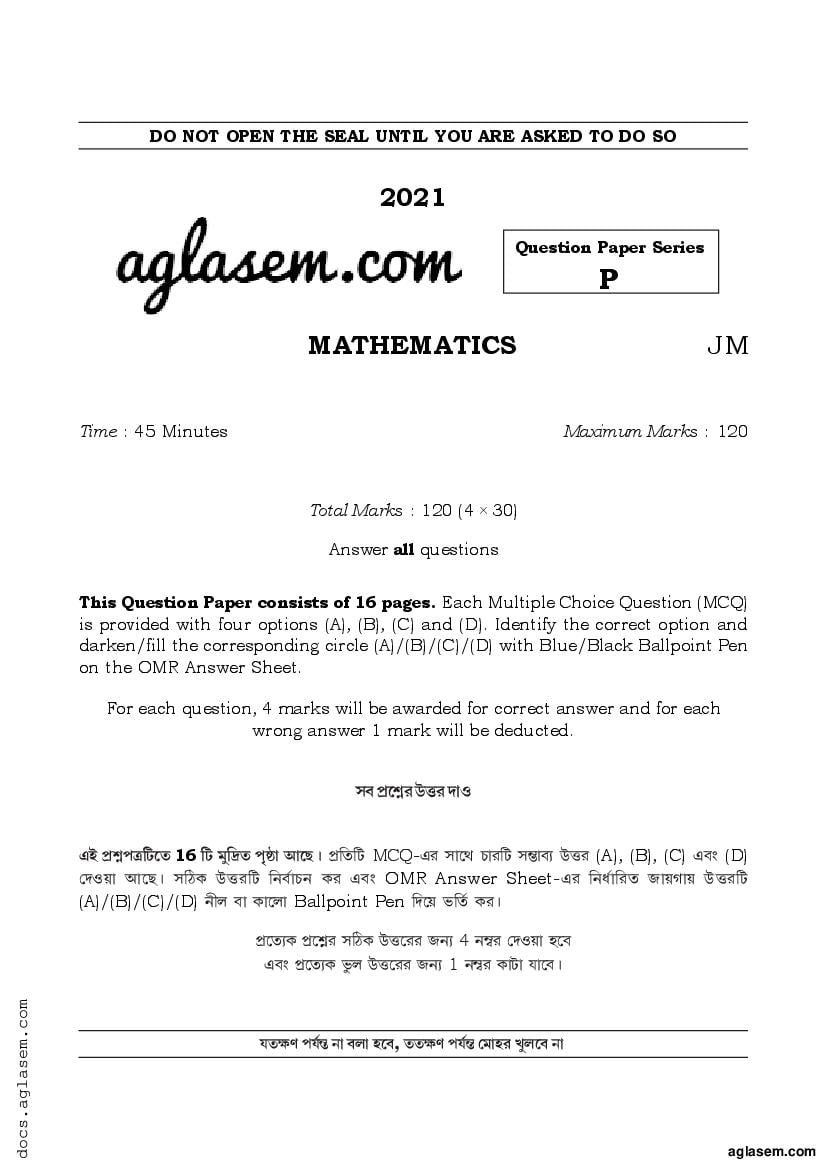
2021
Question Paper Series
P
MATHEMATICS JM
Time : 45 Minutes Maximum Marks : 120
Total Marks : 120 (4 × 30)
Answer all questions
This Question Paper consists of 16 pages. Each Multiple Choice Question (MCQ)
is provided with four options (A), (B), (C) and (D). Identify the correct option and
darken/fill the corresponding circle (A)/(B)/(C)/(D) with Blue/Black Ballpoint Pen
on the OMR Answer Sheet.
For each question, 4 marks will be awarded for correct answer and for each
wrong answer 1 mark will be deducted.
Τ šøìÅ¥¹ l¡üv¡¹ ƒà*
&Òü šøÅ¥šy[i¡ìt¡ 16 [i¡ ³å[‰t¡ šõË¡à "àìá¡ú šø[t¡[i¡ MCQ-&¹ Îàì= W¡à¹[i¡ δ±à¤¸ l¡üv¡¹ (A), (B), (C) &¤} (D)
ëƒ*Úà "àìá¡ú Î[k¡A¡ l¡üv¡¹[i¡ [>¤¢àW¡> A¡¹ &¤} OMR Answer Sheet-&¹ [>‹¢à[¹t¡ \àÚKàÚ l¡üv¡¹[i¡
(A)/(B)/(C)/(D) >㺠¤à A¡àìºà Ballpoint Pen [ƒìÚ ®¡[t¢¡ A¡¹¡ú
šøìt¡¸A¡ šøìÅ¥¹ Î[k¡A¡ l¡üv¡ì¹¹ \>¸ 4 >´¬¹ ëƒ*Úà Òì¤
&¤} šøìt¡¸A¡ ®å¡º l¡üv¡ì¹¹ \>¸ 1 >´¬¹ A¡ài¡à ™à줡ú
™t¡Û¡o š™¢”z >à ¤ºà Òì¤, t¡t¡Û¡o š™¢”z ë³àÒ¹ Jåºì¤ >à¡
Page 2
ρ = { (a , b ) : a , b ∈ ℝ, a 2 + b 2 = 1 } , then ρ is
(A) symmetric and transitive
(B) symmetric but neither reflexive nor transitive
(C) transitive but neither reflexive nor symmetric
(D) None of the above
1ú ³ì> A¡¹, ρ = { (a , b ) : a , b ∈ ℝ, a 2 + b 2 = 1 } &A¡[i¡ δšA¢¡ ë™Jàì> ℝ γÑz ¤àÑz¤ Î}J¸à¹ ëÎi¡, ρ
δšA¢¡[i¡ Òì¤
(A) [Îì³[i¡öA¡ &¤} i¡öà[X[i¡®¡
(B) [Îì³[i¡öA¡ [A¡”ñ [¹ìóá[G®¡ ¤à i¡öà[X[i¡®¡ >Ú
(C) i¡öà[X[i¡®¡ [A¡”ñ [¹ìóá[G®¡ ¤à [Îì³[i¡öA¡ >Ú
(D) l¡üšì¹¹ ëA¡àì>à[i¡Òü >Ú
2. If [x] denotes the greatest integer less than or equal to x, then the range of the function
f (x ) = [x ] − x is
(A) [0,1) (B) (–1,0]
(C) (–∞,∞) (D) (–1,1)
2ú ™[ƒ [x], &A¡[i¡ Î줢àZW¡ šèo¢Î}J¸à ë¤àc¡àÚ ™à x - &¹ ë=ìA¡ ëáài¡ ¤à γà> ( ≤ x ) ÒÚ, t¡ì¤ f (x ) = [x ] − x
"ìšÛ¡A¡[i¡¹ [¤Ñz๠"e¡º[i¡ Òì¤
(A) [0,1) (B) (–1,0]
(C) (–∞,∞) (D) (–1,1)
JM—Series P 2
Page 3
(A) on the boundary and in the interior of an ellipse
(B) on the boundary and in the interior of a circle
(C) in the interior of a hyperbola
(D) None of the above
3ú \[i¡º ¹à[Å z ™[ƒ z −1 + z +1 ≤ 4 δšA¢¡[i¡ìA¡ [·ý¡ A¡ì¹, t¡àÒìº "à¹Ksi¡ t¡ìº z -&¹ "¤Ñ‚à>
Òì¤
(A) &A¡[i¡ l¡üš¤õìv¡¹ l¡üšì¹ &¤} [®¡t¡ì¹
(B) &A¡[i¡ ¤õìv¡¹ l¡üšì¹ &¤} [®¡t¡ì¹
(C) &A¡[i¡ š¹à¤õìv¡¹ [®¡t¡ì¹
(D) l¡üšì¹¹ ëA¡à>[i¡Òü >Ú
4. Solution of the differential equation x 2 (x dx + y dy ) + 2y (x dy − y dx ) = 0 , subject to the
condition y(1) = 0, is
(A) (x 2 + y 2 )(x − 2)2 = 4x 2 (B) (x 2 + y 2 )(x + 2)2 = 9x 2
(C) (x 2 − y 2 )(x + 2)2 = 4x 2 (D) (x 2 − y 2 )(x − 2)2 = 9x 2
4ú x 2 (x dx + y dy ) + 2y (x dy − y dx ) = 0 &Òü "¤A¡º γãA¡¹o[i¡¹ y (1) = 0 Åt¢¡ ë³ì> ë™ Î³à‹à> Òì¤,
t¡à Òº
(A) (x 2 + y 2 )(x − 2)2 = 4x 2 (B) (x 2 + y 2 )(x + 2)2 = 9x 2
(C) (x 2 − y 2 )(x + 2)2 = 4x 2 (D) (x 2 − y 2 )(x − 2)2 = 9x 2
JM—Series P 3 [ P.T.O.
Page 4
are in GP, where α, β are the roots of ax 2 + bx + c = 0, then
(A) ∆ ≠ 0 (B) b∆ = 0
(C) c ∆ = 0 (D) ∆ = 0
5ú ax 2 + bx + c = 0 [‡Qàt¡ γãA¡¹ìo¹ ¤ã\‡Ú Òº α * β, ™[ƒ α + β , α2 + β2 , α3 + β3 GP ët¡ =àìA¡
&¤} ∆ = b 2 − 4ac ÒÚ, t¡àÒìº
(A) ∆ ≠ 0 (B) b∆ = 0
(C) c ∆ = 0 (D) ∆ = 0
sin2 − 1
6. The value of tan−1 is
cos 2
π π
(A) −1 (B) 1 −
2 4
π π
(C) 2 − (D) −1
2 4
sin2 − 1
6ú tan−1 - &¹ ³à> Òº
cos 2
π π
(A) −1 (B) 1 −
2 4
π π
(C) 2 − (D) −1
2 4
JM—Series P 4
Page 5
respectively. If at the time of calculation two observations were wrongly taken as 30 and
70 in place of 3 and 27 respectively, then the correct standard deviation is
(A) 8·24 (B) 9·24
(C) 10·24 (D) 7·24
7ú 100 [i¡ š™¢ì¤Û¡ìo¹ KØl¡ (mean) &¤} γ¸A¡ [¤W¡å¸[t¡ (standard deviation) Òº ™=àyû¡ì³ 40 &¤} 10 .
™[ƒ [ÒìÎ줹 Î³Ú ƒå[i¡ š™¢ì¤Û¡o 30 &¤} 70 ëA¡ ®å¡º A¡ì¹ ™=àyû¡ì³ 3 &¤} 27 &¹ š[¹¤ìt¢¡ ë>*Úà ÒìÚ
=àìA¡, t¡àÒìº Î[k¡A¡ γ¸A¡ [¤W塸[t¡ Òì¤
(A) 8·24 (B) 9·24
(C) 10·24 (D) 7·24
8. The statement ( p → r ) ∨ (q → r ) is logically equivalent to
(A) ( p ∧ q ) ∨ r
(B) ( p ∨ q ) → r
(C) ( p ∧ q ) → r
(D) ( p → q ) → r
8ú ( p → r ) ∨ (q → r ) l¡ü[v¡û¡[i¡¹ γt塺¸ l¡ü[v¡û¡[i¡ Òì¤
(A) ( p ∧ q ) ∨ r
(B) ( p ∨ q ) → r
(C) ( p ∧ q ) → r
(D) ( p → q ) → r
JM—Series P 5 [ P.T.O.
Page 6
5
x 2 = −1 and x3 = are
2
(A) parallel to each other (B) pairwise perpendicular
(C) concurrent (D) not concurrent
5
9ú y = x 2 − x + 1 ¤yû¡ì¹Jà¹ ë™ Î¤ [¤@ƒåìt¡ ®å \ x1 = 0 , x 2 = −1 , x3 = &¤} ëÎÒü [¤@ƒåP¡[ºìt¡ "[S¡t¡
2
"[®¡º´¬P¡[º
(A) š¹Ñš¹ γà”z¹àº (B) šø[t¡ ™åKº &ìA¡ "šì¹¹ l¡üš¹ º´¬
(C) γ[¤@ƒå (D) γ[¤@ƒå >Ú
ab
10. In a triangle ABC if sin A sin B = , then the triangle is
c2
(A) equilateral (B) isosceles
(C) right angled (D) None of the above
10ú ABC [y®å¡ì\ sin A sin B = ab2 Òìº, ABC [y®å¡\[i¡ Òì¤
c
(A) γ¤à× (B) γ[‡¤à×
(C) γìA¡àoã (D) l¡üšì¹¹ ëA¡à>[i¡Òü >Ú
11. The area of the region bounded by y =|x| and y = −|x|+2 is
(A) 4 sq.units (B) 3 sq.units
(C) 2 sq.units (D) 1 sq.unit
11ú y =|x| &¤} y = −|x|+2 ‡à¹à Îã³à¤‡ý¡ "e¡ìº¹ ëÛ¡yó¡º Òº
(A) 4 ¤K¢ &A¡A¡ (B) 3 ¤K¢ &A¡A¡
(C) 2 ¤K¢ &A¡A¡ (D) 1 ¤K¢ &A¡A¡
JM—Series P 6
Page 7
12. If q x +r p = 0 , then the values of x are
r p x +q
(A) −( p + q + r ), ± p 2 + q 2 + r 2 + pq + qr + rp
(B) ± ( p 2 + q 2 + r 2 ), ± p 2 + q 2 + r 2 + pq + qr + rp
(C) 0, ± ( p + q + r )
(D) −( p + q + r ), ± p 2 + q 2 + r 2 − pq − qr − rp
x+p q r
12ú ™[ƒ q x +r p = 0 ÒÚ, t¡ì¤ x-&¹ ³à>P¡[º Òì¤
r p x +q
(A) −( p + q + r ), ± p 2 + q 2 + r 2 + pq + qr + rp
(B) ± ( p 2 + q 2 + r 2 ), ± p 2 + q 2 + r 2 + pq + qr + rp
(C) 0, ± ( p + q + r )
(D) −( p + q + r ), ± p 2 + q 2 + r 2 − pq − qr − rp
2
d 2y
{ ( 2
13. If y = loge x + x + a
2
)} , then ( x2 + a2 ) dx 2
+x
dy
dx
=?
(A) 2 (B) a2y
(C) –a 2y (D) –2
2 2
{ (
13ú ™[ƒ y = loge x + x2 + a2 )} ÒÚ, t¡àÒìº ( x + a ) ddxy + x dy
2 2
dx
=? 2
(A) 2 (B) a2y
(C) –a 2y (D) –2
JM—Series P 7 [ P.T.O.
Page 8
x tan x
14. ∫ sec x + tan x dx = ?
0
π π
(A) −1 (B) π + 1
2 2
π π
(C) +1 (D) π − 1
2 2
π
x tan x
14ú ∫ sec x + tan x dx = ?
0
π π
(A) −1 (B) π + 1
2 2
π π
(C) +1 (D) π − 1
2 2
e x (x 2 + 1)
15. ∫ (x + 1)2 dx = ?
x x −1 1
(A) e +C (B) e x +C
x +1 (x + 1)2
x +1 x 1
(C) e x +C (D) e 2
+C
x −1 x +1
e x (x 2 + 1)
15ú ∫ dx = ?
(x + 1)2
x x −1 1
(A) e +C (B) e x +C
x +1 (x + 1)2
x +1 x 1
(C) e x +C (D) e 2
+C
x −1 x +1
JM—Series P 8
Page 9
of c1 + 2c 2 + 3c 3 + … + nc n is
(A) (n + 1)2n −1 (B) n 2n −1
n n −1
(C) (n + 1)2 (D) (n + 2)2
16ú (1 + x )n -&¹ [¤Ñzõ[t¡¹ ÎÒKP¡[º ™[ƒ c 0 , c1, c 2 ,……, cn ÒÚ, t¡àÒìº c1 + 2c 2 + 3c 3 + … + nc n -&¹ ³à>
Òì¤
(A) (n + 1)2n −1 (B) n 2n −1
n n −1
(C) (n + 1)2 (D) (n + 2)2
17. If sec ax + sec bx = 0 , then the values of x form
(A) two arithmetic progressions
(B) two geometric progressions
(C) one arithmetic progression and one geometric progression
(D) None of the above
17ú ™[ƒ sec ax + sec bx = 0 ÒÚ, t¡ì¤ x-&¹ ³à>γèÒ
(A) ƒå[i¡ γà”z¹ šøK[t¡ Kk¡> A¡ì¹
(B) ƒå[i¡ P¡ì>àv¡¹ šøK[t¡ Kk¡> A¡ì¹
(C) &A¡[i¡ γà”z¹ šøK[t¡ &¤} &A¡[i¡ P¡ì>àv¡¹ šøK[t¡ Kk¡> A¡ì¹
(D) l¡üšì¹¹ ëA¡à>[i¡Òü >Ú
JM—Series P 9 [ P.T.O.
Page 10
18. If the function f (x ) = x 3 + bx 2 + ax + 5 satisfies Rolle’s theorem on [1,3] with c = 2 + ,
3
then
(A) a = 11, b = −6 (B) a = 11, b = 6
(C) a = −11, b = 6 (D) a = −11, b = −6
18ú ™[ƒ c = 2 + 1 - &¹ \>¸ [1,3] [¤Ñzàì¹ f (x ) = x 3 + bx 2 + ax + 5 "ìšÛ¡A¡[i¡ Rolle’s theorem ëA¡
3
[·ý¡ A¡ì¹, t¡àÒìº
(A) a = 11, b = −6 (B) a = 11, b = 6
(C) a = −11, b = 6 (D) a = −11, b = −6
19. A function whose graph is symmetrical about y-axis is given by
2
(A) f (x ) = loge (x + x + 1) (B) f ( x + y ) = f ( x ) + f (y ), ∀ x , y ∈ R
(C) f ( x ) = cos x + sin x (D) None of the above
19ú [>ì´•¹ ë™ "ìšÛ¡A¡[i¡¹ Køàó¡ y-"ìÛ¡¹ ÎàìšìÛ¡ šø[t¡Î³, ëÎ[i¡ Òº
2
(A) f (x ) = loge (x + x + 1) (B) f (x + y ) = f (x ) + f (y ), ∀ x , y ∈ R
(C) f (x ) = cos x + sin x (D) l¡üšì¹¹ ëA¡à>[i¡Òü >Ú
JM—Series P 10
Page 11
3x1 + x 2 ≤ 15
3x1 + 4x 2 ≤ 24
x1, x 2 ≥ 0
Then the maximum value of the function Z = 4x1 + 3x 2 is
(A) 20 (B) 25
(C) 15 (D) 30
20ú ³ì> A¡¹, x1 &¤} x2 W¡º¹à[Å ƒå[i¡ >ãìW¡¹ Åt¢¡P¡[º šè¹o A¡ì¹ –
3x1 + x 2 ≤ 15
3x1 + 4x 2 ≤ 24
x1, x 2 ≥ 0
t¡àÒìº Z = 4x1 + 3x 2 "ìšÛ¡A¡[i¡¹ W¡¹³ ³à> Òì¤
(A) 20 (B) 25ø
(C) 15 (D) 30
21. How many 5-digit numbers divisible by 3 can be formed by using the digits 0,1,2,3,4
and 5, without repetition of digits?
(A) 148 (B) 224
(C) 336 (D) 216
21ú 0,1,2,3,4 * 5 Î}J¸àP¡[º &A¡¤àì¹¹ ë¤[Å ¤¸¤Ò๠>à A¡ì¹ 3 ‡à¹à [¤®¡à\¸ 5 "ìS¡¹ A¡t¡P¡[º Î}J¸à Kk¡>
A¡¹à ë™ìt¡ šàì¹?
(A) 148¡ (B) 224
(C) 336 (D) 216
JM—Series P 11 [ P.T.O.
Page 12
22. If [x] denotes the greatest integer less than or equal to x, then Lt =?
x →0 sin| x |
(A) 0 (B) 1
(C) Does not exist (D) –1
x [x ]
22ú ™[ƒ [x] &A¡[i¡ Î줢àZW¡ šèo¢Î}J¸à ë¤àc¡àÚ ™à x -&¹ ë=ìA¡ ëáài¡ ¤à γà> ( ≤ x ) ÒÚ, t¡ì¤ Lt =?
x →0 sin| x |
(A) 0 (B) 1
(C) "[Ñzâ« ë>Òü (D) –1
→ ^ ^ ^ → ^ → ^ ^ ^ → → →
23. If a = i + j + k , b = i and c = c1 i + 2 j + c 3 k , then a , b , c will be coplanar for
(A) c1 = 1 and c 3 = any real number
(B) c1 = 2 and c 3 = 1
(C) c1 = any real number and c 3 = 1
(D) c1 = any real number and c 3 = 2
→ ^ ^ → ^ → → → →
23ú ™[ƒ a = i + j^ + k , b = i &¤} c = c1 ^i + 2 ^j + c 3 k^ ÒÚ, t¡àÒìº a , b , c &A¡Òü γt¡ìº "¤[Ñ‚t¡ Òì¤
™J>
(A) c1 = 1 &¤} c 3 = ë™ìA¡à> ¤àÑz¤ Î}J¸à
(B) c1 = 2 &¤} c 3 = 1
(C) c1 = ë™ìA¡à> ¤àÑz¤ Î}J¸à &¤} c 3 = 1
(D) c1 = ë™ìA¡à> ¤àÑz¤ Î}J¸à &¤} c 3 = 2
JM—Series P 12
Page 13
is
(A) –1:2 (B) –2:5
(C) 2:3 (D) –1:4
24ú (1,2,3) &¤} (4,5,6) [¤@ƒåKà³ã ιºì¹JàìA¡ yz t¡º ë™ ">åšàìt¡ [¤®¡v¡û¡ A¡ì¹, t¡à Òº
(A) ¡–1:2 (B) –2:5
(C) 2:3 (D) –1:4
25. The equation of the plane passing through the line of intersection of the planes
2x + 3y − 5z + 7 = 0 , 7 x − 4y + 3z − 11 = 0 and parallel to the line joining the points
(3,1,–2) and (1,–2,4) is
(A) 333x – 124y + 49z – 361 = 0 (B) 124x – 333y + 49z + 361 = 0
(C) 49x + 124y + 331z + 61 = 0 (D) 330x + 120y + 40z + 361 = 0
25ú 2x + 3y − 5z + 7 = 0 &¤} 7x − 4y + 3z − 11 = 0 γt¡º‡ìÚ¹ ëრιºì¹JàKà³ã &¤} (3,1–2) *
(1,–2,4) [¤@ƒå‡ìÚ¹ Î}ì™àKA¡à¹ã ιºì¹J๠ÎìU γà”z¹àº γt¡ìº¹ γãA¡¹o Òº
(A) 333x – 124y + 49z – 361 = 0 (B) 124x – 333y + 49z + 361 = 0
(C) 49x + 124y + 331z + 61 = 0 (D) 330x + 120y + 40z + 361 = 0
26. Two positive numbers x and y are such that x 2 + y 2 = a 2 , (a > 0) . Then the sum x + y
will be maximum when
a a
(A) x = ,y = (B) x = a , y = a
2 2
a a
(C) x = a , y = (D) x = ,y =a
2 2
26ú x &¤} y ƒå[i¡ ‹>àâ«A¡ Î}J¸à &¤} x 2 + y 2 = a 2 , (a > 0) ú x &¤} y &¹ ë™ ³àì>¹ \>¸ x + y ¹à[Å[i¡¹
³à> W¡¹³ Òì¤, t¡à Òº
a a
(A) x = ,y = (B) x = a , y = a
2 2
a a
(C) x = a , y = (D) x = ,y =a
2 2
JM—Series P 13 [ P.T.O.
Page 14
1 1 1
are concurrent, then + + =?
1−a 1−b 1−c
(A) 0 (B) 2
(C) 1 (D) None of the above
27ú ™[ƒ ax + y + 1 = 0 , x + by + 1 = 0 , x + y + c = 0 (a, b, c "γà> &¤} ≠ 1 ) ιºì¹Jà [t¡>[i¡ γ[¤@ƒå
1 1 1
ÒÚ, t¡ì¤ + + =?
1−a 1−b 1−c
(A) 0 (B) 2
(C) 1 (D) l¡üšì¹¹ ëA¡à>[i¡Òü >Ú
28. The equations of tangents to the hyperbola 3x 2 − y 2 = 3 parallel to the straight line
2x − y + 4 = 0 are
(A) y = 2x ± 3 (B) y = 2x ± 1
(C) y = 2x ± 2 (D) y = 2x ± 5
28ú 3x 2 − y 2 = 3 š¹à¤õìv¡¹, 2x − y + 4 = 0 ιºì¹J๠Î[Òt¡ γà”z¹àº њŢA¡P¡[º¹ γãA¡¹o Òì¤
(A) y = 2x ± 3 (B) y = 2x ± 1
(C) y = 2x ± 2 (D) y = 2x ± 5
JM—Series P 14
Page 15
intersect at the point P, α being a parameter. Then the locus of P is an ellipse with
eccentricity
b2 − a 2 b2 − a 2
(A) (B)
a b
b2 − a 2
(C) (D) None of the above
b2 + a 2
29ú ax cos α + by sin α = a &¤} ax sin α − by cos α = b , (b > a > 0) ƒå[i¡ š[¹¤t¢¡>Å㺠ιºì¹J๠ëáƒ
[¤@ƒå P, ë™Jàì> α &A¡[i¡ š¸à¹à[³i¡à¹¡ú P-&¹ Îe¡à¹š=[i¡ Òº &A¡[i¡ l¡üš¤õv¡ ™à¹ l¡ü;ìA¡@ƒøt¡à
b2 − a 2 b2 − a 2
(A) (B)
a b
b2 − a2
(C) (D) l¡üšì¹¹ ëA¡à>[i¡Òü >Ú
b2 + a 2
30. Let, A is a 3×3 matrix and B is its adjoint matrix. If | B | = 144 , then | A | = ?
(A) ±2 (B) ±12
(C) ±8 (D) ±48
30ú ³ì> A¡¹, A &A¡[i¡ 3×3 ³¸à[i¡öG &¤} B Òº A - &¹ Î}ºN¥ (adjoint) ³¸à[i¡öG ™[ƒ | B | = 144 ÒÚ, t¡ì¤
| A |= ?
(A) ±2 (B) ±12
(C) ±8 (D) ±48
JM—Series P 15 [ P.T.O.
Page 16
★ ★ ★
JM—Series P 16 FF21—700×3
Document Details
| Board / Org | Tripura Exams |
| Exam | Tripura Board Joint Entrance Examination |
| Type | Question Paper |
| Pages | 16 |
| Updated | 22 Jul 2026 |