Kerala SET 2019 Jul Question Paper _18_
Finished viewing? Save it for later —
Download Kerala SET 2019 Jul Question Paper _18_ (PDF · 11 pages)About Kerala SET 2019 Jul Question Paper _18_
Kerala SET 2019 Jul Question Paper _18_ is available here for free download. Published by Kerala Exams for Kerala SET, this question paper can be viewed online or downloaded as a PDF (11 pages). Candidates preparing for Kerala SET can use Kerala SET 2019 Jul Question Paper _18_ to understand the exam pattern, the type of questions asked, and the overall difficulty level.
Frequently Asked Questions
How can I download Kerala SET 2019 Jul Question Paper _18_?
Open this page and click the Download button to save Kerala SET 2019 Jul Question Paper _18_ as a PDF. It is completely free on AglaSem Docs.
Is Kerala SET 2019 Jul Question Paper _18_ free to download?
Yes. Kerala SET 2019 Jul Question Paper _18_ can be viewed online and downloaded as a PDF free of cost on AglaSem Docs.
How many pages does Kerala SET 2019 Jul Question Paper _18_ have?
Kerala SET 2019 Jul Question Paper _18_ contains 11 pages, which you can read online or download together as a single PDF.
Where can I find more Kerala SET study material?
You can find more Kerala SET question papers, sample papers, syllabus, and answer keys on AglaSem Docs.
Kerala SET 2019 Jul Question Paper _18_ – Text
Read the full text of this question paper below — useful to quickly search, copy and reference the content online without downloading the PDF.
📄 View text version (11 pages)
Page 1
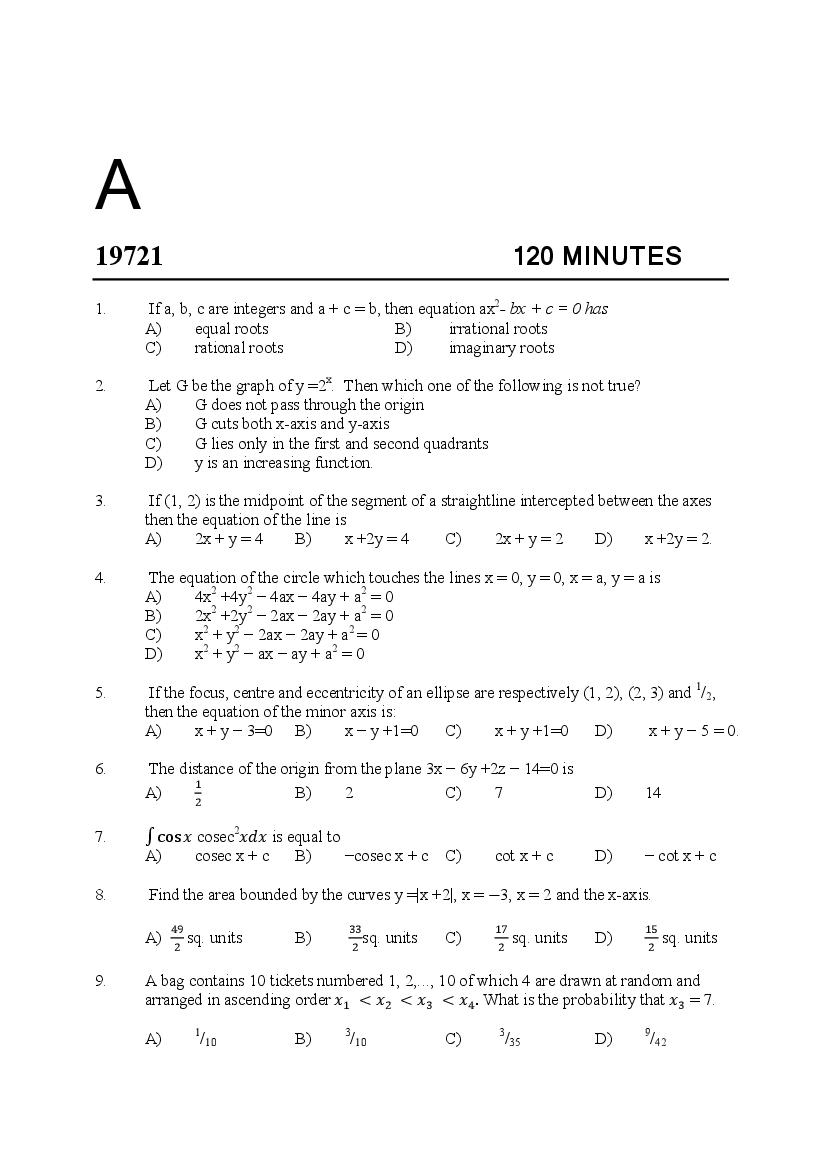
19721 120 MINUTES
1. If a, b, c are integers and a + c = b, then equation ax2- bx + c = 0 has
A) equal roots B) irrational roots
C) rational roots D) imaginary roots
2. Let G be the graph of y =2x. Then which one of the following is not true?
A) G does not pass through the origin
B) G cuts both x-axis and y-axis
C) G lies only in the first and second quadrants
D) y is an increasing function.
3. If (1, 2) is the midpoint of the segment of a straightline intercepted between the axes
then the equation of the line is
A) 2x + y = 4 B) x +2y = 4 C) 2x + y = 2 D) x +2y = 2.
4. The equation of the circle which touches the lines x = 0, y = 0, x = a, y = a is
A) 4x2 +4y2 − 4ax − 4ay + a2 = 0
B) 2x2 +2y2 − 2ax − 2ay + a2 = 0
C) x2 + y2 − 2ax − 2ay + a2 = 0
D) x2 + y2 − ax − ay + a2 = 0
5. If the focus, centre and eccentricity of an ellipse are respectively (1, 2), (2, 3) and 1/2,
then the equation of the minor axis is:
A) x + y − 3=0 B) x − y +1=0 C) x + y +1=0 D) x + y − 5 = 0.
6. The distance of the origin from the plane 3x − 6y +2z − 14=0 is
A) B) 2 C) 7 D) 14
7. ∫ cos cosec2 is equal to
A) cosec x + c B) −cosec x + c C) cot x + c D) − cot x + c
8. Find the area bounded by the curves y =|x +2|, x = −3, x = 2 and the x-axis.
A) sq. units B) sq. units C) sq. units D) sq. units
9. A bag contains 10 tickets numbered 1, 2,..., 10 of which 4 are drawn at random and
arranged in ascending order < < < . What is the probability that = 7.
1 3 3 9
A) /10 B) /10 C) /35 D) /42
Page 2
10. Let n( )= be a sequence of functions defined on [0, 1]. Let ( ) =
1 =1
and g( ) = 0 for all . Then which of the following is true?
A) n converges to f pointwise and not uniformly
B) n converges to g pointwise and not uniformly
C) n converges to f uniformly
D) n converges to g uniformly
0
11. Consider f(x) defined on [0, 1] as follows. ( ) =
1 ℎ
Then which of the following is true?
A) is Riemann integrable and ∫ =1
B) is Riemann integrable and ∫ =0
C) is Lebesgue integrable and ∫ =1
D) is Lebesgue integrable and ∫ =0
12. Consider the following statements about a non measurable subset A of ℝ.
(i) A ∪ B is non measurable for all B ⊆ ℝ.
(ii) A ∩ B is measurable for some B ⊆ ℝ.
(iii) A + x is measurable for all x ∈ ℝ.
Then which of the following holds.
A) (i) and (ii)
B) (i) and (iii)
C) (i) holds and (iii) does not hold
D) (ii) holds and (iii) does not hold
13. The real part of is
A) 1 B) 2 C) −1 D) −2
14. If the radius of convergence of the power series ∑ anzn is 2 then the radius of
convergence of ∑anz2n is
A) 2 B) √2 C) 4 D)
15. Which of the following is a harmonic conjugate of u(x) = x2 − y2 + x.
A) x +2xy B) y +2xy C) y2 − 2xy D) x2 +2xy
16. The residue of (z) = at z = −1 is
( )
1 e
A) e B) /e C) /2 D) e2/2
2
Page 3
A) 2 B) 4 C) 6 D) 12
18. Let f be a non trivial homomorphism from ℤ10 to ℤ15. Then which of the following
holds?
A) Im is of order 10. B) Ker is of order 5.
C) Ker is of order 2. D) is a one to one map.
19. Let G be a group of order 70. Then the number of 5-Sylow subgroups of G is
A) 1 B) 3 C) 5 D) 7
20. Which of the following is a zero divisor in the polynomial ring ℤ12 [x] ?
A) 1+ x B) 2+ x C) 3+2x D) 4+2x
21. Which of the following is an irreducible polynomial over the rationals?
A) x3 +2x +3 B) x3 +3x2 +6 C) 2x3 + x2 +1 D) x3 − 2x +1
22. Let α be the real cube root of 2 and let ℚ be the field of rationals. Then the degree
[ℚ( ) : ℚ] equals:
A) 1 B) 2 C) 3 D) 4
23. Let A be a 3 × 3 matrix such that A3 − 2A2 − I = 0 where I is the identity matrix. Then
A−1 equals:
A) A B) A2 C) A2 − 2A D) A2 +2A
24. Consider the following system of linear equations.
2x +3y + z = 1
3x +2y +4z = 4
x + y +z = 2
Then which of the following is true about the system?
A) It has a unique solution.
B) It has exactly two solutions.
C) If has infinitely many solutions.
D) It has no solution.
25. Let S be the subspace of ℝ spanned by (1, 0, 1). Then which of the following
subspace W has the property that ℝ = S ⊕ W?
A) W = span of {(1, 1, 1), (2, 1, 1)}
B) W = span of {(1, 1, 1), (1, 2, 1)}
C) W = span of {(1, 1, 1), (0, 1, 0)}
D) W = span of {(1, 1, 1), (2, 0, 2)}
26. Let : ℝ →ℝ be a linear transformation given by
(x1, x2, x3, x4) = (x1,x1,x1,x4 − x1). Then dimension of null space of is
A) 0 B) 1 C) 2 D) 3
27. Which of the following is a diagonalizable matrix?
3
Page 4
A) 0 2 0 B) 2 1 0 C) 0 1 0 D) 0 2 1
0 0 2 0 0 1 0 0 1 0 0 2
28. Let (x − 1)2 (x − 2)3 be the characteristic polynomial of a diagonalizable matrix. Then
its minimal polynomial is
A) (x − 1) (x − 2) B) (x − 1) (x − 2)3
2
C) (x − 1) (x − 2) D) (x − 1)2(x − 2)3
29. Which of the following is not true in the case of divisibility and gcd.
A) If a | bc and if (a,b) = 1, then a | c
B) If(a,b)=(a,c)=1, then (a,bc)=1
C) If(a,b)=1, then (a + b,a− b) is either 1 or 3
D) If(a,b)=1and if d | (a+ b), then (a,d)=(b,d) = 1.
30. The number of integers n,1≤ n ≤ 10 such that φ(n)= φ(2n), where φ(n) is the Euler
totient function, is
A) 1 B) 2 C) 3 D) 4
31. If the solution of the linear congruence equation 7x ≡ 6 (mod 15) is of the form x ≡ 6 .7n
(mod 15), then n equals
A) 3 B) 6 C) 7 D) 8
32. The differential equation of the family of circles touching the y-axis at the origin is
A) 2xy +x2 = y2 B) x2 − 2xy = y2
C) x2 + y2 +2xy =0 D) x2 + y 2 − 2xy = 0.
33. The particular solution of the equation + y = tan is
A) y = sin cos − cos ∫ sin tan
B) y = − sin cos − cos ∫ sin tan
C) y = sin cos + cos ∫ sin tan
D) y = − sin cos + cos ∫ sin tan
34. If Pn(x) denotes the nth degree Legendre polynomial then find the value of ∫ ( )
2 2 2 2
A) /5 B) /7 C) /3 D) /9
35. The integral of the equation (4x + yz)dx +(xz − 2y)dy +(xy − 2z)dz =0 is
A) 2x 2 + y 2 + z 2 − xyz = c B) 4x 2 − 2y 2 − 2z 2 + xyz = c
C) 2x 2 − y 2 − z 2 − xyz = c D) 2x 2 − y 2 − z 2 + xyz = c
36. The auxiliary equations for finding a complete integral of the equation p + q + pq =0
by Charpit’s method are
A) = = = = B) = = = =
4
Page 5
37. The value of m such that the equation xuxx + muxy + yuyy − 2ux = 0 is parabolic is
A) xy B) C) 2xy D) −2
38. Let d be a metric on the set ℕ of all natural numbers defined by d(x, y) = |x − y|. Then
which of the following is not true in this space.
A) {1} is an open set. B) {1} is a closed set.
C) {1, 2} is an open set. D) every open ball is a closed ball
39. Let ℝ be the set of all reals. Then which of the following is a metric on ℝ.
A) d(x,y) = max{|x|, |y|} B) d(x,y)= x2 + y2
| |
C) d(x,y)= D) d(x,y)= 1 + |x - y|
| |
40. Let ℝ be a topological space with base {(a, ∞): a< 0}. Then which of the following is
a limit of the sequence xn =(−1)n .
A) 0 B) 1 C) −1 D) 2
41. Let X be the normed linear space ℝ2 with norm ∥∥ p. Then the value of p for which X is
strictly convex is
A) 1 B) 2 C) 3 D) ∞
1 2
42. Let X = ℝ2 with norm ∥∥1 and A ∈ BL(X) be represented by the matrix M =
3 3
Then ∥A∥ is equal to
A) 3 B) 4 C) 5 D) 6
43. Let H be the Hilbert space l2 and S = {(0, 1, 1, 0,...) , (1, 1, 1, 0,...)}. Then the set
whose linear span is equal to the linear span of S is
A) (1,0,1,0, … ), (0, , , 0, … )
√ √
B) , , 0, … , (1,0,1,0, … )
√ √
C) (1,0,0,0, … ), ( , , 0, … )
√ √
D) (1,0,0,0, … ), (0, , , 0, … )
√ √
44. Let R be a relation on ℤ × ℤ such that ((a,b),(c,d)) R iff a-d=b-
c. Which one of the following is true about R?
A) Reflexive but not symmetric
B) Symmetric but not reflexive
C) Both reflexive and symmetric
D) Neither reflexive nor symmetric
5
Page 6
+ + .
A) − B) C)
D)
46. If , ,⋯, are the roots of + 1 = 0 . Then the value of
the product (1 + )(1 + ) ⋯ (1 + ) is
A) 0 B) -1 C) 1 D) 2019
( )
47. If lim( , )→( , ) = and lim( , )→( , ) = , then
A) exists but does not B) does not exist but
exists
C) Both and exist D) Both and do not exist
√−
48. The domain of the functions f defined by f(x) = ( −3)( +5) is
A) (−∞,−5) U (−5,3) U (3,∞) B) (−∞,5] U (3,∞]
C) (−∞,−5) U (−5,0] D) (−∞,3) U (3,∞)
49. Which of the following sets of functions is countable?
i) { f | f : N {0,1}}
ii) { f | f : {0,1} N }
iii) { f | f : N {0,1}, f(1) ≤f(2)}
iv) { f | f : {0,1} N, f(0) ≤ f(1)}
A) (i) and (iii) B) (ii) and (iv) C) (i) only
D) (ii) only
50. The equation of the plane which passes through (1,2,3) and
parallel to the plane 4 + 5 − 3 = 7 is
A) 3 +4 −3 =7 B) 4 +5 −3 =5
C) 5 −4 + =3 D) 4 +5 −3 +7= 0
6
Page 7
51. For what value of k is the function f(x)=
, =0
continuous at x = 0?
A) 0 B) C) 1 D) 2
52. Find if y=tan
A) B) C) +
( )
D)
53. If the radius of a circle is increasing at the rate of 5.5cm/s
then how fast is the area of the circle increasing when the radius
of the circle is 6cm?
A) 12 /s B) 36 /s C) 60 /s
D) 66 /s
( )
54. The value of the definite integral ∫
A) -1 B) 0 C) 1
D)
55. The number of different symmetric square matrices of order n
with each element being either 0 or 1 is
A) 2 B) 2 C) 2 D)
2
56. lim + +⋯+ is
→
A) 0 B) C) 1 D)
57. Let ∑ be a series of real numbers. Which of the following is
true?
7
Page 8
B) If ∑ is divergent, then { } does not converge to 0
C) If → 0 then ∑ is convergent
D) If ∑ is convergent then → 0 as →
58. The number of discontinuities of a monotone function is
A) finite B) infinite
C) countable D) uncountable
59. The value of √ + √− is
A) 0 B) 1 C) D) √2
60. The function ( ) = has
A) a removable singularity at =0
B) a simple pole at = 0 with residue 1
C) a simple pole at = 0 with residue
D) an essential singularity at = 0
61. The bilinear transformation which maps the points
= 1, − , −1 into the points = , 0, − is
( ) ( )
A) B) C) D)
e z
62. The value of the integral where is the circle
c z 1
| | = 1 2 is
A) 2 B) 2 C) 0 D) 4
63. Let F be a field of order 256. Then
A) F has a subfield of order 8 B) F has a subfield of order
16
C) F has a subfield of order 32 D) F has a subfield of
order 64
64. Which of the following is not true?
8
Page 9
B) Every group of odd order is cyclic
C) The order of a cyclic group and that of its
generating element are same
D) Every subgroup of a cyclic group is cyclic
1 2 3 4 5 6 7 8
65. The order of the permutation in S8 is
4 1 5 6 3 2 8 7
A) 4 B)6
C) 8 D) 16
66. The order of the element (1,2) in 5 10 is
A) 5 B) 10
C) 15 D) 20
67. The splitting field of the set of polynomials {x2-2 , x2-3}
over is
A) (2) B) (3) C)
3
( 2) D) (2,3)
68. The gcd of 3+4i and -4+3i in the integral domain ( [i] , + , .)
is
A) 3+4i B) - 4+3i
C) Both A and B D) neither A nor B
69. Which of the following is not true?
A) If A is a mn matrix and B is an n p matrix, then
rank(AB) min{rank(A),rank(B)}
B) If A is a mn matrix and B is a non singular matrix of
order n, then
rank(AB)= rank A
C) If A is a mn matrix and B is a np matrix, then
rank(AB) rank(A)
D) If A is a mn matrix and B is a np
matrix, then rank(AB)=min{rank(A),rank(B)}
70. Let W be the solution space of the system of homogeneous
equations 2x+2y+z=0, 3x+3y-2z=0, x+y-3z=0. Then dim W is
A) 0 B) 1
C) 2 D) 3
9
Page 10
A) T:ℝ3ℝ3 defined by T(x,y,z) =(x+y , x+z+2 , y+z )
B) T:ℝ2ℝ2 defined by T(x,y)=(x.0)
C) T:ℝ2ℝ2 defined by T(x,y)=(y,x)
D) T:ℝ3ℝ2 defined by T(x,y,z)=(y,z,x)
72. The solution of the linear congruence 4 ≡ 3( 7) is
A) 2(mod7) B) 4(mod 7) C) 6(mod 7) D)
8(mod 7)
73. The integrating factor of the differential equation ( − ) −
= 0 is
A) B) C) D)
74. The wronskian of the differential equation + 4 = 4 sec 2 is
A) 2 B) cos2x C) sin2x
D)
75. If ( ) is the Bessel’s function of order , ∈ ℤ. Then
A) ( )=− ( )
B) ( ) = (− )
C) ( )and ( ) are independent
D) ( ) = (−1) ( )
76. The generating function for the Legendre polynomial ( ) is
A) (1 + 2 + ) B) (1 − 2 + )
1
C) (1 − 2 + ) D) (1 + 2 + ) 2
77. The order and degree of the partial differential equation
= are
A) 2, 3 B) 3, 2 C) 2, 1 D) 3,
1
78. Which of the following is not true?
10
Page 11
B) The product of two completely regular spaces is completely
regular
C) The product of two first countable spaces is first countable
D) The product of two second countable space is second
countable
79. Which of the following is not a Banach space?
A) Kn B) C) D)
p
L (E)
80. If {x1,x2,x3} is an orthogonal set of an inner product space X with
||xi||=2, i=1,2,3, then ||x1+x2+x3||2 is
A) 2√3 B) 6 C) 12 D) 36
______________________
11
Document Details
| Board / Org | Kerala Exams |
| Exam | Kerala SET |
| Type | Question Paper |
| Pages | 11 |
| Updated | 23 Oct 2026 |