MBOSE Class 10 Question Paper 2018 for Science and Technlolgy
Finished viewing? Save it for later —
Download MBOSE Class 10 Question Paper 2018 for Science and Technlolgy (PDF · 12 pages)About MBOSE Class 10 Question Paper 2018 for Science and Technlolgy
MBOSE Class 10 Question Paper 2018 for Science and Technlolgy is available here for free download. Published by Meghalaya Board for Class 10, this question paper can be viewed online or downloaded as a PDF (12 pages). Candidates preparing for Class 10 can use MBOSE Class 10 Question Paper 2018 for Science and Technlolgy to understand the exam pattern, the type of questions asked, and the overall difficulty level.
Frequently Asked Questions
How can I download MBOSE Class 10 Question Paper 2018 for Science and Technlolgy?
Open this page and click the Download button to save MBOSE Class 10 Question Paper 2018 for Science and Technlolgy as a PDF. It is completely free on AglaSem Docs.
Is MBOSE Class 10 Question Paper 2018 for Science and Technlolgy free to download?
Yes. MBOSE Class 10 Question Paper 2018 for Science and Technlolgy can be viewed online and downloaded as a PDF free of cost on AglaSem Docs.
How many pages does MBOSE Class 10 Question Paper 2018 for Science and Technlolgy have?
MBOSE Class 10 Question Paper 2018 for Science and Technlolgy contains 12 pages, which you can read online or download together as a single PDF.
Where can I find more Class 10 study material?
You can find more Class 10 question papers, sample papers, syllabus, and answer keys on AglaSem Docs.
MBOSE Class 10 Question Paper 2018 for Science and Technlolgy – Text
Read the full text of this question paper below — useful to quickly search, copy and reference the content online without downloading the PDF.
📄 View text version (12 pages)
Page 1
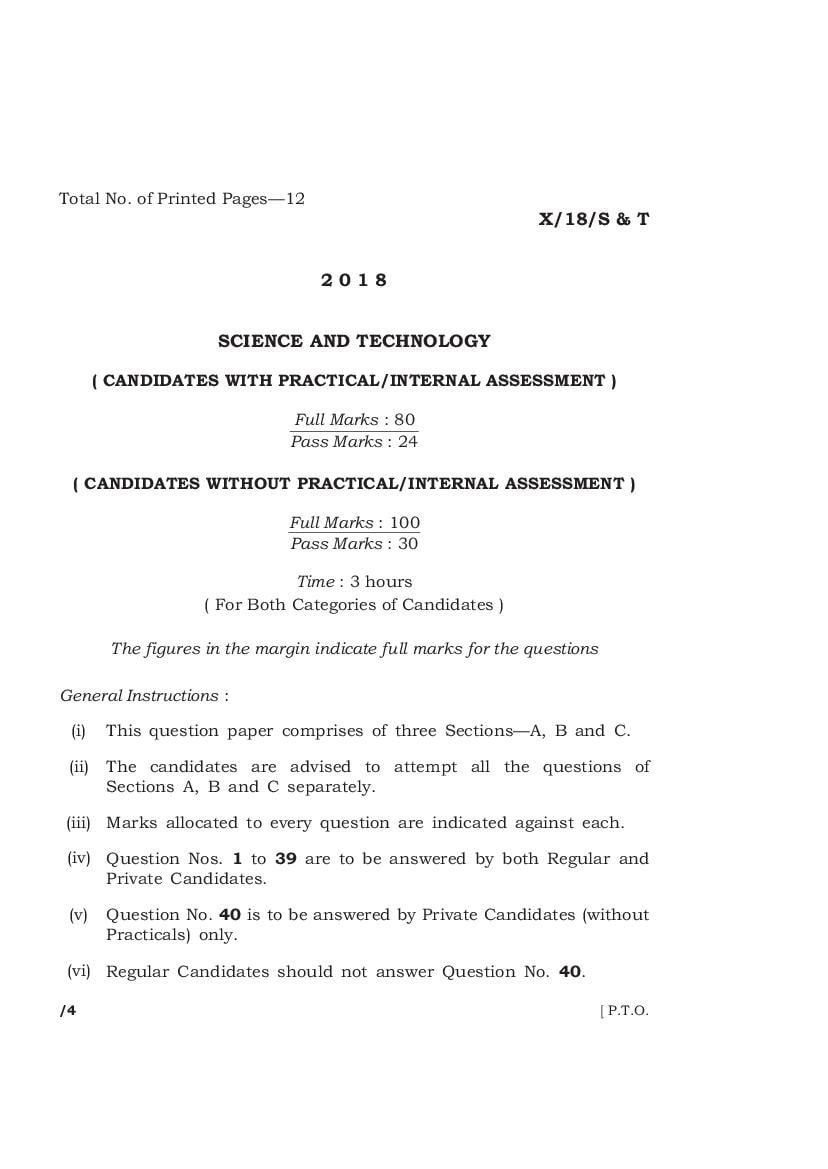
X/18/S & T
2018
SCIENCE AND TECHNOLOGY
( CANDIDATES WITH PRACTICAL/INTERNAL ASSESSMENT )
Full Marks : 80
Pass Marks : 24
( CANDIDATES WITHOUT PRACTICAL/INTERNAL ASSESSMENT )
Full Marks : 100
Pass Marks : 30
Time : 3 hours
( For Both Categories of Candidates )
The figures in the margin indicate full marks for the questions
General Instructions :
(i) This question paper comprises of three Sections—A, B and C.
(ii) The candidates are advised to attempt all the questions of
Sections A, B and C separately.
(iii) Marks allocated to every question are indicated against each.
(iv) Question Nos. 1 to 39 are to be answered by both Regular and
Private Candidates.
(v) Question No. 40 is to be answered by Private Candidates (without
Practicals) only.
(vi) Regular Candidates should not answer Question No. 40.
/4 [ P.T.O.
Page 2
SECTION—A
( PHYSICS )
( Marks : 26 )
Choose and write the correct answers from the following : 1×3=3
1. With respect to the object, the real image is
(a) slanted
(b) flat
(c) inverted
(d) erect 1
2. When a ray of light travels from a rarer medium to a denser
medium obliquely
(a) it bends towards the normal
(b) it bends away from the normal
(c) it goes undeviated
(d) it is reflected back 1
3. The coil of the electric kettle is made of
(a) copper
(b) tungsten
(c) aluminium
(d) nichrome 1
X/18/S & T/4 [ Contd.
Page 3
Answer the following questions in one word or one sentence each :
1×3=3
4. Define magnification of a lens. 1
5. Name the light sensitive and colour sensitive cells present in
the retina of the human eye. ½+½=1
6. What is a magnetic field? 1
Answer the following short-answer type questions in 30–40 words
each : 2×3=6
7. Either
(a) State the laws of refraction of light. 2
Or
(b) Define power of a lens. 1
(c) Name the instrument used for measuring the power of
a lens. 1
8. What is myopia? How is it corrected? 2
9. How much work is done in moving a charge of 3 C across two
points having a potential difference 15 V? 2
Answer the following short-answer type questions in 50–60 words
each : 3×3=9
10. Give the type of mirror which is used as a rear-view mirror in a
car. Give two reasons. 1+2=3
11. (a) What is electric motor? 1
(b) Explain the different ways to induce current in the coil. 2
X/18/S & T/4 [ P.T.O.
Page 4
12. Either
(a) Name a substance used almost exclusively for making
filaments of electric bulbs. 1
(b) Name the factors affecting the resistance of a conductor.
½+½+½+½=2
Or
(c) Define resistivity of a substance. 1
(d) Write the formula for equivalent resistance when three
resistances R1, R2 and R 3 are connected in parallel. 2
Answer the following long-answer type questions in 70–80 words : 5
13. Either
(a) What do you mean by electromagnetic induction? 1
(b) What is earthing? Why is earthing of electrical appliances
necessary? 1+2=3
(c) A 200 W bulb is lighted for 2 hours. How much energy is
consumed? 1
Or
(d) Write any three differences between a convex lens and a
concave lens. 3
(e) Find the power of a concave lens of focal length 2 m. 2
X/18/S & T/4 [ Contd.
Page 5
SECTION—B
( CHEMISTRY )
( Marks : 26 )
Choose and write the correct answers from the following : 1×3=3
14. Which of the following is a Bronsted-Lowry acid? 1
(a) CO2
(b) SO2
(c) SO 3
(d) H2O
15. The organic compounds containing —CHO group are called
(a) ketone
(b) carboxylic acid
(c) aldehyde
(d) alcohol 1
16. Which of the following metals is the most abundant in the
earth’s crust?
(a) Iron
(b) Sodium
(c) Magnesium
(d) Aluminium 1
X/18/S & T/4 [ P.T.O.
Page 6
Answer the following questions in one word or one sentence each :
1×2=2
17. What do you mean by the term metallurgy? 1
18. What is rancidity? 1
Answer the following short-answer type questions in 30–40 words
each : 2×2=4
19. Why does the colour of copper (II) sulphate solution change,
when an iron nail is dipped in it? 2
20. Either
(a) Write down two uses of sodium hydrogen carbonate. 1+1=2
Or
(b) What do you mean by the cracking of alkane? Name two
types of cracking. 1+½+½=2
Answer the following short-answer type questions in 50–60 words
each : 3×4=12
21. (a) Define displacement reaction. Give example. 1+1=2
(b) State Mendeleev’s periodic law. 1
X/18/S & T/4 [ Contd.
Page 7
22. (a) What are hydrocarbons? 1
(b) Give the IUPAC name of CH 3COOH. 1
(c) Write down the structural formula of methanoic acid. 1
23. What is meant by refining of metals? Name four methods
commonly used for refining of impure metals. 1+(½×4)=3
24. Either
(a) What do you mean by period and group in the periodic
table? ½+½=1
(b) How does the valency of an element change (i) on moving
down a group and (ii) on moving from left to right in a
period? 1+1=2
Or
(c) What are monoacidic base and diacidic base? Give one
example of each. 1½+1½=3
Answer the following long-answer type questions in 70–80 words : 5
25. Either
(a) What is redox reaction? Give example. 2
(b) What is neutralization? 1
(c) Give any two uses of ethanoic acid. 2
Or
(d) What are semimetals? Name any two semimetals. 2
(e) What do you mean by ionization energy? What are the
factors which determine the magnitude of ionization of
energy? 1+1+1=3
X/18/S & T/4 [ P.T.O.
Page 8
SECTION—C
( BIOLOGY )
( Marks : 28 )
Choose and write the correct answers from the following : 1×3=3
26. Which of the following cells are formed in the bone marrow?
(a) RBCs
(b) Leucocytes
(c) Leucocytes and RBC
(d) Lymphocytes 1
27. Hormone which controls cellular metabolism is
(a) adrenaline
(b) insulin
(c) thyroxine
(d) testosterone 1
28. Bryophyllum plant produces vegetatively by
(a) leaf bud
(b) adventitious buds
(c) root
(d) stem 1
X/18/S & T/4 [ Contd.
Page 9
Answer the following questions in one word or one sentence each :
1×3=3
29. Name the plant tissue concerned with transport of water and
food materials. 1
30. Name the male and female reproductive whorl of a flower.
½+½=1
31. Define heredity. 1
Answer the following short-answer type questions in 20–30 words
each : 2×4=8
32. Distinguish between breathing and respiration
(any two points). 2
33. Name the structures that help in excretion in tapeworm,
earthworm, cockroach and human beings. ½×4=2
34. Either
(a) Define photosynthesis. Write the overall reaction of
photosynthesis. 1+1=2
Or
(b) What is reproduction? Name the different types of
reproduction. 1+½+½=2
35. Differentiate between homologous and analogous organs. 1+1=2
X/18/S & T/4 [ P.T.O.
Page 10
Answer the following short-answer type questions in 50–60 words
each : 3×3=9
36. (a) Name the three major divisions of the human brain. Which
is the most prominent part of the brain? 1½+½=2
(b) What do you mean by reflex action? 1
37. Either
(a) Differentiate any three points between aerobic and
anaerobic respiration. 3
Or
(b) Differentiate between sensory and motor nerve cells. 1+1=2
(c) What is ultrafiltration? 1
38. Write the full form of AIDS. Write down any two preventive
methods of AIDS. 1+2=3
Answer the following long-answer type questions in 70–80 words : 5
39. Either
(a) Write down any three digestive functions of liver. 3
(b) Differentiate between saprophytic and parasitic nutrition. 2
Or
(c) Why is blood red in colour? 1
(d) Give any four functions of lymph. 4
X/18/S & T/4 [ Contd.
Page 11
[ For Private Candidates (without Practicals) only ]
40. I. Answer any three of the following questions : 2×3=6
(a) Distinguish between real image and virtual image. 2
(b) What is a lens? Name the two types of lens. 1+½+½=2
(c) Define electric power. State its SI unit. 1+1=2
(d) What are conductors? Give two examples. 1+1=2
(e) What do you mean by atmospheric refraction? 2
II. Answer any three of the following questions : 2×3=6
(a) What is decomposition reaction? Give an example.
1+1=2
(b) (i) Define activity series of metals. 1
(ii) Name the metal having the highest melting point
and lowest melting point. ½+½=1
(c) Give two uses of sodium carbonate. 2
(d) Which process are used for the enrichment of
(i) sulphide ores and (ii) oxide ores? 1+1=2
(e) (i) Name two allotropes of carbon. ½+½=1
(ii) Write down the IUPAC name of C2H 5OH. 1
III. Answer any four of the following questions : 2×4=8
(a) Differentiate between self-pollination and cross-
pollination. 2
(b) What is excretion? Name any two nitrogenous wastes
products. 1+½+½=2
X/18/S & T/4 [ P.T.O.
Page 12
(c) Differentiate between systemic circulation and
pulmonary circulation. 1+1=2
(d) Write down the differences between dominant gene
and recessive gene. 1+1=2
(e) Give two examples of reflex actions in our daily life
activities. 1+1=2
(f) Name the following :
(i) Small openings present on the leaf surface 1
(ii) The duct which carries urine from urinary
bladder to outside the body 1
HHH
8K—54070/4 X/18/S & T
Document Details
| Board / Org | Meghalaya Board |
| Exam | Class 10 |
| Type | Question Paper |
| Pages | 12 |
| Updated | 30 Apr 2026 |