UGC NET Percussion Instruments Question Paper 2018
Finished viewing? Save it for later —
Download UGC NET Percussion Instruments Question Paper 2018 (PDF · 32 pages)About UGC NET Percussion Instruments Question Paper 2018
UGC NET Percussion Instruments Question Paper 2018 is available here for free download. Published by NTA for UGC NET, this question paper can be viewed online or downloaded as a PDF (32 pages). Candidates preparing for UGC NET can use UGC NET Percussion Instruments Question Paper 2018 to understand the exam pattern, the type of questions asked, and the overall difficulty level.
Frequently Asked Questions
How can I download UGC NET Percussion Instruments Question Paper 2018?
Open this page and click the Download button to save UGC NET Percussion Instruments Question Paper 2018 as a PDF. It is completely free on AglaSem Docs.
Is UGC NET Percussion Instruments Question Paper 2018 free to download?
Yes. UGC NET Percussion Instruments Question Paper 2018 can be viewed online and downloaded as a PDF free of cost on AglaSem Docs.
How many pages does UGC NET Percussion Instruments Question Paper 2018 have?
UGC NET Percussion Instruments Question Paper 2018 contains 32 pages, which you can read online or download together as a single PDF.
Where can I find more UGC NET study material?
You can find more UGC NET question papers, sample papers, syllabus, and answer keys on AglaSem Docs.
UGC NET Percussion Instruments Question Paper 2018 – Text
Read the full text of this question paper below — useful to quickly search, copy and reference the content online without downloading the PDF.
📄 View text version (32 pages)
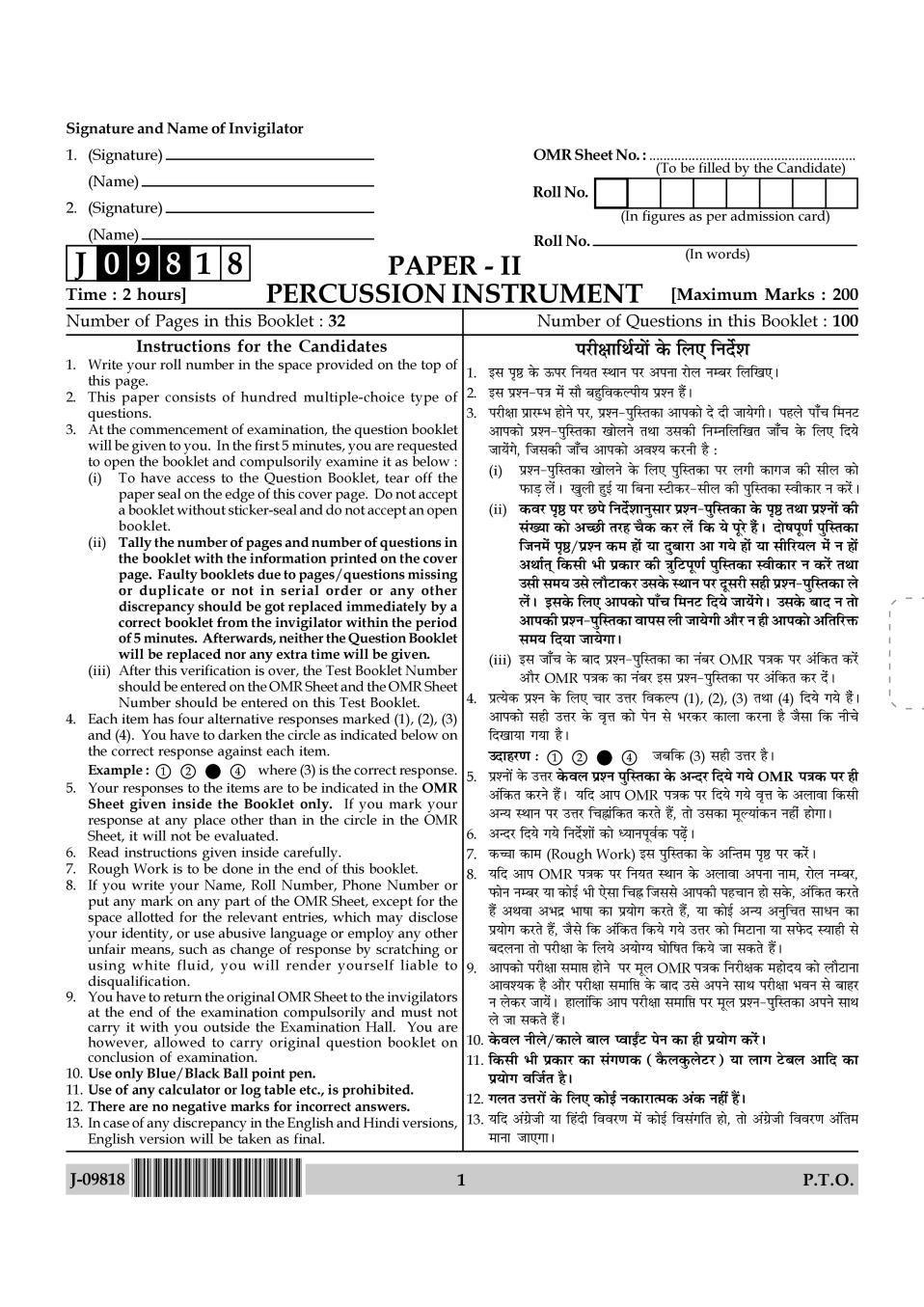
Page 1
1. (Signature) OMR Sheet No. : ..........................................................
(To be filled by the Candidate)
(Name)
Roll No.
2. (Signature)
(In figures as per admission card)
(Name) Roll No.
(In words)
J 0
9 9
8 8 1 8 PAPER - II
Time : 2 hours] PERCUSSION INSTRUMENT [Maximum Marks : 200
Number of Pages in this Booklet : 32 Number of Questions in this Booklet : 100
Instructions for the Candidates ¬⁄UˡÊÊÁÕ¸ÿÙ¢ ∑§ Á‹∞ ÁŸŒ¸‡Ê
1. Write your roll number in the space provided on the top of
1. ß‚ ¬ÎDU ∑§ ™§¬⁄U ÁŸÿà SÕÊŸ ¬⁄U •¬ŸÊ ⁄UÙ‹U Ÿê’⁄U Á‹Áπ∞–
this page.
2. This paper consists of hundred multiple-choice type of 2. ß‚ ¬˝‡Ÿ-¬òÊ ◊¢ ‚ÊÒ ’„ÈÁfl∑§À¬Ëÿ ¬˝‡Ÿ „Ò¥–
questions. 3. ¬⁄UˡÊÊ ¬˝Ê⁄êU÷ „ÙŸ ¬⁄U, ¬˝‡Ÿ-¬ÈÁSÃ∑§Ê •Ê¬∑§Ù Œ ŒË ¡ÊÿªË– ¬„‹U ¬UÊ°ø Á◊Ÿ≈U
3. At the commencement of examination, the question booklet •Ê¬∑§Ù ¬˝‡Ÿ-¬ÈÁSÃ∑§Ê πÙ‹Ÿ ÃÕÊ ©‚∑§Ë ÁŸêŸÁ‹Áπà ¡Ê°ø ∑§ Á‹∞ ÁŒÿ
will be given to you. In the first 5 minutes, you are requested ¡Êÿ¢ª, Á¡‚∑§Ë ¡Ê°ø •Ê¬∑§Ù •fl‡ÿ ∑§⁄UŸË „Ò —
to open the booklet and compulsorily examine it as below :
(i) ¬˝‡Ÿ-¬ÈÁSÃ∑§Ê πÙ‹Ÿ ∑§ Á‹∞ ¬ÈÁSÃ∑§Ê ¬⁄U ‹ªË ∑§Êª¡ ∑§Ë ‚Ë‹ ∑§Ê
(i) To have access to the Question Booklet, tear off the
paper seal on the edge of this cover page. Do not accept »§Ê«∏ ‹¢U– πÈ‹Ë „È߸ ÿÊ Á’ŸÊ S≈UË∑§⁄U-‚Ë‹U ∑§Ë ¬ÈÁSÃ∑§Ê SflË∑§Ê⁄U Ÿ ∑§⁄¢U–
a booklet without sticker-seal and do not accept an open (ii) ∑§fl⁄U ¬ÎDU ¬⁄U ¿U¬ ÁŸŒ¸‡ÊÊŸÈ‚Ê⁄U ¬˝‡Ÿ-¬ÈÁSÃ∑§Ê ∑§ ¬ÎDU ÃÕÊ ¬˝‡ŸÙ¢ ∑§Ë
booklet. ‚¢ÅÿÊ ∑§Ù •ë¿UË Ã⁄U„ øÒ∑§ ∑§⁄U ‹¢U Á∑§ ÿ ¬Í⁄U „Ò¢U– ŒÙ·¬Íáʸ ¬ÈÁSÃ∑§Ê
(ii) Tally the number of pages and number of questions in Á¡Ÿ◊¢ ¬ÎDU/¬˝‡Ÿ ∑§◊ „Ù¢ ÿÊ ŒÈ’Ê⁄UÊ •Ê ªÿ „Ù¢ ÿÊ ‚ËÁ⁄Uÿ‹U ◊¢ Ÿ „Ù¢
the booklet with the information printed on the cover •ÕʸØ Á∑§‚Ë ÷Ë ¬˝∑§Ê⁄U ∑§Ë òÊÈÁ≈U¬Íáʸ ¬ÈÁSÃ∑§Ê SflË∑§Ê⁄U Ÿ ∑§⁄¢U ÃÕÊ
page. Faulty booklets due to pages/questions missing
or duplicate or not in serial order or any other ©‚Ë ‚◊ÿ ©‚ ‹Uı≈UÊ∑§⁄U ©‚∑§ SÕÊŸ ¬⁄U ŒÍ‚⁄UË ‚„Ë ¬˝‡Ÿ-¬ÈÁSÃ∑§Ê ‹
discrepancy should be got replaced immediately by a ‹¢– U ß‚∑§ Á‹∞ •Ê¬∑§Ù ¬Ê°ø Á◊Ÿ≈U ÁŒÿ ¡Êÿ¢ª– ©‚∑§ ’ÊŒ Ÿ ÃÙ
correct booklet from the invigilator within the period •Ê¬∑§Ë ¬˝‡Ÿ-¬ÈÁSÃ∑§Ê flʬ‚ ‹Ë ¡ÊÿªË •ı⁄U Ÿ „Ë •Ê¬∑§Ù •ÁÃÁ⁄UQ§
of 5 minutes. Afterwards, neither the Question Booklet ‚◊ÿ ÁŒÿÊ ¡ÊÿªÊ–
will be replaced nor any extra time will be given. (iii) ß‚ ¡Ê°ø ∑§ ’ÊŒ ¬˝‡Ÿ-¬ÈÁSÃ∑§Ê ∑§Ê Ÿ¥’⁄U OMR ¬òÊ∑§ ¬⁄U •¢Á∑§Ã ∑§⁄¢U
(iii) After this verification is over, the Test Booklet Number
should be entered on the OMR Sheet and the OMR Sheet
•Uı⁄U OMR ¬òÊ∑§ ∑§Ê Ÿ¥’⁄U ß‚ ¬˝‡Ÿ-¬ÈÁSÃ∑§Ê ¬⁄U •¢Á∑§Ã ∑§⁄U Œ¢–
Number should be entered on this Test Booklet. 4. ¬˝àÿ∑§ ¬˝‡Ÿ ∑§ Á‹∞ øÊ⁄U ©ûÊ⁄U Áfl∑§À¬ (1), (2), (3) ÃÕÊ (4) ÁŒÿ ªÿ „Ò¢–
4. Each item has four alternative responses marked (1), (2), (3) •Ê¬∑§Ù ‚„Ë ©ûÊ⁄U ∑§ flÎûÊ ∑§Ù ¬Ÿ ‚ ÷⁄U∑§⁄U ∑§Ê‹Ê ∑§⁄UŸÊ „Ò ¡Ò‚Ê Á∑§ ŸËø
and (4). You have to darken the circle as indicated below on ÁŒπÊÿÊ ªÿÊ „Ò–
the correct response against each item. ©ŒÊ„⁄UáÊ — ¡’Á∑§ (3) ‚„Ë ©ûÊ⁄U „Ò–
Example : where (3) is the correct response. 5. ¬˝‡ŸÊ¥ ∑§ ©ûÊ⁄U ∑§fl‹ ¬˝‡Ÿ ¬ÈÁSÃ∑§Ê ∑§ •ãŒ⁄U ÁŒÿ ªÿ OMRU ¬òÊ∑§ ¬⁄U „Ë
5. Your responses to the items are to be indicated in the OMR
•¥Á∑§Ã ∑§⁄UŸ „Ò¥– ÿÁŒ •Ê¬ OMRU ¬òÊ∑§ ¬⁄U ÁŒÿ ªÿ flÎûÊ ∑§ •‹ÊflÊ Á∑§‚Ë
Sheet given inside the Booklet only. If you mark your
response at any place other than in the circle in the OMR •ãÿ SÕÊŸ ¬⁄U ©ûÊ⁄U ÁøqÊ¢Á∑§Ã ∑§⁄Uà „Ò¥, ÃÙ ©‚∑§Ê ◊ÍÀUÿÊ¢∑§Ÿ Ÿ„Ë¢ „٪ʖ
Sheet, it will not be evaluated. 6. •ãŒ⁄U ÁŒÿ ªÿ ÁŸŒ¸‡ÊÙ¢ ∑§Ù äÿÊŸ¬Ífl¸∑§ ¬…∏¢U–
6. Read instructions given inside carefully. 7. ∑§ìÊÊ ∑§Ê◊ (Rough Work) ß‚ ¬ÈÁSÃ∑§Ê ∑§ •ÁãÃ◊ ¬ÎDU ¬⁄U ∑§⁄¢U–
7. Rough Work is to be done in the end of this booklet. 8. ÿÁŒ •Ê¬ OMR ¬òÊ∑§ ¬⁄U ÁŸÿà SÕÊŸ ∑§ •‹ÊflÊ •¬ŸÊ ŸÊ◊, ⁄UÊ‹ Ÿê’⁄U,
8. If you write your Name, Roll Number, Phone Number or
put any mark on any part of the OMR Sheet, except for the
»§ÊŸ Ÿê’⁄U ÿÊ ∑§Ê߸ ÷Ë ∞‚Ê Áøq Á¡‚‚ •Ê¬∑§Ë ¬„øÊŸ „Ê ‚∑§, •¥Á∑§Ã ∑§⁄UÃ
space allotted for the relevant entries, which may disclose „Ò¥ •ÕflÊ •÷Œ˝ ÷Ê·Ê ∑§Ê ¬˝ÿʪ ∑§⁄Uà „Ò¥, ÿÊ ∑§Ê߸ •ãÿ •ŸÈÁøà ‚ÊœŸ ∑§Ê
your identity, or use abusive language or employ any other ¬˝ÿʪ ∑§⁄Uà „Ò¥, ¡Ò‚ Á∑§ •¥Á∑§Ã Á∑§ÿ ªÿ ©ûÊ⁄U ∑§Ê Á◊≈UÊŸÊ ÿÊ ‚»§Œ SÿÊ„Ë ‚
unfair means, such as change of response by scratching or ’Œ‹ŸÊ ÃÊ ¬⁄UˡÊÊ ∑§ Á‹ÿ •ÿÊÇÿ ÉÊÊÁ·Ã Á∑§ÿ ¡Ê ‚∑§Ã „Ò¥–
using white fluid, you will render yourself liable to 9. •Ê¬∑§Ù ¬⁄UˡÊÊ ‚◊Ê# „ÙŸ §¬⁄U ◊Í‹ OMR ¬òÊ∑§ ÁŸ⁄UˡÊ∑§ ◊„ÙŒÿ ∑§Ù ‹Uı≈UÊŸÊ
disqualification. •Êfl‡ÿ∑§ „Ò •ı⁄U ¬⁄UˡÊÊ ‚◊ÊÁ# ∑§ ’ÊŒ ©‚ •¬Ÿ ‚ÊÕ ¬⁄UˡÊÊ ÷flŸ ‚ ’Ê„⁄U
9. You have to return the original OMR Sheet to the invigilators Ÿ ‹∑§⁄U ¡Êÿ¢– „Ê‹Ê¥Á∑§ •Ê¬ ¬⁄UˡÊÊ ‚◊ÊÁ# ¬⁄U ◊Í‹ ¬˝‡Ÿ-¬ÈÁSÃ∑§Ê •¬Ÿ ‚ÊÕ
at the end of the examination compulsorily and must not
carry it with you outside the Examination Hall. You are ‹ ¡Ê ‚∑§Ã „Ò¥–
however, allowed to carry original question booklet on 10. ∑§fl‹ ŸË‹/∑§Ê‹ ’Ê‹U åflÊßZ≈U ¬Ÿ ∑§Ê „Ë ¬˝ÿʪ ∑§⁄¢U–
conclusion of examination. 11. Á∑§‚Ë ÷Ë ¬˝∑§Ê⁄U ∑§Ê ‚¢ªáÊ∑§ (∑Ò§‹∑ȧ‹≈U⁄U) UÿÊ ‹Êª ≈U’‹ •ÊÁŒ ∑§Ê
10. Use only Blue/Black Ball point pen. ¬˝ÿÙª flÁ¡¸Ã „Ò–
11. Use of any calculator or log table etc., is prohibited.
12. ª‹Ã ©ûÊ⁄UÊ¥ ∑§ Á‹∞ ∑§Ê߸ Ÿ∑§Ê⁄UÊà◊∑§ •¥∑§ Ÿ„Ë¥ „Ò¥–
12. There are no negative marks for incorrect answers.
13. In case of any discrepancy in the English and Hindi versions, 13. ÿÁŒ •¥ª˝¡Ë ÿÊ Á„¥ŒË Áflfl⁄UáÊ ◊¥ ∑§Ê߸ Áfl‚¥ªÁà „Ê, ÃÊ •¥ª˝¡Ë Áflfl⁄UáÊ •¥ÁÃ◊
English version will be taken as final. ◊ÊŸÊ ¡Ê∞ªÊ–
J-09818 !J-09818-PAPER-II! 1 P.T.O.
Page 2
PAPER - II
Note : This paper contains hundred (100) objective type questions of two (2) marks each. All
questions are compulsory.
1. The following Quote is extracted from which of the following books ?
‘Talantaravarti Yeh Kalo Sau Layanallayah’.
(1) Sangeet Ratnakar (2) Sangeet Chudamani
(3) Natya Shastra (4) Brihaddeshi
2. The author of the book ‘Bharat Bhasya’ is :
(1) Nanyadeo (2) Ramkrishna Kavi
(3) Nandikeshwara (4) Kailash Chandra Brihaspati
3. The number of Dhruva tÂl of Karnataki Tistra JÂti is :
(1) 9 (2) 10
(3) 11 (4) 12
4. Given below are two statements, one is Assertion (A) and other is Reason (R). Read (A) and
(R) carefully and use the code for answer.
Assertion (A) : A word Vitat is also used for percussion instruments.
Reason (R) : This word is found only during medieval period.
Code :
(1) (A) is false, but (R) is true (2) (A) is true , but (R) is false
(3) (A) and (R) both are false (4) (A) and (R) both are true
5. Which among the following is written in right order ?
(1) Kshan, Luv, Nimish, Kashtha (2) Luv, Kshan, Nimish, Kashtha
(3) Kshan, Luv, Kashtha, Nimish (4) Luv, Kshan, Kashtha, Nimish
6. The skin of which of the following animals is used to create TÂr Dhwani (High Pitch) ?
(1) Camel (2) Goat (3) Alligator (4) Ox
J-09818 !J-09818-PAPER-II! 2 Paper-II
Page 3
¬˝‡Ÿ¬òÊ - II
ŸÊ≈U — ß‚ ¬˝‡Ÿ-¬òÊ ◊¥ ‚ÊÒ (100) ’„È-Áfl∑§À¬UËÿ ¬˝‡Ÿ „Ò¥– ¬˝àÿ∑§ ¬˝‡Ÿ ∑§ ŒÙ (2) •¢∑§ „Ò¥– ‚÷Ë ¬˝‡Ÿ •ÁŸflÊÿ¸ „Ò¥–
1. ““ÃÊ‹ÊãÃ⁄UÊflÃ˸ ÿ— ∑§Ê‹Ê˘‚ÊÒ ‹ÿŸÊÑÿ—”” ©¬ÿȸÄà Á∑§‚ ª˝¥Õ ◊¥ Á‹πÊ „Ò?
(1) ‚¥ªËà ⁄UàŸÊ∑§⁄U (2) ‚¥ªËà øÈ«UÊ◊ÁáÊ
(3) ŸÊ≈K ‡ÊÊSòÊ (4) ’΄g‡ÊË
2. ÷⁄Uà ÷Êcÿ ∑§ ‹π∑§ „Ò¥ —
(1) ŸÊãÿŒfl (2) ⁄UÊ◊∑ΧcáÊ ∑§Áfl
(3) Ÿ¥ÁŒ∑§‡fl⁄U (4) ∑Ò§‹Ê‡ÊøãŒ˝ ’΄S¬ÁÃ
3. ∑§áÊʸ≈U∑§Ë ÁÃSòÊ ¡ÊÁà œ˝Èfl ÃÊ‹ ∑§Ë ◊ÊòÊÊ „Ò —
(1) 9 (2) 10
(3) 11 (4) 12
4. •Á÷∑§ÕŸ (A) ÃÕÊ ∑§Ê⁄UáÊ (R) ∑§Ê ¬…∏ •ÊÒ⁄U ŸËø ÁŒÿ ∑ͧ≈UÊ¥ ∑§Ë ‚„ÊÿÃÊ ‚ ‚„Ë ©ûÊ⁄U Œ¥ —
•Á÷∑§ÕŸ (A) : •flŸh flÊlÊ¥ ∑§ Á‹ÿ ∞∑§ ‡ÊéŒ ÁflÃà ÷Ë ¬˝ÿʪ ◊¥ •ÊÿÊ „Ò–
∑§Ê⁄UáÊ (R) : ß‚ ‡ÊéŒ ∑§Ê ¬˝ÿʪ ◊äÿ∑§Ê‹ ◊¥ „Ë ¬˝Êåà „ÊÃÊ „Ò–
∑ͧ≈U —
(1) (A) ª‹Ã „Ò, Á∑§ãÃÈ (R) ‚„Ë „Ò– (2) (A) ‚„Ë „Ò, Á∑§ãÃÈ (R) ª‹Ã „Ò–
(3) (A) ÃÕÊ (R) ŒÊŸÊ¥ ª‹Ã „Ò¥– (4) (A) ÃÕÊ (R) ŒÊŸÊ¥ ‚„Ë „Ò¥–
5. ÁŸêŸÁ‹Áπà ◊¥ ‚ ∑§ÊÒŸ‚Ê ‚„Ë ∑˝§◊ ◊¥ Á‹πÊ ªÿÊ „Ò?
(1) ˇÊáÊ, ‹fl, ÁŸÁ◊·, ∑§Êc∆U (2) ‹fl, ˇÊáÊ, ÁŸÁ◊·, ∑§Êc∆U
(3) ˇÊáÊ, ‹fl, ∑§Êc∆U, ÁŸÁ◊· (4) ‹fl, ˇÊáÊ, ∑§Êc∆U, ÁŸÁ◊·
6. ÃÊ⁄U (™°§ø Sfl⁄U) äflÁŸ ©à¬ãŸ ∑§⁄UŸ ∑§ Á‹∞ Á∑§‚ ¬‡ÊÈ ∑§Ë πÊ‹ (ø◊¸) ¬˝ÿʪ ∑§Ë ¡ÊÃË „Ò —
(1) ™°§≈U (2) ’∑§⁄UÊ (3) ◊ª⁄U◊ë¿U (4) ÷Ò¥‚
J-09818 !J-09818-PAPER-II! 3 Paper-II
Page 4
(1) Guru (2) KÂkpad (3) Anudrut (4) Drut
8. The Sutras and Chakras of 32 TihÂiis are described in which of the following books ?
(1) Bhatkhande Sangeet Shastra (2) Sangeet Chintamani
(3) Bhartiy Sangeet Vadya (4) Bharat Ka Sangeet Siddhant
9. Which of the following famous singers left for her heavenly abode on 3 April 2017 ?
(1) Kishori Amonkar (2) Girija Devi
(3) Veena Sahastrabuddhe (4) M.S.Shubhlakshami
10. Which one among the following is not a Sashabda Kriya according to NÂtyashastra ?
(1) Dhruva (2) Shamp (3) ÀvÂp (4) SannipÂt
11. One Pall of Bedam TihÂii in Kumbha TÂl will consist of how many VarnÂs ?
(1) 12 (2) 14 (3) 13 (4) 15
12. The ChakradÂr of DhamÂr can be played in which of the following tÂlÂs without any change ?
(1) Chautal (2) Sultal (3) Badi Sawari (4) Gajjhampa
13. ‘Niyat Gati is called Laya in music’.
The above statement has been written by which of the following authors in his book ?
(1) Pt. Onkar Nath Thakur (2) Prof. Premlata Sharma
(3) Thakur Jaideo Singh (4) Dr. Lalmani Mishra
14. The authoress of the book ‘Pashchatya Swarlipi Paddhati Evam Bhartiya Sangeet’ is :
(1) Dr. Swatantra Sharma (2) Dr. Pankaj Mala Sharma
(3) Dr. Subhadra Chowdhari (4) Dr. Premlata Sharma
15. The translator of the book ‘Ashtottar TÂl Lakshanam’ is :
(1) Pt. Vishnu Sharma (2) Prof. Premlata Sharma
(3) Dr. Puru Dadheech (4) Dr. Subhadra Chowdhari
J-09818 !J-09818-PAPER-II! 4 Paper-II
Page 5
(1) ªÈL§ (2) ∑§Ê∑§¬Œ (3) •áÊÈŒ˝Èà (4) Œ˝ÈÃ
8. 32 ÁÄÊ߸ÿÊ¥ ∑§Ê ø∑˝§ •ÊÒ⁄ ©‚∑§ ‚ÍòÊ Á∑§‚ ª˝¥Õ ◊¥ flÁáʸà „Ò¥?
(1) ÷ÊÃπ¥«∏ ‚¥ªËà ‡ÊÊSòÊ (2) ‚¥ªËà ÁøãÃÊ◊ÁáÊ
(3) ÷Ê⁄UÃËÿ ‚¥ªËà flÊl (4) ÷⁄Uà ∑§Ê ‚¥ªËà Á‚hÊ¥Ã
9. 3 •¬Ò˝‹ 2017 ∑§Ê Á∑§‚ ¬˝ÅÿÊà ªÊÁÿ∑§Ê ∑§Ê ÁŸœŸ „È•Ê —
(1) Á∑§‡ÊÊ⁄UË •◊ÊŸ∑§⁄U (2) ÁªÁ⁄U¡Ê ŒflË
(3) flËáÊÊ ‚„SòÊ’Èh (4) ∞◊.∞‚. ‡ÊÈ÷‹ˇ◊Ë
10. ŸÊ≈˜Uÿ‡ÊÊSòÊ ∑§ •ŸÈ‚Ê⁄U ‚‡ÊéŒ Á∑˝§ÿÊ Ÿ„Ë¥ „Ò —
(1) œ˝Èfl (2) ‡Êê¬Ê (3) •Êflʬ (4) ‚Á㟬ÊÃ
11. ∑ȧê÷ ÃÊ‹ ◊¥ ’Œ◊ ÁÄÊ߸ ∑§Ê ∞∑§ ¬À‹Ê Á∑§ÃŸ fláÊÊZ ∑§Ê •ÊÿªÊ?
(1) 12 (2) 14 (3) 13 (4) 15
12. œ◊Ê⁄U ∑§Ë ø∑˝§ŒÊ⁄U Á’ŸÊ ¬Á⁄UflÁøà Á∑§ÿ •ÊÒ⁄U Á∑§‚ ÃÊ‹ ◊¥ ’¡Ê߸ ¡Ê ‚∑§ÃË „Ò–
(1) øÊÒÃÊ‹ (2) ‚Í‹ÃÊ‹ (3) ’«UË ‚flÊ⁄UË (4) ª¡¤Ê¥¬Ê
13. ““ÁŸÿà ªÁà ∑§Ê ‚¥ªËà ◊¥ ‹ÿ ∑§„à „Ò¥””
©¬ÿ¸ÈÄà ∑§ÕŸ Á∑§‚ ‹π∑§ Ÿ •¬ŸË ¬ÈSÃ∑§ ◊¥ Á‹πÊ „Ò?
(1) ¬¥. •Ê¥∑§Ê⁄U ŸÊÕ ∆UÊ∑ȧ⁄U (2) ¬˝Ê. ¬˝◊‹ÃÊ ‡Ê◊ʸ
(3) ∆UÊ∑ȧ⁄U ¡ÿŒfl Á‚¥„ (4) «UÊÚ. ‹Ê‹◊ÁáÊ Á◊üÊÊ
14. ““¬Ê‡øÊàÿ Sfl⁄UÁ‹Á¬ ¬hÁà ∞fl¥ ÷Ê⁄UÃËÿ ‚¥ªËÔ” ¬ÈSÃ∑§ ∑§Ë ‹Áπ∑§Ê „Ò¥ —
(1) «UÊÚ. SflÃ¥òÊ ‡Ê◊ʸ (2) «UÊÚ. ¬¥∑§¡ ◊Ê‹Ê ‡Ê◊ʸ
(3) «UÊÚ. ‚È÷Œ˝Ê øÊÒœ⁄UË (4) «UÊÚ. ¬˝◊‹ÃÊ ‡Ê◊ʸ
15. ““•c≈UÊûÊ⁄U ÃÊ‹ ‹ˇÊáÊ◊˜”” ¬ÈSÃ∑§ ∑§ •ŸÈflÊŒ∑§ „Ò¥ —
(1) ¬¥.ÁflcáÊÈ ‡Ê◊ʸ (2) ¬˝Ê. ¬˝◊‹ÃÊ ‡Ê◊ʸ
(3) «UÊÚ. ¬ÈL§ ŒœËø (4) «UÊÚ. ‚È÷Œ˝Ê øÊÒœ⁄UË
J-09818 !J-09818-PAPER-II! 5 Paper-II
Page 6
(a) TritÂl (i) Khemta
(b) EktÂl (ii) Gajjhampa
(c) Pancham Sawari (iii) Laxmi
(d) Mutt (iv) Ekwaii
Code :
(a) (b) (c) (d)
(1) (iv) (ii) (i) (iii)
(2) (iv) (i) (iii) (ii)
(3) (iv) (i) (ii) (iii)
(4) (iv) (iii) (ii) (i)
17. Which one of the following instruments has a deep voice according to Someshwar_________.
(1) Daf (2) Dakkuli (3) Dhol (4) Bheri
18. Sharang Dev has described the characteristic of Hudukk as the characteristics of ________.
(1) Chang (2) Jhallari (3) Ghadas (4) DimDima
19. ‘‘Geet VadyapadavinyasÂnÂm KriyÂkÂlayoh Samyam Laya”.’’
The above extract is from which of the following :
(1) NÂtyashastra (2) Sangeet Chudamani
(3) Mansollas (4) Amarkosh
20. Which famous singer has died on 24 Oct. 2017 ?
(1) Kishori Amonkar (2) M.S. Shubhlakshami
(3) Veena Sahastrabuddhe (4) Girija Devi
21. Which among the following is not a tabl player ?
(1) Dr. Yogmaya Shukla (2) Dr. Aban E. Mistri
(3) Dr. Anuradha Pal (4) Dr. Veena Sahastrabuddhe
J-09818 !J-09818-PAPER-II! 6 Paper-II
Page 7
(a) GËÃÊ‹ (i) π◊≈UÊ
(b) ∞∑§ÃÊ‹ (ii) ª¡¤Ê¥¬Ê
(c) ¬¥ø◊ SÊflÊ⁄UË (iii) ‹ˇ◊Ë
(d) ◊ûÊ (iv) ß∑§flÊ߸
∑ͧ≈U —
(a) (b) (c) (d)
(1) (iv) (ii) (i) (iii)
(2) (iv) (i) (iii) (ii)
(3) (iv) (i) (ii) (iii)
(4) (iv) (iii) (ii) (i)
17. ‚Ê◊‡fl⁄U ∑§ •ŸÈ‚Ê⁄U ª¥÷Ë⁄U äflÁŸ flÊ‹Ê flÊl ________–
(1) «U»§ (2) «UÄ∑ȧ‹Ë (3) …UÊ‹ (4) ÷⁄UË
18. ‡ÊÊ⁄¥UªŒfl Ÿ „È«ÈUÄ∑§Ê ∑§ ‹ˇÊáÊ ∑§Ê „Ë ________ flÊl ∑§Ê ‹ˇÊáÊ ’ÃÊÿÊ „Ò–
(1) ø¥ª (2) ¤ÊÀ‹⁄UË (3) ÉÊ«U‚ (4) Á«U◊Á«U◊Ê
19. ““ªËà flÊl¬ÊŒÊÁŒãÿÊ‚ÊŸÊ¥ Á∑˝§ÿÊ∑§Ê‹ÿÊ— ‚êÿ¥ ‹ÿ””
©¬⁄UÊÄà Á∑§‚ ª˝¥Õ ∑§Ê „Ò?
(1) ŸÊ≈K‡ÊÊSòÊ (2) ‚¥ªËà øÍ«UÊ◊ÁáÊ
(3) ◊ÊŸ‚ÊÀ‹Ê‚ (4) •◊⁄U ∑§Ê·
20. 24 •Ä≈ÍU’⁄U 2017 ∑§Ê Á∑§‚ ¬˝ÅÿÊà ªÊÁÿ∑§Ê ∑§Ê ÁŸœŸ „È•Ê?
(1) Á∑§‡ÊÊ⁄UË •◊ÊŸ∑§⁄U (2) ∞◊.∞‚. ‡ÊÈ÷‹ˇ◊Ë
(3) flËáÊÊ ‚„SòÊ’Èh (4) ÁªÁ⁄U¡Ê ŒflË
21. ߟ◊¥ ‚ ∑§ÊÒŸ Ã’‹Ê flÊÁŒ∑§Ê Ÿ„Ë¥ „Ò¥?
(1) «UÊÚ. ÿʪ◊ÊÿÊ ‡ÊÈÄ‹ (2) «UÊÚ. •Ê’ÊŸ ß. Á◊dË
(3) «UÊÚ. •ŸÈ⁄UÊœÊ ¬Ê‹ (4) «UÊÚ. flËáÊÊ ‚„SòÊ’Èh
J-09818 !J-09818-PAPER-II! 7 Paper-II
Page 8
TÂl ?
1 4 1 2
(1) (2) (3) (4)
4 1 2 2
23. One Cycle (Àvartan) of Teen TÂl consists of Àdi of One Cycle (Àvartan) of which three TÂlÂs ?
(1) DÂdarÂ−Rupak−Rudra TÂl (2) EktÂl−Rupak−Kaharawa
(3) DÂdarÂ−Kaharawa−Rupak (4) Rupak−JhaptÂl−Rudra TÂl
24. Name of father of Ustad Shammu Khan of Ajarada Gharana was :
(1) Ust. Qutub Bakhsh (2) Ust. Habibuddin Khan
(3) Ust. Hassu Khan (4) Ust. Rafiquddin Khan
25. Who among the following is the father of Lalli Masit Khan ?
(1) Ust. Imam Ali (2) Ust. Nanhe Khan
(3) Ust. Chand Khan (4) Ust. Kale Khan
26. Given below are two statements, one is called Assertion (A) and the other is Reason (R). Read
the statements carefully and find answer from the code.
Assertion (A) : Shabdalankar is visible in Tabl playing.
Reason (R) : Use of Arthalankar is impossible.
Code :
(1) (A) is false but (R) is true
(2) (A) is true but (R) is false
(3) (A) and (R) both are true
(4) (A) and (R) both are false
27. Stands for slow laya in western music :
(1) Moderato (2) Lento (3) Vivo (4) Presto
28. ‘TÂl is Chhand and Theka is it’s poetry’.
Which of the following authors has written the above mentioned line in his book ?
(1) Pt. Vijay Shankar Mishra (2) Pt. Madhukar Ganesh Godebole
(3) Pt. Girish Chandra Srivastawa (4) Pt. Chhotelal Mishra
J-09818 !J-09818-PAPER-II! 8 Paper-II
Page 9
1 4 1 2
(1) (2) (3) (4)
4 1 2 2
23. ÃËŸÃÊ‹ ∑§ ∞∑§ •ÊfløŸ ◊¥ Á∑§Ÿ ÃËŸ ÃÊ‹Ê¥ ∑§ ∞∑§ •ÊfløŸ ∑§Ë •Ê«UË •ÊÃË „Ò?
(1) ŒÊŒ⁄UÊ−L§¬∑§−M§Œ˝ÃÊ‹ (2) ∞∑§ÃÊ‹−M§¬∑§−∑§„⁄UflÊ
(3) ŒÊŒ⁄UÊ−∑§„⁄UflÊ−M§¬∑§ (4) M§¬∑§−¤Ê¬ÃÊ‹−M§Œ˝ÃÊ‹
24. •¡⁄UÊ«∏Ê ÉÊ⁄UÊŸÊ ∑§ ©. ‡Êê◊Í πÊ° ∑§ Á¬ÃÊ ∑§Ê ŸÊ◊ „Ò —
(1) ©. ∑ȧÃÈ’ ’Å‡Ê (2) ©. „’Ë’©gËŸ πÊ°
(3) ©. „S‚Í πÊ° (4) ©. ⁄U$»§Ë∑ȧgËŸ πÊÚ°
25. ‹À‹Ë ◊‚Ëà πÊ° ∑§ Á¬ÃÊ ∑§Ê ŸÊ◊ „Ò —
(1) ©. ß◊Ê◊ •‹Ë (2) ©. Ÿã„¥ πÊ°
(3) ©. øÊ°Œ πÊ° (4) ©. ∑§Ê‹ πÊ°
26. •Á÷∑§ÕŸ (A) ÃÕÊ ∑§Ê⁄UáÊ (R) ∑§Ê ¬…∏¥ •ÊÒ⁄U ŸËø ÁŒÿ ªÿ ∑ͧ≈U ∑§Ë ‚„ÊÿÃÊ ‚ ‚„Ë ©ûÊ⁄U Œ¥ —
•Á÷∑§ÕŸ (A) : Ã’‹Ê flÊŒŸ ◊¥ ‡ÊéŒÊ‹¥∑§Ê⁄U ÁŒπÊ߸ ŒÃ „Ò¥–
∑§Ê⁄UáÊ (R) : •Õʸ‹¥∑§Ê⁄U ∑§Ê ¬˝ÿʪ •‚¥÷fl „Ò–
∑ͧ≈U —
(1) (A) ª‹Ã „Ò; Á∑§ãÃÈ (R) ‚„Ë „Ò–
(2) (A) ‚„Ë „Ò; Á∑§ãÃÈ (R) ª‹Ã „Ò–
(3) (A) ÃÕÊ (R) ŒÊŸÊ¥ ‚„Ë „¥Ò–
(4) (A) ÃÕÊ (R) ŒÊŸÊ¥ ª‹Ã „¥Ò–
27. ¬Ê‡øÊàÿ ‚¥ªËà ◊¥ œË◊Ë ‹ÿ ∑§ Á‹ÿ „Ò —
(1) ◊Ê«U⁄UÊ≈UÊ (2) ‹ã≈UÊ (3) ÁflflÊ (4) ¬˝S≈UÊ
28. ““ÃÊ‹ ¿¥UŒ „Ò •ÊÒ⁄U ∆U∑§Ê ©‚∑§Ë ∑§ÁflÃÊ””
©¬ÿȸÄà ∑§ÕŸ Á∑§‚ ‹π∑§ Ÿ •¬ŸË ¬ÈSÃ∑§ ◊¥ Á‹πÊ „Ò?
(1) ¬¥. Áfl¡ÿ ‡Ê¥∑§⁄U Á◊üÊ (2) ¬¥. ◊œÈ∑§⁄U ªáÊ‡Ê ªÊ«U’Ê‹
(3) ¬¥. ÁªÁ⁄U‡Ê øãŒ˝ üÊËflÊSÃfl (4) ¬¥. ¿UÊ≈U‹Ê‹ Á◊üÊ
J-09818 !J-09818-PAPER-II! 9 Paper-II
Page 10
(1) Uttar Pradesh Sangeet Natak Akademi
(2) Gujarat Sangeet Natak Akademi
(3) Madhya Pradesh Sangeet Natak Akademi
(4) Delhi Sangeet Natak Akademi
30. How many TÂl systems are in practice in Karnataka music ?
(1) 4 (2) 5 (3) 6 (4) 3
31. Match the following and use code to find right answer :
Artist Award
(a) Pt. Samta Prasad - Ratna Sadasya (i) 1977
(b) Swami Pagal Das - Akademi Award (ii) 1990
(c) Pt. Kishan Maharaj - Kalidas Sanman (iii) 1997
(d) Prof. Lalji Srivastawa - Swar Sadhana Ratna (iv) 1971
Code :
(a) (b) (c) (d)
(1) (iv) (ii) (i) (iii)
(2) (iv) (i) (ii) (iii)
(3) (iv) (i) (iii) (ii)
(4) (ii) (iii) (iv) (i)
32. Which one of the following sequences of Tabl players of Ajarad Gharana is written in right
ascending order ?
(1) Ust. Manju Khan, Ust. Hassu Khan, Ust. Shammu Khan, Ust. Habibuddin Khan
(2) Ust. Hassu Khan, Ust. Shammu Khan, Ust. Habibuddin Khan, Ust. Manju Khan
(3) Ust. Shammu Khan, Ust. Hassu Khan, Ust. Habibuddin Khan, Ust. Manju Khan
(4) Ust. Habibuddin Khan, Ust. Manju Khan, Ust. Shammu Khan, Ust. Hassu Khan
33. Which among the following percussion instrument is not a Anga Vadya ?
(1) Mridang (2) Dardar (3) Patah (4) Panav
J-09818 !J-09818-PAPER-II! 10 Paper-II
Page 11
(1) ©ûÊ⁄U ¬˝Œ‡Ê ‚¥ªËà ŸÊ≈U∑§ •∑§ÊŒ◊Ë
(2) ªÈ¡⁄UÊà ‚¥ªËà ŸÊ≈U∑§ •∑§ÊŒ◊Ë
(3) ◊äÿ¬˝Œ‡Ê ‚¥ªËà ŸÊ≈U∑§ •∑§ÊŒ◊Ë
(4) ÁŒÀ‹Ë ‚¥ªËà ŸÊ≈U∑§ •∑§ÊŒ◊Ë
30. ∑§ŸÊ¸≈U∑§ ‚¥ªËà ◊¥ Á∑§ÃŸË ÃÊ‹ ¬hÁÃÿÊ¥ ∑§Ê ¬˝øÊ⁄U ⁄U„Ê?
(1) 4 (2) 5 (3) 6 (4) 3
31. ‚È◊Á‹Ã ∑§ËÁ¡ÿ —
∑§‹Ê∑§Ê⁄U ¬È⁄US∑§Ê⁄U
(a) ¬¥. ‚Ê◊ÃÊ ¬˝‚ÊŒ - ⁄UàŸ ‚ŒSÿ (i) 1977
(b) SflÊ◊Ë ¬Êª‹ŒÊ‚ - •∑§ÊŒ◊Ë ¬È⁄US∑§Ê⁄U (ii) 1990
(c) ¬¥. Á∑§‡ÊŸ ◊„Ê⁄UÊ¡ - ∑§ÊÁ‹ŒÊ‚ ‚ã◊ÊŸ (iii) 1997
(d) ¬˝Ê. ‹Ê‹¡Ë üÊËflÊSÃfl - Sfl⁄U ‚ÊœŸÊ ⁄UàŸ (iv) 1971
∑ͧ≈U —
(a) (b) (c) (d)
(1) (iv) (ii) (i) (iii)
(2) (iv) (i) (ii) (iii)
(3) (iv) (i) (iii) (ii)
(4) (ii) (iii) (iv) (i)
32. ∑§Ê‹∑˝§◊ •ŸÈ‚Ê⁄U •¡⁄UÊ«∏Ê ÉÊ⁄UÊŸ ∑§ Ã’‹Ê flÊŒ∑§Ê¥ ∑§Ê ’…∏à ∑˝§◊ ◊¥ Á‹π¥ —
(1) ©. ◊¥¡Í πÊ°, ©. „S‚Í πÊ°, ©. ‡Êê◊Í πÊ°, ©. „’Ë’ÈŒ˜ŒËŸ πÊ°
(2) ©. „S‚Í πÊ°, ©. ‡Êê◊Í πÊ°, ©. „’Ë’ÈŒ˜ŒËŸ πÊ°, ©. ◊¥¡Í πÊ°
(3) ©. ‡Êê◊Í πÊ°, ©. „S‚Í πÊ°, ©. „’Ë’ÈŒ˜ŒËŸ πÊ°, ©. ◊¥¡Í πÊ°
(4) ©. „’Ë’ÈŒ˜ŒËŸ πÊ°, ©. ◊¥¡Í πÊ°, ©. ‡Êê◊Í πÊ°, ©. „S‚Í πÊ°
33. ∑§ÊÒŸ ‚Ê •flŸh flÊl •¥ª flÊl ∑§Ë üÊáÊË ∑§Ê Ÿ„Ë¥ „Ò?
(1) ◊ÎŒ¥ª (2) ŒŒ¸⁄U (3) ¬≈U„ (4) ¬áÊfl
J-09818 !J-09818-PAPER-II! 11 Paper-II
Page 12
Layas while performing acting by different characters ?
(1) Sangeet Kaladhar (2) NÂtyashastra
(3) TÂl MÂrtand (4) TÂl Shastra
35. While describing the 108 TÂlas, Somenath Kavi has marked as Shuddha TÂlÂs :
(1) 25 (2) 27 (3) 28 (4) 24
36. Pt. Arvind Mulgaonkar died on :
(1) 27 Feb 2018 (2) 29 Feb 2018
(3) 12 Feb 2018 (4) 20 Feb 2018
37. The famous Tabl Maestro who had also taught in Dartington College of Arts,
London :
(1) Ustad Shafat Ahmad Khan (2) Ustad Latif Ahmad Khan
(3) Ustad Inam Ali Khan (4) Ustad Chhamma Khan
38. A composition which can be played equally in ChautÂl, Gajjhamp and Sul TÂl will consist of how
many MatrÂs ?
(1) 60 Matras (2) 45 Matras (3) 48 Matras (4) 50 Matras
39. One Cycle (Àvartan) of Teen TÂl consists of Àdi of One Cycle (Àvartan) of which two TÂlÂs ?
(1) Rupak - Tivra (2) Jattal - Badi Sawari
(3) Chautal - Khemta (4) Gajjhampa - Pancham Sawari
40. Which Tabl player became famous by playing tabl in Maharashtra Natak
Company ?
(1) Ust. Amir Hussain Khan (2) Ust. Muneer Khan
(3) Ust. Chudiawale Imam Bakhsha (4) Ust. Ahmad JÂn Thirakawa
41. Which tabl player had created Jawabi Jodas for GatÂs composed by Ustad Haji Vilayat Ali Khan
?
(1) Ust. Salari Mian (2) Ust. Modu Khan
(3) Ust. Mammu Khan (4) Ust. Abid Hussain
42. Which one among the following Western instrumental orchestra is an extra large instrumental
orchestra ?
(1) Soneta (2) Symphony (3) Opera (4) Concerto
J-09818 !J-09818-PAPER-II! 12 Paper-II
Page 13
(1) ‚¥ªËà ∑§‹Êœ⁄U (2) ŸÊ≈K‡ÊÊSòÊ
(3) ÃÊ‹ ◊Êøá«U (4) ÃÊ‹ ‡ÊÊSòÊ
35. ‚Ê◊ŸÊÕ ∑§Áfl Ÿ 108 ÃÊ‹Ê¥ ∑§ ÁflfløŸ ◊¥ Á∑§ÃŸË ÃÊ‹Ê¥ ∑§Ê “‡ÊÈhÃÊ‹” ∑§„Ê „Ò?
(1) 25 (2) 27 (3) 28 (4) 24
36. ¬¥. •⁄UÁfl¥Œ ◊È‹ªÊ°fl∑§⁄U ∑§Ê ÁŸœŸ „È•Ê —
(1) 27 »§⁄Ufl⁄UË 2018 (2) 29 »§⁄Ufl⁄UË 2018
(3) 12 »§⁄Ufl⁄UË 2018 (4) 20 »§⁄Ufl⁄UË 2018
37. ∞∑§ ¬˝‚Áh Ã’‹Ê flÊŒ∑§ Á¡ã„Ê¥Ÿ «UÁ≈Zª≈UŸ ∑§Ê‹¡ •Ê»§ •Ê≈¸˜U‚ ‹¥ŒŸ ◊¥ Á‡ÊˇÊáÊ ∑§Êÿ¸ ÷Ë Á∑§ÿÊ —
(1) ©. ‡Ê»§Êà •„◊Œ πÊ° (2) ©. ‹ÃË»§ •„◊Œ πÊ°
(3) ©. ߟÊ◊ •‹Ë πÊ° (4) ©. ¿Uê◊Ê πÊ°
38. øÊÒÃÊ‹, ª¡¤Ê¥¬Ê ÃÕÊ ‚Í‹ ÃÊ‹ ◊¥ ‚◊ÊŸ M§¬ ‚ ’¡Ÿ flÊ‹Ë ⁄UøŸÊ Á∑§ÃŸ ◊ÊòÊÊ ∑§Ë „ʪË?
(1) 60 ◊ÊòÊÊ (2) 45 ◊ÊòÊÊ (3) 48 ◊ÊòÊÊ (4) 50 ◊ÊòÊÊ
39. ÃËŸÃÊ‹ ∑§ ∞∑§ •ÊfløŸ ◊¥ Á∑§ã„Ë¥ ŒÊ ÃÊ‹Ê¥ ∑§ ∞∑§ •ÊfløŸ ∑§Ë •Ê«∏Ë •ÊÃË „Ò —
(1) M§¬∑§ - ÃËfl˝Ê (2) ¡ÃÃÊ‹ - ’«∏Ë ‚flÊ⁄UË
(3) øÊÒÃÊ‹ - π◊≈UÊ (4) ª¡¤Ê¥¬Ê - ¬¥ø◊ ‚flÊ⁄UË
40. Á∑§‚ Ã’‹Ê flÊŒ∑§ Ÿ ◊„Ê⁄UÊc≈˛U ŸÊ≈U∑§ ∑§ê¬ŸË ◊¥ Ã’‹Ê flÊŒŸ ∑§⁄U∑§ ‹Ê∑§Á¬˝ÿÃÊ ¬˝Êåà ∑§Ë?
(1) ©. •◊Ë⁄U „È‚ÒŸ πÊ° (2) ©. ◊ÈŸË⁄U πÊ°
(3) ©. øÈ«∏ËÿÊflÊ‹ ß◊Ê◊ ’Å‡Ê (4) ©. •„◊Œ ¡ÊŸ ÁÕ⁄U∑§flÊ
41. ©. „Ê¡Ë Áfl‹Êÿà •‹Ë πÊ° ∑§Ë ªÃÊ¥ ∑§ ¡flÊ’Ë ¡Ê«∏ Á∑§‚ Ã’‹Ê flÊŒ∑§ Ÿ Á∑§ÿ?
(1) ©. ‚‹Ê⁄UË Á◊ÿÊ° (2) ©. ◊ÊŒÍ πÊ°
(3) ©. êÊê◊Í πÊ° (4) ©. •ÊÁ’Œ „È‚ÒŸ
42. ÁŸêŸ ¬Ê‡øÊàÿ flÊl-flÎ㌠◊¥ ‚ ∑§ÊÒŸ ‚Ê •Áà Áfl‡ÊÊ‹ flÊl-flÎ㌠„Ò?
(1) ‚ÊŸ≈UÊ (2) Á‚껧ŸË (3) •Ê¬⁄UÊ (4) ∑§ÊŸ˜‚≈Uʸ
J-09818 !J-09818-PAPER-II! 13 Paper-II
Page 14
order ?
(1) Neumus Notation, Solfa Notation, Cheve Notation, Staff Notation
(2) Solfa Notation, Neumus Notation, Cheve Notation, Staff Notation
(3) Staff Notation, Cheve Notation, Neumus Notation, Solfa Notation
(4) Solfa Notation, Cheve Notation, Neumus Notation, Staff Notation
44. Pt. Sharda Sahay had received Uttar Pradesh Sangeet Natak Akademi Award in which of the
following years ?
(1) 1986 (2) 1987 (3) 1971 (4) 1972
45. The author of the book ‘Sangeet Raj’ is :
(1) Nandikeswara (2) Nanyadeo
(3) Rana Kumbha (4) Singh Bhupal
46. Match the following and use code to find right answer :
(a) Divya Laghu (i) 6
(b) Sinh Laghu (ii) 10
(c) Varna Laghu (iii) 8
(d) Vadya Laghu (iv) 12
Code :
(a) (b) (c) (d)
(1) (i) (iii) (ii) (iv)
(2) (iii) (i) (ii) (iv)
(3) (ii) (i) (iv) (iii)
(4) (iv) (i) (ii) (iii)
47. Which one among the following is written in right ascending order according to the number of
their Clappings (TÂli) ?
(1) Basant TÂl, Farodast TÂl, RÂs TÂl, Ashtmangal TÂl.
(2) RÂs TÂl, Ashtmangal TÂl, Basant TÂl, Farodast TÂl.
(3) Ashtmangal TÂl, RÂs TÂl, Farodast TÂl, Basant TÂl.
(4) Farodast TÂl, Basant TÂl, RÂs TÂl, Ashtmangal TÂl.
J-09818 !J-09818-PAPER-II! 14 Paper-II
Page 15
(1) ãÿÍê‚ ¬lÁÃ, ‚ÊÀ»§Ê ¬lÁÃ, øËu ¬lÁÃ, S≈UÊ»§ ¬lÁÃ
(2) ‚ÊÀ»§Ê ¬lÁÃ, ãÿÍê‚ ¬lÁÃ, øËu ¬lÁÃ, S≈UÊ»§ ¬lÁÃ
(3) S≈UÊ»§ ¬lÁÃ, øËu ¬lÁÃ, ãÿÍê‚ ¬lÁÃ, ‚ÊÀ»§Ê ¬lÁÃ
(4) ‚ÊÀ»§Ê ¬lÁÃ, øËu ¬lÁÃ, ãÿÍê‚ ¬lÁÃ, S≈UÊ»§ ¬lÁÃ
44. ¬¥. ‡ÊÊ⁄UŒÊ ‚„Êÿ ∑§Ê ©ûÊ⁄U ¬˝Œ‡Ê ‚¥ªËà ŸÊ≈U»§ •∑§ÊŒ◊Ë ¬È⁄US∑§Ê⁄U Á∑§‚ ‚Ÿ˜ ◊¥ ¬˝Êåà „È•Ê?
(1) 1986 (2) 1987 (3) 1971 (4) 1972
45. “‚¥ªËà ⁄UÊ¡” ∑§ ‹π∑§ „Ò¥ —
(1) Ÿ¥ÁŒ∑§‡fl⁄U (2) ŸÊãÿŒfl
(3) ⁄UÊáÊÊ ∑È¥§÷Ê (4) Á‚¥„ ÷ͬʋ
46. ÁŸêŸÁ‹Áπà ∑§Ê ‚È◊Á‹Ã ∑§ËÁ¡∞ —
(a) ÁŒ√ÿ ‹ÉÊÈ (i) 6
(b) Á‚¥„ ‹ÉÊÈ (ii) 10
(c) fláʸ ‹ÉÊÈ (iii) 8
(d) flÊl ‹ÉÊÈ (iv) 12
∑ͧ≈U —
(a) (b) (c) (d)
(1) (i) (iii) (ii) (iv)
(2) (iii) (i) (ii) (iv)
(3) (ii) (i) (iv) (iii)
(4) (iv) (i) (ii) (iii)
47. ÁŸêŸÁ‹Áπà ÃÊ‹Ê¥ ∑§Ê ÃÊ‹Ë ∑§Ë ‚¥ÅÿÊ ∑§ •ÊœÊ⁄U ¬⁄U ’…∏à ∑˝§◊ ◊¥ Á‹Áπ∞ —
(1) ’‚¥Ã ÃÊ‹, »§⁄UÊŒSà ÃÊ‹, ⁄UÊ‚ ÃÊ‹, •c≈U◊¥ª‹ ÃÊ‹
(2) ⁄UÊ‚ ÃÊ‹, •c≈UU◊¥ª‹ ÃÊ‹, ’‚¥Ã ÃÊ‹, »§⁄UÊŒSà ÃÊ‹
(3) •c≈UU◊¥ª‹ ÃÊ‹, ⁄UÊ‚ ÃÊ‹, »§⁄UÊŒSà ÃÊ‹, ’‚¥Ã ÃÊ‹
(4) »§⁄UÊŒSà ÃÊ‹, ’‚¥Ã ÃÊ‹, ⁄UÊ‚ ÃÊ‹, •c≈U◊¥ª‹ ÃÊ‹
J-09818 !J-09818-PAPER-II! 15 Paper-II
Page 16
(1) Dundubhi (2) Dhavas (3) Dhol (4) Dakkuli
49. How many Ang are there in the Charchari TÂl of Ancient 108 tÂlÂs ?
(1) 26 (2) 22 (3) 32 (4) 28
50. Types of KÂvyas according to Bharat :
(1) Two (2) Three (3) Four (4) Five
51. Ust. Abid Hussain Khan was teaching in Marris Music College, Lucknow during which of the
following periods ?
(1) From 1932 to 1940 (2) From 1920 to 1938
(3) From 1926 to 1936 (4) From 1925 to 1939
52. Who among the following is related to JÂwli GharÂn of PakhÂwaj ?
(1) Pt. Kripal Rai (2) Pt. Ramasheesh Pathak
(3) Pt. Ramakanth Pathak (4) Pt. PÂgal Das
53. Given below are two statements, one is called Assertion (A) and the other is Reason (R). Read
them carefully and find right answer from the code.
Assertion (A) : Positive result is achieved by the spontaneity of companion of vocalist.
Reason (R) : Pre fixed TukadÂs used suddenly do not work.
Code :
(1) (A) is false, but (R) is true
(2) (A) is true, but (R) is false
(3) (A) and (R) both are false
(4) (A) and (R) both are true
54. One Cycle (Àvartan) of Teen TÂl consists of KuÂdi of One Cycle (Àvartan) of which two TÂlÂs ?
(1) Tivra - Jaimangal
(2) Jhaptal - Rudra
(3) Rudra - Madi
(4) Pancham Sawari - Dadara
J-09818 !J-09818-PAPER-II! 16 Paper-II
Page 17
(1) ŒÈ¥ŒÈÁ÷ (2) …Ufl‚ (3) …UÊ‹ (4) «UÄ∑ȧ‹Ë
49. ¬˝ÊøËŸ 108 ÃÊ‹Ê¥ ∑§Ë “øø¸⁄UË ÃÊ‹” ◊¥ Á∑§ÃŸ •¥ª „Ò¥?
(1) 26 (2) 22 (3) 32 (4) 28
50. ÷⁄Uà ∑§ ◊ÃÊŸÈ‚Ê⁄U ∑§Ê√ÿ ∑§ ¬˝∑§Ê⁄U „Ò¥ —
(1) ŒÊ (2) ÃËŸ (3) øÊ⁄U (4) ¬Ê°ø
51. ©. •ÊÁ’Œ „È‚ÒŸ πÊ° Ÿ Á∑§‚ ‚Ÿ˜ ◊¥ ◊Á⁄U‚ êÿÍÁ¡∑§ ∑§Ê‹¡ ‹πŸ™§ ◊¥ •äÿʬŸ ∑§Êÿ¸ Á∑§ÿÊ?
(1) 1932 ‚ 1940 (2) 1920 ‚ 1938
(3) 1926 ‚ 1936 (4) 1925 ‚ 1939
52. ¬πÊfl¡ ∑§ ¡Êfl‹Ë ÉÊ⁄UÊŸ ‚ ‚ê’ÁãœÃ „Ò —
(1) ¬¥. ∑Χ¬Ê‹ ⁄UÊÿ (2) ¬¥. ⁄UÊ◊ʇÊË· ¬Ê∆U∑§
(3) ¬¥. ⁄U◊Ê∑§Êãà ¬Ê∆U∑§ (4) ¬¥.¬Êª‹ŒÊ‚
53. •Á÷∑§ÕŸ (A) ÃÕÊ ∑§Ê⁄UáÊ (R) ∑§Ê ¬…∏ •ÊÒ⁄U ŸËø ÁŒÿ ∑ͧ≈U ∑§Ë ‚„ÊÿÃÊ ‚ ‚„Ë ©ûÊ⁄U Œ¥ —
•Á÷∑§ÕŸ (A) : ªÊÿ∑§Ë ∑§ •ŸÈM§¬ ©¬¡ •¥ª ∑§Ë ‚ÊÕ-‚¥ªÃ ‚ ©Áøà ¬Á⁄UáÊÊ◊ ‚Êäÿ „ÊÃÊ „Ò–
∑§Ê⁄UáÊ (R) : ’Ò∆U Á’∆UÊ∞ ≈ÈU∑§«U ‚„‚Ê ∑§Ê◊ Ÿ„Ë¥ •Êà „Ò¥–
∑ͧ≈U —
(1) (A) ª‹Ã „Ò, Á∑§ãÃÈ (R) ‚„Ë „Ò–
(2) (A) ‚„Ë „Ò, Á∑§ãÃÈ (R) ª‹Ã „Ò–
(3) (A) ÃÕÊ (R) ŒÊŸÊ¥ ª‹Ã „Ò¥–
(4) (A) ÃÕÊ (R) ŒÊŸÊ¥ ‚„Ë „Ò¥–
54. ÃËŸÃÊ‹ ∑§ ∞∑§ •ÊfløŸ ◊¥ Á∑§ã„Ë¥ ŒÊ ÃÊ‹Ê¥ ∑§ ∞∑§ •ÊfløŸ ∑§Ë ∑ȧ•Ê«∏Ë •ÊÃË „Ò–
(1) ÃËfl˝Ê - ¡ÿ◊¥ª‹
(2) ¤Ê¬ÃÊ‹ - L§Œ˝
(3) L§Œ˝ - ◊ÁáÊ
(4) ¬¥ø◊‚flÊ⁄UË - ŒÊŒ⁄UÊ
J-09818 !J-09818-PAPER-II! 17 Paper-II
Page 18
(1) Vibhag (2) MÂtra Sankhya
(3) Khali Ka Vibhag (4) JÂti
56. In which of the following years Ustad Allarakkha Khan was conferred upon with TÂl VilÂs Samman
by Sur Singar Sansad, Bombay ?
(1) 1977 (2) 1965 (3) 1960 (4) 1970
57. The author of the book ‘Bhartiya Sangeet ka Itihas’ is :
(1) Lalmani Mishra (2) Sharad Chandra Sridhar Paranjpe
(3) Govind Rav Rajurkar (4) Puru Dadheech
58. Maximum number of Laghus are used in which TÂl of SaptatÂlÂs ?
(1) MathtÂl (2) Dhruvtal
(3) TriputtÂl (4) AthtÂl
59. Match the following and use code to find right answer :
(a) BiÂd in Basant tÂl in one Àvartan (i) 8
1
(b) BiÂd in DhamÂr tÂl in one Àvartan (ii) 5
7
3
(c) BiÂd in Badi Sawari Tal in one Àvartan (iii) 13
5
1
(d) KuÂd of Vishnu TÂl in one Àvartan (iv) 9
7
Code :
(a) (b) (c) (d)
(1) (ii) (i) (iii) (iv)
(2) (ii) (iii) (i) (iv)
(3) (i) (ii) (iii) (iv)
(4) (ii) (i) (iv) (iii)
J-09818 !J-09818-PAPER-II! 18 Paper-II
Page 19
(1) Áfl÷ʪ (2) ◊ÊòÊÊ ‚¥ÅÿÊ
(3) πÊ‹Ë ∑§Ê Áfl÷ʪ (4) ¡ÊÁÃ
56. ©.•À‹Ê⁄UÅπÊ πÊ° ∑§Ê ‚È⁄U Á‚¥ªÊ⁄U ‚¥‚Œ ’ê’߸ mÊ⁄UÊ ““ÃÊ‹ Áfl‹Ê‚”” ‚ê◊ÊŸ Á∑§‚ ‚Ÿ˜ ◊¥ ¬˝Êåà „È•Ê?
(1) 1977 (2) 1965 (3) 1960 (4) 1970
57. ““÷Ê⁄UÃËÿ ‚¥ªËà ∑§Ê ßÁÄʂ”” ∑§ ‹π∑§ „Ò¥ —
(1) ‹Ê‹◊ÁáÊ Á◊üÊÊ (2) ‡Ê⁄UŒøãŒ˝ üÊËœ⁄U ¬⁄UÊ¥¡¬
(3) ªÊÁfl¥Œ ⁄UÊfl ⁄UÊ¡È⁄U∑§⁄U (4) ¬ÈL§ ŒÁœø
58. ‚åÃÊÃÊ‹Ê¥ ◊¥ Á∑§‚ ÃÊ‹ ◊¥ ‚’‚ •Áœ∑§ ‹ÉÊÈ ∑§Ê ¬˝ÿʪ „È•Ê „Ò —
(1) ◊∆UÃÊ‹ (2) œ˝ÈflÃÊ‹
(3) ÁòʬÈ≈UÃÊ‹ (4) •∆UÃÊ‹
59. ‚È◊Á‹Ã ∑§ËÁ¡∞ —
(a) ’‚¥Ã ÃÊ‹ ∑§Ë Á’•Ê«U ∞∑§ •ÊfløŸ ◊¥ (i) 8
1
(b) œ◊Ê⁄U ÃÊ‹ ∑§Ë Á’•Ê«U ∞∑§ •ÊfløŸ ◊¥ (ii) 5
7
3
(c) ’«∏Ë ‚flÊ⁄UË ÃÊ‹ ∑§Ë Á’•Ê«U ∞∑§ •ÊfløŸ ◊¥ (iii) 13
5
1
(d) ÁflcáÊÈ ÃÊ‹ ∑§Ë ∑ȧ•Ê«U ∞∑§ •ÊfløŸ ◊¥ (iv) 9
7
∑ͧ≈U —
(a) (b) (c) (d)
(1) (ii) (i) (iii) (iv)
(2) (ii) (iii) (i) (iv)
(3) (i) (ii) (iii) (iv)
(4) (ii) (i) (iv) (iii)
J-09818 !J-09818-PAPER-II! 19 Paper-II
Page 20
ascending order ?
(1) Ust. Mammu Khan, Ust. Mohammad Khan, Ust. Modu Khan, Ust.Bakhshu Khan.
(2) Ust. Modu Khan, Ust.Bakhshu Khan, Ust. Mammu Khan, Ust. Mohammad Khan.
(3) Ust. Bakhshu Khan, Ust. Modu Khan, Ust. Mohammad Khan, Ust. Mammu Khan.
(4) Ust. Mohammad Khan, Ust. Modu Khan, Ust. Mammu Khan, Ust. Bakhshu Khan.
61. Sharang Dev has presented Patah in how many forms ?
(1) Two (2) Three (3) Four (4) Five
62. How many tÂlÂs have been described in Abhinav TÂl Manjari ?
(1) 20 (2) 25 (3) 30 (4) 35
63. _________ is one of the six AngÂs of Vedas.
(1) Laya (2) TÂl (3) Chhand (4) Shruti
64. Who among the following artists is called the ‘Treasurer’ (Koshadyaksha) of tabla ?
(1) Ust. Nazzu Mian (2) Pt. Bhagat Ji
(3) Pt. Lallan Babu (4) Pt. Bikku Ji
65. Which among the following is the trainer of Swami Ramdas ?
(1) Pt. Madan Mohan Upadhyay (2) Pt. Ramji Upadhyay
(3) Pt. Keshav Ji (4) Pt. Baba Thakur Das
66. One Cycle (Àvartan) of Teen TÂl consists of BiÂdi of one cycle (Àvartan) of which three TÂlÂs ?
(1) Vishnu - Shikhar - Dadara
(2) EktÂl - JhaptÂl - Mutt
(3) Dadara - JhaptÂl - EktÂl
(4) JhaptÂl - EktÂl - Rupak
J-09818 !J-09818-PAPER-II! 20 Paper-II
Page 21
(1) ©. ◊ê◊Í πÊ°, ©. ◊Ê„ê◊Œ πÊ°, ©. ◊ÊŒÍ πÊ°, ©. ’ŇÊÍ πÊ°
(2) ©. ◊ÊŒÍ πÊ°, ©. ’ŇÊÍ πÊ°, ©. ◊ê◊Í πÊ°, ©. ◊Ê„ê◊Œ πÊ°
(3) ©. ’ŇÊÍ πÊ°, ©. ◊ÊŒÍ πÊ°, ©. ◊Ê„ê◊Œ πÊ°, ©. êÊê◊Í πÊ°
(4) ©. ◊Ê„ê◊Œ πÊ°, ©. ◊ÊŒÍ πÊ°, ©. ◊ê◊Í πÊ°, ©. ’ŇÊÍ πÊ°
61. ‡ÊÊ¥⁄UªŒfl ∑§ ¬≈U„ ∑§Ê Á∑§ÃŸ M§¬Ê¥ ◊¥ ¬˝SÃÈà Á∑§ÿÊ „Ò?
(1) ŒÊ (2) ÃËŸ (3) øÊ⁄U (4) ¬Ê°ø
62. •Á÷Ÿfl ÃÊ‹ ◊¥¡⁄UË ◊¥ Á∑§ÃŸ ÃÊ‹Ê¥ ∑§Ê fláʸŸ „Ò?
(1) 20 (2) 25 (3) 30 (4) 35
63. flŒ ∑§ ¿U— •¥ªÊ¥ ◊¥ „Ò —
(1) ‹ÿ (2) ÃÊ‹ (3) ¿¥UŒ (4) üÊÈÁÃ
64. Á∑§‚ ∑§‹Ê∑§Ê⁄U ∑§Ê Ã’‹ ∑§Ê ∑§Ê·ÊäÿˇÊ ∑§„Ê ¡ÊÃÊ „Ò?
(1) ©. ãÊîÊÍ Á◊ÿÊ° (2) ¬¥. ÷ªÃ ¡Ë
(3) ¬¥. ‹À‹Ÿ ’Ê’Í (4) ¬¥. Á’Ä∑ͧ ¡Ë
65. SflÊ◊Ë ⁄UÊ◊ŒÊ‚ ∑§ ªÈL§ „Ò¥ —
(1) ¬¥. ◊ŒŸ ◊Ê„Ÿ ©¬ÊäÿÊÿ (2) ¬¥. ⁄UÊ◊¡Ë ©¬ÊäÿÊÿ
(3) ¬¥. ∑§‡Êfl ¡Ë (4) ¬¥. ’Ê’Ê ∆UÊ∑ȧ⁄U ŒÊ‚
66. ÃËŸÃÊ‹ ∑§ ∞∑§ •ÊfløŸ ◊¥ Á∑§Ÿ ÃËŸ ÃÊ‹Ê¥ ∑§ ∞∑§ •ÊfløŸ ∑§Ë Á’•Ê«∏Ë •ÊÃË „Ò?
(1) ÁflcáÊÈ - Á‡Êπ⁄U - ŒÊŒ⁄UÊ
(2) ∞∑§ÃÊ‹ - ¤Ê¬ÃÊ‹ - ◊ûÊ
(3) ŒÊŒ⁄UÊ - ¤Ê¬ÃÊ‹ - ∞∑§ÃÊ‹
(4) ¤Ê¬ÃÊ‹ - ∞∑§ÃÊ‹ - M§¬∑§
J-09818 !J-09818-PAPER-II! 21 Paper-II
Page 22
(1) Karnatak Sangeet (2) Western Music
(3) Ravindra Sangeet (4) Hindustani Sangeet
68. The grandson of Bade Kale Khan of Delhi was :
(1) Ust. Boli Bakhsh (2) Ust. Ghulam Khan
(3) Ust. Natthu Khan (4) Ust. Muneer Khan
69. The grandson of Ust. Chand Khan of Delhi :
(1) Ust. Langade Hussain (2) Ust. Ghaseeta Khan
(3) Ust. Nanhe Khan (4) Ust. Fazali Khan
70. The instrumental composition of western music which is played in the middle of an Act is called :
(1) Etude (2) Interlude (3) Intonation (4) Opus
71. In which of the following years Dr. Aban Mistri was honoured by the President as ‘The First Lady
of India’ ?
(1) 1981 (2) 2018 (3) 1991 (4) 2008
72. The author of the book ‘Bharat Ka Sangeet Siddhant’ is :
(1) Nanyadeo (2) Ramkrishna Kavi
(3) Nandikeshwara (4) Kailash Chandra Brihaspati
73. Which Anga has not been used in SapttÂlas ?
(1) Anudrut (2) Plut (3) Laghu (4) Drut
74. Match the following and use code to find right answer :
Artist Year of Akademi Award
(a) Pt. Nandan Mehta (i) 2009
(b) Pt. Lakshaman Singh Sin (ii) 2007
(c) Pt. E.M. Subramaniam (iii) 2004
(d) Pt. Suresh Talwalkar (iv) 2011
Code :
(a) (b) (c) (d)
(1) (i) (iii) (iv) (ii)
(2) (ii) (i) (iv) (iii)
(3) (iv) (iii) (i) (ii)
(4) (ii) (iv) (iii) (i)
J-09818 !J-09818-PAPER-II! 22 Paper-II
Page 23
(1) ∑§ŸÊ¸≈U∑§ ‚¥ªËà (2) ¬Ê‡øÊàÿ ‚¥ªËÃ
(3) ⁄UflËãŒ˝ ‚¥ªËà (4) Á„ãŒÈSÃÊŸË ‚¥ªËÃ
68. ÁŒÀ‹Ë ∑§ ’«∏ ∑§Ê‹ πÊ° ∑§ ¬ÊÒòÊ Õ —
(1) ©. ’Ê‹Ë ’Å‡Ê (2) ©. ªÈ‹Ê◊ πÊ°
(3) ©. ŸâÕÍ πÊ° (4) ©. ◊ÈŸË⁄U πÊ°
69. ÁŒÀ‹Ë ∑§ ©. øÊ°Œ πÊ° ∑§ ¬ÊÒòÊ Õ —
(1) ©. ‹¥ª«∏ „È‚Ÿ (2) ©. ÉÊ‚Ë≈U πÊ°
(3) ©. ãÊã„¥ πÊ° (4) ©. »§$¡‹Ë πÊÚ°
70. ¬Ê‡øÊàÿ ‚¥ªËà ∑§Ë ∞‚Ë flÊl ⁄UøŸÊ ¡Ê Á∑§‚Ë ŸÊ≈U∑§ (Acts) ∑§ ◊äÿ ◊¥ ’¡Ê߸ ¡ÊÃË „Ò ©‚ ∑§„à „Ò¥ —
(1) ∞≈KÍ«U (2) ßã≈U⁄UÀÿÍ«U (3) ßã≈UÊŸ‡ÊŸ (4) •Ê¬‚
71. «UÊÚ. •Ê’ÊŸ Á◊SòÊË ∑§Ê ““Œ »§S≈U ‹«UË •ÊÚ»§ ߥÁ«UÿÊ”” ¬È⁄US∑§Ê⁄U ◊„Ê◊„Ë◊ ⁄UÊc≈˛U¬Áà ¡Ë ∑§ mÊ⁄UÊ Á∑§‚ ‚Ÿ˜ ◊¥ ÁŒÿÊ
ªÿÊ?
(1) 1981 (2) 2018 (3) 1991 (4) 2008
72. ““÷⁄Uà ∑§Ê ‚¥ªËà Á‚hʥÔ” ∑§ ‹π∑§ „Ò¥ —
(1) ŸÊãÿŒfl (2) ⁄UÊ◊∑ΧcáÊ ∑§Áfl
(3) ŸÁãŒ∑§‡fl⁄U (4) ∑Ò§‹Ê‡ÊøãŒ˝ ’΄S¬ÁÃ
73. ‚åÃÃÊ‹Ê¥ ◊¥ Á∑§‚ •¥ª ∑§Ê ¬˝ÿʪ Ÿ„Ë¥ „È•Ê „Ò?
(1) •áÊÈŒ˝Èà (2) å‹Èà (3) ‹ÉÊÈ (4) Œ˝ÈÃ
74. ‚È◊Á‹Ã ∑§ËÁ¡∞ ÃÕÊ ∑ȧ≈U ∑§Ë ‚„ÊÿÃÊ ‚ ‚„Ë ©ûÊ⁄U ’ÃÊ߸ÿ —
(∑§‹Ê∑§Ê⁄U) (•∑§ÊŒ◊Ë ¬È⁄US∑§Ê⁄U)
(a) ¬¥. Ÿ¥ŒŸ ◊„ÃÊ (i) 2009
(b) ¬¥. ‹ˇ◊áÊ Á‚¥„ Á‚Ÿ (ii) 2007
(c) ¬¥. ߸.∞◊. ‚È’˝◊áÿ◊ (iii) 2004
(d) ¬¥. ‚È⁄U‡Ê Ëfl‹∑§⁄U (iv) 2011
∑ͧ≈U —
(a) (b) (c) (d)
(1) (i) (iii) (iv) (ii)
(2) (ii) (i) (iv) (iii)
(3) (iv) (iii) (i) (ii)
(4) (ii) (iv) (iii) (i)
J-09818 !J-09818-PAPER-II! 23 Paper-II
Page 24
(1) Strotogata, Gopuchchh, Mridanga, Pipilika
(2) Gopuchchh, Strotogata, Mridanga, Pipilika
(3) Strotogata, Mridanga, Gopuchchh, Pipilika
(4) Strotogata, Pipilika, Mridanga, Gopuchchh
76. In the age of Bharat which among the following instrument players had an important place as an
independent orchestra of percussion instruments ?
(1) Muraj Vadak (2) Patah Vadak
(3) Panav Vadak (4) Dundubhi Vadak
77. Bharat has used the term ‘Viddha’ for which of the following ?
(1) For type of instrument (2) For giving Swara to instrument
(3) For playing method (4) For making instrument
78. How many categories of classical TÂlÂs are in practice in northern India according to Dr. Arun
Kumar Sen ?
(1) 2 (2) 5 (3) 6 (4) 8
79. Who among the following Tabl players had gone on his first foreign trip as a team member of
music representation with Pt. Jawahar Lal Nehru ?
(1) Pt. Samta Prasad (2) Ust. Ahmad Jan Thirkava
(3) Ust. Afaque Hussain Khan (4) Pt. Nikhil Ghosh
80. Who among the following is the son and a disciple of Pakhawaj Maestro Pt. Shankar Bhaiya
Ghoraparkar ?
(1) Pt. Yashvant Rao (2) Pt. Shankar Rao
(3) Pt. Vasant Rao (4) Pt. Balwant Rao
81. One Cycle (Àvartan) of Jat TÂl consists of BiÂdi of One Cycle (Àvartan) of which two TÂlas ?
(1) Yatishikhar - Rudra
(2) Shikhar - Pancham Sawari
(3) Gajjhampa - Pancham Sawari
(4) Gajjhampa - Jaimangal
J-09818 !J-09818-PAPER-II! 24 Paper-II
Page 25
(1) SòÊÊÃʪÃÊ, ªÊ¬Èë¿U, ◊ÎŒ¥ªÊ, ¬ËÁ¬Á‹∑§Ê
(2) ªÊ¬Èë¿U, dÊÃʪÃÊ, ◊ÎŒ¥ªÊ, ¬ËÁ¬Á‹∑§Ê
(3) dÊÃʪÃÊ, ◊ÎŒ¥ªÊ, ªÊ¬Èë¿U, ¬ËÁ¬Á‹∑§Ê
(4) dÊÃʪÃÊ, ¬ËÁ¬Á‹∑§Ê, ◊ÎŒ¥ªÊ, ªÊ¬Èë¿U
76. ÷⁄UÃ∑§Ê‹ ◊¥ •flŸh flÊlÊ¥ ∑§ SflÃãòÊ flÊl flÎ㌠◊¥ ¬˝◊Èπ SÕÊŸ ¬˝Êåà ÕÊ —
(1) ◊È⁄U¡ flÊŒ∑§ (2) ¬≈U„ flÊŒ∑§
(3) ¬áÊfl flÊŒ∑§ (4) ŒÈãŒÈ÷Ë flÊŒ∑§
77. ÷⁄Uà Ÿ “Áflh” ∑§Ê ¬˝ÿʪ Á∑§ÿÊ „Ò —
(1) flÊl ¬˝∑§Ê⁄U ∑§ Á‹∞ (2) flÊl ∑§Ê Sfl⁄U ¬˝ŒÊŸ ∑§ Á‹∞
(3) flÊŒŸ ÁflÁœ ∑§ Á‹∞ (4) flÊl ÁŸ◊ʸáÊ ∑§ Á‹∞
78. «UÊÚ. •L§áÊ ∑ȧ◊Ê⁄U ‚Ÿ ∑§ •ŸÈ‚Ê⁄U ©ûÊ⁄U ÷Ê⁄Uà ◊¥ ¬˝øÁ‹Ã ‡ÊÊSòÊËÿ ÃÊ‹Ê¥ ∑§Ë Á∑§ÃŸË üÊÁáÊÿÊ° „Ò¥?
(1) 2 (2) 5 (3) 6 (4) 8
79. ¬¥. ¡flÊ„⁄U‹Ê‹ Ÿ„M§ ∑§ ‚¥ªËà ∑§‹Ê∑§Ê⁄U ¬˝ÁÃÁŸÁœ ◊¥«U‹ ◊¥ Á∑§‚ Ã’‹Ê flÊŒ∑§ Ÿ •¬ŸË ¬˝Õ◊ ÁflŒ‡Ê ÿÊòÊÊ ∑§Ë
ÕË?
(1) ¬¥. ‚Ê◊ÃÊ ¬˝‚ÊŒ (2) ©. •„◊Œ ¡ÊŸ ÁÕ⁄U∑§flÊ
(3) ©. •»§Ê∑§ „È‚Ÿ πÊ° (4) ¬¥. ÁŸÁπ‹ ÉÊÊ·
80. ¬πÊfl¡ flÊŒ∑§ ¬¥. ‡Ê¥∑§⁄U ÷ßÿÊ ÉÊÊ⁄U¬⁄U∑§⁄U ∑§ ¬ÈòÊ ∞fl¥ Á‡Êcÿ „Ò¥ —
(1) ¬¥. ÿ‡Êfl¥Ã ⁄UÊfl (2) ¬¥. ‡Ê¥∑§⁄U ⁄UÊfl
(3) ¬¥. fl‚ãà ⁄UÊfl (4) ¬¥. ’‹flãà ⁄UÊfl
81. ¡ÃÃÊ‹ ∑§ ∞∑§ •ÊfløŸ ◊¥ Á∑§Ÿ ŒÊ ÃÊ‹Ê¥ ∑§ ∞∑§ •ÊfløŸ ∑§Ë Á’•Ê«∏Ë •ÊÃË „Ò?
(1) ÿÁÃÁ‡Êπ⁄U - L§Œ˝
(2) Á‡Êπ⁄U - ¬¥ø◊ ‚flÊ⁄UË
(3) ª¡¤Ê¥¬Ê - ¬¥ø◊ ‚flÊ⁄UË
(4) ª¡¤Ê¥¬Ê - ¡ÿ◊¥ª‹
J-09818 !J-09818-PAPER-II! 25 Paper-II
Page 26
JhapTÂl according to Jhap TÂl thek ?
1 1
(1) 1 (2) 1
2 4
1 1
(3) 2 (4) 2
2 4
83. The trainer (Guru) of Mehboob Khan Mirajkar was :
(1) Ust. Modu Khan (2) Ust. Jamal Khan
(3) Ust. Alladian Khan of Amaravati (4) Ust. Chand Khan Bijnauri
84. The trainer (Guru) of Ust. Kallu Khan was :
(1) Ust. Langade Ahemadali (2) Ust. Modu Khan
(3) Ust. Miru Khan (4) Ust. Sitab Khan
85. Stands for Samanya Drut laya in western music :
(1) Lento (2) Grave (3) Allegro (4) Largo
86. The author of the book ‘Natya Shastra 28th Adhyay’ is :
(1) Dr. Arun Kumar Sen (2) Thakur Jaideo Singh
(3) Dr. Premlata Sharma (4) Acharya Brihaspati
87. Match the following ‘Vak Aksharas’ according to Bharat and then use code to find right answer :
(a) Tripuskar Ke Dahine Mukh Se (i) K T DH T TH R
(b) Bayen Mukh Se (ii) GH M H
(c) Urdhwak Mukh Se (iii) G D
(d) Alingyak Mukh Se (iv) KH TH D DH L
Code :
(a) (b) (c) (d)
(1) (i) (ii) (iii) (iv)
(2) (ii) (i) (iii) (iv)
(3) (iv) (iii) (i) (ii)
(4) (iii) (i) (ii) (iv)
J-09818 !J-09818-PAPER-II! 26 Paper-II
Page 27
1 1
(1) 1 (2) 1
2 4
1 1
(3) 2 (4) 2
2 4
83. ©. ◊„’Í’ πÊ° Á◊⁄U¡∑§⁄U ∑§ ªÈL§ „Ò¥ —
(1) ©. ◊ÊŒÍ πÊ° (2) ©. ¡◊Ê‹ πÊ°
(3) ©. •À‹ÊÁŒÿÊ° πÊ° •◊⁄UÊflÃË flÊ‹ (4) ©. øÊ°Œ πÊ° Á’¡ŸÊÒ⁄UË
84. ©. ∑§À‹Í πÊ° ∑§ ªÈL§ —
(1) ©. ‹¥ª«∏ •„◊Œ•‹Ë (2) ©. ◊ÊŒÈ πÊ°
(3) ©. ◊ËM§ πÊ° (4) ©. Á‚ÃÊ’ πÊ°
85. ¬Ê‡øÊàÿ ‚¥ªËà ◊¥ ‚Ê◊Êãÿ Œ˝Èà ‹ÿ ∑§ Á‹∞ „Ò —
(1) ‹ã≈UÊ (2) ª̋fl (3) •‹ª˝Ê (4) ‹Ê⁄UªÊ
86. ““ŸÊ≈K‡ÊÊSòÊ 28flÊ° •äÿÊÿ”” ¬ÈSÃ∑§ ∑§ ‹π∑§ „Ò¥ —
(1) «UÊ. •M§áÊ ∑ȧ◊Ê⁄U ‚Ÿ (2) ∆UÊ∑ȧ⁄U ¡ÿŒfl Á‚¥„
(3) «UÊ. ¬˝◊‹ÃÊ ‡Ê◊ʸ (4) •ÊøÊÿ¸ ’΄S¬ÃË
87. ÷⁄Uà ∑§ •ŸÈ‚Ê⁄U “flÊ∑§ •ˇÊ⁄UÊ¥” ∑§Ê ‚È◊Á‹Ã ∑§ËÁ¡∞ —
(a) ÁòʬÈS∑§⁄U ∑§ ŒÊÁ„Ÿ ◊Èπ ‚ (i) ∑§ ≈U … Ã Õ ⁄U
(b) ’Ê°∞ ◊Èπ ‚ (ii) ÉÊ ◊ „
(c) ©äfl¸∑§ ◊Èπ ‚ (iii) ª Œ
(d) •Á‹¥Çÿ∑§ ◊Èπ ‚ (iv) π ∆U «U œ ‹
∑ͧ≈U —
(a) (b) (c) (d)
(1) (i) (ii) (iii) (iv)
(2) (ii) (i) (iii) (iv)
(3) (iv) (iii) (i) (ii)
(4) (iii) (i) (ii) (iv)
J-09818 !J-09818-PAPER-II! 27 Paper-II
Page 28
The above extract is taken from the preface of which of the following books ?
(1) Tabl Shastra
(2) TÂl Martand
(3) Pakhawaj Aur Tabla Ke Gharane Evam Paramparayen
(4) Bhartiya TÂlon Ka Shastriya Vivechan
89. The author of the book ‘TÂlpran’ is :
(1) Dr. Jamuna Prasad Patel (2) Dr. Amit Verma
(3) Dr. Mahendra Prasad Sharma (4) Dr. Sudhanshu Pandey
90. Which one among the following is written in right ascending order according to their number of
clappings (TÂli) :
(1) Pashto TÂl, Bhanumati TÂl, Farodast TÂl, Basant TÂl.
(2) Bhanumati TÂl, Pashto TÂl, Basant TÂl, Farodast TÂl.
(3) Basant TÂl, Bhanumati TÂl, Pashto TÂl, Farodast TÂl.
(4) Farodast TÂl, Bhanumati TÂl, Basant TÂl, Pashto TÂl.
91. Konahat, Sambhrant, Visham and Ardhasam Patakshara came out of the mouth of which of the
following ?
(1) Pt. Narad (2) Pt. Bharat
(3) Pt. Nandikeshvar (4) Brahma
92. In which chapter of Bharatarnav Granth, there is a mention of chracteristics of 112 TÂlÂs ?
(1) Pancham (2) Sashtam
(3) Saptam (4) Ashtam
93. Number of MÂtrik Ganas described in Chhandomanjari are :
(1) 4 (2) 3 (3) 2 (4) 6
94. Which maestro among the following has played Tabl for the film ‘Sahab, Biwi Aur Ghulam’ ?
(1) Pt. Kishan Maharaj (2) Ust. Akbar Hussain Khan
(3) Ust. Allarakkha Khan (4) Ust. Afaque Hussain Khan
J-09818 !J-09818-PAPER-II! 28 Paper-II
Page 29
©¬ÿȸÄà ∑§ÕŸ Á∑§‚ ¬ÈSÃ∑§ ∑§ •Ê◊Èπ ∑§Ê •¥‡Ê „Ò–
(1) Ã’‹Ê ‡ÊÊSòÊ
(2) ÃÊ‹ ◊Êûʸá«U
(3) ¬πÊfl¡ •ÊÒ⁄U Ã’‹Ê ∑§ ÉÊ⁄UÊŸ ∞fl¥ ¬⁄Uê¬⁄UÊÿ¥
(4) ÷Ê⁄UÃËÿ ÃÊ‹Ê¥ ∑§Ê ‡ÊÊSòÊËÿ ÁflfløŸ
89. “ÃÊ‹¬˝ÊáÊ” ¬ÈSÃ∑§ ∑§ ‹π∑§ „Ò¥ —
(1) «UÊÚ. ¡◊ÈŸÊ ¬˝‚ÊŒ ¬≈U‹ (2) «UÊÚ. •Á◊à fl◊ʸ
(3) «UÊÚ. ◊„ãŒ˝ ¬˝‚ÊŒ ‡Ê◊ʸ (4) «UÊÚ. ‚Ȝʰ‡ÊÈ ¬Êá«U
90. ÁŸêŸÁ‹Áπà ÃÊ‹Ê¥ ∑§Ê ÃÊ‹Ë ∑§ •ÊœÊ⁄U ¬⁄U ’…∏à ∑˝§◊ ◊¥ Á‹Áπ∞ —
(1) ¬‡ÃÊ ÃÊ‹, ÷ÊŸÈ◊ÃË ÃÊ‹, »§⁄UÊŒSà ÃÊ‹, ’‚¥Ã ÃÊ‹
(2) ÷ÊŸÈ◊ÃË ÃÊ‹, ¬‡ÃÊ ÃÊ‹, ’‚¥Ã ÃÊ‹, »§⁄UÊŒSà ÃÊ‹
(3) ’‚¥Ã ÃÊ‹, ÷ÊŸÈ◊ÃË ÃÊ‹, ¬‡ÃÊ ÃÊ‹, »§⁄UÊŒSà ÃÊ‹
(4) »§⁄UÊŒSà ÃÊ‹, ÷ÊŸÈ◊ÃË ÃÊ‹, ’‚¥Ã ÃÊ‹, ¬‡ÃÊ ÃÊ‹
91. ∑§ÊáÊÊ„Ã, ‚¥÷˝ãÃ, Áfl·◊, •œ¸‚◊ ¬≈UÊˇÊ⁄U Á∑§‚∑§ ◊Èπ ‚ ÁŸ∑§‹?
(1) ¬¥. ŸÊ⁄UŒ (2) ¬¥.÷⁄ÃU
(3) ¬¥. Ÿ¥ÁŒ∑§‡fl⁄U (4) ’˝rÊÊ
92. ÷⁄UÃÊáʸfl ª˝¥Õ ∑§ Á∑§‚ •äÿÊÿ ◊¥ 112 ÃÊ‹Ê¥ ∑§ ‹ˇÊáÊÊ¥ ∑§Ê ©À‹π „Ò?
(1) ¬¥ø◊˜ (2) ·c≈U◊˜
(3) ‚åÃ◊˜ (4) •c∆U◊˜
93. ¿UãŒÊ◊¥¡⁄UË ª˝ãÕ ◊¥ Á∑§ÃŸ ◊ÊÁòÊ∑§ ªáÊÊ¥ ∑§Ê ©À‹π „Ò?
(1) 4 (2) 3 (3) 2 (4) 6
94. “‚Ê„’, ’Ë’Ë •ÊÒ⁄U ªÈ‹Ê◊” Á»§À◊ ◊¥ Á∑§‚ ∑§‹Ê∑§Ê⁄U Ÿ Ã’‹Ê flÊŒŸ Á∑§ÿÊ „Ò?
(1) ¬¥. Á∑§‡ÊŸ ◊„Ê⁄UÊ¡ (2) ©. •∑§’⁄U „È‚ÒŸ πÊ°
(3) ©. •À‹Ê⁄UÄπÊ πÊ° (4) ©. •$»§Ê∑§ „È‚ÒŸ πÊ°
J-09818 !J-09818-PAPER-II! 29 Paper-II
Page 30
change ?
(1) Shikhar (2) Gajjhampa
(3) Rudra (4) Matta
96. One Cycle (Àvartan) of Teen TÂl consists of KuÂdi of One Cycle (Àvartan) of which three TÂlÂs ?
(1) Ek TÂl - Kaharawa - Dadara
(2) Rupak - Ek TÂl - Dadara
(3) Dadara - Kaharawa - Pashto
(4) Dadara - Rupak - Pashto
97. The place of birth of Ust. Amir Hussain Khan is :
(1) Meerut (2) Farrukhabad (3) Bankheda (4) Delhi
98. Given below are two statements, one is called Assertion (A) and the other is Reason (R). Read
the statements carefully and find right answer from the code.
Assertion (A) : Talented artist can not create new Shabda Sangati and New Khand in
compositions.
Reason (R) : Creativity can not construct joy.
Code :
(1) (A) is false, but (R) is true
(2) (A) is true, but (R) is false
(3) (A) and (R) both are true
(4) (A) and (R) both are false
99 . According to Pt. Arvind Mulgaonkar, The approximate period of beginning of Ajarada Gharana
was :
(1) 1700 - 1750 (2) 1600 - 1650 (3) 1800 - 1850 (4) 1900 - 1950
100. Stands for Ativilambit laya in western music :
(1) Moderato (2) Vivo (3) Presto (4) Largo
-o0o-
J-09818 !J-09818-PAPER-II! 30 Paper-II
Page 31
(1) Á‡Êπ⁄U (2) ª¡¤Ê¥¬Ê
(3) L§Œ˝ (4) ◊ûÊ
96. ÃËŸÃÊ‹ ∑§ ∞∑§ •ÊfløŸ ◊¥ Á∑§Ÿ ÃËŸ ÃÊ‹Ê¥ ∑§ ∞∑§ •ÊfløŸ ∑§Ë ∑ȧ•Ê«UË •ÊÃË „Ò?
(1) ∞∑§ÃÊ‹ - ∑§„⁄UflÊ - ŒÊŒ⁄UÊ
(2) M§¬∑§ - ∞∑§ÃÊ‹ - ŒÊŒ⁄UÊ
(3) ŒÊŒ⁄UÊ - ∑§„⁄UflÊ - ¬‡ÃÊ
(4) ŒÊŒ⁄UÊ - M§¬∑§ - ¬‡ÃÊ
97. ©. •◊Ë⁄U „È‚Ÿ πÊ° ∑§Ê ¡ã◊ SÕ‹ —
(1) ◊⁄U∆U (2) »§L¸§πÊ’ÊŒ (3) ’Ÿπ«∏Ê (4) ÁŒÀ‹Ë
98. •Á÷∑§ÕŸ (A) ÃÕÊ ∑§Ê⁄UáÊ (R) ∑§Ê ¬…∏ •ÊÒ⁄U ŸËø ÁŒÿ ∑ͧ≈U ∑§Ë ‚„ÊÿÃÊ ‚ ‚„Ë ©ûÊ⁄U Œ¥ —
•Á÷∑§ÕŸ (A) : ¬˝ÁÃ÷ʇÊÊ‹Ë ∑§‹Ê∑§Ê⁄U ⁄UøŸÊ•Ê¥ ◊¥ Ÿß¸ ‡ÊéŒ ‚¥ªÁÃ, Ÿ∞ π¥«UÊ¥ ∑§Ê ÁŸ◊ʸáÊ Ÿ„Ë¥ ∑§⁄U ‚∑§ÃÊ–
∑§Ê⁄UáÊ (R) : ‚ΡŸÊà◊∑§ÃÊ •ÊŸ¥Œ ∑§Ê ÁŸ◊ʸáÊ Ÿ„Ë¥ ∑§⁄U ¬ÊÃË–
∑ͧ≈U —
(1) (A) ª‹Ã „Ò, Á∑§ãÃÈ (R) ‚„Ë „Ò–
(2) (A) ‚„Ë „Ò, Á∑§ãÃÈ (R) ª‹Ã „Ò–
(3) (A) ÃÕÊ (R) ŒÊŸÊ¥ ‚„Ë „Ò¥–
(4) (A) ÃÕÊ (R) ŒÊŸÊ¥ ª‹Ã „Ò¥–
99 . ¬¥. •⁄UÁfl¥Œ ◊È‹ªÊ¥fl∑§⁄U ∑§ •ŸÈ‚Ê⁄U •¡⁄UÊ«∏Ê ÉÊ⁄UÊŸ ∑§Ê ‚¥÷ÊÁflà ¬˝Ê⁄¥U÷ ∑§Ê‹ „Ò —
(1) 1700 ‚ 1750 (2) 1600 ‚ 1650 (3) 1800 ‚ 1850 (4) 1900 ‚ 1950
100. ¬Ê‡øÊàÿ ‚¥ªËà ◊¥ •ÁÃÁfl‹Áê’à ‹ÿ ∑§ Á‹∞ „Ò —
(1) ◊Ê«U⁄UÊ≈UÊ (2) ÁflflÊ (3) ¬˝S≈UÊ (4) ‹Ê⁄UªÊ
-o0o-
J-09818 !J-09818-PAPER-II! 31 Paper-II
Page 32
J-09818 !J-09818-PAPER-II! 32 Paper-II
Document Details
| Board / Org | NTA |
| Exam | UGC NET |
| Type | Question Paper |
| Pages | 32 |
| Updated | 30 Apr 2026 |