Goa Board Class 12 Question Paper June 2018 Co-Operation _New Pattern_
Finished viewing? Save it for later —
Download Goa Board Class 12 Question Paper June 2018 Co-Operation _New Pattern_ (PDF · 4 pages)About Goa Board Class 12 Question Paper June 2018 Co-Operation _New Pattern_
Goa Board Class 12 Question Paper June 2018 Co-Operation _New Pattern_ is available here for free download. Published by Goa Board for Class 12, this question paper can be viewed online or downloaded as a PDF (4 pages). Candidates preparing for Class 12 can use Goa Board Class 12 Question Paper June 2018 Co-Operation _New Pattern_ to understand the exam pattern, the type of questions asked, and the overall difficulty level.
Frequently Asked Questions
How can I download Goa Board Class 12 Question Paper June 2018 Co-Operation _New Pattern_?
Open this page and click the Download button to save Goa Board Class 12 Question Paper June 2018 Co-Operation _New Pattern_ as a PDF. It is completely free on AglaSem Docs.
Is Goa Board Class 12 Question Paper June 2018 Co-Operation _New Pattern_ free to download?
Yes. Goa Board Class 12 Question Paper June 2018 Co-Operation _New Pattern_ can be viewed online and downloaded as a PDF free of cost on AglaSem Docs.
How many pages does Goa Board Class 12 Question Paper June 2018 Co-Operation _New Pattern_ have?
Goa Board Class 12 Question Paper June 2018 Co-Operation _New Pattern_ contains 4 pages, which you can read online or download together as a single PDF.
Where can I find more Class 12 study material?
You can find more Class 12 question papers, sample papers, syllabus, and answer keys on AglaSem Docs.
Goa Board Class 12 Question Paper June 2018 Co-Operation _New Pattern_ – Text
Read the full text of this question paper below — useful to quickly search, copy and reference the content online without downloading the PDF.
📄 View text version (4 pages)
Page 1
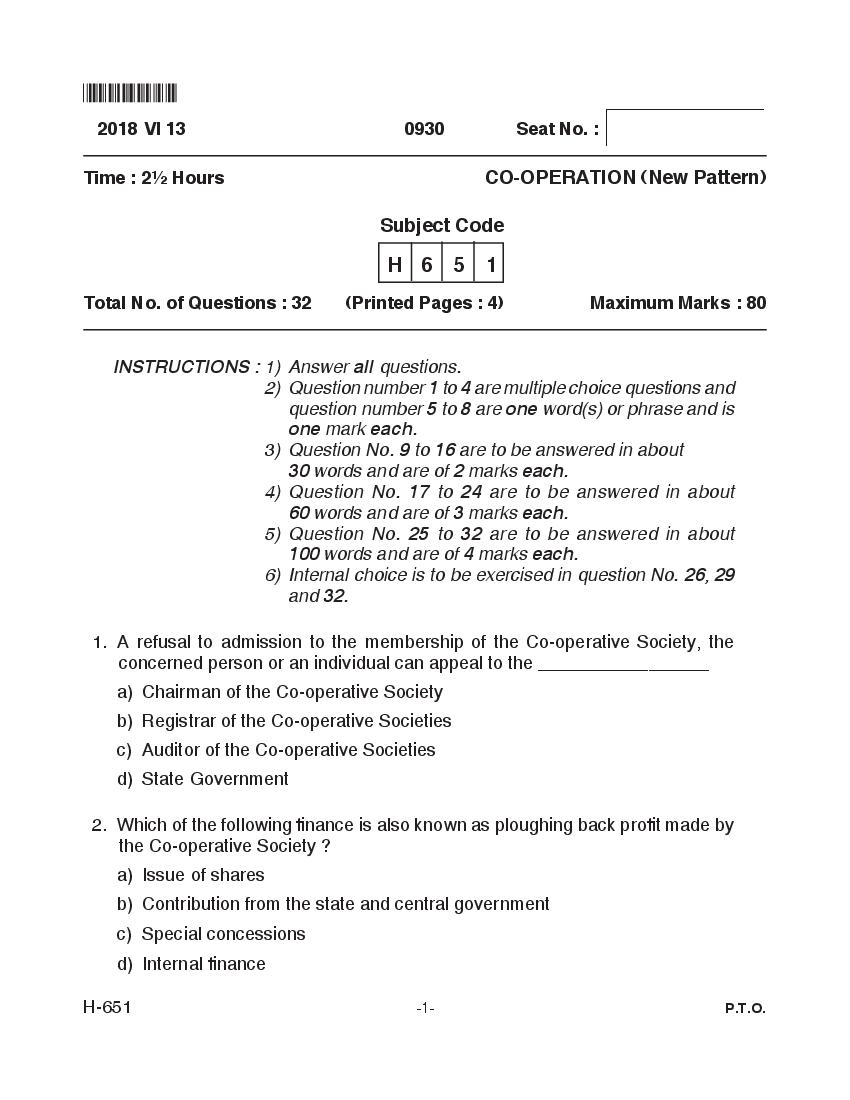
Time : 2� Hours CO-OPERATION (new Pattern)
Subject Code
H 6 5 1
Total No. of Questions : 32 (Printed Pages : 4) Maximum Marks : 80
Instructions : 1) Answer all questions.
2) Question number 1 to 4 are multiple choice questions and
question number 5 to 8 are one word(s) or phrase and is
one mark each.
3) Question No. 9 to 16 are to be answered in about
30 words and are of 2 marks each.
4) Question No. 17 to 24 are to be answered in about
60 words and are of 3 marks each.
5) Question No. 25 to 32 are to be answered in about
100 words and are of 4 marks each.
6) Internal choice is to be exercised in question No. 26, 29
and 32.
1. A refusal to admission to the membership of the Co-operative Society, the
concerned person or an individual can appeal to the _________________
a) Chairman of the Co-operative Society
b) Registrar of the Co-operative Societies
c) Auditor of the Co-operative Societies
d) State Government
2. Which of the following finance is also known as ploughing back profit made by
the Co-operative Society ?
a) Issue of shares
b) Contribution from the state and central government
c) Special concessions
d) Internal finance
H-651 -1- P.T.O.
Page 2
year is ________________
a) Two b) Three c) Four d) Ten
4. The most of the bigger organisations find it necessary to set up __________
a) Annual audit department b) Continuous audit department
c) Internal audit department d) Interim audit department
5. In which year Rural Banking Inquiry Committee was set up in India ?
6. In which year the NABARD was set up ?
7. Write the full form of KVIC.
8. The year in which the multi State Co-operative Societies Act, 1984 was revised
and renamed.
9. Explain any two features of good organisation.
10. The Co-operative Societies office need a secretary to function. Comment
(any four).
11. Point out any two points distinguishing statutory books and non-statutory books.
12. Explain any two contents of final accounts.
13. Why National Co-operative Development Corporation (NCDC) was set up in
India ? (any two)
14. How does S.B.I. promote processing Co-operative Societies ?
15. Mention any four individual level sources of credit available to farmers in India.
16. Distinguish between Co-operative Banks and Commercial Banks. (any two).
H-651 -2-
Page 3
of a Co-operative Society.
18. Discuss any three factors determining the capital requirement in a Co-operative
Society.
19. A first meeting of newly registered Co-operative Society shall be held very soon.
What business need to be transacted at such a meeting (any six).
20. “Auditing is more reliable then accounting”. Justify this statement by highlighting
any six benefits of auditing.
21. Elaborate any three developmental functions undertaken by the Co-operative
Department.
22. Discuss any three functions of R.B.I. in developing Cooperatives.
23. List out any six training programmes organised by the Dayanand Bandodkar
Co-operative training centre, Panjim.
24. Mention any six provisions of the Co-operative Societies Act, 1912.
25. The Chairman is the manager of meeting. Elaborate with reference to its duties
in the meeting.
26. Explain any four essentials of a valid meeting.
OR
Explain the procedure of conducting a meeting in a Co-operative Society.
27. What is the significance of maintaining stock register to the Co-operative
Society ? (any eight)
28. “Our audit system has many drawbacks”. In view of this statement highlight
any eight weakness of audit.
H-651 -3- P.T.O.
Page 4
OR
Highlight any eight special concessions and exemptions given to
Co-operative Societies.
30. The Goa Co-operative Housing Finance and Federation Ltd. has assisted
people of Goa in undertaking Construction of housing projects” Comment.
(any eight)
31. Many Co-operative Banks in our country are on the door step of liquidation.
To overcome this problems, what measures should they adopt ?
32. Write any eight features of the Maharashtra Co-operative Societies Act, 1960.
OR
Write any eight important provisions of the Goa Co-operative Societies Act, 2001
in respect to the registration of Co-operative Societies.
_____________
H-651 -4-
Document Details
| Board / Org | Goa Board |
| Exam | Class 12 |
| Type | Question Paper |
| Pages | 4 |
| Updated | 30 Apr 2026 |