GATE Sample Paper for Mathematics
Finished viewing? Save it for later —
Download GATE Sample Paper for Mathematics (PDF · 14 pages)About GATE Sample Paper for Mathematics
GATE Sample Paper for Mathematics is available here for free download. Published by IIT for Graduate Aptitude Test in Engineering, this sample paper can be viewed online or downloaded as a PDF (14 pages). Candidates preparing for Graduate Aptitude Test in Engineering can use GATE Sample Paper for Mathematics to understand the exam pattern, the type of questions asked, and the overall difficulty level.
Frequently Asked Questions
How can I download GATE Sample Paper for Mathematics?
Open this page and click the Download button to save GATE Sample Paper for Mathematics as a PDF. It is completely free on AglaSem Docs.
Is GATE Sample Paper for Mathematics free to download?
Yes. GATE Sample Paper for Mathematics can be viewed online and downloaded as a PDF free of cost on AglaSem Docs.
How many pages does GATE Sample Paper for Mathematics have?
GATE Sample Paper for Mathematics contains 14 pages, which you can read online or download together as a single PDF.
Where can I find more Graduate Aptitude Test in Engineering study material?
You can find more Graduate Aptitude Test in Engineering question papers, sample papers, syllabus, and answer keys on AglaSem Docs.
GATE Sample Paper for Mathematics – Text
Read the full text of this sample paper below — useful to quickly search, copy and reference the content online without downloading the PDF.
📄 View text version (14 pages)
Page 1
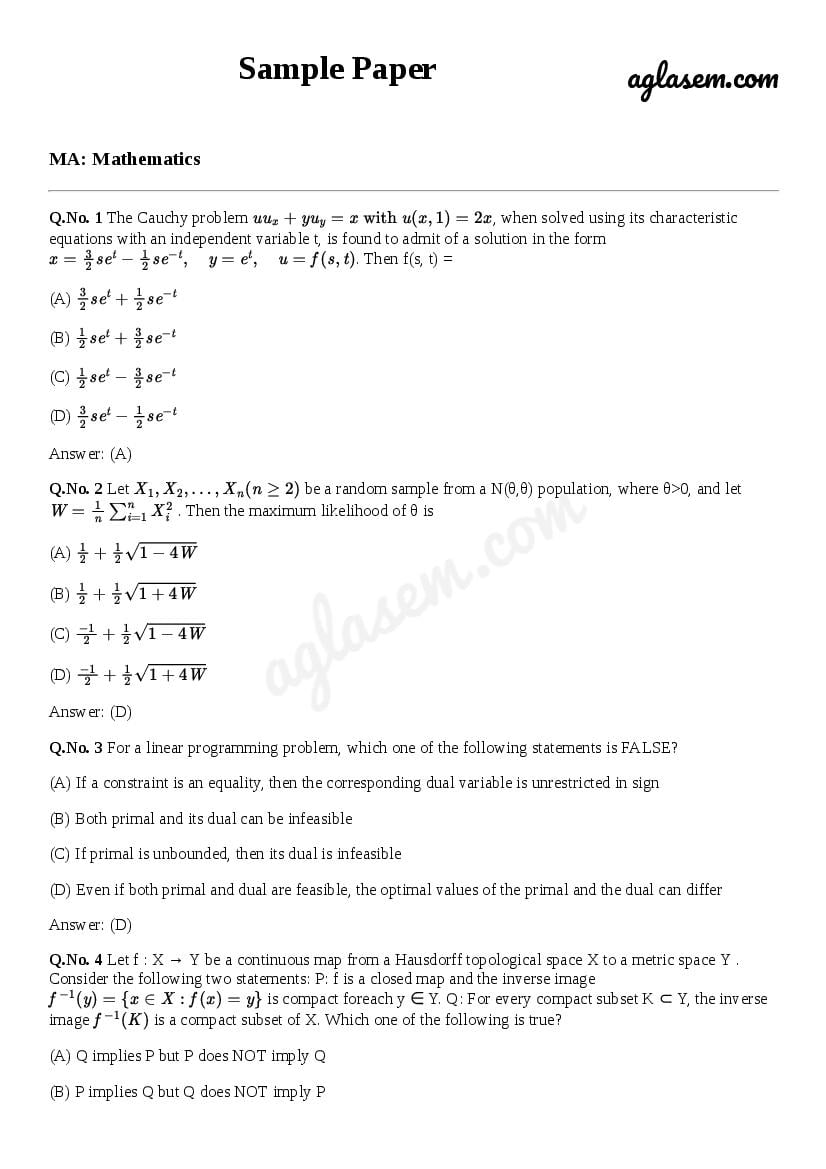
MA: Mathematics
Q.No. 1 The Cauchy problem uu + yu = x with u(x , 1) = 2x , when solved using its characteristic
x y
equations with an independent variable t, is found to admit of a solution in the form
u = f (s , t). Then f(s, t) =
3 t 1 −t t
x = se − se , y = e ,
2 2
(A) 3
2
se
t
+
1
2
se
−t
(B) 1
2
se
t
+
3
2
se
−t
(C) 1
2
se
t
−
3
2
se
−t
(D) 3
2
se
t
−
1
2
se
−t
Q.No. 2 Let X , X , … , X (n ≥ 2) be a random sample from a N(θ,θ) population, where θ>0, and let
1 2 n
W = ∑
1
X
n
. Then the maximum likelihood of θ is
n
i=1
2
i
(A) 1
2
+
1
2
√ 1 − 4W
(B) 1
2
+
1
2
√ 1 + 4W
(C) −1
2
+
1
2
√ 1 − 4W
(D) −1
2
+
1
2
√ 1 + 4W
Q.No. 3 For a linear programming problem, which one of the following statements is FALSE?
(A) If a constraint is an equality, then the corresponding dual variable is unrestricted in sign
(B) Both primal and its dual can be infeasible
(C) If primal is unbounded, then its dual is infeasible
(D) Even if both primal and dual are feasible, the optimal values of the primal and the dual can differ
Q.No. 4 Let f : X → Y be a continuous map from a Hausdorff topological space X to a metric space Y .
Consider the following two statements: P: f is a closed map and the inverse image
(y) = {x ∈ X : f (x ) = y} is compact foreach y ∈ Y. Q: For every compact subset K ⊂ Y, the inverse
−1
f
image f (K ) is a compact subset of X. Which one of the following is true?
−1
(A) Q implies P but P does NOT imply Q
(B) P implies Q but Q does NOT imply P
Page 2
(D) neither P implies Q nor Q implies P
Q.No. 5 Which one of the following statements is true?
(A) Every group of order 12 has a non-trivial proper normal subgroup
(B) Some group of order 12 does not have a non-trivial proper normal subgroup
(C) Every group of order 12 has a subgroup of order 6
(D) Every group of order 12 has an element of order 12
Q.No. 6 For a linear programming problem (LPP) and its dual, which one of the following is NOT TRUE?
(A) The dual of the dual is primal
(B) If the primal LPP has an unbounded objective function. then the dual LPP is infeasible
(C) If the primal LPP is infeasible. then the dual LPP must have unbounded objective function
(D) If the primal LPP has a finite optimal solution. then the dual I-PP also has a finite optimal Solution
Q.No. 7 If u(x,y) = 1 + x + y + f(xy), where f:R² → R is a differentiable function, then u satisfies
(A) x ∂u
∂x
− y
∂u
∂y
= x
2
− y
2
(B) x ∂u
∂x
− y
∂u
∂y
= 0
(C) x ∂u
∂x
− y
∂u
∂y
= x − y
(D) y ∂u
∂x
− x
∂u
∂y
= x − y
Q.No. 8 For a balanced transportation problem with three sources and three destinations where costs,
availabilities and demands are all finite and positive, which one of the following statements is FALSE?
(A) The transportation problem does not have unbounded solution
(B) The number of non-basic variables of the transportation problem is 4
(C) The dual variables of the transportation problem are unrestricted in sign
(D) The transportation problem has at most 5 basic feasible solutions
Q.No. 9 Let X1, X2, . . . , Xn be independent and identically distributed random variables with proba-bility
−θ(x −1)
θe , x ≥ 1
density function given by f X
(x ; θ) = { Also, let X = 1nPni=1 Xi. Then the
0 otherwise
maximum likelihood estimator of θ is
Page 3
(B) (1/X̄ ) − 1
(C) 1/(X̄ − 1)
(D) X̄
Q.No. 10 Suppose that M is a 5 x 5 matrix with real entries and p(x) = det(xl — M). Then
(A) p(0) = det(M)
(B) every eigenvalue of M is real if p(1) + p(2) = 0 = p(2) + p(3)
(C) m-1 is necessarily a polynomial in M of degree 4 if M is invertible
(D) M is not invertible if m2 - 2M = 0
Q.No. 11 Let C[0, 1] denote the space of all real-valued continuous functions on [0, 1] equipped with the
supremum norm ∥ ⋅ ∥ . Let T : C[0, 1] → C[0, 1] be the linear operator defined by
∞
x
f (y)dy Then
−y
T(f )(x ) = ∫ e
0
(A) ∥T∥ = 1
(B) I — T is not invertible
(C) T is surjective
(D) ∥I + T∥ = 1 + ∥T∥
Q.No. 12 Let R be a commutative ring with 1 (unity) which is not a field. Let I ⊂ R be a proper ideal such
that every element of R not in I is invertible in R. Then the number of maximal ideals of R is
(A) 1
(B) 2
(C) 3
(D) infinite
3
Q.No. 13 The initial value problem y = y ,
′
5 y(0) = b has
(A) a unique solution if b = 0
(B) no solution if b = 1
(C) infinitely many solutions if b = 2
(D) a unique solution if b = 1
Page 4
x n−1 3
n
= + , n ≥ 1
2 x n−1
sequence {xn}
(A) converges only if x0 > 1
(B) converges only if x0 < 3
(C) converges for any x0
(D) does not converge for any x0
Q.No. 15 Let y (x ) = x and y (x ) = x |x | for x∊R. Consider the following statement: (P): y₁(x) and
1
3
2
2
2
y₂(x) are linearly independent solutions of x − 4x + 6y = 0 on R. (Q): The Wronskian
2 d y
dx
2
dy
dx
for all x∊R. Which of the above statements hold TRUE?
dy2 dy1
y1 (x ) (x ) − y2 (x ) (x ) = 0
dx dx
(A) Both P and Q
(B) Only P
(C) Only Q
(D) Neither P nor Q
Q.No. 16 If f: C \ {0}➝C is a function such that f (z ) = f ( z
|z |
) and its restriction to the unit circle is
continuous, then
(A) f is continuous but not necessarily analytic
(B) f is analytic but not necessarily a constant function
(C) f is a constant function
(D) lim z →0 f (z ) exists
Q.No. 17 Let D = [-1,1] x [-1,1], If the function f: D→R is defined by f(x, y)=\left\{
2 2
x −y
2
, (x , y) ≠ (0, 0)
2 2
(x +y )
0, (x , y) = (0, 0)
\right, then
(A) f is continuous at (0, 0)
(B) both the first order partial derivatives of f exist at (0, 0)
1
(C) ∬ D
|f (x , y)| 2 dx dy
(D) ∬ D
|f (x , y)|dx dy
Page 5
supremum norm ∥ ⋅ ∥ . Let f ∈ C[0, 1] be such that
∞
$|f (x ) − f (y)| ≤ M |x − y|, $f orall$x , y ∈ [0, 1]$andf ors om e$M > 0$ For n ∈ ℕ, Let
1
f n (x ) = f (x
1+
n ) . If S = {f n
: n ∈ N} , then
(A) the closure of S is compact
(B) S is closed and bounded
(C) S is bounded but not totally bounded
(D) S is compact
Q.No. 19 Let f: C → C be non-zero and analytic at all points in Z . If F(z ) =πf(z ) cot(πz ) for z𝟄 C\Z then
the residue of F at n𝟄 Z is _____ . ( C is the set of all complex numbers, Z is the set of all integers and C \ Z
denotes the set of all complex numbers excluding integers)
(A) x f(n)
(B) f(n)
(C) f(n)/π
(D) (df/ dz)z=n
Q.No. 20 Consider the subspace Y={(x, x): x𝟄 C} of the normed linear space (C²,|| ||) . If Ф is a bounded
linear functional on ,Y defined by Ф(x,x ) , then which one of the following sets is equal to {ᴪ(1,0 ) : ᴪ is a
norm preserving extension of Ф , (C²,|| ||)} ( C is the set of all complex numbers, C² = {(x ,y,): x ,y𝟄 C} and ||
(x₁,x₂) || sup {|,x₁|,|x₂||
(A) {1}
(B) [½ ,3/2]
(C) [1,∞)
(D) [0,1]
Q.No. 21 Let T₁ be the co-countable topology on R (the set of real numbers) and T₂ be the co-finite topology
2
on . Consider the following statements: I. In (R ,T₁) the sequence { } converges to 0. II. In (R ,T₂), the
1
n −1
2
sequence { } converges to 0. III. In (R ,T₁) there is no sequence of rational numbers which converges to
1
n −1
√3. IV. In (R ,T₂) there is no sequence of rational numbers which converges to √3. Which of the above
statements are TRUE?
(A) I and II only
(B) II and III only
(C) III and IV only
Page 6
Q.No. 22 Consider the following statements: I : log(lzl) is harmonic on C \ {0} II : log(lzl) has a harmonic
conjugate on C \ {O} Then
(A) both I and II are true
(B) I is true but II is false
(C) I is false but II is true
(D) both I and II are false
Q.No. 23 Suppose that I and I are topologies on X induced by metrics d1 and d2, respectively, such that
1 2
I ⊆ I . Then which of the following statements is TRUE?
1 2
(A) If a sequence converges in (X, d2) then it converges in (X, d1)
(B) If a sequence converges in (X, d1) then it converges in (X, d2)
(C) Every open ball in (X, d1) is an open ball in (X, d2)
(D) The map x↦x from (X,d1) to (X,d2) is continuous
Q.No. 24 Suppose that U = R ∖ {(x , y) ∈ R : x , y ∈ Q}, V = R ∖ {(x , y) ∈ R
2 2 2 2
: x > 0, y =
1
x
}
Then, with respect to the Euclidean metric on ℝ2,
(A) both U and V are disconnected
(B) U is disconnected but V is connected
(C) U is connected but V is disconnected
(D) both U and V are connected
2
Q.No. 25 If y = 3e 2x
+ e
−2x
− αx is the solution of the initial value problem d y
dx
2
+ βy = 4αx , y(0) = 4
and , where 𝝰,𐌁∊ R, then
dy
(0) = 1
dx
(A) 𝝰 = 3 and 𐌁 = 4
(B) 𝝰 = 1 and 𐌁 = 2
(C) 𝝰 = 3 and 𐌁 = -4
(D) 𝝰 = 1 and 𐌁 = -2
Q.No. 26 An urn contains four balls, each ball having equal probability of being white or black. Three black
balls are added to the urn. The probability that five balls in the urn are black is
Page 7
(B) 3/8
(C) 1/2
(D) 5/7
Q.No. 27 For an odd prime p, consider the ring Z[√−p] = {a + b√−p : a, b ∈ Z} ⊆ C. Then the element
2 in Z[√−p] is
(A) a unit
(B) a square
(C) a prime
(D) irreducible
Q.No. 28 Let T and T denote the usual topology and the discrete topology on R, respectively. Consider the
u d
following three topologies: T₁ = Usual topology on R = R × R, T₂ = Topology generated by the basis
2
{U × V : U ∈ T , V ∈ T } on R x R, T₃ = Dictionary order topology on R x R. Then
d u
(A) T 3
T1 ⊆ T2
(B) T T
1 2 T3
(C) T ⊆ T
3 2
T1
(D) T 1 T2 = T3
Q.No. 29 Let P 𝜺 Mm x n .Consider the following statements: I : If X P Y = 0 for all X 𝜺 M 1 x m(R) and Y 𝜺
M n x 1(R), then P= 0. II : If m = n, P is symmetric and P2 = 0, then P = 0. Then
(A) both I and II are true
(B) I is true but II is false
(C) I is false but II is true
(D) both I and II are false
Q.No. 30 Consider the following statements: I. The set QxZ is uncountable. II. The set {f : f is a function
from to {0, 1}} is uncountable. III. The set {√ p : is a prime number} is uncountable. IV. For any infinite set,
there exists a bijection from the set to one of its proper subsets. (Q is the set of all rational numbers, Z is the
set of all integers and is the set of all natural numbers) Which of the above statements are TRUE?
(A) I and IV only
(B) II and IV only
Page 8
(D) I, II and IV only
Q.No. 31 Let f : R → R be a twice continuously differentiable function. The order of convergence of the
secant method for finding root of the equation f(x) = 0 is
1+√ 5
(A) 2
(B) 2
1+√ 5
(C) 1+√ 5
3
(D) 3
1+√ 5
Q.No. 32 Let the general integral of the partial differential equation
= 2(x − yz ) be given by F (u,v )=0, where F=R² is a continuously
∂z 2 ∂z
(2x y − 1) + (z − 2x )
∂x ∂y
differentiable function. ( R is the set of all real numbers and R²={ (x ,y ) : x, y 𝟄 R} ) Then which one of the
following is TRUE?
(A) u= x² +y² +z, v=xz +y
(B) u= x² +y² -z, v=xz -y
(C) u= x² -y² +z, v=yz +x
(D) u= x² +y² -z, v=yz -x
Q.No. 33 Let X and Y be normed linear spaces, and let T: X→ Y be any bijective linear map with closed
graph. Then which one of the following statements is TRUE?
(A) The graph of T is equal to X xY
(B) T-1 is continuous
(C) The graph of T-1 is closed
(D) T is continuous
Q.No. 34 Consider the Linear Programming Problem (LPP):
Subject to 2x 1 + x 2 ≤ 6
− x1 + x2 ≤ 1
M ax im iz e$αx 1 + x 2 where α is a constant. If (3, 0) is the only optimal
x1 + x2 ≤ 4
x 1 ≥ 0, x 2 ≥ 0
solution, then
(A) α < −2
(B) −2 < α < 1
Page 9
(D) α > 2
Q.No. 35 Let X , X , … , X
1 2 n (n ≥ 2) be independent and identically distributed random variables with
finite variance 𝞂² and let X̄ = . Then the covariance between X̄ and X − X̄ is
1 n
∑ Xi 1
n i=1
(A) 0
(B) -𝞂²
2
(C) −σ
η
2
(D) σ
η
α 3 0
⎡ ⎤
Q.No. 36 Let M = β 3 1 Consider the following statements: l: There exists a lower triangular matrix
⎣ ⎦
0 1 2
L such that M = L L , where L denotes transpose of L. II: Gauss-Seidel method for Mx = b (b ∊ R³)
t t
converges for any initial choice x₀ ∊ R³ Then,
(A) I is not true when α > 9
2
,β = 3
(B) II is not true when α > 9
2
, β = −1
(C) II is not true when α = 4, β = 3
2
(D) I is true when α = 5, β = 3
Q.No. 37 Consider the ordered square I₀², the set [0,1] x[0,1] with the dictionary order topology. Let the
general element of I₀² be denoted by x * y, where x y 𝟄 [0,1]. Then the closure of the subset S= { x * ¾ : 0
(A) S U ( (a,b ] x{0}) U ( [ a,b) x{1} )
(B) S U ( (a,b ] x{0}) U ( ( a,b] x{1} )
(C) S U ( (a,b ) x{0}) U ( ( a,b) x{1} )
(D) S U ( (a,b ] x{0})
2 2 1
(x + y ) sin( ), if (x , y) ≠ (0, 0)
Q.No. 38 Let f: R² → R be defined by f (x , y) = { Consider
2 2
x +y
0, if (x , y) = (0, 0)
the following statements: I. The partial derivatives , f f exist at (0, 0) but are unbounded in any
neighbourhood of (0, 0). II. f is continuous but not differentiable at (0, 0). III. f is not continuous at (0, 0). IV.
f is differentiable at (0, 0). ( R is the set of all real numbers and R² ={(x ,y ) : x ,y𝟄 R ) Which of the above
statements is/are TRUE?
(A) I and II only
Page 10
(C) IV only
(D) III only
Q.No. 39 Suppose V is a finite dimensional vector space over R. If W₁, W₂ and W₃ are subspaces of V , then
which of the following statements is TRUE?
(A) If W₁ + W₂ + W₃ = V then span(W₁ U W₂) U span(W₂ U W₃) U span( W₃ U W₁) = V
(B) If W₁ ⋂ W₂ = {0} and W₁ ⋂ W₃ = {0}, then W₁ ⋂ (W₂ + W₃) = {0}
(C) If W₁ + W₂ = W₁ + W₃, then W₂ = W₃
(D) If W₁ ≠ V, then span(V\W₁) = V
Q.No. 40 A solution of the Dirichlet problem ∇²u(r,𝛉 ) = 0, 0
n
(−1) −1
(A) u(r,𝛉 )= π/2 + ∑
∞ n
[ 2
]r cos(nθ)
n=1 n
n+1
(−1) −1
(B) u(r,𝛉 )= π/2 + ∑
∞ n
[ 2
]r cos(nθ)
n=1 n
n
(−1) −1
(C) u(r,𝛉 )= π/2 + 2 ∞ n
∑ [ 2
]r cos(nθ)
π n=1 n
n
(−1) −1
(D) u(r,𝛉 )= π/2 - 2
π
∑
∞
n=1
[
n
2
]r
n
cos(nθ)
Q.No. 41 The general solution of the differential equation x y = y + √x ′ 2
+ y
2
f or x > 0 is given by
(with an arbitrary positive constant k)
(A) k y 2
= x + √x
2
+ y
2
(B) k x 2
= x + √x
2
+ y
2
(C) k x 2
= y + √x
2
+ y
2
(D) k y 2
= y + √x
2
+ y
2
Q.No. 42 Let X , X , … , X (m ≥ 2) be a random sample from a binomial distribution with parameters
1 2 m
n=1 and p, p∊(0,1) and let X̄ = ∑ X . Then a uniformly minimum variance unbiased estimator for
1
m
m
i=1 i
p(1-p) is
(A) m
m −1
X̄ (1 − X̄ )
(B) X̄ (1 − X̄ )
Page 11
m
X̄ (1 − X̄ )
(D) 1
m
X̄ (1 − m X̄ )
Q.No. 43 Let f (z ) = (x 2 2
+ y ) + i2x y and g(z ) = 2x y + i(y − x ) for z = x + iy ∈ C Then, in the
2 2
complex plane C.
(A) f is analytic and g is NOT analytic
(B) f is NOT analytic and g is analytic
(C) neither f nor g is analytic
(D) both f and g are analytic
Q.No. 44 For the linear programming problem (LPP): Maximize Z = 2 x1 + 4 x2 subject to -x1 + 2 x2 <4, 3x1
+ 𝞫x₂<6, x1,x2 ≥ 0 𝞫 𝟄 R ( R is the set of all real numbers) consider the following statements: I. The LPP
always has a finite optimal value for any 𝞫 ≥ 0. II. The dual of the LPP may be infeasible for some 𝞫 ≥ 0.
III. If for some ,𝞫 the point (1,2) is feasible to the dual of the LPP, then Z ≤ 16 for any feasible solution (x1 ,
xsub>2 ) of the LPP. IV. If for some ,𝞫,x1 and x2 are the basic variables in the optimal table of the LPP with
x1= 1/2 then the optimal value of dual of the LPP is 10. Then which of the above statements are TRUE?
(A) I and III only
(B) I, III and IV only
(C) III and IV only
(D) II and IV only
2
Q.No. 45 Let f n
: [0, 1] → R be given by f (x ) =
n
x
2
2x
+(1−2nx )
2
, n = 1, 2, … Then the sequence (fₙ)
(A) converges uniformly on [0, 1]
(B) does NOT converge uniformly on [0 , 1] but has a subsequence that converges uniformly on [0, 1]
(C) does NOT converge pointwise on [0, 1]
(D) converges pointwise on [0, 1] but does NOT have a subsequence that converges uniformly on [0, 1]
Q.No. 46 Let {Xi} be a sequence of independent Poisson(λ) variables and let tW = ∑ X . Thenthe n
1
n
n
i=1
i
limiting distribution of √n(W − λ) is the normal distribution with zero mean and variance given by
n
(A) 1
(B) √λ
(C) λ
Page 12
Q.No. 47 Consider the polynomial p(X ) = X + 4 in the ring Q[X ] of polynomials in the variable X with
4
coefficients in the field Q of rational numbers. Then
(A) the set of zeros of p(X) in C forms a group under multiplication
(B) p(X) is reducible in the ring Q[X]
(C) the splitting field of p(X) has degree 3 over Q
(D) the splitting field of p(X) has degree 4 over Q
Q.No. 48 Let f (z ) = e 1/z
, z ∈ C∖ {0} and let, for n∈N
}∖ {0}. If for a subset S of ℂ, denotes the closure of S in ℂ,
1 1
R n = {z = x + iy ∈ C : |x | < , |y| <
n n
then
¯
(A) f (R n+1 ) ≠ f (R n )
¯
¯
¯
(B) f (R )∖ f (R
n n+1 ) = f (R n ∖ R n+1 )
¯
¯
(C) f (⋂
∞ ∞
n=1
Rn ) = ⋂
n=1
f (R n )
¯
¯
(D) f (R ) = f (R
n n+1 )
n 2
Q.No. 49 If , u n = ∫
1
e
−r
dt , n=1,2,3…… then which one of the following statements is TRUE?
(A) Both the sequence {u } and the series ∑ are convergent
∞ ∞
n
un
n=1 n=1
(B) Both the sequence {u } n
∞
n=1
and the series ∑ ∞
n=1
un are divergent
(C) The sequence {u } n
∞
n=1
is convergent but the series ∑ ∞
n=1
un is divergent
(D) lim x →∞ u x =
2
e
Q.No. 50 In the Laurent series expansion of f(z) = 1 z(z − 1) valid for |z − 1| > 1, the coefficient of 1 z − 1 is
(A) −2
(B) −1
(C) 0
(D) 1
Q.No. 51 Let X denote R 2 endowed with the usual topology. Let Y denote R endowed with the co-finite
topology. If Z is the product topological space Y × Y, then
Page 13
(B) the topology of X is strictly coarser (weaker) than that of Z
(C) the topology of Z is strictly coarser (weaker) than that of X
(D) the topology of X cannot be compared with that of Z
Q.No. 52 Let f : C → C be an entire function with f(0) = 1, f(1) = 2 and f'(0) = 0. If there exists M > 0 such
that |f (z )| ≤ M f or all z ∈ C, then f (2) =
′′
(A) 2
(B) 5
(C) 2 + 5i
(D) 5 + 2i
Q.No. 53 Consider the subspace V = {(x ) ∈ ℓ : ∑ |x | < ∞} of the Hilbert space l² of all square
n
2 ∞
n=1 n
summable real sequences. For n∊N, define T : V → R by T ((x )) = ∑ x . Consider the following
n
n n k i=1 i
statements: (P): {T : n ∈ N} is pointwise bounded on V. (Q): {T : n ∈ N} is uniformly bounded on
n n
{x ∈ V : ∥x ∥ = 1}. Which of the above statements hold TRUE?
2
(A) Both P and Q
(B) Only P
(C) Only Q
(D) Neither P nor Q
Q.No. 54 For n 𝜺 N, let T : (l , ∥ ⋅ ∥ ) → (l
n
1
1
∞ 1
, ∥ ⋅ ∥∞ ) and T : (l , ∥ ⋅ ∥1 ) → (l
∞
, ∥ ⋅ ∥∞ ) be the bounded
xj, j ≤ n
linear operators defined by T (x , x , …) = (y , y , …) , where yj =y
n 1 2 1 2 j = { and
x n, j > n
T(x 1 , x 2 , …) = (x 1 , x 2 , …) . Then
(A) ||Tn|| does not converge to ||Tn|| as n → ∞
(B) ||Tn - T|| converges to zero as n → ∞
(C) for all x 𝜺 l1, ||Tn(x) - T(x) || converges to zero as n → ∞
(D) for each non-zero x 𝜺 l1 there exists a continuous linear functional g on l∞ that g (Tn (x)) does not
converge to g( T(x) ) as n → ∞
Q.No. 55 Let f: R → R be defined by f (x ) = ∑ χ
∞
n=0
(x ) where χ
1
n
2
(n,n+1] (n,n+1]
is the characteristic
function of the interval (n, n + 1]. For α 𝜺 R, let Sα = {x 𝜺 R : f (x) > α). Then
Page 14
(B) S√5/2 is not measurable
(C) S0 is closed
(D) S1/√2 is measurable
Document Details
| Board / Org | IIT |
| Exam | Graduate Aptitude Test in Engineering |
| Type | Sample Paper |
| Pages | 14 |
| Language | english |
| Updated | 22 Jul 2026 |