GATE Sample Paper for Metallurgical Engineering
Finished viewing? Save it for later —
Download GATE Sample Paper for Metallurgical Engineering (PDF · 12 pages)About GATE Sample Paper for Metallurgical Engineering
GATE Sample Paper for Metallurgical Engineering is available here for free download. Published by IIT for Graduate Aptitude Test in Engineering, this sample paper can be viewed online or downloaded as a PDF (12 pages). Candidates preparing for Graduate Aptitude Test in Engineering can use GATE Sample Paper for Metallurgical Engineering to understand the exam pattern, the type of questions asked, and the overall difficulty level.
Frequently Asked Questions
How can I download GATE Sample Paper for Metallurgical Engineering?
Open this page and click the Download button to save GATE Sample Paper for Metallurgical Engineering as a PDF. It is completely free on AglaSem Docs.
Is GATE Sample Paper for Metallurgical Engineering free to download?
Yes. GATE Sample Paper for Metallurgical Engineering can be viewed online and downloaded as a PDF free of cost on AglaSem Docs.
How many pages does GATE Sample Paper for Metallurgical Engineering have?
GATE Sample Paper for Metallurgical Engineering contains 12 pages, which you can read online or download together as a single PDF.
Where can I find more Graduate Aptitude Test in Engineering study material?
You can find more Graduate Aptitude Test in Engineering question papers, sample papers, syllabus, and answer keys on AglaSem Docs.
GATE Sample Paper for Metallurgical Engineering – Text
Read the full text of this sample paper below — useful to quickly search, copy and reference the content online without downloading the PDF.
📄 View text version (12 pages)
Page 1
MT: Metallurgical Engineering
Q.No. 1 Terminal rise velocity of a spherical shaped solid in a liquid obeys the following functional relationship: U =f( d, W,μ,ρ ) Where, U is the terminal rise
velocity, d is the diameter of the solid, W is the apparent weight of the solid, µ is the viscosity of liquid and ρ is the density of liquid. According to Buckingham Π
theorem, the number of independent dimensionless variables needed to describe the phenomenon is _______________.
(A) 1
(B) 2
(C) 3
(D) 5
Q.No. 2 For a laminar flow of a liquid metal over a flat plate, the thicknesses of the velocity and thermal boundary layers are 𝛿𝑣 and 𝛿𝑡 respectively. Kinematic
viscosity (viscosity/density) of liquid metal is significantly lower than its thermal diffusivity [thermal conductivity / (density × specific heat)]. Based on this
information, pick the correct option. (Note: The temperature of the liquid metal is different from that of the plate).
(A) 𝛿𝑣 < 𝛿𝑡
(B) 𝛿𝑣 > 𝛿𝑡
(C) 𝛿𝑣 = 𝛿𝑡
(D) Information insufficient
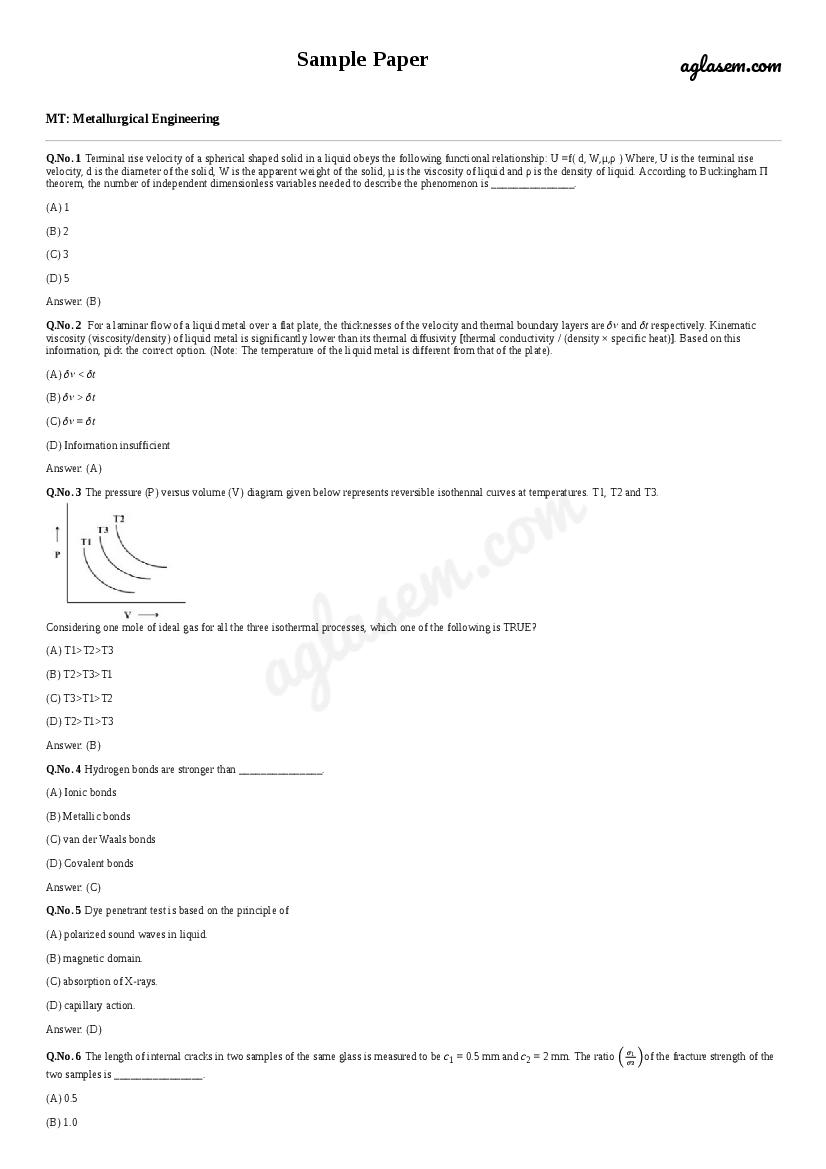
Q.No. 3 The pressure (P) versus volume (V) diagram given below represents reversible isothennal curves at temperatures. T l, T2 and T3.
Considering one mole of ideal gas for all the three isothermal processes, which one of the following is TRUE?
(A) T1>T2>T3
(B) T2>T3>T1
(C) T3>T1>T2
(D) T2>T1>T3
Q.No. 4 Hydrogen bonds are stronger than _______________.
(A) Ionic bonds
(B) Metallic bonds
(C) van der Waals bonds
(D) Covalent bonds
Q.No. 5 Dye penetrant test is based on the principle of
(A) polarized sound waves in liquid.
(B) magnetic domain.
(C) absorption of X-rays.
(D) capillary action.
Q.No. 6 The length of internal cracks in two samples of the same glass is measured to be 𝑐1 = 0.5 mm and 𝑐2 = 2 mm. The ratio ( of the fracture strength of the
σ1
)
σ2
two samples is ________________.
(A) 0.5
(B) 1.0
Page 2
(D) 4.0
Q.No. 7 Angle between two neighboring tetrahedral bonds in Si having a diamond cubic structure is:
(A) 102.5°
(B) 109.5°
(C) 120°
(D) 135.5°
Q.No. 8 When 1 mole of C3H8 at 300 K is burnt with stoichiometric amount of oxygen at 300 K to form CO2 and H20, the adiabatic flame temperature is 5975 K. If
C3H8 is burnt under the same conditions but with excess oxygen, the adiabatic flame temperature will be
(A) equal to 5975 K irrespective of the amount of excess oxygen.
(B) higher than 5975 K irrespective of the amount of excess oxygen.
(C) lower than 5975 K irrespective of the amount of excess oxygen.
(D) higher or lower than 5975 K depending on the amount of excess oxygen.
Q.No. 9 Th eP ourbaix plotof th ereaction$Al 3+
+ 2H2 O = AlO
−
2
+
+ 4H $inpotential(E )vers us pH diagram is :
(A)
(B)
(C)
(D)
Q.No. 10 Arrange the following processes in INCREASING magnitude of surface roughness of the casting. P. Investment casting Q. Permanent mould casting R.
Pressure die casting S. Sand casting
(A) R < S < Q < P
(B) P < S < Q < R
(C) R < P < Q < S
(D) Q < P < R < S
Page 3
What is this process called?
(A) Martempering
(B) Ausforming
(C) Inter-critical forming
(D) Normalizing
Q.No. 12 If the solid-liquid interfacial energy increases by 10%, the energy barrier for homogeneous nucleation of a spherical solid from the liquid, will change by:
(A) 21%
(B) 33%
(C) -10%
(D) 46%
Q.No. 13 The sequence of precipitation to reach stable equilibrium during ageing of Al-4.5 wt. % Cu alloy is:
(A) GP zone → θ → θ ′ ′′
→ θ
(B) GP zone → θ ′′
→ θ
′
→ θ
(C) GP zone → θ → θ ′′ ′
→ θ
(D) GP zone → θ ′′
→ θ → θ
′
Q.No. 14 Which one of the following processes is an example of an electrolytic cell?
(A) Corrosion of a metal rod in ambient atmosphere
(B) Charging of a rechargeable battery
(C) Discharging of a rechargeable battery
(D) Sacrificial cathodic protection system
Q.No. 15 At low temperature, two parallel edge dislocations lying on parallel slip planes are shown in different configurations below.
(A) P-3, Q-2, R-4, S-1
(B) P-4, Q-1, R-3, S-2
(C) P-1, Q-3, R-2, S-4
(D) P-2, Q-4, R-1, S-3
Page 4
(A) P-1, 0-2, R-3, S-4
(B) P-2, Q-3, R-1, S-4
(C) Q-1, R-2, S-3 P-4
(D) P-4, Q-2, R-1, S-3
Q.No. 17 T and T are the melting points of pure metal A and pure stoichiometric oxide AO , respectively, and T < T . The stoichiometric metal oxidation
1 2 2 1 2
reaction A(s ) + O (g) = AO (s ) is in equilibrium at I atm pressure at temperature less than T . If the temperature increases, which schematic represents the
2 2 1
conect standard free energy change versus temperature plot?
(A)
(B)
(C)
Page 5
Q.No. 18 Cupola is a furnace used to produce.
(A) cast irons.
(B) plain carbon steels.
(C) copper alloys
(D) aluminium alloys.
Q.No. 19 Given the three vectors X= -i-j + k, Y = -i+2j+k and Z=i + k, which one of the following statements is TRUE?
(A) X, Y and Z are mutually perpendicular.
(B) X, Y and Z are coplanar.
(C) X makes an angle of 30° with the normal to the plane containing Y and Z.
(D) Z makes an angle of 60° with the normal to the plane containing X and Y.
Q.No. 20 Match the automobile components in Column I with the corresponding manufacturing
(A) P-1, Q-2, R-3, S-4
(B) P-3, Q-4, R-1, S-2
(C) P-3, Q-2, R-4, S-1
(D) P-4, Q-1, R-3, S-2
Page 6
(A) P-1, Q-2, R-4, S-3
(B) P-2, Q-4, R-1, S-3
(C) P-2, Q-3, R-4, S-1
(D) P-2, Q-1, R-4, S-3
Q.No. 22 Which of the following materials are protected by passivation (i.e., formation of a thin adherent film on the surface) from corrosion? P. Aluminium alloys
Q. Mild steel R. Stainless steel S. Silver
(A) P & Q
(B) Q & R
(C) Q & S
(D) P & R
Q.No. 23 For each of the crystallographic system listed in Group-I, match the conesponding minimum symmetry in Group-II
(A) P-3: 0-4: R-2: S-3
(B) P-4: 0-3: R-2: S-1
(C) P-1, Q-2; R-4; S-3
(D) P-4, Q-3; R-1; S-2
Q.No. 24 In a typical scanning electron microscope (SEM) image, information about topography and atomic contrast are obtained from ________________.
(A) secondary electron and auger electron, respectively.
(B) primary electron and secondary electron, respectively.
(C) secondary electron and back-scatter electron, respectively.
(D) back-scatter electron and auger electron, respectively.
Q.No. 25 The directional derivative of 𝜙 = 𝑥2 + 𝑦 along the unit vector u^ = 1
5
(3 ^
ı + 4^
ȷ) at (1,1) is _____________.
(A) 3
(B) 2
(C) 1
(D) 0
Q.No. 26 At equilibrium, the maximum number of phases in a three-component system at CONSTANT PRESSURE is:
(A) 1
(B) 2
(C) 3
(D) 4
Q.No. 27 Determine the correctness or otherwise of the following Assertion ( a) and the Reason [r] Assertion ( a): Low-alloy steels used for medium-temperature
creep resistance often have additions of strong carbide-forming elements. Reason (r): During creep deformation, the particles with higher misfit with the matrix, lose
Page 7
(A) Both [a] and [r] are true and [r] is the correct reason for [a]
(B) Both [a] and [r) are true but [r] is not the correct reason for [a]
(C) Both [a] and [r] are false
(D) [a] is true but [r] is false.
Q.No. 28 In a Jominy end-quench test of the eutectoid plain-carbon steel, which of the following represents the sequence of microstructures observed from the
quenched end of the specimen?
(A) Fine Pearlite, Coarse Pearlite, Martensite and Pearlite, Martensite
(B) Martensite, Martensite and Pearlite, Fine Pearlite, Coarse Pearlite
(C) Coarse Pearlite, Pearlite and Martensite, Fine Pearlite, Martensite
(D) Martensite, Martensite and Pearlite, Coarse Pearlite, Fine Pearlite
Q.No. 29 The curl of vector fields shown below is not zero for _____________.
(A)
(B)
(C)
(D)
Q.No. 30 A dielectric material is
(A) Electrical conductor
(B) Metallic magnet
(C) Two coupled electrical conductors
(D) Electrical insulator
Q.No. 31 What is the most-abundant anion in a 2CaO.SiO2 melt?
(A) (SiO4)4-
(B) (Si2O7)6-
(C) (Si3O10) 8-
(D) (Si4O14) 10-
Page 8
∗
(Given : (i)$Cb = $bulk concentrationof dis s olvedAlinliquids teel, (ii)$C = $s aturationconcentrationof Alinliquids teelatth egiventem perature, (iii)
(A) C ∗
− Cb
(B) C − C
b m
(C) C ∗
− Cm
(D) √C C ∗
m − Cb
Q.No. 33 The table (see options below) providing correct information about crystal structure, co-ordination number and packing fraction is ________________.
[Note: FCC: Face centered cubic; BCC: Body centered cubic; DC: Diamond cubic.CN: Coordination number; PF: Packing fraction]
(A)
(B)
(C)
(D)
Q.No. 34 What is the voltage required to electrolytically refine impure copper of activity 𝑎𝐶𝑢 = 0.9 (Raoultian standard state) to pure copper at 300 K Given: Gas
constant R = 8.314 J mol- 1 K-1, and Faraday’s constant F = 96500 C mol-1 .
(A) 1.36 mV
(B) 2.72 mV
(C) 0 mV
(D) 5.44 mV
Q.No. 35 W-Ni compact is prepared by liquid phase sintering at 1500 C. If the size of tungsten grains is 40 μm and the interfacial tungsten-tungsten and tungsten-
∘
nickel energies are 0.52 and 0.30 J. m respectively, the predicted average neck size (in μm) of sintered tungsten grain is:
−2
(A) 10
(B) 15
(C) 20
(D) 25
Q.No. 36 In the edge dislocation configuration given in the figure, dislocations X and Y are fixed and separated by a distance 2h on the same slip plane. Dislocation
Z is free to glide on a parallel slip plane. The two slip planes are separated by a distance h. Which one of the following statements is TRUE regarding the stability of
dislocation Z at positions 1, 2 and 3? Assume all dislocations have identical Burgers vector.
(A) Position 1: unstable equilibrium; Position 2: unstable; Position 3: unstable
Page 9
(C) Position 1: unstable equilibrium; Position 2: stable; Position 3: unstable
(D) Position 1: stable equilibrium; Position 2: unstable; Position 3: stable
Q.No. 37 What is the requirement for equilibrium at a triple junction as shown in the schematic, with γ12, γ23, γ13 as grain boundary tensions and θ1, θ2, θ3 as
dihedral angles?
(A) γ23 /Cos( θ1) = γ13 / Cos( θ2) = γ12 / Cos ( θ3)
(B) γ23 /Sin( θ1) = γ13 / Sin( θ2) = γ12 / Sin ( θ3)
(C) γ23 /Sin( θ2).Sin( θ3) = γ13 / Sin( θ1).Sin( θ3) = γ12 / Sin( θ1).Sin( θ2)
(D) γ23 Sin( θ1) = γ13 Sin( θ2) = γ12 Sin( θ3)
Q.No. 38 In green sand casting, which one of the following is NOT a part of the gating system?
(A) Runner
(B) Sprue
(C) Riser
(D) Pouring basin
Q.No. 39 Consider a dilute substitutional solid solution of X in a metal A. The powder diffraction pattern of this alloy reveals that all the peaks have shifted to the
left when compared to those for pure A (with no splitting of peaks). If such a solute interacts and segregates to an edge dislocation, which of the following positions
around the dislocation will it preferentially occupy?
(A) P
(B) Q
(C) R
(D) S
Q.No. 40 The dye penetrant test for detecting flaws is based on: Magnetism Sound propagation
(A) Magnetism
(B) sound propagation
(C) X-ray absorption
(D) Capillary action
Page 10
(B)
(C)
(D)
∂S
∂P
∂s
∂v
∂S
∂τ
∂S
∂P
At 300K, ΔH
∣
Q.No. 41 For a single phase system with K components, the exact differential of Gibbs free energy is given as : 𝑑𝐺 = −𝑆𝑑𝑇 + 𝑉𝑑𝑃 + ∑ 𝜇𝑖𝑑𝑛𝑖 Which one of the
following can be derived from the above expression as a Maxwell’s relation?
T,n i
T,n t
T,n l
T,n i
(A) 5.6 × 10⁶
(B) 3.6 × 10⁷
(C) 4.0 × 10⁸
(D) 7.3 × 108
= −
=
= −
=
∂v
∂τ
∂V
∂P
∘
∂V
∂T
p,n t
∂V
∂P
P ,n i
T,n i
T,n i
Q.No. 42 The equilibrium constant for the following reaction at 300 K is ___________. C(graphite)+2H2(g)-> CH4(g) Given:
= −74, 900J ⋅ mol
−1
; ΔS
∘ −1
= −80J ⋅ mol ⋅ K
−1
𝑅 = 8.314J ⋅ mol
−1 −1
K
Q.No. 43 An aluminium single crystal is loaded in tension along [1-10] axis. Among the following slip systems, the one that will be activated first
is__________________.
(A)
(B)
(C)
(D)
Q.No. 44 A single Crystal of an FCC metal is subjected to a sufficiently large tensile stress along the [110] direction to activate some of the slip systems. Which one
of the following slip systems will be activated:
(A)
¯
a
(B)
¯
a
(C)
¯
a
(D)
¯
¯
a
2
2
2
2
[110](111)
[011](111)
[011](111)
[110](111)
Q.No. 45 A slip system consists of a slip plane and a slip direction. Which one of the following is NOT a valid slip system in a FCC copper crystal?
(A) (111)[11̅0]
(B) (1̅11)[011]
(C) (11̅1)[101̅]
(D) (111̅)[101]
Q.No. 46 The Boudouard (or, carbon gasification) reaction is_____________________.
(A) C(s ) +
(D) CO(g) +
1
2
O2 (g) → CO(g)
(B) C(s ) + O (g) → CO (g)
2
(C) C(s ) + CO (g) → 2CO(g)
1
2
2
O2 (g) → CO2 (g)
2
Q.No. 47 The carbide that is primarily responsible for intergranular corrosion in austenitic stainless steel is __________________.
Page 11
(B) Fe3C
(C) SiC
(D) Mn3C
Q.No. 48 The smallest period of function f (x ) = sin( nx
k
) is_____________.
(A) 2𝜋
(B) 𝑘/𝑛
(C) 2𝜋𝑘/𝑛
(D) 2𝜋𝑛/𝑘
Q.No. 49 In froth flotation, the primary purpose of adding collectors is to:
(A) make the surface of the mineral hydrophobic.
(B) make the surface of the mineral hydrophilic.
(C) stabilize the froth.
(D) adjust the pH.
Q.No. 50 For a material to exhibit superplasticity, one of the requirements is:
(A) Coarse-grained microstructure
(B) High strain-rate sensitivity
(C) Low strain-hardening exponent
(D) High modulus of elasticity
Q.No. 51 Four alloys, C1, C2, C3, C4, shown in the phase diagram are poured at temperature T in a mold. During solidification, which one of these alloys is
1
expected to have the highest fluidity?
(A) C1
(B) C2
(C) C3
(D) C4
Q.No. 52 Match the processes in Column I with the most appropriate mechanisms in Column II
(A) P-1, 0-4, R-2, S-3
(B) P-3, Q-1, R-2, S-4
(C) P-3, Q-4, R-2, S-1
(D) P-1, Q-2, R-3, S-4
Page 12
Ω
−1
.m
−1
. If the electron and hole mobilities are 0.75 and 0.06
2
m V
−1
s respectively, the intrinsic carrier concentration (per m ) at room temperature is:
−1 3
(A) 5.1 × 10 12
(B) 7.7 × 10 12
(C) 8.3 × 10 12
(D) 1.1 × 10 14
Q.No. 54 Determine the correctness or otherwise of the following Assertion ( a) and the Reason [r] Assertion ( a): The rate of homogenization in a dilute
substitutional solid solution of B in A is controlled by the diffusivity of B. Reason (r]: Atomic migration cannot occur along dislocations and grain boundaries. Both
[a] and [r) are true and [r) is the correct reason for [a] Both ( a) and (r) are true but [r] is not the correct reason for [a] Both [a] and [r] are false [a] is true but [r) is
false
(A) Both [a] and [r) are true and [r) is the correct reason for [a]
(B) Both ( a) and (r) are true but [r] is not the correct reason for [a]
(C) Both [a] and [r] are false
(D) [a] is true but [r) is false
Q.No. 55 Match the materials in Column I with their common applications in Column II.
(A) P-1, 0-3, R-2, S-4
(B) P-4, Q-2, R-1, S-3
(C) P-2, Q-1, R-4, S-3
(D) P-2, Q-3, R-1, S-4
Document Details
| Board / Org | IIT |
| Exam | Graduate Aptitude Test in Engineering |
| Type | Sample Paper |
| Pages | 12 |
| Language | english |
| Updated | 22 Jul 2026 |