TN 11th Model Question Paper History
Finished viewing? Save it for later —
Download TN 11th Model Question Paper History (PDF · 5 pages)About TN 11th Model Question Paper History
TN 11th Model Question Paper History is available here for free download. Published by Tamil Nadu Board for Class 11, this sample paper can be viewed online or downloaded as a PDF (5 pages). Candidates preparing for Class 11 can use TN 11th Model Question Paper History to understand the exam pattern, the type of questions asked, and the overall difficulty level.
Frequently Asked Questions
How can I download TN 11th Model Question Paper History?
Open this page and click the Download button to save TN 11th Model Question Paper History as a PDF. It is completely free on AglaSem Docs.
Is TN 11th Model Question Paper History free to download?
Yes. TN 11th Model Question Paper History can be viewed online and downloaded as a PDF free of cost on AglaSem Docs.
How many pages does TN 11th Model Question Paper History have?
TN 11th Model Question Paper History contains 5 pages, which you can read online or download together as a single PDF.
Where can I find more Class 11 study material?
You can find more Class 11 question papers, sample papers, syllabus, and answer keys on AglaSem Docs.
TN 11th Model Question Paper History – Text
Read the full text of this sample paper below — useful to quickly search, copy and reference the content online without downloading the PDF.
📄 View text version (5 pages)
Page 1
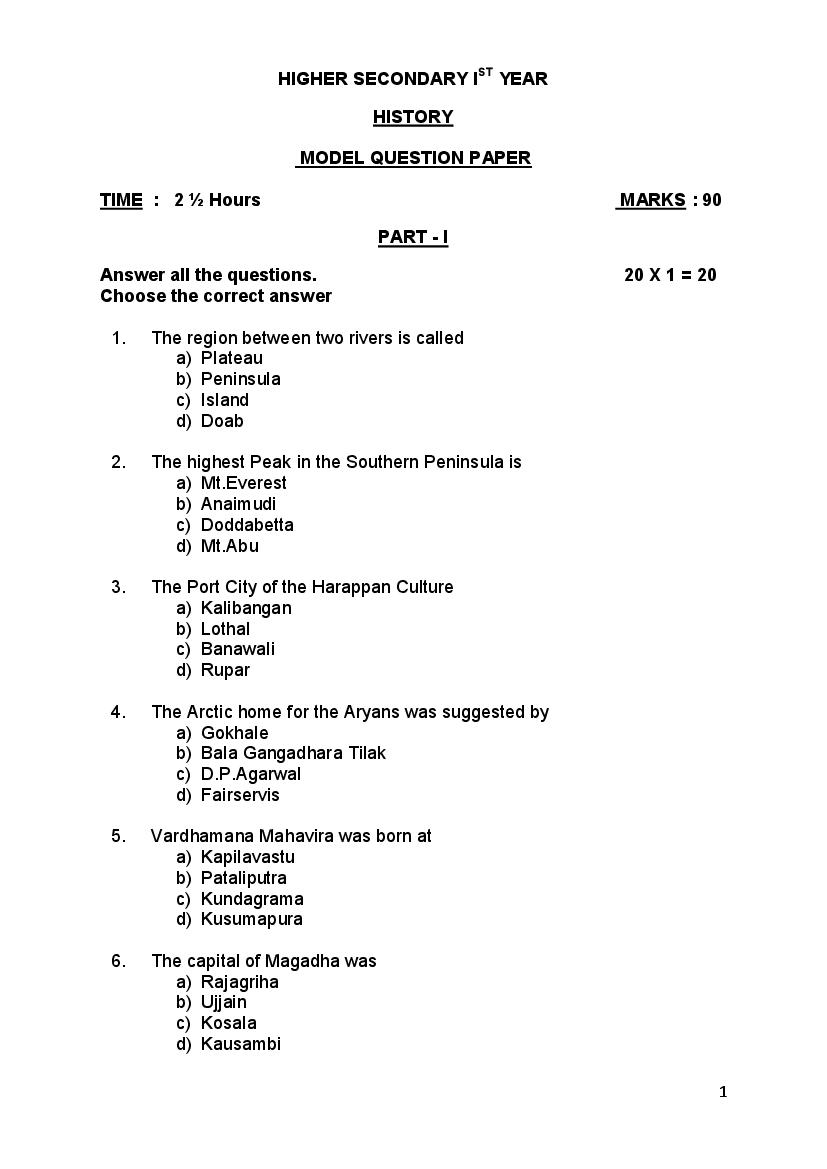
HISTORY
MODEL QUESTION PAPER
TIME : 2 ½ Hours www.tnschools.co.in MARKS : 90
PART - I
Answer all the questions. 20 X 1 = 20
Choose the correct answer
1. The region between two rivers is called
a) Plateau
b) Peninsula
c) Island
d) Doab
2. The highest Peak in the Southern Peninsula is
a) Mt.Everest
b) Anaimudi
c) Doddabetta
d) Mt.Abu
3. The Port City of the Harappan Culture
a) Kalibangan
b) Lothal
c) Banawali
d) Rupar
4. The Arctic home for the Aryans was suggested by
a) Gokhale
b) Bala Gangadhara Tilak
c) D.P.Agarwal
d) Fairservis
5. Vardhamana Mahavira was born at
a) Kapilavastu
b) Pataliputra
c) Kundagrama
d) Kusumapura
6. The capital of Magadha was
a) Rajagriha
b) Ujjain
c) Kosala
d) Kausambi
1
Page 2
a) Kalinga Edict
b) XIII Rock Edict
c) Saranath Pillar
d) Arthasastra
8. Nasik inscription describes the achievements of
a) Pushyamitra Sunga
b) Gautamiputra Satakarni
c) Kanishka
d) Menander
9. List the correct order of places held Buddhist Council
1. Vaisali 2. Kashmir 3. Rajagriha 4. Pataliputra
a) 1,2,3,4
b) 2,4,1,3
c) 2,4,3,1
d) 2,1,3,4
10. The earliest Tamil grammar work of the sangam period
a) Nannool
b) Tolkappiyam
c) Sathuragarathi
d) Tirukkural
11. The Gupta era starts from the year
a) 310 A.D.
b) 320 A.D.
c) 330 A.D.
d) 300 A.D.
12. The founder of Nalanda University
a) Samudragupta
b) Chandragupta II
c) Kumaragupta
d) Skandagupta
13. The Banskhera inscriptions contains the signature of
a) Hiuen Tsang
b) Bana
c) Harsha
d) Pulakesin II
14. The Pallava ruler who destroyed the Kalabhras
a) Vishnugopa
b) Simhavishnu
c) Mahendravarman I
d) Rajasimha
2
Page 3
a) Firdausi
b) Barani
c) Mahmud
d) Alberuni
16. Sequential order of Delhi Sultans
1) Khalji
2) Slave
3) Sayyids
4) TughIaq
a) 1, 2, 3, 4 b) 2,1,4,3 c) 1,2,4,3 d) 3, 4, 2, 1
17. The Kotla fort at Delhi was the creation of
a) Firoz Tughlaq
b) Iltutmish
c) Alauddin Khalji
d) Sikkandar Lodi
18. The most famous disciple of Ramananda
a) Kabir
b) Ramadas
c) Namadeva
d) Chaitanya
19. Krishna Deva Raya belonged to dynasty of
a) Sangama
b) Saluva
c) Tuluva
d) Aravidu
20. St.George Fort is located at
a) Kolkatta
b) Chennai
c) Delhi
d) Mumbai
PART - II
Explain any seven Questions briefly. In which 7 X 2 = 14
Question No.30 is compulsory
21. Deccan Plateau
22. The Great Bath
23. Tripitakas
24. Kadai Yelu Vallalhal
3
Page 4
26. Aryabatta
27. Qutab Minar
28. Din Illahi
29. Faterpur sikri
30. Comments on Raziya’s bravery
PART - III
Answer any 7 Questions. Out of which Question No.40 is 7 X 3 = 21
compulsory
31. Briefly Describe the Geography of South India
32. Write a note on the old stone Age
33. Account for the decline of Buddhism in India
34. Trace the causes for the rise of Marathas
35. Write a note on the Internal and foreign trade under the
Mughals
36. Write the development of Tamil literature under the Cholas
37. Explain: Nalanda University
38. Examine the market reforms of Alauddin Khalji
39. Write a short note on Indo-Java Art
40. Explain the reasons of the British Victory over the French
PART - IV
Answer all the Questions 7 X 5 = 35
41. India is a land of unity in diversity - Elucidate
(or)
Give a brief account of the life and teachings of Buddha
42. Give an account of Alexander’s invasion of India
(or)
Give an account of Ashoka’s achievements and his policy of
Damma
4
Page 5
(or)
Mention the salient features of the Pallava Art
44. Examine the Achievements of Rajaraja I
(or)
Give an account of the spread of Indian Culture in South-East
Asia.
45. Estimate the achievements of Krishna Devaraya
(or)
Assess the achievements of Akbar
46. Examine the salient features of the Mughal Art and Architecture
(or)
Give an account of the Life and Achievements of Shivaji
47. Mark the extent of the Gupta’s empire and mark the following
place on India Map.
Pataliputra, Vaisali, Prayag, Malwa, Magadha
(or)
Draw the time line chart Marking any five incidents from 1600
A.D. to 1700 A.D.
-------
5
Powered by TCPDF (www.tcpdf.org)
Document Details
| Board / Org | Tamil Nadu Board |
| Exam | Class 11 |
| Type | Sample Paper |
| Pages | 5 |
| Language | english |
| Updated | 09 Jun 2026 |