JNUEE 2020 Question Paper Ph.D Chemical Science
Finished viewing? Save it for later —
Download JNUEE 2020 Question Paper Ph.D Chemical Science (PDF · 13 pages)About JNUEE 2020 Question Paper Ph.D Chemical Science
JNUEE 2020 Question Paper Ph.D Chemical Science is available here for free download. Published by NTA for JNUEE, this question paper can be viewed online or downloaded as a PDF (13 pages). Candidates preparing for JNUEE can use JNUEE 2020 Question Paper Ph.D Chemical Science to understand the exam pattern, the type of questions asked, and the overall difficulty level.
Frequently Asked Questions
How can I download JNUEE 2020 Question Paper Ph.D Chemical Science?
Open this page and click the Download button to save JNUEE 2020 Question Paper Ph.D Chemical Science as a PDF. It is completely free on AglaSem Docs.
Is JNUEE 2020 Question Paper Ph.D Chemical Science free to download?
Yes. JNUEE 2020 Question Paper Ph.D Chemical Science can be viewed online and downloaded as a PDF free of cost on AglaSem Docs.
How many pages does JNUEE 2020 Question Paper Ph.D Chemical Science have?
JNUEE 2020 Question Paper Ph.D Chemical Science contains 13 pages, which you can read online or download together as a single PDF.
Where can I find more JNUEE study material?
You can find more JNUEE question papers, sample papers, syllabus, and answer keys on AglaSem Docs.
JNUEE 2020 Question Paper Ph.D Chemical Science – Text
Read the full text of this question paper below — useful to quickly search, copy and reference the content online without downloading the PDF.
📄 View text version (13 pages)
Page 1
Roll No:
Application No:
Name:
Exam Date: 07-Oct-2020
Exam Time: 09:00-12:00
Examination: 1. Course Code - Ph.D.
2. Field of Study - Chemical Science (CHEH)
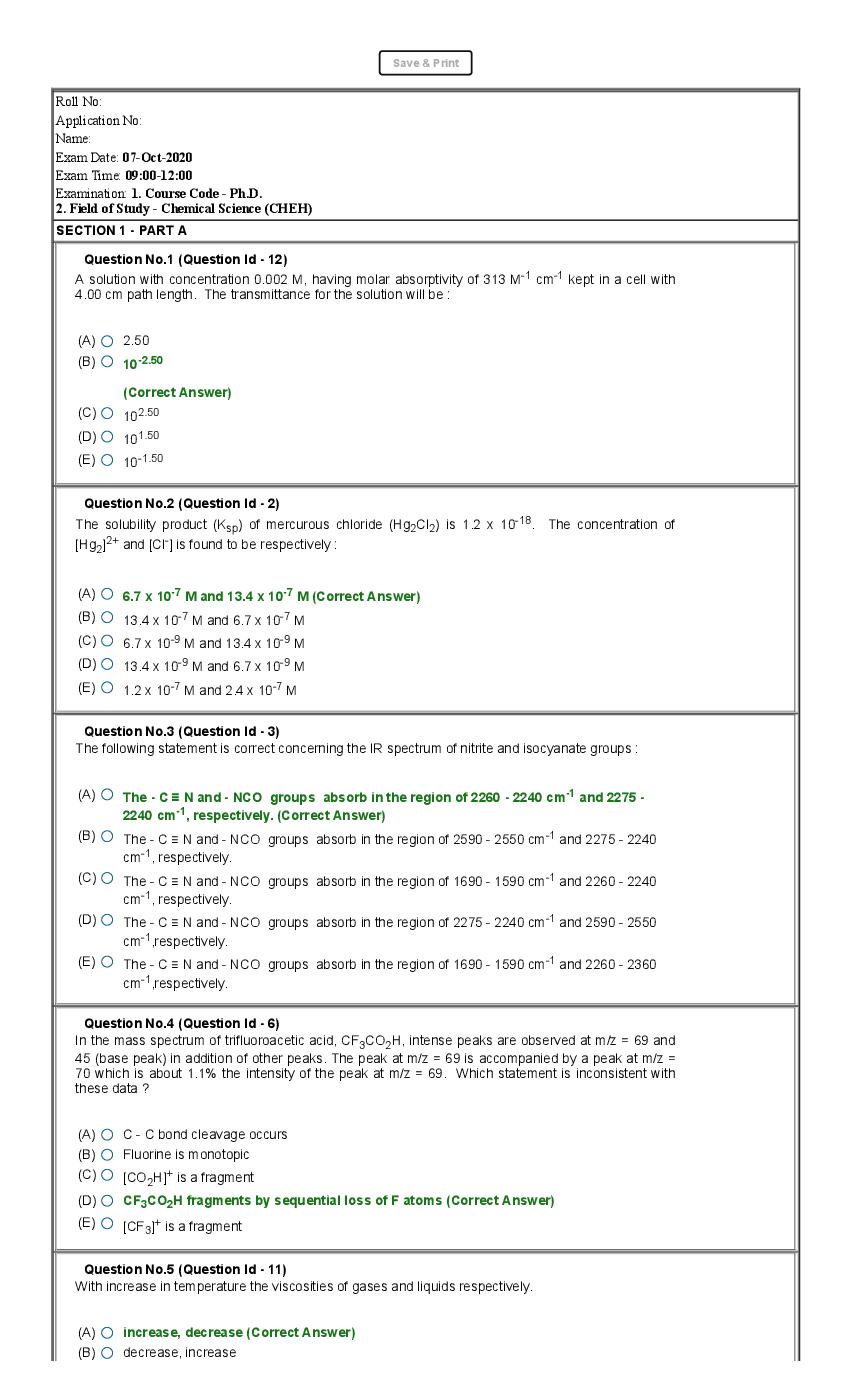
SECTION 1 - PART A
Question No.1 (Question Id - 12)
A solution with concentration 0.002 M, having molar absorptivity of 313 M-1 cm-1 kept in a cell with
4.00 cm path length. The transmittance for the solution will be :
(A) 2.50
(B) 10-2.50
(C) 102.50
(D) 101.50
(E) 10-1.50
Question No.2 (Question Id - 2)
The solubility product (Ksp) of mercurous chloride (Hg2Cl2) is 1.2 x 10⁻¹⁸. The concentration of
[Hg2]2+ and [Cl-] is found to be respectively :
(A) 6.7 x 10⁻⁷ M and 13.4 x 10⁻⁷ M (Correct Answer)
(B) 13.4 x 10⁻⁷ M and 6.7 x 10⁻⁷ M
(C) 6.7 x 10⁻⁹ M and 13.4 x 10⁻⁹ M
(D) 13.4 x 10⁻⁹ M and 6.7 x 10⁻⁹ M
(E) 1.2 x 10⁻⁷ M and 2.4 x 10⁻⁷ M
Question No.3 (Question Id - 3)
The following statement is correct concerning the IR spectrum of nitrite and isocyanate groups :
(A) The - C ≡ N and - NCO groups absorb in the region of 2260 - 2240 cm-1 and 2275 -
2240 cm-1, respectively. (Correct Answer)
(B) The - C ≡ N and - NCO groups absorb in the region of 2590 - 2550 cm-1 and 2275 - 2240
cm-1, respectively.
(C) The - C ≡ N and - NCO groups absorb in the region of 1690 - 1590 cm-1 and 2260 - 2240
cm-1, respectively.
(D) The - C ≡ N and - NCO groups absorb in the region of 2275 - 2240 cm-1 and 2590 - 2550
cm-1,respectively.
(E) The - C ≡ N and - NCO groups absorb in the region of 1690 - 1590 cm-1 and 2260 - 2360
cm-1,respectively.
Question No.4 (Question Id - 6)
In the mass spectrum of trifluoroacetic acid, CF3CO2H, intense peaks are observed at m/z = 69 and
45 (base peak) in addition of other peaks. The peak at m/z = 69 is accompanied by a peak at m/z =
70 which is about 1.1% the intensity of the peak at m/z = 69. Which statement is inconsistent with
these data ?
(A) C - C bond cleavage occurs
(B) Fluorine is monotopic
(C) [CO2H]+ is a fragment
(D) CF3CO2H fragments by sequential loss of F atoms (Correct Answer)
(E) [CF3]+ is a fragment
Question No.5 (Question Id - 11)
With increase in temperature the viscosities of gases and liquids respectively.
(A) increase, decrease (Correct Answer)
(B) decrease, increase
Page 2
(D) increase, increase
(E) unaffected by temperature
Question No.6 (Question Id - 10)
Mixture containing A, B and C was injected into a gas chromatograph. “A” gave a sharp peak in 40
seconds, “B” and “C” gave peaks at 250 and 330 seconds respectively. The adjusted retention time
are :
(A) 290 s and 370 s
(B) 290 s and 210 s
(C) 370 s and 290 s
(D) 210 s and 290 s (Correct Answer)
(E) 80 s and 40 s
Question No.7 (Question Id - 4)
The 1H NMR spectrum of a compound ‘A’ shows a doublet and a septet. Which of the following
statements is true ?
(A) The spectroscopic data are consistent with ‘A’ containing a n-propyl group.
(B) The spectroscopic data are consistent with ‘A’ being (CH3)2CHCl. (Correct Answer)
(C) The spectroscopic data are consistent with ‘A’ containing CH3CH2 group.
(D) The spectroscopic data are consistent with ‘A’ being (CH3)2CCl2.
(E) The spectroscopic data are consistent with ‘A’ containing (CH3)3C group.
Question No.8 (Question Id - 8)
What will be the decreasing order of absorption of wavelength of light in the visible region for the
following complexes ?
A. [Co(NH3)6]3+
B. [Co(H2O)6]3+
C. [Co(CN)6]3-
Choose the correct answer from the options given below
(A) A>B>C
(B) C>A>B
(C) B>C>A
(D) A>C>B
(E) B > A > C (Correct Answer)
Question No.9 (Question Id - 5)
A 0.2 M solution of an optically active compound. ‘C’ has an observed rotation in a 10 cm cell of (+)
0.6°. The specific rotation of the compound is 20° at room temperature and at 592 nm. The
molecular weight of the compound ‘C’ is :
(A) 150 (Correct Answer)
(B) 200
(C) 120
(D) 240
(E) 160
Question No.10 (Question Id - 14)
The lead (Pb) content in the replicate detemination of a blood sample was found to be 0.750, 0.754,
0.750 ppm. The standard deviation will be :
(A) 0.023
(B) 0.0023 (Correct Answer)
(C) 0.00023
(D) 0.0032
(E) 0.032
Page 3
In an experiment, absorbance measurements were recorded as 0.588, 0.580, 0.586, 0.573, 0.575.
The random error for the third result will be :
(A) -0.5809
(B) 0.5809
(C) -0.0056
(D) +0.0056
(E) 0.001
Question No.12 (Question Id - 9)
A mineral absorbs ultraviolet light and then emits a photon of wavelength 540 nm after converting
some of absorbed light energy to heat. The energy of emission is :
(A) 3.68 x 10⁻¹⁹ J (Correct Answer)
(B) 1.84 x 10⁻¹⁹ J
(C) 7.36 x 10⁻¹⁹ J
(D) 5.40 x 10⁻¹⁹ J
(E) 2.70 x 10⁻¹⁹ J
Question No.13 (Question Id - 1)
(A) 1.0 gm
(B) 2.0 gms
(C) 1.25 gms (Correct Answer)
(D) 0.5 gm
(E) 3.0 gms
Question No.14 (Question Id - 7)
When a mixture of NaCl, Conc. H2SO4, and K2Cr2O7 is heated in a dry test tube, deep red vapour of
A evolved. This vapour (A) dissolved in aqueous NaOH gave a yellow solution, which upon
treatment with AgNO3 formed a brick-red precipitate (B). A and B are, respectively :
(A) CrO2Cl2 and Ag2Cr2O7
(B) CrO2Cl2 and Ag2CrO4 (Correct Answer)
(C) Na2 [CrOCl5] and Ag2Cr2O7
(D) Na2 [CrOCl5] and Ag2CrO4
(E) CrOCl and AgCrO4
Question No.15 (Question Id - 15)
For the systematic error, which statement among the following is not correct ?
(A) It is determinate error
(B) It is indeterminate error (Correct Answer)
(C) It is reproducible
(D) It arises due to uncalibration
(E) It arises due to chemical contamination
SECTION 2 - PART B
Question No.1 (Question Id - 41)
The point group of H2O2, if it is in trans form :
(A) C2u
Page 4
(C) C2h (Correct Answer)
(D) D2d
(E) C2
Question No.2 (Question Id - 27)
(A)
(B)
(C)
(D)
(E)
Question No.3 (Question Id - 16)
(A)
(B)
(C)
(D)
Page 5
Question No.4 (Question Id - 22)
(A)
(B)
(C)
(D)
(E)
Question No.5 (Question Id - 25)
(A)
(B)
(C)
Page 6
(E)
Question No.6 (Question Id - 49)
For an hexagonal crystal system.
(A) a = b = c ; α = β = γ = 90°
(B) a = b ≠ c ; α = β = 90° γ = 120° (Correct Answer)
(C) a = b = c ; α = β = 90° γ = 120°
(D) a = b ≠ c ; α = β = γ = 90°
(E) a ≠ b ≠ c ; α = γ = 90° ≠ β
Question No.7 (Question Id - 38)
Release of O2 from oxyhemoglobin is favoured by :
(A) High pH, low conc. of CO2 and high temperature
(B) High pH, low conc. of CO2 and low temperature
(C) Low pH, low conc. of CO2 and high temperature
(D) High pH, high conc. of CO2 and low temperature
(E) Low pH, high conc. of CO2 and high temperature (Correct Answer)
Question No.8 (Question Id - 40)
An excited atom has a mean life of 10-8 s and radiates a photon while coming down to the ground
state. The inherent uncertainty in the frequency is [h = 6.626 x 10⁻³⁴; Js]
(A) 1.054 x 10+34 Hz
(B) 8 x 10⁻⁸ Hz
(C) 8 x 10⁶ Hz (Correct Answer)
(D) 8 x 10⁻⁶ Hz
(E) 1.054 x 10⁶ Hz
Question No.9 (Question Id - 43)
The first line in the rotational spectrum of carbonmonoxide appears at frequency 3.8424 cm-1. The C
- O bond length will be :
[ NA= 6.022 x 10²³/mol ; C = 3 x 10⁸ m/s)
(A) 1.9 Å
(B) 1.4 Å
(C) 0.90 Å
(D) 1.13 Å (Correct Answer)
(E) 1.23 Å
Question No.10 (Question Id - 33)
The CORRECT trend in ligand-to-metal charge transfer (LMCT) energies of the following metal
tetraoxidoanions :
(A) (Correct Answer)
(B)
(C)
(D)
(E)
Question No.11 (Question Id - 46)
For the reaction, Ag + Fe(ClO4)3 ⇋ AgClO4 + Fe(ClO4)2, the equilibrium constant at 25°C is 0.60.
The standard e.m.f. of a corresponding cell, Ag⎟Ag+⎟⎟Fe++⎟Fe+++Pt will be : [F = 96500 C mol-1 ;
Page 7
(A) -1.1 x 10⁻³ volt
(B) -11 x 10-3 volt
(C) -0.13 volt
(D) -0.013 volt (Correct Answer)
(E) -0.013 x 10⁻³ volt
Question No.12 (Question Id - 30)
(A) +3.32 V
(B) +1.11 V
(C) +2.48 V
(D) +1.66 V (Correct Answer)
(E) +4.97 V
Question No.13 (Question Id - 47)
In a second order reaction of the type A + B → P, initially the concentrations of reactants were [A]0 =
0.10 mol dm-3 and [B]0 = 0.075 mol dm-3. After 1 hr the concentration of B fell to [B] = 0.04 mol dm-3.
The rate constant k of the reaction will be :
(A) 2.20 x 10⁻² dm3 mol-1 s-1
(B) 1.20 x 10⁻³ dm3 mol-1 s-1
(C) 2.20 x 10⁻³ dm3 mol-1 s-1 (Correct Answer)
(D) 2.20 x 10⁻³ dm3 mol-1
(E) 1.20 x 10⁻² dm3 mol-1 s-1
Question No.14 (Question Id - 39)
An electron is confined to an one-dimension box of length 1Å. The ground state energy will be : [h =
6.626 x 10⁻³⁴ Js; m = 9.11 x 10⁻³¹kg]
(A) 6.024 x 10¹⁸ J
(B) 6.024 x 10⁻¹⁸ J (Correct Answer)
(C) 6.024 x 10¹⁸ k.cal
(D) 6.024 x 10⁻¹⁸ k.cal
(E) 43.904 x 10+17 k.cal
Question No.15 (Question Id - 34)
The ground terms for Cr2+, Cr3+ and Fe2+ are :
(A) 5D, 4F and 5D (Correct Answer)
(B) 4F, 5D and 5D
(C) 3F, 5D and 5D
(D) 3F, 6S and 5D
(E) 3F, 4F and 5D
Question No.16 (Question Id - 19)
(S)–2–Phenylbutanal is reacted with Grignard reagent, methyl magnesium iodide.
The absolute configuration of the chiral carbons in the product of the above reaction is :
(A) 1 S, 3 S
(B) 1 R, 2 R
(C) 1 S, 2 R
Page 8
(E) 1 R, 2 S
Question No.17 (Question Id - 26)
(A) electrocyclic ring opening ; 4πe ; conrotatory. (Correct Answer)
(B) electrocyclic ring opening ; 2πe ; disrotatory.
(C) .cycloaddition, 6πe, disrotatory
(D) .sigmatropic, 2πe, (antara, antara)
(E) .sigmatropic, 4πe, (supra, supra)
Question No.18 (Question Id - 48)
The characteristic conditions of the Langmuir isotherm are :
A. Adsorption cannot proceed beyond monolayer coverage
B. All sites are equivalent and the surface is uniform
C. Adsorption can proceed beyond monolayer coverage
D. All sites are non-equivalent
The correct option would be :
(A) A and C
(B) A and B (Correct Answer)
(C) Only A
(D) Only B
(E) A, B and C
Question No.19 (Question Id - 21)
(A)
(B)
(C)
(D)
(E)
Page 9
Pick the correct answer from the following A straight chain silicone polymer is formed by :
(A) Hydrolysis of CH3SiCl3 followed by condensation polymerization.
(B) Hydrolysis of (CH3)2 SiCl2 followed by condensation polymerization. (Correct Answer)
(C) .Hydrolysis of (CH3)3 SiCl followed by condensation polymerization.
(D) Hydrolysis of (CH3)4 Si followed by addition polymerization.
(E) Hydrolysis of tetra ethyl ortho silicate followed by condensation polymerization.
Question No.21 (Question Id - 29)
Choose the CORRECT order of solubility of the following compounds in water in each set.
I. LiF, LiCl, LiBr
II. Ag2O, Ag2S, AgCl
(A) LiBr > LiCl > LiF and AgCl > Ag2S > Ag2O
(B) LiF > LiCl > LiBr and Ag2O > Ag2S > AgCl
(C) LiBr > LiCl > LiF and Ag2O > AgCl > Ag2S (Correct Answer)
(D) LiF > LiCl > LiBr and Ag2S > Ag2O > AgCl
(E) LiF > LiCl > LiBr and AgCl > Ag2O > Ag2S
Question No.22 (Question Id - 44)
The difference in chemical potential between two regions of a system is +9.1 kJ mol-1. By how much
does the Gibbs energy change when 0.10 mmol of a substance is transfered from one region to the
other ?
(A) 1.9 x 10⁻³ kJ
(B) 91.0 x 10⁻³ kJ
(C) 19 x 10-3 kJ
(D) 9.1 x 10⁻³ kJ
(E) 0.91 x 10⁻³ kJ (Correct Answer)
Question No.23 (Question Id - 17)
(A) I : Antiaromatic ; II : Aromatic ; III : Aromatic
(B) I : Aromatic ; II : Aromatic ; III : Aromatic
(C) I : Nonaromatic ; II : Nonaromatic ; III : Nonaromatic
(D) I : Aromatic ; II : Nonaromatic ; III : Nonaromatic (Correct Answer)
(E) I : Antiaromatic ; II : Antiaromatic ; III : Antiaromatic
Question No.24 (Question Id - 45)
A sample consisting of 1.00 mol of perfect gas is expanded isothermally and reversibly at 20°C from
5 dm3 to 15 dm3. The q of the process is :
[R = 8.314 JK-1 mol-1]
(A) +0.982 kJ
(B) -0.982 kJ
(C) -26.8 kJ
(D) -2.68 kJ
(E) +2.68 kJ (Correct Answer)
Question No.25 (Question Id - 23)
Page 10
(B)
(C)
(D)
(E)
Question No.26 (Question Id - 31)
Out of the following reactions, which one will yield metal nitride ?
(A) NH4Cl + NaNH2
(B) NH3(aq) + NaOCl
(C) Ca(s) + NH3(l) (Correct Answer)
(D) NaNH2 + NaNO3 at elevated temperatures
(E) NaNH2 + N2O at elevated temperatures
Question No.27 (Question Id - 36)
Arrange the following in the decreasing order of Rh–C bond lengths.
A. Rh (CO) (Cl) (PPh3)2
B. Rh (CO) (Cl) (PEt3)2
C. Rh (CO) (Cl) [P(C6F5)3]2
D. Rh (CO) (Cl) (PMePh2)2
Choose the correct answer from the options given below
(A) B>D>A>C
(B) A>D>B>C
(C) D>A>B>C
(D) C>B>A>D
(E) C > A > D > B (Correct Answer)
Question No.28 (Question Id - 42)
Asymmetric top molecule among the following :
(A) CH2CHCl (Correct Answer)
(B) BCl3
(C) CH3Cl
(D) OCS
(E) CCl4
Question No.29 (Question Id - 20)
Page 11
(B)
(C)
(D)
(E)
Question No.30 (Question Id - 28)
Considering the halides and oxides of elements from the periodic table, which statement is correct
from the following :
(A) Metals form basic oxides and high oxidation state halides of transition metals tend to be
ionic.
(B) Metals form basic oxides and low oxidation state halides of transition metals tend to
be ionic. (Correct Answer)
(C) Non-metals form acidic oxides and p-block halides are predominantly ionic.
(D) Non-metals form basic oxides and p-block halides are predominantly covalent.
(E) Metals form acidic oxides and s-block oxides are predominantly ionic.
Question No.31 (Question Id - 18)
Elucidate the plausible molecular structure of a compound with molecular formula C7H12O4, using
following spectroscopic data :
IR (cm-1) : 2990 - 2880, 1735, 1150, 1035.
'H NMR : δ 1.28 (6 H, triplet)
δ 3.23 (4 H, quartet)
δ 4.16 (2 H, singlet)
Mass spectrum :
m/z : 161, 160, 133, 115, 43, 29
(A)
(B)
(C)
(D)
Page 12
Question No.32 (Question Id - 24)
(A)
(B)
(C)
(D)
(E)
Question No.33 (Question Id - 50)
The fraction condensed (ρ) of a polymer by stepwise process with degree of polymerization < N > =
251 would be :
(A) 9.96
(B) 0.996 (Correct Answer)
(C) 1.96
(D) 2.0
(E) 0.0996
Question No.34 (Question Id - 37)
The bond order of the metal-metal bonds in [Re2Cl4(P(C2H5)3)4], [Re2Cl4(P(C2H5)2 Ph)4]⊕ and
[Re2Cl4(P(C2H5)Ph2)4]2+, respectively.
(A) 4.0, 3.5 and 3.0
(B) 3.5, 3.0 and 4.0
(C) 4.0, 3.0 and 3.5
(D) 3.0, 3.5 and 4.0 (Correct Answer)
(E) 3.0, 4.0 and 3.5
Question No.35 (Question Id - 35)
Among the following statements, which one characterizes the electronic absorption spectra of
lanthanoid ions :
(A) Sharp absorptions due to the strong interaction of the f-orbitals with the ligand vibration.
(B) Spectra that are independent of the ligand type and coordination number. (Correct
Answer)
(C) Molar absorption coefficients are comparable with d-block elements.
(D) Numerous absorptions due to orbital mixing.
(E) Numerous absorptions due to the capability to show higher coordination number.
Page 13
Document Details
| Board / Org | NTA |
| Exam | JNUEE |
| Type | Question Paper |
| Pages | 13 |
| Language | english |
| Updated | 22 Jul 2026 |