GATE Sample Paper for Textile Engineering and Fibre Science
Finished viewing? Save it for later —
Download GATE Sample Paper for Textile Engineering and Fibre Science (PDF · 13 pages)About GATE Sample Paper for Textile Engineering and Fibre Science
GATE Sample Paper for Textile Engineering and Fibre Science is available here for free download. Published by IIT for Graduate Aptitude Test in Engineering, this sample paper can be viewed online or downloaded as a PDF (13 pages). Candidates preparing for Graduate Aptitude Test in Engineering can use GATE Sample Paper for Textile Engineering and Fibre Science to understand the exam pattern, the type of questions asked, and the overall difficulty level.
Frequently Asked Questions
How can I download GATE Sample Paper for Textile Engineering and Fibre Science?
Open this page and click the Download button to save GATE Sample Paper for Textile Engineering and Fibre Science as a PDF. It is completely free on AglaSem Docs.
Is GATE Sample Paper for Textile Engineering and Fibre Science free to download?
Yes. GATE Sample Paper for Textile Engineering and Fibre Science can be viewed online and downloaded as a PDF free of cost on AglaSem Docs.
How many pages does GATE Sample Paper for Textile Engineering and Fibre Science have?
GATE Sample Paper for Textile Engineering and Fibre Science contains 13 pages, which you can read online or download together as a single PDF.
Where can I find more Graduate Aptitude Test in Engineering study material?
You can find more Graduate Aptitude Test in Engineering question papers, sample papers, syllabus, and answer keys on AglaSem Docs.
GATE Sample Paper for Textile Engineering and Fibre Science – Text
Read the full text of this sample paper below — useful to quickly search, copy and reference the content online without downloading the PDF.
📄 View text version (13 pages)
Page 1
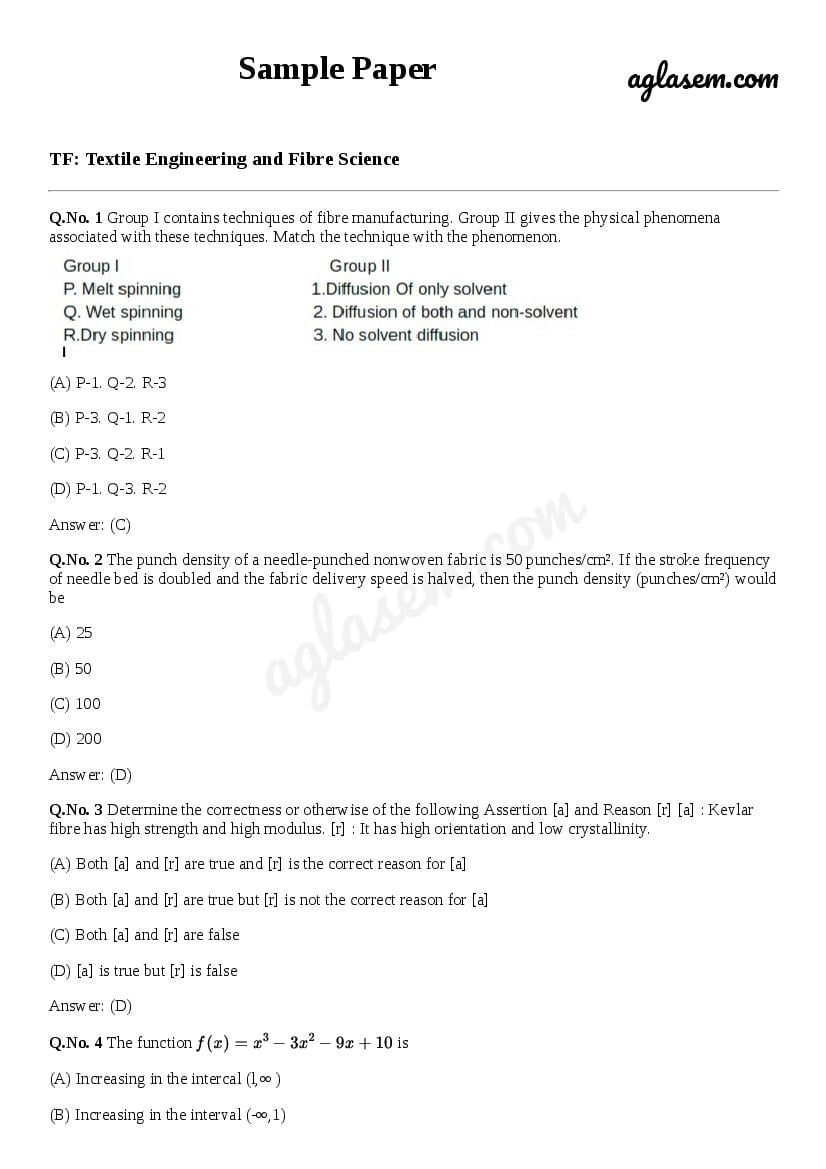
TF: Textile Engineering and Fibre Science
Q.No. 1 Group I contains techniques of fibre manufacturing. Group II gives the physical phenomena
associated with these techniques. Match the technique with the phenomenon.
(A) P-1. Q-2. R-3
(B) P-3. Q-1. R-2
(C) P-3. Q-2. R-1
(D) P-1. Q-3. R-2
Q.No. 2 The punch density of a needle-punched nonwoven fabric is 50 punches/cm². If the stroke frequency
of needle bed is doubled and the fabric delivery speed is halved, then the punch density (punches/cm²) would
be
(A) 25
(B) 50
(C) 100
(D) 200
Q.No. 3 Determine the correctness or otherwise of the following Assertion [a] and Reason [r] [a] : Kevlar
fibre has high strength and high modulus. [r] : It has high orientation and low crystallinity.
(A) Both [a] and [r] are true and [r] is the correct reason for [a]
(B) Both [a] and [r] are true but [r] is not the correct reason for [a]
(C) Both [a] and [r] are false
(D) [a] is true but [r] is false
Q.No. 4 The function f (x ) = x 3
− 3x
2
− 9x + 10 is
(A) Increasing in the intercal (l,∞ )
(B) Increasing in the interval (-∞,1)
Page 2
(D) Decreasing in the interval (-3 l) is
Q.No. 5 Consider two yarns, One 100% wool and the Other 100% cotton, each containing 100 fibres in the
yarn cross-section. The respective limit irregularities (%) of wool and cotton yarns will approximately be
(A) 11.2 and 10.6
(B) 10.6 and 11.2
(C) 11.8 and 11.2
(D) 11.8 and 10.6
αx − 2y = 4
Q.No. 6 The system of linear equations { } has
2x + 4y = β
(A) No solution for α = 1,β=-8
(B) Unique solution for α = -1,β= 8
(C) Infinitely many solutions for α = -1,β= -8
(D) Infinitely many solutions forα = 1,β= 8
Q.No. 7 Acrylic fibre is made from at least 85% by weight of
(A) Acrylic acid
(B) Acrylonitrile
(C) Acrylamide
(D) Methyl methacrylate
Q.No. 8 At front centre (0°) and at back centre (180°) Of a shuttle loom,
(A) The sley velocities are the same but accelerations are different
(B) The sley velocities are different but accelerations are the same
(C) The sley velocities are the same and also accelerations are the same
(D) The sley velocities are different and also accelerations are different
Q.No. 9 For multifilament yarns, optimum add-on (%) of size is in the range
(A) 0-0.5
(B) 4-8
Page 3
(D) 30-35
Q.No. 10 Viscose rayon is soluble in
(A) Acetone
(B) Formic acid 85% (v/v)
(C) Chloroform
(D) Sulfuric acid 59% (w/w)
Q.No. 11 An opening roller in blowroom with 100 cm length, 38 cm diameter and 2 teeth per cm2 is rotating
at an angular velocity of 400 rpm to deliver fibre tufts at a production rate of 500 kg/h. The intensity of
opening (fibre mass in mg per tooth) of the opening roller approximately is
(A) 0.44
(B) 0.87
(C) 1.74
(D) 2.74
Q.No. 12 Techniques used to determine the glass transition temperature of textile fibres are P) X-ray
diffraction (XRD) Q) Differential scanning calorimetry (DSC) R) Thermogravimetric analysis (TGA) S)
Dynamic mechanical analysis (DMA)
(A) P & Q only
(B) Q & R only
(C) Q & S only
(D) R & S only
Q.No. 13 If a solution curve of the differential equation x
dy
dx
= y + 2x then this curve also passes through
3
the point (1,0) then the curve also passes through the point (l. 0).
(A) (-1.0)
(B) (0,-1)
(C) (2.10)
(D) (-2.6)
Page 4
application.
(A) P-4, Q-2, R-3, S-1
(B) P-3, Q-4, R-2, S-1
(C) P-3, Q-4, R-1, S-2
(D) P-4, Q-1, R-2, S-3
Q.No. 15 Group I lists chemical processes. Group II lists chemicals used in these processes. Match the
process with the corresponding chemical
(A) P-2,Q-3,R-4,S-1
(B) P-2,Q-1,R-4,S-3
(C) P-3,Q-1,R-2,S-3
(D) P-2,Q-1,R-3,S-4
Q.No. 16 In air-jet weaving, the correct combination of parameters, on which drag force on weft yarn
depends, is P. Weave pattern Q. Density of air R. Weft yarn diameter S. Picks per cm
(A) P and Q
(B) Q and R
(C) R and S
(D) P and S
Q.No. 17 The cross-sectional shape of a fibre affects the following properties of yarn P) Lustre Q) Torsional
rigidity R) Flexural rigidity S) Packing density
(A) P & Q only
(B) P & R only
(C) P, Q & R only
Page 5
Q.No. 18 The purpose of having grooves or notches in modern flyer tops in speed frames is to
(A) Increase real twist in roving
(B) Insert false twist in roving
(C) Reduce neps in roving
(D) Increase fineness of roving
Q.No. 19 The pair of natural fibres, belonging to the category of seed fibre, is
(A) Cotton and Sisal
(B) Kenaf and Kapok
(C) Cotton and Kenaf
(D) Cotton and Kapok
Q.No. 20 Match the process steps in viscose fibre manufacture listed in Group I with the corresponding
chemicals given in Group II. The correct option is Group I P. Ageing Q. Steeping R. Xanthation S. Wet
spinning Group II (1) Carbon disulphide (2) Zinc sulphate (3) Sodium hydroxide (4) Manganese salt
(A) P-4, Q-3, R-2, S-1
(B) P-4, Q-3, R-1, S-2
(C) P-3, Q-4, R-1, S-2
(D) P-2, Q-3, R-1, S-4
Q.No. 21 Compared to filaments in spunbonded nonwovens, those in meltblown nonwovens have P) Lower
orientation of molecular chains Q) Higher orientation of molecular chains R) Lower variability in diameter
S) Higher variability in diameter
(A) P & R only
(B) P & S only
(C) Q & R only
(D) Q & S only
Page 6
(A) P-3, Q-4, R-2, S-1
(B) P-1, Q-4, R-2, S-3
(C) P-3, Q-4, R-1, S-2
(D) P-3, Q-1, R-2, S-4
Q.No. 23 The discharging agent used in discharge printing of cotton with reactive dyes is
(A) Citric acid
(B) Sodium dithionite
(C) Thio-urea dioxide
(D) Sodium formaldehyde sulphoxylate
Q.No. 24 Determine the correctness or otherwise of the following Assertion [a] and the Reason [r]. [a]: In a
carding machine, carding type of wire point configuration is used between cylinder and doffer. [r]: Carding
type of wire point configuration gives the best fibre transfer without disturbing the fibre alignment.
(A) Both [a] and [r] are true and [r] is the correct reason for [a]
(B) Both [a] and [r] are true but [r] is not the correct reason for [a]
(C) Both [a] and [r] are false
(D) [a] is true but [r] is false
Q.No. 25 The tenacity of
(A) P>Q>R>S
(B) S>R>Q>P
(C) R>S>P>Q
(D) Q>R>S >P
Page 7
(A) Extension of fibre
(B) Crimping of fibre
(C) Swelling of fibre
(D) Compression of fibre
Q.No. 27 One of the points which lies on the solution curve of the following differential equation 2𝑥𝑦 𝑑𝑥 +
x + y 𝑑𝑦 = 0 with the initial condition 𝑦(1) = 1 is
2 2
(A) (−1, 1)
(B) (0, 0)
(C) (0, 1)
(D) (2, 1)
Q.No. 28 Diamond bars appear in woven fabric due to
(A) Faulty loom parts
(B) Excessive warp irregularity
(C) Periodic fault in wam yarn
(D) Periodic fault in weft yam
Q.No. 29 Determine the correctness or otherwise Of the following Assertion [a] and Reason [a]:
Caprolactam is polymerized in the presence Of small amount Of water to produce fibre grade nylon 6. [r]:
Water acts as a catalyst and converts caprolactam to aminocaproic acid.
(A) Both [al and Irl are true and [rl is the correct reason for [a]
(B) Both [a] and [r] are true but [r] is not the correct reason for [a]
(C) Both [a] and [r] are false
(D) [a] is true but [r] is false
Q.No. 30 In a loom, seven-wheel take-up motion is
(A) Negative and intermittent
(B) Negative and continuous
(C) Positive and intermittent
Page 8
Q.No. 31 The gum present in the raw mulberry silk fibre is
(A) Sericin
(B) Fibroin
(C) Keratin
(D) Casein
Q.No. 32 If 𝐴 and 𝐵 are two independent events such that 𝑃(𝐴) = 1/4 and 𝑃(𝐵) = 2/3, then 𝑃(𝐴 ∪ 𝐵) is equal
to
(A) 11/12
(B) 1/12
(C) 3/4
(D) 5/6
Q.No. 33 In wool, the sulfur containing amino acid is
(A) Alanine
(B) Cystine
(C) Glycine
(D) Serine
Q.No. 34 The relative humidity (in %) and temperature (in °C) of standard testing atmosphere are
respectively
(A) 65 and 25
(B) 65 and 20
(C) 60 and 25
(D) 60 and 20
Q.No. 35 A dye is applied on a fibre using Na₂S₂O4 as an auxiliary. Washing fastness of the dye on fibre is
good. The correct combination of the dye and the fibre is
(A) Cationic dye, acrylic fibre
(B) Vat dye, cotton fibre
Page 9
(D) Reactive dye, cotton fibre
Q.No. 36 Which of the following fibre(s) is(are) manufactured by melt spinning process
(A) P only
(B) Q and R only
(C) R only
(D) R and S only
Q.No. 37 If both the concentration (%, w/w) of size paste and target add-on are 12%, the total wet pick-up
(kg) by 12 kg bone-dry warp sheet is
(A) 6
(B) 12
(C) 18
(D) 24
Q.No. 38 Determine the correctness or otherwise Of the following Assertion [a] and Reason [r] [a]: Foam
finishing significantly reduces the energy consumed in drying. [r]: The specific heat of air is significantly
lower than that of water.
(A) Both [a] and [r] are true and [r] is the correct reason for [a]
(B) Both [a] and [r] are true but [r] is not the correct reason for [a]
(C) Both [a] and [r] are false
(D) [a] is true but [r] is false
Q.No. 39 Let L = lim x→
π
2
tan x
(sin x ) . The value of L is
(A) 0
(B) 1
(C) 2
(D) ∞
Page 10
(A) P-1, Q-2, R-4, S-3
(B) P-1, Q-2, R-3, S-4
(C) P-2, Q-1, R-4, S-3
(D) P-2, Q-1, R-3, S-4
Q.No. 41 A tuck stitch in knitting makes the fabric
(A) Narrower
(B) Thinner
(C) More rigid in course direction
(D) Wider and porous
Q.No. 42 Let 𝑋 be a binomial random variable with mean 1 and variance 3/4. The probability that 𝑋 takes the
value 3 is
(A) 3/64
(B) 3/16
(C) 27/64
(D) 3/4
Q.No. 43 Pilling resistance of
(A) Ring yam is higher than open-end rotor yarn but lesser than air vortex yarn
(B) Air vortex yarn is higher than ring yam but lesser than open-end rotor yarn
(C) Open-end rotor yam is higher than ring yam but lesser than air vortex yam
(D) Ring yarn is higher than air vortex yarn but lesser than open-end rotor yarn
Q.No. 44 Determine the correctness or otherwise of the following Assertion [a] and the Reason [r]. [a]: The
work factor of silk fibre is greater than 0.5. [r]: The work factor is calculated by assuming the following as
Page 11
(A) Both [a] and [r] are true and [r] is the correct reason for [a]
(B) Both [a] and [r] are true but [r] is not the correct reason for [a]
(C) Both [a] and [r] are false
(D) [a] is true but [r] is false
Q.No. 45 The spinning system in which one revolution of twisting element imparts several turns to the fibre
strand is
(A) Ring
(B) Rotor
(C) Friction
(D) wrap
Q.No. 46 For 𝑥 in [0, 𝜋], the maximum value of (sin 𝑥 + cos 𝑥) is
(A) 1/√2
(B) 1
(C) √2
(D) 2
Q.No. 47 In a three-sigma control chart. the probability that a point falls outside the control limits. when a
process is under control. is
(A) 0
(B) 0.0027
(C) 0.01
(D) 0.05
Q.No. 48 Determine the correctness or otherwise of the following Assertion [a] and the Reason [r] Assertion:
Jet dyeing machines yield level dyeing in short dyeing time Reason: Jet dyeing machines use pressure jets to
force dye into the fibre
Page 12
(B) Both [a] an Copyfish
(C) Both [a] an
(D) [a] is true b
Q.No. 49 Match the test in Group I with fabric property in Group II.
(A) P-1, Q-2, R-3, S-4
(B) P-1, Q-2, R-4, S-3
(C) P-2, Q-1, R-3, S-4
(D) P-2, Q-1, R-4, S-3
Q.No. 50 In dyeing of wool with levelling acid dyes, with time, the pH of dye bath
(A) Increases
(B) Decreases
(C) Remains constant
(D) First increases and then decreases
2
Q.No. 51 The solution of the differential equation d y
dx
2
+
dy
dx
− 2y = 0 which satisfies the conditions y(0) =
O, y'(0) = 3 is
(A) e −x
(B) e x
(C) e + e
x −2x
(D) e − e
x −2x
1 1 2
⎡ ⎤
Q.No. 52 For the matrix A A = 0 1 3 , the eigenvalues of the matrix are
⎣ ⎦
0 0 1
(A) 1,0,1
Page 13
(C) 1,1,0
(D) 1,1,1
Q.No. 53 During crystallization of polyester
(A) Heat is evolved
(B) Heat is absorbed
(C) No exchange of heat takes place
(D) Small molecule such as water is eliminated
Q.No. 54 Laplace transform Of cosh(t) is
(A) 2
s −1
1
(B) s
s −1
(C) s
2
s −1
(D) 2
s +1
s
Q.No. 55 Wool gives warmth because it has .
(A) P and Q only
(B) Q and R only
(C) P and S only
(D) P and R only
Document Details
| Board / Org | IIT |
| Exam | Graduate Aptitude Test in Engineering |
| Type | Sample Paper |
| Pages | 13 |
| Language | english |
| Updated | 22 Jul 2026 |