Finished viewing? Save it for later —
Download CBSE Class 10 Syllabus 2022-23 Maths (PDF · 6 pages)About CBSE Class 10 Syllabus 2022-23 Maths
CBSE Class 10 Syllabus 2022-23 Maths is available here for free download. Published by CBSE for Class 10, this syllabus can be viewed online or downloaded as a PDF (6 pages). Candidates preparing for Class 10 can use CBSE Class 10 Syllabus 2022-23 Maths to understand the exam pattern, the type of questions asked, and the overall difficulty level.
Frequently Asked Questions
How can I download CBSE Class 10 Syllabus 2022-23 Maths?
Open this page and click the Download button to save CBSE Class 10 Syllabus 2022-23 Maths as a PDF. It is completely free on AglaSem Docs.
Is CBSE Class 10 Syllabus 2022-23 Maths free to download?
Yes. CBSE Class 10 Syllabus 2022-23 Maths can be viewed online and downloaded as a PDF free of cost on AglaSem Docs.
How many pages does CBSE Class 10 Syllabus 2022-23 Maths have?
CBSE Class 10 Syllabus 2022-23 Maths contains 6 pages, which you can read online or download together as a single PDF.
Where can I find more Class 10 study material?
You can find more Class 10 question papers, sample papers, syllabus, and answer keys on AglaSem Docs.
CBSE Class 10 Syllabus 2022-23 Maths – Text
Read the full text of this syllabus below — useful to quickly search, copy and reference the content online without downloading the PDF.
📄 View text version (6 pages)
Page 1
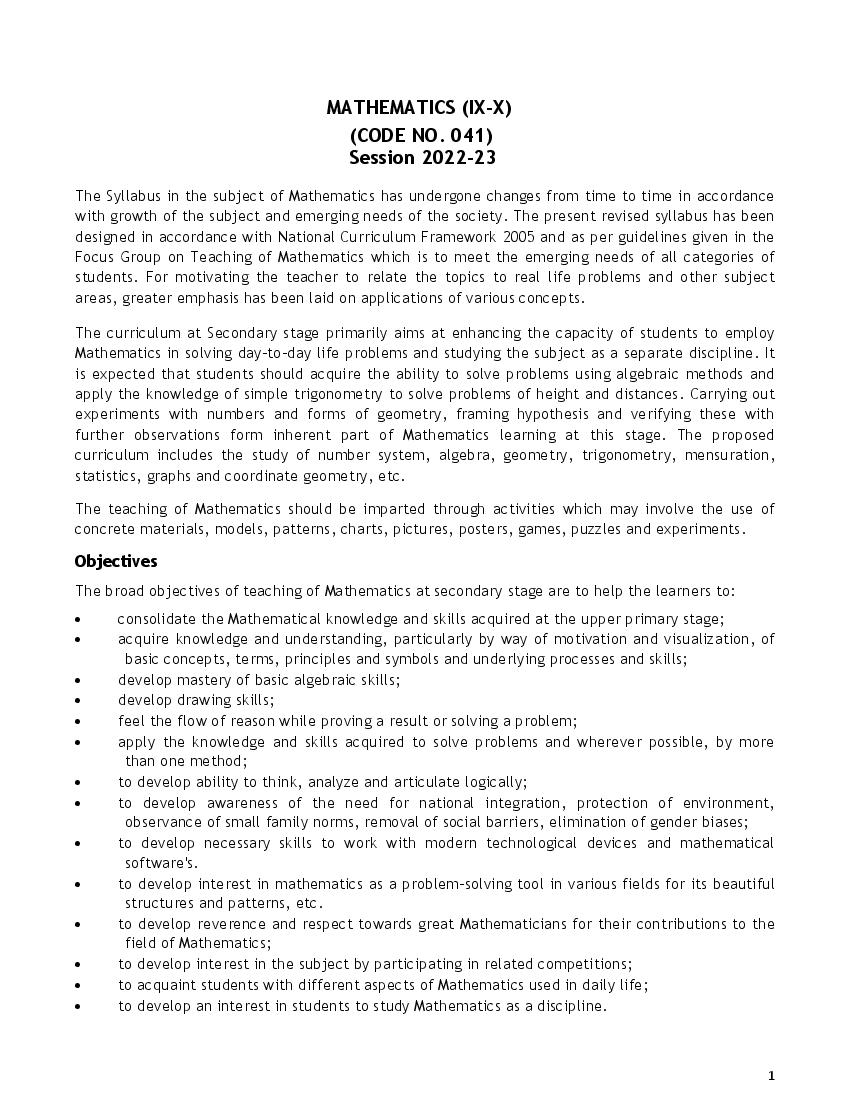
(CODE NO. 041)
Session 2022-23
The Syllabus in the subject of Mathematics has undergone changes from time to time in accordance
with growth of the subject and emerging needs of the society. The present revised syllabus has been
designed in accordance with National Curriculum Framework 2005 and as per guidelines given in the
Focus Group on Teaching of Mathematics which is to meet the emerging needs of all categories of
students. For motivating the teacher to relate the topics to real life problems and other subject
areas, greater emphasis has been laid on applications of various concepts.
The curriculum at Secondary stage primarily aims at enhancing the capacity of students to employ
Mathematics in solving day-to-day life problems and studying the subject as a separate discipline. It
is expected that students should acquire the ability to solve problems using algebraic methods and
apply the knowledge of simple trigonometry to solve problems of height and distances. Carrying out
experiments with numbers and forms of geometry, framing hypothesis and verifying these with
further observations form inherent part of Mathematics learning at this stage. The proposed
curriculum includes the study of number system, algebra, geometry, trigonometry, mensuration,
statistics, graphs and coordinate geometry, etc.
The teaching of Mathematics should be imparted through activities which may involve the use of
concrete materials, models, patterns, charts, pictures, posters, games, puzzles and experiments.
Objectives
The broad objectives of teaching of Mathematics at secondary stage are to help the learners to:
consolidate the Mathematical knowledge and skills acquired at the upper primary stage;
acquire knowledge and understanding, particularly by way of motivation and visualization, of
basic concepts, terms, principles and symbols and underlying processes and skills;
develop mastery of basic algebraic skills;
develop drawing skills;
feel the flow of reason while proving a result or solving a problem;
apply the knowledge and skills acquired to solve problems and wherever possible, by more
than one method;
to develop ability to think, analyze and articulate logically;
to develop awareness of the need for national integration, protection of environment,
observance of small family norms, removal of social barriers, elimination of gender biases;
to develop necessary skills to work with modern technological devices and mathematical
software's.
to develop interest in mathematics as a problem-solving tool in various fields for its beautiful
structures and patterns, etc.
to develop reverence and respect towards great Mathematicians for their contributions to the
field of Mathematics;
to develop interest in the subject by participating in related competitions;
to acquaint students with different aspects of Mathematics used in daily life;
to develop an interest in students to study Mathematics as a discipline.
1
Page 2
Units Unit Name Marks
I NUMBER SYSTEMS 06
II ALGEBRA 20
III COORDINATE GEOMETRY 06
IV GEOMETRY 15
V TRIGONOMETRY 12
VI MENSURATION 10
VII STATISTICS & PROBABILTY 11
Total 80
UNIT I: NUMBER SYSTEMS
1. REAL NUMBER (15) Periods
Fundamental Theorem of Arithmetic - statements after reviewing work done earlier and
after illustrating and motivating through examples, Proofs of irrationality of
UNIT II: ALGEBRA
1. POLYNOMIALS (8) Periods
Zeros of a polynomial. Relationship between zeros and coefficients of quadratic
polynomials.
2. PAIR OF LINEAR EQUATIONS IN TWO VARIABLES (15) Periods
Pair of linear equations in two variables and graphical method of their
solution, consistency/inconsistency.
Algebraic conditions for number of solutions. Solution of a pair of linear equations in two
variables algebraically - by substitution, by elimination. Simple situational problems.
3. QUADRATIC EQUATIONS (15) Periods
Standard form of a quadratic equation ax2 + bx + c = 0, (a ≠ 0). Solutions of quadratic
equations (only real roots) by factorization, and by using quadratic formula. Relationship
between discriminant and nature of roots.
Situational problems based on quadratic equations related to day to day activities to be
incorporated.
6
Page 3
Motivation for studying Arithmetic Progression Derivation of the nth term and sum of the
first n terms of A.P. and their application in solving daily life problems.
UNIT III: COORDINATE GEOMETRY
Coordinate Geometry (15) Periods
Review: Concepts of coordinate geometry, graphs of linear equations. Distance formula.
Section formula (internal division).
UNIT IV: GEOMETRY
1. TRIANGLES (15) Periods
Definitions, examples, counter examples of similar triangles.
1. (Prove) If a line is drawn parallel to one side of a triangle to intersect the other two
sides in distinct points, the other two sides are divided in the same ratio.
2. (Motivate) If a line divides two sides of a triangle in the same ratio, the line is parallel
to the third side.
3. (Motivate) If in two triangles, the corresponding angles are equal, their corresponding
sides are proportional and the triangles are similar.
4. (Motivate) If the corresponding sides of two triangles are proportional, their
corresponding angles are equal and the two triangles are similar.
5. (Motivate) If one angle of a triangle is equal to one angle of another triangle and the
sides including these angles are proportional, the two triangles are similar.
2. CIRCLES (10) Periods
Tangent to a circle at, point of contact
1. (Prove) The tangent at any point of a circle is perpendicular to the radius through the
point of contact.
2. (Prove) The lengths of tangents drawn from an external point to a circle are equal.
7
Page 4
1. INTRODUCTION TO TRIGONOMETRY (10) Periods
Trigonometric ratios of an acute angle of a right-angled triangle. Proof of their
existence (well defined); motivate the ratios whichever are defined at 0 and 90 . Values
o o
of the trigonometric ratios of 300, 450 and 600. Relationships between the ratios.
2. TRIGONOMETRIC IDENTITIES (15) Periods
Proof and applications of the identity sin2A + cos2A = 1. Only simple identities to be
given.
3. HEIGHTS AND DISTANCES: Angle of elevation, Angle of Depression. (10)Periods
Simple problems on heights and distances. Problems should not involve more than two
right triangles. Angles of elevation / depression should be only 30°, 45°, and 60°.
UNIT VI: MENSURATION
1. AREAS RELATED TO CIRCLES (12) Periods
Area of sectors and segments of a circle. Problems based on areas and perimeter /
circumference of the above said plane figures. (In calculating area of segment of a
circle, problems should be restricted to central angle of 60°, 90° and 120° only.
2. SURFACE AREAS AND VOLUMES (12) Periods
Surface areas and volumes of combinations of any two of the following: cubes, cuboids,
spheres, hemispheres and right circular cylinders/cones.
UNIT VII: STATISTICS AND PROBABILITY
1. STATISTICS (18) Periods
Mean, median and mode of grouped data (bimodal situation to be avoided).
2. PROBABILITY (10) Periods
Classical definition of probability. Simple problems on finding the probability of an
event.
8
Page 5
QUESTION PAPER DESIGN
CLASS – X (2022-23)
Time: 3 Hours Max. Marks: 80
%
S. Total
Typology of Questions Weightage
No. Marks
(approx.)
Remembering: Exhibit memory of previously learned material by
recalling facts, terms, basic concepts, and answers.
43 54
1
Understanding: Demonstrate understanding of facts and ideas by
organizing, comparing, translating, interpreting, giving descriptions, and
stating main ideas
Applying: Solve problems to new situations by applying acquired 19 24
2
knowledge, facts, techniques and rules in a different way.
Analysing :
Examine and break information into parts by identifying motives or
causes. Make inferences and find evidence to support generalizations
Evaluating:
Present and defend opinions by making judgments about information, 18 22
3
validity of ideas, or quality of work based on a set of criteria.
Creating:
Compile information together in a different way by combining elements
in a new pattern or proposing alternative solutions
80 100
Total
INTERNAL ASSESSMENT 20 MARKS
Pen Paper Test and Multiple Assessment (5+5) 10 Marks
Portfolio 05 Marks
Lab Practical (Lab activities to be done from the prescribed books) 05 Marks
9
Page 6
QUESTION PAPER DESIGN
CLASS – X (2022-23)
Time: 3Hours Max. Marks: 80
%
S. Total
Typology of Questions Weightage
No. Marks
(approx.)
Remembering: Exhibit memory of previously learned material by
recalling facts, terms, basic concepts, and answers.
1 60 75
Understanding: Demonstrate understanding of facts and ideas by
organizing, comparing, translating, interpreting, giving descriptions, and
stating main ideas
Applying: Solve problems to new situations by applying acquired 12 15
2
knowledge, facts, techniques and rules in a different way.
Analysing :
Examine and break information into parts by identifying motives or
causes. Make inferences and find evidence to support generalizations
Evaluating:
Present and defend opinions by making judgments about information, 8 10
3
validity of ideas, or quality of work based on a set of criteria.
Creating:
Compile information together in a different way by combining elements
in a new pattern or proposing alternative solutions
80 100
Total
INTERNAL ASSESSMENT 20 MARKS
Pen Paper Test and Multiple Assessment (5+5) 10 Marks
Portfolio 05 Marks
Lab Practical (Lab activities to be done from the prescribed books) 05 Marks
PRESCRIBED BOOKS:
1. Mathematics - Textbook for class IX - NCERT Publication
2. Mathematics - Textbook for class X - NCERT Publication
3. Guidelines for Mathematics Laboratory in Schools, class IX - CBSE Publication
4. Guidelines for Mathematics Laboratory in Schools, class X - CBSE Publication
5. Laboratory Manual - Mathematics, secondary stage - NCERT Publication
6. Mathematics exemplar problems for class IX, NCERT publication.
7. Mathematics exemplar problems for class X, NCERT publication.
10
Document Details
| Board / Org | CBSE |
| Exam | Class 10 |
| Type | Syllabus |
| Pages | 6 |
| Language | english |
| Updated | 15 Jul 2026 |