Goa Board Class 12 Question Paper June 2018 Sociology (New Pattern)
Finished viewing? Save it for later —
Download Goa Board Class 12 Question Paper June 2018 Sociology (New Pattern) (PDF · 4 pages)About Goa Board Class 12 Question Paper June 2018 Sociology (New Pattern)
Goa Board Class 12 Question Paper June 2018 Sociology (New Pattern) is available here for free download. Published by Goa Board for Class 12, this question paper can be viewed online or downloaded as a PDF (4 pages). Candidates preparing for Class 12 can use Goa Board Class 12 Question Paper June 2018 Sociology (New Pattern) to understand the exam pattern, the type of questions asked, and the overall difficulty level.
Frequently Asked Questions
How can I download Goa Board Class 12 Question Paper June 2018 Sociology (New Pattern)?
Open this page and click the Download button to save Goa Board Class 12 Question Paper June 2018 Sociology (New Pattern) as a PDF. It is completely free on AglaSem Docs.
Is Goa Board Class 12 Question Paper June 2018 Sociology (New Pattern) free to download?
Yes. Goa Board Class 12 Question Paper June 2018 Sociology (New Pattern) can be viewed online and downloaded as a PDF free of cost on AglaSem Docs.
How many pages does Goa Board Class 12 Question Paper June 2018 Sociology (New Pattern) have?
Goa Board Class 12 Question Paper June 2018 Sociology (New Pattern) contains 4 pages, which you can read online or download together as a single PDF.
Where can I find more Class 12 study material?
You can find more Class 12 question papers, sample papers, syllabus, and answer keys on AglaSem Docs.
Goa Board Class 12 Question Paper June 2018 Sociology (New Pattern) – Text
Read the full text of this question paper below — useful to quickly search, copy and reference the content online without downloading the PDF.
📄 View text version (4 pages)
Page 1
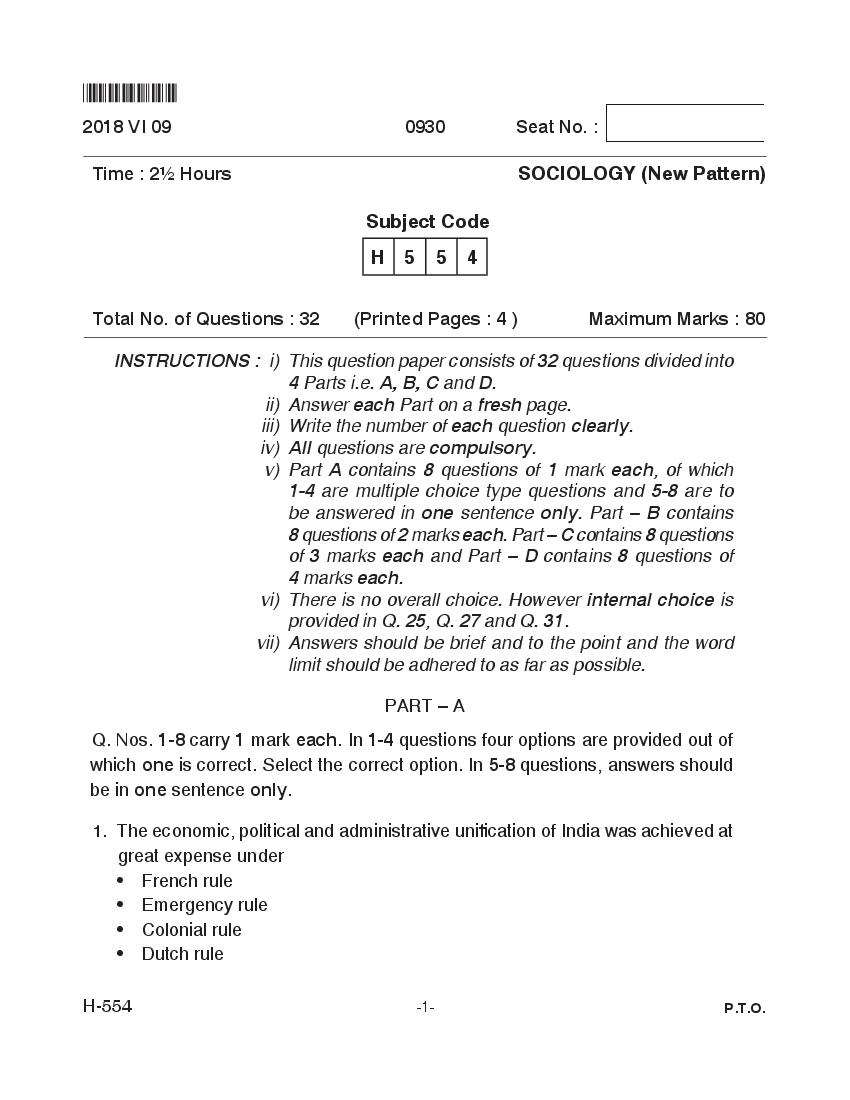
Time : 2½ Hours SOCIOLOGY (New Pattern)
Subject Code
H 5 5 4
Total No. of Questions : 32 (Printed Pages : 4 ) Maximum Marks : 80
Instructions : i) This question paper consists of 32 questions divided into
4 Parts i.e. A, B, C and D.
ii) Answer each Part on a fresh page.
iii) Write the number of each question clearly.
iv) All questions are compulsory.
v) Part A contains 8 questions of 1 mark each, of which
1-4 are multiple choice type questions and 5-8 are to
be answered in one sentence only. Part – B contains
8 questions of 2 marks each. Part – C contains 8 questions
of 3 marks each and Part – D contains 8 questions of
4 marks each.
vi) There is no overall choice. However internal choice is
provided in Q. 25, Q. 27 and Q. 31.
vii) Answers should be brief and to the point and the word
limit should be adhered to as far as possible.
PART – A
Q. Nos. 1-8 carry 1 mark each. In 1-4 questions four options are provided out of
which one is correct. Select the correct option. In 5-8 questions, answers should
be in one sentence only.
1. The economic, political and administrative unification of India was achieved at
great expense under
• French rule
• Emergency rule
• Colonial rule
• Dutch rule
H-554 -1- P.T.O.
Page 2
• Occupation and status
• Religion and rituals
• Norms and authority
• Purity and pollution
3. The emergence of machine production based on the inanimate power resources
like steam and electricity is known as
• Globalization
• Industrialisation
• Capitalism
• Colonialism
4. The highest court and the ultimate interpreter of the Constitution is
• The Civil Court
• The District Court
• The High Court
• The Supreme Court
5. What are prejudices ?
6. State one feature of community identity.
7. What is disinvestment ?
8. Define a Reformist Social Movement.
PART – B
Q. Nos. 9-16 are short answer type questions carrying 2 marks each. Answers to
them should normally not exceed 40 words.
9. State the checks suggested by Robert Malthus to control population growth.
10. What is meant by commodification ? Give an example.
11. Explain the term social exclusion.
12. Explain any two disadvantages of the interview method.
H-554 -2-
Page 3
14. State any two changes that took place in rural India after independence.
15. Explain globalisation of culture.
16. What was the role of mass media in independent India ?
PART – C
Q. Nos. 17-24 are also short answer type questions carrying 3 marks each. Answers
to them should normally not exceed 60 words.
17. ‘Agriculture contributes only about one fourth of the Gross Domestic product
today’. Give reasons.
18. Write a note on the traditional business community of the Vaishyas.
19. Explain the three key principles of social stratification.
20. Explain the survey method.
21. ‘Sanskritization as a concept has been critiqued at different levels’. Analyse.
22. Explain the concept of contract farming.
23. Explain the term weightless economy.
24. Analyse the growth of the radio as a medium of communication in Independent
India.
PART – D
Q. Nos. 25-32 are long answer type questions carrying 4 marks each. Answers to
them should normally not exceed 100 words. Internal choice is provided in Q. 25,
Q. 27 and Q. 31.
25. Analyse the population policy in India.
OR
Analyse the factors responsible for declining sex-ratio in India.
H-554 -3- P.T.O.
Page 4
27. Analyse social reform movements initiated towards women’s equality and rights
in the nineteenth century.
OR
Analyse the struggles of the differently abled.
28. ‘Communalism is a recurrent source of tension and violence in India’. Explain.
29. Explain the impact of British industrialisation on Indian Society.
30. Write a note on the powers and social responsibilities of Panchayats.
31. ‘Indian industrialisation differs from that of the developed world’. Analyse.
OR
‘The contractor system is most visible in the hiring of casual labour for work on
construction sites’. Analyse.
32. Explain the Dalit movement as a caste based movement.
–––––––––––––
H-554 -4-
Document Details
| Board / Org | Goa Board |
| Exam | Class 12 |
| Type | Question Paper |
| Pages | 4 |
| Updated | 30 Apr 2026 |