UPSC IAS 2015 Question Paper for Commerce _ Accountancy Paper-I
Finished viewing? Save it for later —
Download UPSC IAS 2015 Question Paper for Commerce _ Accountancy Paper-I (PDF · 13 pages)About UPSC IAS 2015 Question Paper for Commerce _ Accountancy Paper-I
UPSC IAS 2015 Question Paper for Commerce _ Accountancy Paper-I is available here for free download. Published by UPSC for UPSC CSE (IAS), this question paper can be viewed online or downloaded as a PDF (13 pages). Candidates preparing for UPSC CSE (IAS) can use UPSC IAS 2015 Question Paper for Commerce _ Accountancy Paper-I to understand the exam pattern, the type of questions asked, and the overall difficulty level.
Frequently Asked Questions
How can I download UPSC IAS 2015 Question Paper for Commerce _ Accountancy Paper-I?
Open this page and click the Download button to save UPSC IAS 2015 Question Paper for Commerce _ Accountancy Paper-I as a PDF. It is completely free on AglaSem Docs.
Is UPSC IAS 2015 Question Paper for Commerce _ Accountancy Paper-I free to download?
Yes. UPSC IAS 2015 Question Paper for Commerce _ Accountancy Paper-I can be viewed online and downloaded as a PDF free of cost on AglaSem Docs.
How many pages does UPSC IAS 2015 Question Paper for Commerce _ Accountancy Paper-I have?
UPSC IAS 2015 Question Paper for Commerce _ Accountancy Paper-I contains 13 pages, which you can read online or download together as a single PDF.
Where can I find more UPSC CSE (IAS) study material?
You can find more UPSC CSE (IAS) question papers, sample papers, syllabus, and answer keys on AglaSem Docs.
UPSC IAS 2015 Question Paper for Commerce _ Accountancy Paper-I – Text
Read the full text of this question paper below — useful to quickly search, copy and reference the content online without downloading the PDF.
📄 View text version (13 pages)
Page 1
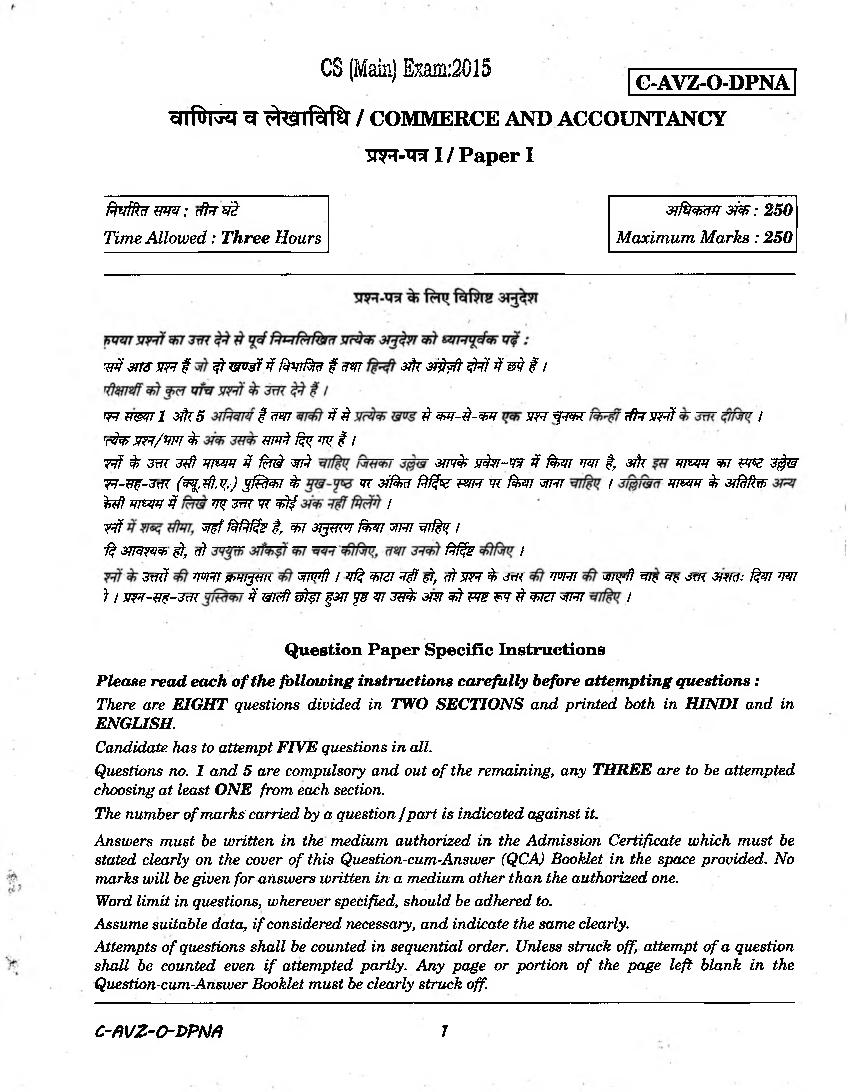
G-AVZ-O-DPNA
g r te r ^ ^ r f^ ft r / c o m m e r c e a n d a c c o u n t a n c y
■sr^T-^wI / Paper I
ftvfM vm : rffc wi 37$fam3&: 250
Time Allowed: Three Hours Maximum M arks: 250
w# m s w&# & m sf $ ftvrftm #' <m 3jfr 3T&0 &ff # stf # /
m w m l 3ffcs % ww $ d d m -d -m x w rp m rffrw ff i
’c&Fjm/nFi % m*d ffr w i t
yif & 3fK 3?ft W&m # ^ ^ 37N& 2$W -W $ fe&T W #, 3/fc *77*W W fW 3 ^
^r-w-^rfz (*%.&?.■) yfed'hi % 7T zjf&f ftffe ? w 7Tftm vm i m m & siMw
btft m m $ w? zfff m ^ /
yjf wffeftfife iTwx 3^mw fewrvm ^rt,& i
i$ w w * &, (ft ftffe i
3rRf 1JVRTfrHI^HH *m*ft / 2jf$ cfrldl J(?f (&, <ff 3777 $> drf< Tjuffl w^f) ^if? Wf> drf< 3W(f: f&T J7W
11 J&?-W-3rK $ ®7c# &fW§37T ^8 W 3V& 37# # ?W W # tt T *f&T I
Question Paper Specific Instructions
Please read each of the following instructions carefully before attempting questions:
There are EIGHT questions divided in TWO SECTIONS and printed both in HINDI and in
ENGLISH.
Candidate has toattemptFIVE questionsinall.
Questions no. 1 and 5 are compulsory and out ofthe remaining, any THREE are tobe attempted
choosingatleastONE fromeachsection.
The numberofmarkscarriedbya question/part isindicatedagainstit.
Answers must be written in the medium authorized in the Admission Certificate which must be
stated clearly on the cover ofthis Question-cum-Answer (QCA) Booklet in the spaceprovided. No
markswill begivenforanswers writtenina mediumotherthantheauthorizedone.
Wordlimitinquestions, whereverspecified, should beadheredto.
Assumesuitabledata, ifconsiderednecessary, and indicatethesameclearly.
Attemptsofquestionsshall becounted in sequential order. Unless struckoff, attempt ofa question
shall be counted even if attempted partly. Any page or portion of the page left blank in the
Question-cum-AnswerBookletmust beclearlystruckoff.
C-AVZ-O-DPNA 7
Page 2
y.'k
1^ ' *
>' •,' ♦
{ 4 , * * •' . ^
. . . rv . v
Q l. P>Hfr)f&d 3iyff S^31?&S3513rTC rPm*! 1 5 0 :
-Answer the following questions in about 150 words each : 10x5=1
(a) % ’Mi'kcrfN srmTfor w r a ^ ■??#<? ii i
. ., w i w t ; 3515m 1
E xplain in b rie f ; the concept of "Activity Based Costing*. G ive a
num erical exam ple.
(b) “ s%?rcf ^ aftr ^ ( ^ ) % sfta aim ?t<iT I 1”
. WI 3m. w ^ f ? r)<slWJ| - 3 ^fiT I^WTcT ^
; ’ -^ n ^ I,
“Cash from operations (C FO ) is not the same as profit a fter tax (P A T ).”
, , Do;you agree w ith this statem ent ? Give reasons using the Accounting
Standard - 3.
(c)’ 3*k (TT.TT.TTtf.sft.) % 3 ^ sffa
f I
- W h at are the objectives and functions of A uditing and Assurance
Standards Board (AASB) ? E xplain. :,
(d) ^ ^<srioh<ui, 3^r ^ ^ i
E xplain1the accounting for V A T , w ith examples.
(e) gWJT W ^tcTT | ? 'STcnto
I
W h at is inter-process profit ? Show the treatm ent of inter-process profit
w ith an exam ple.
Q 2. (a) X 1%. 3 $ TTcfi <£t « lc ^ ^ 1^5nT ^ i ’1 fadHR 3TE#
;3raMH 'S f , ^ ^ if f I PlSMW
5 y p ft I , 3fk ^ 5 1 STI^t frcffa sftcR 10 ^ ^ t I
: ? 1 ,50,000 3 ia te w *jt aflT ^raknff % fair ?= io.ooo jrfcf ^ % %rra
'■=5'r“ ■ % 3#^t 1^n'^t *st 11 :
C-fiVZ-O-DPNfi 2
Page 3
? 1,70,000 w ra 3WTift I spfft SfJ ^3T 3?TOR W. 10
t o >J||l<‘M, fe ft Pl«1K»l % f^RT I SHtM' well ^ ^ ^
y^w41 % %ti, r 30,000 3#ftri; t o f wf#<a ^ sira^Rii i
^ nsfa % ^ro %pft .^n^TJ^Ri 3 't o n ^ ^ ?ft, fira% -^R gW :5 ifl*
TF3R3 ? 60,000 ^ ^m p 3ftt ^ftcRff iMMH W li ? 2,00,000 ^
? 2,20,000 i
^ ^ 35% 3fk 3 ^ WRT 10% t I
W wpft *St f t ™ TRta % *SfR 'TC cg&rft % fe w R
n # f % Riftm tR gi^ft fift % fori <J#m erf 3 ft ^rg-37ctf?t Tjsft %
¥<t 3 ^rar t o ^rr ^ bctt 11
A Ltd. is considering the replacement of one of its machines. The existing
machine is in good operating condition, but the company is looking for a
bigger machine. The existing machine is 5 years old, and has remaining
depreciable life of 10 years. The machine was purchased for T 1,50,000
and is being depreciated at ^ 10,000 per yearfor tax purposes.
The new machine will cost ? 2,20,000 or ^ 1,70,000 if exchanged with
the existing machine. It will be depreciated on a straight line basis for
10 years with no salvage value. The management anticipates that, with
the increased operations, there will be a need for an additional net
working capital of W 30,000. The new machine will allow the company to
expand current operations thereby increasing annual revenue by
^ 60,000 and variable operating costs from T 2,00,000 to ^ 2,20,000.
The company's tax rate is 35% and its cost of capital is 10%.
Should the company replace its existing machine ? Assume that the loss
on exchange of existing machinecan be claimed asshort-term capital
loss in the current year itself.
(b) # w ra TT3TR 'JlH'Hld t :
w. a iw f 'sigqra = 30%; 'Jtacff w ra = ? 7jrfcf Tig^R-^R %
10,000 I 1 w :
. 10% 33T I, ^
^cft t.afo, fo tim w. ? 4,000 w*! t i ? 6,000 % 5 # ^
■ . . .
. 20%^?r ^cft I ; *lfar#WRJ ^ w k W 6~m
t alk t e r n <rc ? 4,000 ^ M .1 1 *35H-*arc: ftsft
C-AVZ-O-DPNA 3
Page 4
Cost and revenue information of A Ltd. is as follows :
Contribution to Sales Ratio = 130%; Variable cost = ^ 7 per unit;
Break-even point is equal to 10,000 units. Find the following:
• Company reduces the selling price by 10%, reduces the variable
cost to ^ 6 and spends T 4,000 on advertisement. Find sales to
earn a profit of T 6,000.
• Company increases the selling price by 20%; reduces the variable
cost to ^ 6 and spends ^ 4,000 on advertisement. Find the
break-even volume of sales. 15
■(c)" arm =fvt i96i % alt* aft ^ sro’
% srsfft afk 3^ cim % ^ w i
Explain the provisions of the Income Tax Act, 1961 with regard to set-off
arid carry forward of loss under the head Income from Business and
Profession and Capital Gains. 15
Q3. (a) 5TCT 31 2015 ^ ^ ^ $ Hrffet ^
1^T W I «I5 2015 - 16 % swft 3TPI ^
W RT % ftHfafiskl t :
(i); 5 0 ,0 0 0 ^ W
(ii) oMlrb'ld 3tR (<i>? 30,000 3 # WTf
’ (iii) 3TF *ffn @ -e 3,0003# W
(iv) *raT @ r 2,0003# IT?
(y) |R 3T^Jd-n<+.<ui @ r 2,5003# W
(vi) kjl+rHI W @ ? 5,000 3 # *TT?
(vii) W @ ? 1,000 3 # in?
(viii) 3 # erf ? 15,000 % 3TJSR fa* ^5# f I
(ii) » M tM 33% TJjFT 15% HMdlM'ra ftfa Hit 3
^rr t I ^ 3??% t <j?*t
(x) 3TRrefNr gfctsrr % ? 20,000 3# nr? *rar
t; ^ 33% ■gRT 3^r *TT ? 25,000 3 # % fc[^S t |
(x i) 3 $ % 33% 3n<TOfa % fe lcft 3jk JUrfl'-blH %
f^rt # a^ppft ftrccgr *rar#r sfi»ra: ? 70,000 sffc ? 20,000 «ft i
'■ I ’
C-flVZ-O-DPMfl q
Page 5
I. ^ftcR sftirr iilfil'MH ? 1,20,000 (^TT Tift ? 10 cTPGTt)
n. 3^ ^ ^ ? 25,ooo
m. 3^ppft i^T W TlH^JT ^fffcTEft sfliJRW ? 30,000
IV. ’jjf ^rra (^ R ^ d 5^ ) w 2 ,00,000 ^1
f^lW 2015 - 16% %r?„ 3TF# <w41«l 3!Ft WHI I
Mr. S is employed by A Ltd* at Delhi throughout the financial year
ended on 31st March, 2015. He furnishes the following particulars for
computation of his income for the assessment year 2015 - 16 :
(i) Basic Salary @ ^ 50,000 per month
(ii) Personal Pay @ W 30,000 per month
(iii) Conveyance Allowance @ ^ 3,000 per month
(iv) Uniform Allowance @ ^ 2,000 per month
(v) Knowledge Update Allowance @ ^ 2,500 per month
(vi) Medical Allowance @ T 5,000 per month
(vii) Entertainment Allowance @ ^ 1,000 per month
(viii) He is provided with gift vouchers of ^ 15,000 per year.
(ix) His employer contributes 15% of the basic salary to his recognised
provident fund account. Similar amount is deducted from his salary
as his contribution to the fund.
(x) He gets house rent allowance @ ^ 20,000 per month against a rent
of ^ 25,000 per month paid by him for his residential
accommodation.
(xi) His employer paid electricity and telephone bills of his residential
house amounting to ^ 70,000 and T 20,000 respectively for the
whole year.
(xii) During the year he made the following payments :
I. Life insurance premium ^ 1,20,000 (sum assured is
^ 10 Lacs)
II. Life insurance premium on the life of his major son T 25,000
III. Mediclaim policy premium paid in cash ^ 30,000
IV. Donation of ^ 2,00,000 to an approved charitable trust
Compute his taxable income for the assessment year 2015 — 16.
C -fiV Z-O -V P N A 5
Page 6
,^ 1 'O T ! STOT^ gi?ft fa=Kfou|lcH* 7Tf^E(T3Tf ^ Wfc? 3 U *p
I
What5is the need and importance of sampling in audit ? Briefly outline
. the analytical procedures to be adopted while conducting audit. 15
(c) ‘sfcf ^Ro(41 3T&5 sfk ‘aft ?>sr <pjfcr a # f ’% »(k, vtncfk <3<dw>w
w iw % 3 ^ 1 % *rra, i
Differentiate between ^Basic Earnings Per Share7and Diluted Earnings
Per Share’ with reference to Indian Accounting Standard. 10
Q4. ; (a) • RnfcHfed X % . % ftrfe 11# <fit, % f . 1 arffa, 2014 «ft,
w
^.qft^frRlT 50,000
H <riHd M< 1,00,000
50,000
#?> t#fi 1,50,000
10 25,000
(w ) 30,000
: 3,60,000
($ h<k)- 25,000
Mm ( ^ c m te a ) 1 30,000
urn (?\m m) 50,000
^ % .^TH ^ f :
(i) HW^WI 60% ? 2,00,000 % 3*JK 7M: | .
(ii) araftt % 'jjfen st^i fe u w ^ c R ?20,000. •
.I •
■
l,-■**
(iii) Ufa ^ f e w ? 10,000#? 3RT fe n I
(iv) a ^ , WqlxRn 3pt^ crflm srcravsrcRrc mfell ter i
C-ftVZ-O-DPNA 6
Page 7
(vi) y # t . % ? 20 s f i t i f c r c t , r 50,000% ^ 1
(vii) 31 2014 ^ (^ 3 <£t 3RPPft % «fl^) ? 25 5lfa 3RI «n?JR cftlR
^ ^ IfTt ^ I ■■■; . /
• >•• ' . • % . 1 - V* ‘‘
(viii) 60% ^Kldisfi (3^Kf) ^T W*\ ^ 1^JT TOM
(ix) 3T5[l^ftg^% 3 0 % # ^ ^ # ^ I
1 3T^f, 2014 3?fc 31 W $, 2015 ”# filler % 3F$m <J^T ^
ark 31 2015 w < f ^ % f^ ; erm-^ift ^mr sfk
^sTftTT *ft I
Following table shows relevant financial items of X Ltd. as on 1st April,
2014:
Items
Intangible Assets 50,000
Inventories at cost 1,00,000
Share Capital (Face Value = ^ 2 per share) 50,000
Cash and Bank balances 1,50,000
10% Bonds 215,000
Receivables 30,000
Total Sources 3,60,000
Creditors 25,000
Plant (Net of depreciation) 30,000
Plant at cost 50,000
Transactions during the year are given below :
(i) Sold 60% of the inventories on credit for ^ 2,00,000.
(ii) Salary for the period paid fully ^ 20,000.
C-AVZ-0-2PNA 7
Page 8
(iii) Rent per year ? 10,000. Paid rent for three years.
(iv) Intangible assets amortized over next four years equally .
(v) Plajat is 4 years old. Depreciation is charged using the Straight
Line Method (SLM) (for both tax and accounting purposes).
(vi) Purchased shares of Y Ltd. worth W 50,000 by issuing shares.
,> at ? 20 per share.
. (vii) Redeemed Bonds on 31st March, 2014 (after the payment of
interest) by issuing shares at the market price o f ^ 25 per share.
(viii) Paid off 60% of the creditors.
(ix) Tax paid @ 30% of profits.
; Prepare; Balance Sheets as at 1st April, 2014 and 31st March, 2015
along with Profit & Loss a/c and Cash a/c for the year ended on
31st Mai*ch, 2015. 30
\
(b) sifc -awM % I
Distinguish between Divisible profits and Dividends. 10
: » - J
(c) (ts) % J<JJ|^U| (M ) % 'Mil^chrc4 (fsF^Tlfctfa) ^ I
Discuss j the mechanism of levy of Value Added Tax. >10
C-MZ-O-DPNA 8
Page 9
SECTION B
qs . ftnfcifeH m w i i50~?rs^f f :
Answer the following questions in about 150 words each: 10x5=50
(a) 0<l3<m 3K<pT ^ |C[, ofN^r 3jfc rtm iftdl % |
Examine with an example the relationship between leverage and
profitability.
(b) W ft % %TT OTR-^rracfT ■# yiy'Pl'+dl ^ ^ fafeR. I
Write a note on the relevance of credit-rating for a power sector
company.
(c) tRT eft (W lf-%) %
3 I
Explain iii brief the regulations of SEBI for Buy-back of shares by a
company.
(d) *ft f t # W it cTWRT iftfa W w 35# f 1
Explain briefly the factors that determine the dividend policy of a
company.
(e) “ yfcltllftd 3#fr ^ ^ WRT #cft | l” I
“Retained earnings have no cost.” Comment.
Q6. (a) Rh I^I^cI SWlgR rfefcf ^ W , fedfa cfNtsr W afa ^grE
N S D
( ^ f 3) 17,500 6,700 31,800
OTtecff cfPT?f O f) 4,00,000 3,50,000 2,50,000
*\f (V
in (w) 1,25,000 75,000
srfcf ^\z fluS1-$ m (?) 85 130 37
J-lfo vjjftz qtecff crIMId ( ? ) 38 42*50 12
OTWt mI W h % MRuilffi 3>T 37«f ft+WHI't I
C-flVZ-O-DPNft 9
Page 10
and djegree of combined leverage for the following finns :
N :- S D
Production (in units) 17,500 , 6,700 31,800
Fixeji costs (^) 4,00,000 3,50,000 2,50,000
iInterest
1 on long-term loan (T) 1,25,000 75,000 NIL
iSelling price per unit (^) \ 85 130 37
Variable cost per unit (^) 38 42-50 12
You are also required to interpret'the results of your calculation. 20
i
(b) ftn fd fe rfR lfM 3 1 ^ ^Hlcrl t o ; S^jqicTf
(i) ^ 50 ^ ^ft to ft % ^
W t | I
’(ii) W^TcfT ^ *TFRT ^ T T | % 3S3TT ^ iftfcT f
I
(iii)1Tics ^fr to ft ^Fft 3 STCFft ^ *TT%
(iv) ^ fe f k w&fz % t o ; '^t ti? w t o ^Ft
^>T t |
Explain the important ratios that will be used in each of the following
situations:
(i) A bank is approached by a company for a working capital facility of
W 50 lacs. 'r$Wr
(ii); A long-term creditor who is interested in knowing whether his
1 claim is adequately secured.
(iii) A shareholder who is examining his portfolio to decide whether to
hold or sell his holdings in the company.
(iv) A finance manager who is interested to know the effectiveness with
which the available resources are utilised. 15
C-MZ-ODPNA 70
i
Page 11
(i) fs w j< J # 1 5 '
(ii) fk?ft eft #>3
(iii) (clWlfl ife
(iv) (gfen) Wfo5
Describe the nature of the following debt instruments :
(i) Deep Discount Bonds
(ii) Floating Rate Bonds
(iii) Extendable Notes
(iv) Junk Bonds
Q7. (a) S % . % 3 1 ^ , 20123ffc 3 1 ^ , 2013 % p R ^ f :
31-3-2012 31-3-2013
.. T
50,000 70,000
« imm ft?r4 5,000 8,000
w t 10,000 15,000
<rl-«K 15,000 19,000
ftcT . 4,000 5,000
1,000 500
85,000 1,17,500
^roRraT:
mRhmRmT :
TO 50,000 80,000
8,000 12,000
«.!<*> 5,000 7,500
( ^ r) 20,000 15,000
2,000 3,000
85,000 1,17,500
>AVZ-0-DPNA V
Page 12
(i) SRH m r 5,000 3Tk TfiMt TR T 2,000 iJ^URT <# 2012 - 2013 % ,
#itj TmTfcr 1«rt w 11
,(ii) TRfiq %?p£t rfPTcT ? 1,200 «ft, 1 sdfo, 2012 ^ ? 800 3
fi^T W «n I 33 TR 3HR3, 2012 335 ? 700 % fe n
Tr*n stt i
31 31^ , 2013 ^Ff t o i erf % =ijIT<j>d ■gen? icicncwr foR i
The Balance Sheets of S Ltd. at 31st March, 2012 and 31st March, 2013
are as under:
31-3-2012 31-3-2013
Particulars
f5
Equity and Liabilities :
Shareholder’s Funds :
Share Capital 50,000 70,000
General Reserve 5,000 8,000
Profit and Loss A/c 10,000 15,000
Current Liabilities :
Creditors 15,000 19,000
Bills Payable 4,000 5,000
Outstanding Expenses 1,000 500
85,000 1,17,500
Assets :
Non-Current Assets :
Building 50,000 80,000
Machinery 8,000 12,000
Current Assets :
Stock in Trade 5,000 7,500
Debtors 20,000 15,000
Cash and Bank Balance 2,000 3,000
85,000 1,17,500
C-AVZ-OrPPNA 12
Page 13
(i) Depreciation of ? 5,000 on building and T 2,000 on machinery has
been charged for the year 2012 - 2013.
(ii) A machine costing W 1,200 was sold on 1st April, 2012 for
? 800. Depreciation of ? 700 was provided on the same upto
31st March, 2012.
Prepare classified cash flow statement for the year ended on
31st March, 2013. 20
(b) +l4«n<ri 3 FTC 'sftftn?, I
Explain briefly the factors influencing the working capital requirement. 15
(c) ft&T ftnfa % eft yfrl4>d ^ (3TI^.3TR.3TR.) ^ft
sik qtoWtafi tr i
Discuss the utility and limitations of Internal Rate of Return (IRR)
method of appraising a capital investment decision, 15
Q8. (a ) *TK?T 3 sffaT «bl<1«IK % 3 ‘f l f (3 TI^.3 TK .it.T’ . ) ^ft ijftcBT T O
^ftftnj; I
Explain the role of IRDA in regulating insurance business in India. 15
(b) 'fift sft (^.'5??.) w m ^
Give a critical appraisal of the Modigliani-Miller (MM) approach to the
theory of capital structure. 20
(c) WU % ? ^ c f T f e n *TI | I
What is corporate restructuring ? State the major forms in which it can
be carried out. 15
C-flVZ-O-DPNft 73
Document Details
| Board / Org | UPSC |
| Exam | UPSC CSE (IAS) |
| Type | Question Paper |
| Pages | 13 |
| Updated | 30 Apr 2026 |