ISC Class 12 Sample Paper 2023 Fashion Designing
Finished viewing? Save it for later —
Download ISC Class 12 Sample Paper 2023 Fashion Designing (PDF · 5 pages)About ISC Class 12 Sample Paper 2023 Fashion Designing
ISC Class 12 Sample Paper 2023 Fashion Designing is available here for free download. Published by CISCE for Class 12, this sample paper can be viewed online or downloaded as a PDF (5 pages). Candidates preparing for Class 12 can use ISC Class 12 Sample Paper 2023 Fashion Designing to understand the exam pattern, the type of questions asked, and the overall difficulty level.
Frequently Asked Questions
How can I download ISC Class 12 Sample Paper 2023 Fashion Designing?
Open this page and click the Download button to save ISC Class 12 Sample Paper 2023 Fashion Designing as a PDF. It is completely free on AglaSem Docs.
Is ISC Class 12 Sample Paper 2023 Fashion Designing free to download?
Yes. ISC Class 12 Sample Paper 2023 Fashion Designing can be viewed online and downloaded as a PDF free of cost on AglaSem Docs.
How many pages does ISC Class 12 Sample Paper 2023 Fashion Designing have?
ISC Class 12 Sample Paper 2023 Fashion Designing contains 5 pages, which you can read online or download together as a single PDF.
Where can I find more Class 12 study material?
You can find more Class 12 question papers, sample papers, syllabus, and answer keys on AglaSem Docs.
ISC Class 12 Sample Paper 2023 Fashion Designing – Text
Read the full text of this sample paper below — useful to quickly search, copy and reference the content online without downloading the PDF.
📄 View text version (5 pages)
Page 1
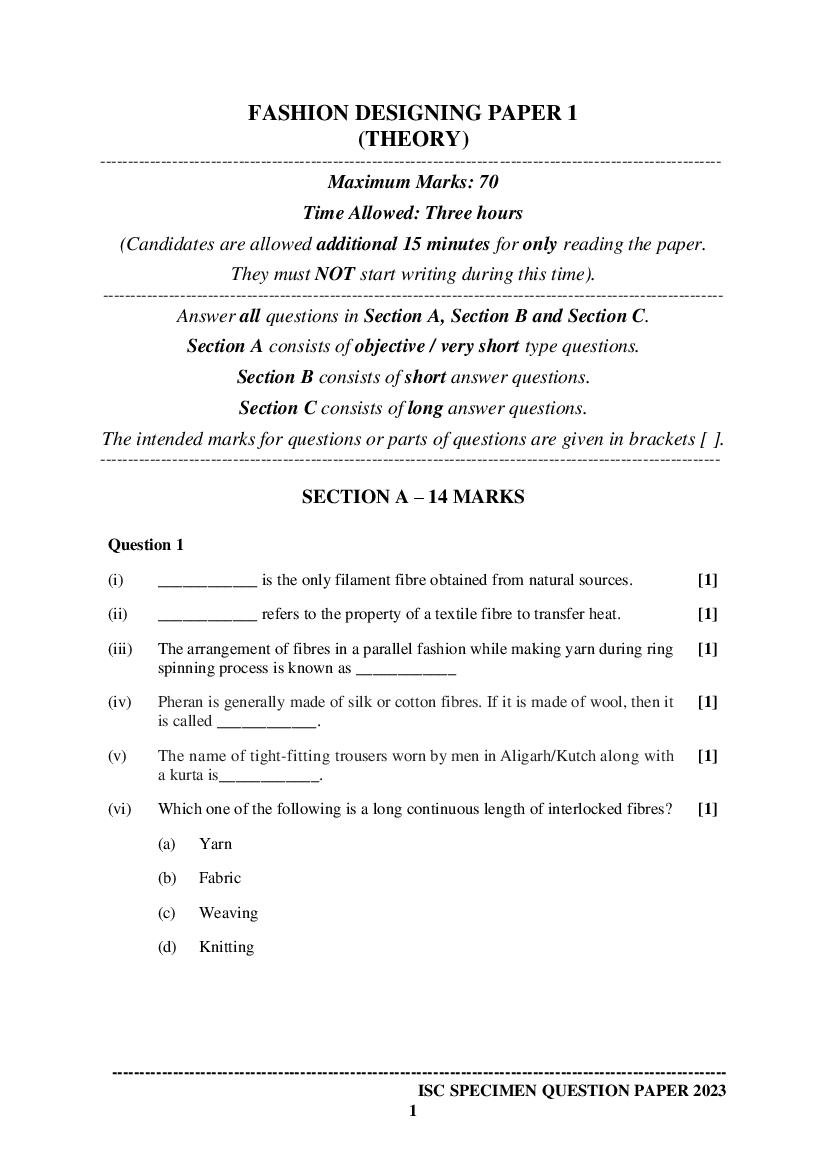
(THEORY)
----------------------------------------------------------------------------------------------------------------
Maximum Marks: 70
Time Allowed: Three hours
(Candidates are allowed additional 15 minutes for only reading the paper.
They must NOT start writing during this time).
----------------------------------------------------------------------------------------------------------------
Answer all questions in Section A, Section B and Section C.
Section A consists of objective / very short type questions.
Section B consists of short answer questions.
Section C consists of long answer questions.
The intended marks for questions or parts of questions are given in brackets [ ].
----------------------------------------------------------------------------------------------------------------
SECTION A – 14 MARKS
Question 1
(i) ____________ is the only filament fibre obtained from natural sources. [1]
(ii) ____________ refers to the property of a textile fibre to transfer heat. [1]
(iii) The arrangement of fibres in a parallel fashion while making yarn during ring [1]
spinning process is known as ____________
(iv) Pheran is generally made of silk or cotton fibres. If it is made of wool, then it [1]
is called ____________.
(v) The name of tight-fitting trousers worn by men in Aligarh/Kutch along with [1]
a kurta is____________.
(vi) Which one of the following is a long continuous length of interlocked fibres? [1]
(a) Yarn
(b) Fabric
(c) Weaving
(d) Knitting
1
Page 2
to human beings?
(a) Vat dyes
(b) Synthetic dyes
(c) Indigenous dyes
(d) Acid dyes
(viii) The famous ____________ sarees are woven in small cluster of villages [1]
around Hyderabad in Telangana District.
(a) Pochampally
(b) Baluchari
(c) Patola
(d) Butidar
(ix) During which period in Europe women adopted minimalistic fashion style? [1]
(a) World War I
(b) Disco decade
(c) Hippies
(d) Punks
(x) During 1918-1919 in Europe, barrel shaped silhouettes were completely [1]
____________ in shape.
(a) Tubular
(b) Circular
(c) S-shape
(d) A-line
(xi) From which kind of weave do we get smooth, lustrous and slippery kind of [1]
fabric?
(xii) Which type of footwear introduced in 1971 in Europe often had soles of two to [1]
four inches thick?
2
Page 3
(xiv) Given below is the microscopic view of a textile fibre. Name the given textile [1]
fibre.
SECTION B – 28 MARKS
Question 2 [4]
Riya is a student of fashion designing. She goes to a shop to buy a pure silk saree for
her mother. However, the silk fabric looks similar to the rayon fabric shown to her by
the shopkeeper.
Being a student of fashion designing, how will Riya differentiate between pure silk
and rayon fabrics?
Question 3 [4]
Explain the wet spinning method used to produce s y n t h e t i c fibres.
Question 4 [4]
Cotton fibre is popularly used in clothing as well as home furnishing sector. Give any
four reasons for its usage in both the sectors.
3
Page 4
The most commonly used textile items are knitted fabrics. What qualities of knitted
fabrics make them so useful?
Question 6 [4]
(i) Explain how World War I affected the fashion of women in Europe.
OR
(ii) Explain the features of Revolutionary Fashion in Europe.
Question 7 [4]
Differentiate between the costumes worn by women in Kashmir and Punjab.
Question 8 [4]
Identify any one of the traditional textiles of India given below and explain its
features.
(i)
OR
4
Page 5
SECTION C – 28 MARKS
Question 9 [7]
Explain the advantages and disadvantages of lycra fabric.
Question 10 [7]
Discuss the differences between woven and knitted fabrics.
Question 11 [7]
Explain the process of dyeing textiles with naturally available marigold flowers.
Question 12 [7]
(i) In Tamil Nadu, women wear a particular type of saree for any special occasion.
Name the saree and draw a sketch. Write a short note on this saree.
OR
(ii) In North India, men wear a knee-length jacket similar to Sherwani. Name the
traditional knee length jacket and draw a sketch. Write a short note on this
garment.
5
Document Details
| Board / Org | CISCE |
| Exam | Class 12 |
| Type | Sample Paper |
| Pages | 5 |
| Updated | 30 Apr 2026 |