ISC Class 12 Sample Paper 2023 Environmental Science
Finished viewing? Save it for later —
Download ISC Class 12 Sample Paper 2023 Environmental Science (PDF · 5 pages)About ISC Class 12 Sample Paper 2023 Environmental Science
ISC Class 12 Sample Paper 2023 Environmental Science is available here for free download. Published by CISCE for Class 12, this sample paper can be viewed online or downloaded as a PDF (5 pages). Candidates preparing for Class 12 can use ISC Class 12 Sample Paper 2023 Environmental Science to understand the exam pattern, the type of questions asked, and the overall difficulty level.
Frequently Asked Questions
How can I download ISC Class 12 Sample Paper 2023 Environmental Science?
Open this page and click the Download button to save ISC Class 12 Sample Paper 2023 Environmental Science as a PDF. It is completely free on AglaSem Docs.
Is ISC Class 12 Sample Paper 2023 Environmental Science free to download?
Yes. ISC Class 12 Sample Paper 2023 Environmental Science can be viewed online and downloaded as a PDF free of cost on AglaSem Docs.
How many pages does ISC Class 12 Sample Paper 2023 Environmental Science have?
ISC Class 12 Sample Paper 2023 Environmental Science contains 5 pages, which you can read online or download together as a single PDF.
Where can I find more Class 12 study material?
You can find more Class 12 question papers, sample papers, syllabus, and answer keys on AglaSem Docs.
ISC Class 12 Sample Paper 2023 Environmental Science – Text
Read the full text of this sample paper below — useful to quickly search, copy and reference the content online without downloading the PDF.
📄 View text version (5 pages)
Page 1
----------------------------------------------------------------------------------------------------------------
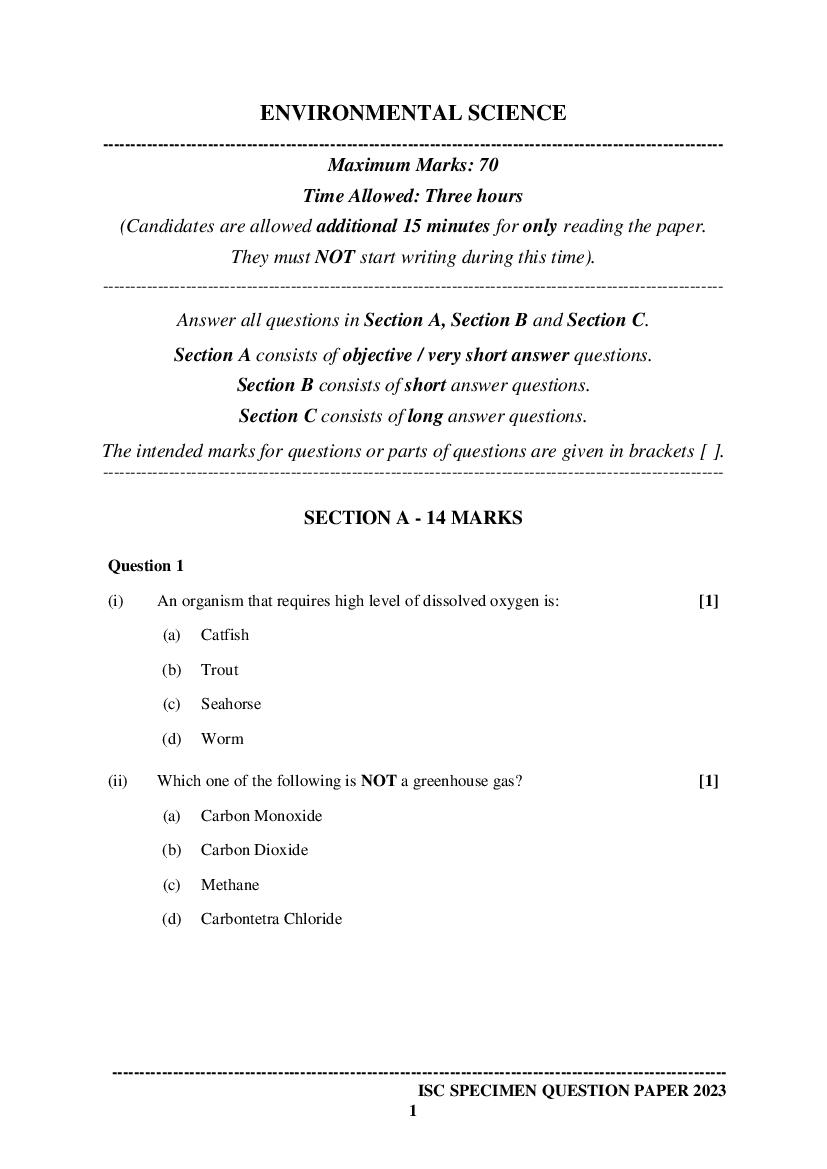
Maximum Marks: 70
Time Allowed: Three hours
(Candidates are allowed additional 15 minutes for only reading the paper.
They must NOT start writing during this time).
----------------------------------------------------------------------------------------------------------------
Answer all questions in Section A, Section B and Section C.
Section A consists of objective / very short answer questions.
Section B consists of short answer questions.
Section C consists of long answer questions.
The intended marks for questions or parts of questions are given in brackets [ ].
----------------------------------------------------------------------------------------------------------------
SECTION A - 14 MARKS
Question 1
(i) An organism that requires high level of dissolved oxygen is: [1]
(a) Catfish
(b) Trout
(c) Seahorse
(d) Worm
(ii) Which one of the following is NOT a greenhouse gas? [1]
(a) Carbon Monoxide
(b) Carbon Dioxide
(c) Methane
(d) Carbontetra Chloride
1
Page 2
(a) Charles Darwin
(b) Alexander von Humboldt
(c) Arthur Tansley
(d) Carl Ritter
(iv) The image given below is the logo of a non-government organisation called: [1]
(a) Green peace
(b) World Wide Fund for Nature
(c) World Bank
(d) United Nations Environment Programme
(v) Most of the ___________ drugs sold in the market are made from the [1]
medicinal plants found in Amazon.
(vi) The GATT was signed in ________. [1]
(vii) _________ is the first country to use urban organic farming. [1]
(viii) Repeated use of heavy machinery on the clayey soil leads to __________. [1]
(ix) Write the expanded forms of the following: [2]
(a) TRIPS
(b) AGMARK
(x) Write one word for the description given below: [4]
(a) The growing of trees on the bunds and boundaries of farming lands,
done by the farmers themselves.
(b) The statistical study of human population.
(c) A government policy to restrict international trade and promote national
manufacturers.
(d) A type of soil with the particle size ranging between 0‧02mm and 0‧002
mm particles.
2
Page 3
Question 2 [4]
(i) What is environmental economics? How does environmental economics help
to reduce the exploitation of natural resources?
OR
(ii) Name the Constitutional Act passed to protect the rights of the tribals.
Enumerate any three rights safeguarded by this Act.
Question 3 [4]
(i) Why was the ivory trade banned by CITES? Explain any three effects of this
ban.
OR
(ii) Explain why Cuba adopted urban organic gardening.
Question 4 [4]
(i) State any two methods of urban agriculture that involve the use of organic
methods.
(ii) Why is soil respiration important?
Question 5 [4]
(i) State any two points to highlight the role of Biosphere Reserves in
conservation.
(ii) Define ecological footprint.
Question 6 [4]
A label on a tomato ketchup bottle mentions ‘Potassium Metabisulphite’ and ‘Sunset
Yellow’ along with other ingredients. Identify the categories to which these two
ingredients belong. Define these categories.
3
Page 4
Name any four indicators of water quality. Briefly explain the significance of each
one of them.
Question 8 [4]
Draw properly labelled diagrams of exponential growth curve and logistic growth
curve.
SECTION C – 28 MARKS
Question 9
As per the statistical data, India produced approximately 316 million tonnes of food
grain in the year 2021, which is claimed to be sufficient to feed everyone in our
country. However, there are still people who do not get sufficient food in terms of
quantity or quality or both.
(i) State any four provisions mentioned in Food Security Bill, 2013. [4]
(ii) “However, there are still people who do not get sufficient food in terms of [3]
quantity or quality or both.” Give any three reasons for food scarcity in India.
Question 10
(i) (a) Mahatma Gandhi’s development model was in favour of [4]
socio – economic harmony. Discuss any four points to justify the
statement.
OR
(b) Write short notes on any two organisations which facilitated
international trade.
(ii) What was Malthus’ theory about human population? Why was his theory [3]
criticised?
Question 11
(i) What are the key provisions of the Basel Convention? [4]
(ii) Is Project Tiger a failure or a success? Support your views by giving any three [3]
reasons.
4
Page 5
Read the passage given below and answer the questions that follow.
Every time you take printouts unnecessarily or throw a paper into the bin, think for a
minute as to how many trees have been felled to manufacture something you use so
often every day.
Can you take out some time from your everyday routine and devote it to starting a
simple recycling programme at your school or your neighbourhood? Not only would
you save our planet from the torture of felling greenery, but you would also reduce
waste generation and dumping of waste into the environment.
(i) Write any four initiatives which you can take as a student to practice and [2]
propagate recycling.
(ii) Explain any three benefits of 3Rs of waste management. [3]
(iii) Briefly explain any two methods of managing biodegradable waste, other than [2]
practicing 3Rs.
5
Document Details
| Board / Org | CISCE |
| Exam | Class 12 |
| Type | Sample Paper |
| Pages | 5 |
| Updated | 30 Apr 2026 |