UPSC IAS 2015 Question Paper for Commerce _ Accountancy Paper-II
Finished viewing? Save it for later —
Download UPSC IAS 2015 Question Paper for Commerce _ Accountancy Paper-II (PDF · 5 pages)About UPSC IAS 2015 Question Paper for Commerce _ Accountancy Paper-II
UPSC IAS 2015 Question Paper for Commerce _ Accountancy Paper-II is available here for free download. Published by UPSC for UPSC CSE (IAS), this question paper can be viewed online or downloaded as a PDF (5 pages). Candidates preparing for UPSC CSE (IAS) can use UPSC IAS 2015 Question Paper for Commerce _ Accountancy Paper-II to understand the exam pattern, the type of questions asked, and the overall difficulty level.
Frequently Asked Questions
How can I download UPSC IAS 2015 Question Paper for Commerce _ Accountancy Paper-II?
Open this page and click the Download button to save UPSC IAS 2015 Question Paper for Commerce _ Accountancy Paper-II as a PDF. It is completely free on AglaSem Docs.
Is UPSC IAS 2015 Question Paper for Commerce _ Accountancy Paper-II free to download?
Yes. UPSC IAS 2015 Question Paper for Commerce _ Accountancy Paper-II can be viewed online and downloaded as a PDF free of cost on AglaSem Docs.
How many pages does UPSC IAS 2015 Question Paper for Commerce _ Accountancy Paper-II have?
UPSC IAS 2015 Question Paper for Commerce _ Accountancy Paper-II contains 5 pages, which you can read online or download together as a single PDF.
Where can I find more UPSC CSE (IAS) study material?
You can find more UPSC CSE (IAS) question papers, sample papers, syllabus, and answer keys on AglaSem Docs.
UPSC IAS 2015 Question Paper for Commerce _ Accountancy Paper-II – Text
Read the full text of this question paper below — useful to quickly search, copy and reference the content online without downloading the PDF.
📄 View text version (5 pages)
Page 1
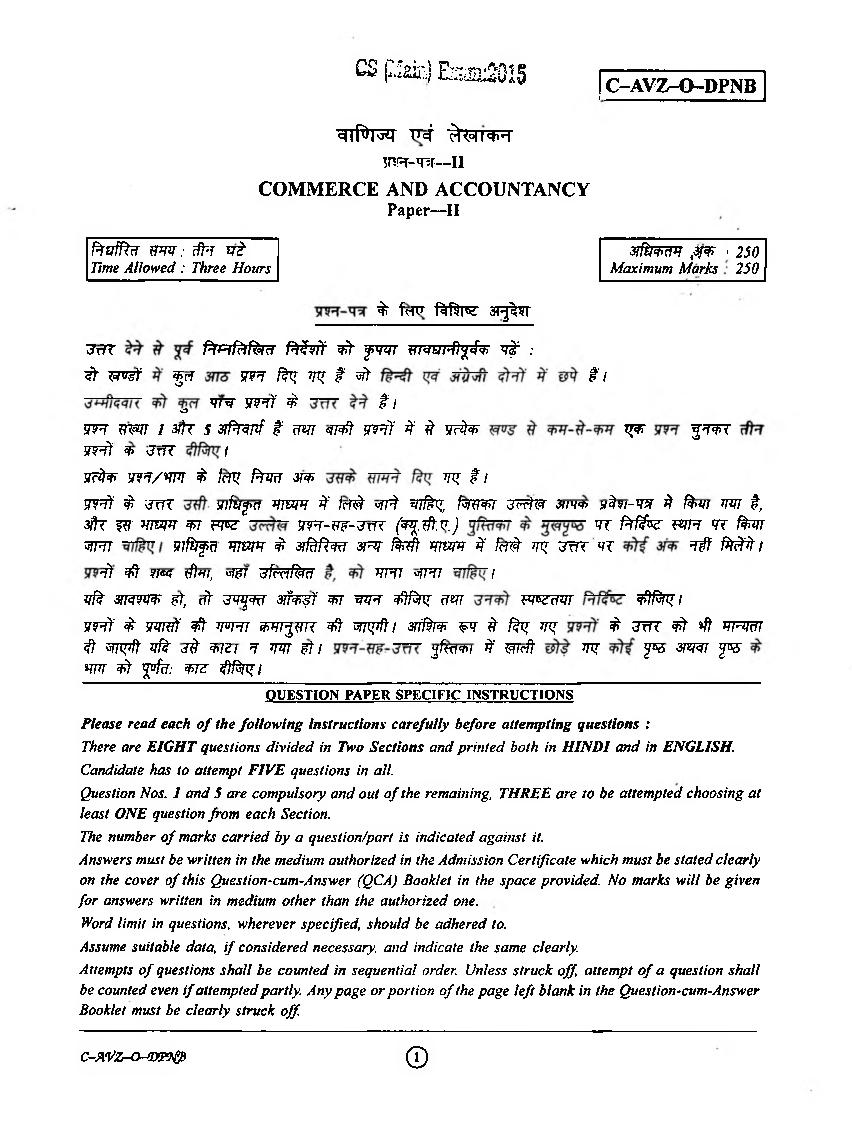
TC-AVZ-O-DPNB.,
^ F H T TTcj ifcpTT^T
3nFT-^pr--II
COMMERCE AND ACCOUNTANCY
Paper—II
Przffcr # W : # r w i s rftfrm <3pF <250
Time Allowed : Three Hours Maximum Marks 250
% fcTT* f^fW 3FJ^T
7t?t firw f& f& di fifih ff # fim h m u i4I%4* v f :
i f w rzf |cr m ^ w I ^ $I
o w ? sm f $ #'/
t f t s w i vh; 5 3 jftw f $ m r *n¥t im l #* # ? f ^ ^ jw
7 ? ^ 3> vJrR f
Xr^'P W f/W l ^ /cKf f^W 3T^ ^ ^/
7 7 ^ £ ^TfT w filpa ■HluW % /cT# uf7^ W7^; fvftfw drr)(q 3hh<?> y^w-W ^ R>^/ WT f ,
3ftT W m m ¥1 ? W VFT-W -^xTT (*%.&.I*.) ¥7" ft/2fe f*7FT *7T ^ 777
wptt y/^d m m £ zrfoffai sfv ffaft m m ? /cr# ^ ztu vt ^ ft<#/
’Z) 3ft ?/«?<■/)*//, vfFT dfrciR^a mfT ufFJT I
v ft m w # wt, <ft zwpm z ffrfijf m w ? ¥tf$m trw ? w <m ¥ ff^ (
jfwif £ wmf ¥f wftt mr^mr ¥f wpfft 3riftw wr i ft? w $ z m # «# m m
$ w p ft yfit <?& 3>}t! W WT Wt Iy f t w i % Weft Wf ^F%> 3WWT ^ 5
mr # ffo : vrz tiftrm
QUESTION PAPER SPECIFIC INSTRUCTIONS
Please read each of the following instructions carefully before attempting questions :
There are EIGHT questions divided in Two Sections and printed both in HINDI and in ENGLISH.
Candidate has to attempt FIVE questions in all.
Question Nos. 1 and 5 are compulsory and out of the remaining, THREE are to be attempted choosing at
least ONE question from each Section.
The number of marks carried by a question/part is indicated against it.
Answers must be written in the medium authorized in the Admission Certificate which must be stated clearly
on the cover of this Question-cum-Answer (QCA) Booklet in the space provided. No marks will be given
for answers written in medium other than the authorized one.
Word limit in questions, wherever specified, should be adhered to.
Assume suitable data, if considered necessary, and indicate the same clearly.
Attempts of questions shall be counted in sequential order. Unless struck off attempt of a question shall
be counted even if attempted partly. Any page or portion of the page left blank in the Question-cum-Answer
Booklet must be clearly struck off.
c-w vz-o-m i® ®
Page 2
SECTION—A
Q. 1 ftTHfaRpRl # TW (*r^P WTWT 150 TO?T ^f) :
Explain the following (each in about 150 words) : 10x5=50
Q. 1(a) tcNr i
Balance Score Card 10
Q. 1(b) MR
VUCA World 10
Q. 1(c) fa
Force Field Analysis 10
Q. 1(d)
Psychological Contract 10
Q. 1(e) sPTFT Tw itted I
Accountability vs Responsibility. 10
Q. 2(a) “w isfa i t TfcnM w r i W t M t l”
ft gff w srf^wT
“Competitiveness of Indian industry is directly linked with digitisation initiatives,” Identify
the issues involved and implication of this statement. 20
Q. 2(b) % w r t f t *TK#T oJTWff^ W l& ft ^ pHTTW 3T^^Tt‘
% WWeTFTf ^ ffe n : TFT t I" ^
*¥ % 1cTq; |nKirH+ ^fr^T |
“Since liberalisation there has been continuous pressure on the functioning of regulatory
agencies which monitor Indian business organisations.” Evaluate this statement and suggest
remedial measures to enhance their effectiveness. 20
Q. 2(c) FWTf % TO m m I ? FWrf^ ^ ^
What is meant by empowered organisations ? Suggest steps to foster an empowered
organisation. 10
C-AVZr-Q-ZmgB ®
Page 3
^ N ro FTVT ^TT t ? t& W R T H ¥ f W ^ f 3flT % ^'i|6^H ^W ^cT l
^ to r m y*rrfor f ?
According to Hendry Mintzberg, how does the power dynamics between various parts of
the organisation, result in different structural forms of organisation ? What are these
structural forms, and how do they affect organisational effectiveness ? 20
Q. 3(b) “T O ircf> F|frT I WT&l % m 3RTTOT
^ 3RRT: ^frrPT t f f e qftfW ^ ^ t I" W W T ^TT^TT
3TTgf^ Md-it ^RffcT^ WFTOf 3ffaWT
“Organisation culture is the long term phenomenon that decides the success or failure of
the mission and vision of the organisation and ultimately its survival in the current global
scenario.” Explain this statement and also identify the cultural problems of modem business
Organisations. 20
Q. 3(c) 3n§f¥*> 3 w w w t c t amrmrq ^
i t Tftr f ? w m ^ f ? 3TFT 3 ^ '3TR % w f a ^ ^ I
In post modern-organisations, are traditional concepts like line and staff functions
irrelevant ? Do you think so ? Give arguments in support of your answer. 10
Q. 4(a) ‘W5 <+, 3m4t, W TrftirTFT Tffeef ^ faffrT % FTFT T? WFT
^ w w I, % fcrq; t ^ r f ^
OTT ^T ^ r t 1 1 " % 3TR TO t ? W ^TT^ef
^ i
“S-O-B-C model gives Only a bare bones sketch of organisation behaviour rather than a
full blown explanation. However it can serve as a conceptual framework for organisational
behaviour.” What do you mean by this statement ? Give suggestions to enrich this model.
20
Q. 4(b) W t ? *TR#T +*-MpW ^ ^
SfW C ^T to r TOT ^ T trr ^Tcft f ? I
What is positive psychology ? How can Indian companies use the concepts of the same
to foster entrepreneurial thinking in their workforce ? Explain. 20
Q. 4(c) " T O # W $m J W ^Tf ¥^T^rfcTT ^ ^TcTT t I ” ft^FT
^Prq; i
“Organisational citizenship behaviour enhances the effectiveness of quality circles.” Comment.
10
C-AVZ-0-4m & ®
Page 4
SECTION—B
Q. 5 PlHlrii&cT ^TTT cTTO 150 3r) :
Explain the following: (each in about 150 words) : 10x5=50
Q. 5(a) f^TT^ W f HIW3 I
Behavioural Anchored Rating Scale. 10
Q. 5(b) WSPT I
Human Resource Accounting. 10
Q. 5(c) ^ wm i
Conciliation vs Mediation in Disputes Resolution. 10
Q. 5(d) 3kT*T ^ sffarc ®F^ I
Pen down strike vs Tool down strike. 10
Q. 5(e) cflcrra^t m I
Banning Lockouts. 10
Q. 6(a) #3prr w tffaisif % ^T«r sr^en^r
TJTT ^ 3^# M il" Iw % Pi ted I
“Cafeteria Scheme allows individual employees to decide, with certain limits, on the
make up of their Fringe Benefits Package.” Discuss. Also examine the implications of
this statement. 20
Q. 6(b) “w w m tt ^rtsr faror f^rnr w fer %rPn£f ^
% fift* w f CT2TT fafWW<q WRT ^ fT 3^STFpT ^f^T
t i " :^ f ^ n T m w it ‘sr*rr3t t wstft ^
WEFT f^TFT W w : ^ WT t ?
“Compared to factory workers, it is more difficult to attempt job analysis, job description,
and job specification for the Scientists and Engineers working in Research and Development
^Departments ” Comment. How does the HR Department help management to address
these challenges effectively ? 20
Q. 6(c) f¥sWT ‘ScTt W J' W ifclT t ? c?JTW ^ tf^ l
What is the impact of ‘Halo Effect’ on Performance Appraisal ? Explain. 10
c-xVZr-a-zm^B (?)
\
Page 5
3 3TT% ^ 3T^Ttsff ^T ifr
“360° feedback system is gaining popularity.” Comment. Also examine the barriers to its
effective implementation in India. 20
Q. 7(b) 3 ^TT 3HFfr RM T ^ 3 W14M! 1948 $
f^ r t I" f ? W 3TTT W f arjrpq-
“I.T. Companies in India seek special concessions in the Factories Act of 1948, for their
establishments.” What are these concessions ? Do you agree that these should be
granted ? Give arguments in support of your answer. 20
Q. 7(c) T O W ^ SR qfr w fc n ft % TO ^ t etf^T ^ ^
w ftfrt ^ arr^TOT t i "
“Constitutional provisions are in favour of Workers Participation in Management, but its
implementation requires effective strategies.” Discuss. 10
Q. 8(a) m asmf ^ ^ t t f r ^
^RTT t ? ^TT t <#rfjpr WMcft WTT TTTR^f TO^T
f ? ^nT |
“Majority of I.T. Companies are keen to reduce their labour turnover.” What are the
reasons for it ? How could exit interviews and post exit questionnaires enable them to do
so ? Comment. 20
Q. 8(b) xrcfT <£ 3f ?t %crurfM ^ mk^mR* tom r 3ncrw+di ifcft
t !" fcTXT f^T cT^' TT SJPT f^TT
^tftt ?
“Collective bargaining requires mutual trust among key stakeholders within an industry.”
Comment. What considerations are to be taken into account in managing collective bargaining
arrangements ? 20
Q. 8(c) "1991 % 3Tf^cPT m H M *TR^k SR W T 7F 11”
“Changing Indian labour legislations is the last unfinished agenda since 1991.” Assess its
rationale. 10
c-xVZr-o-mso® ©
Document Details
| Board / Org | UPSC |
| Exam | UPSC CSE (IAS) |
| Type | Question Paper |
| Pages | 5 |
| Updated | 30 Apr 2026 |