UPSC IAS 2015 Question Paper for Economics Paper-II
Finished viewing? Save it for later —
Download UPSC IAS 2015 Question Paper for Economics Paper-II (PDF · 5 pages)About UPSC IAS 2015 Question Paper for Economics Paper-II
UPSC IAS 2015 Question Paper for Economics Paper-II is available here for free download. Published by UPSC for UPSC CSE (IAS), this question paper can be viewed online or downloaded as a PDF (5 pages). Candidates preparing for UPSC CSE (IAS) can use UPSC IAS 2015 Question Paper for Economics Paper-II to understand the exam pattern, the type of questions asked, and the overall difficulty level.
Frequently Asked Questions
How can I download UPSC IAS 2015 Question Paper for Economics Paper-II?
Open this page and click the Download button to save UPSC IAS 2015 Question Paper for Economics Paper-II as a PDF. It is completely free on AglaSem Docs.
Is UPSC IAS 2015 Question Paper for Economics Paper-II free to download?
Yes. UPSC IAS 2015 Question Paper for Economics Paper-II can be viewed online and downloaded as a PDF free of cost on AglaSem Docs.
How many pages does UPSC IAS 2015 Question Paper for Economics Paper-II have?
UPSC IAS 2015 Question Paper for Economics Paper-II contains 5 pages, which you can read online or download together as a single PDF.
Where can I find more UPSC CSE (IAS) study material?
You can find more UPSC CSE (IAS) question papers, sample papers, syllabus, and answer keys on AglaSem Docs.
UPSC IAS 2015 Question Paper for Economics Paper-II – Text
Read the full text of this question paper below — useful to quickly search, copy and reference the content online without downloading the PDF.
📄 View text version (5 pages)
Page 1
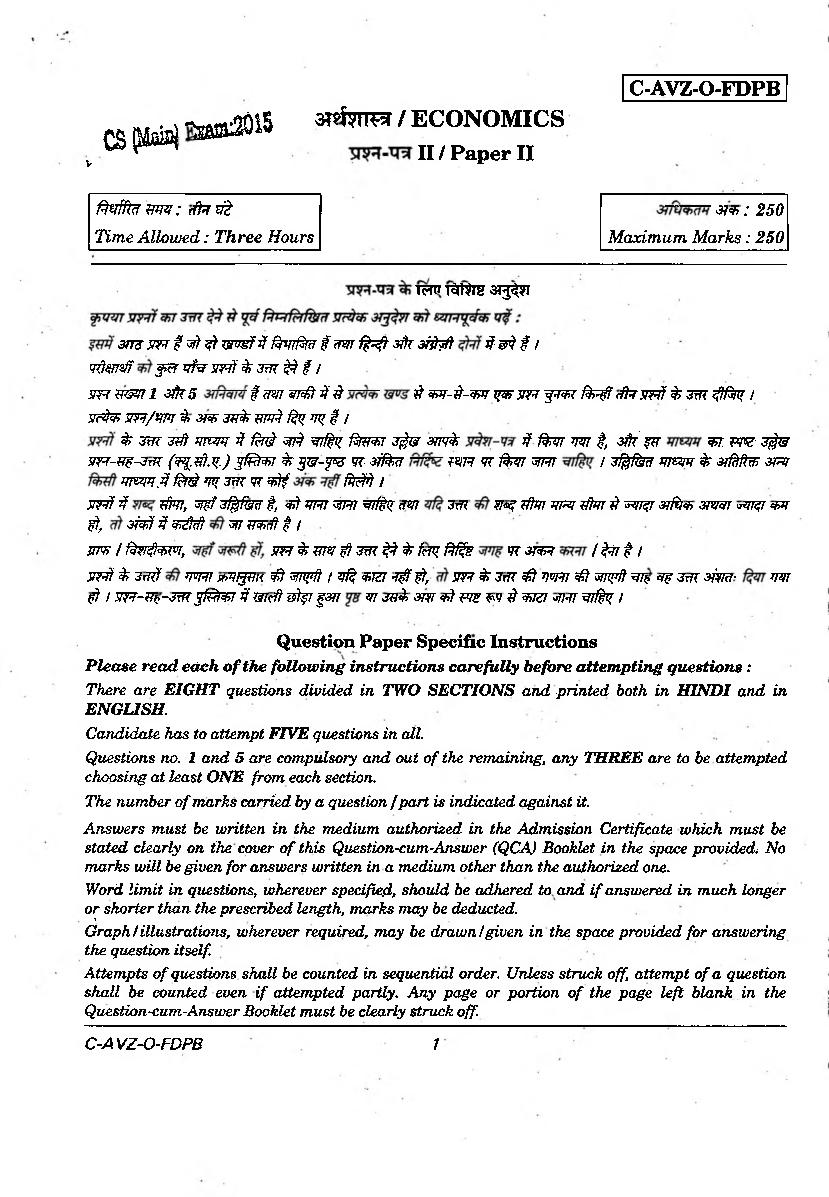
-^ 2 9 1 5 3Tt>fr?TT^/ ECONOMICS
c s ^
V
11/Paper II
ftvffcrm z?: cffrwi <H<k: 250
Time Allowed : Three Hours Maximum M arks: 250
tht*tOTth 3?3^?r
am wr i if if is*gf $ fawftm $ mr fj&t sfk sfiftf # &$ # /
7##7*# $& vfw Wff %3m & $ /
jm w& il &k5 i wmwr&$ d d w -i-m i& wr 31m fatfrffrrwif &zm ffin? i
jicfa; Wf/WT $>37w&& m d fit? w? # /
& zm M mm $ f&i w$ m%q fomr 3$w 3m% $ 1km m t zftiw w ?w 3^
JW-W-3rfT (*%&.!?:) yfctw %■5^ -5^ w 3 7 ^ *97? «7Tt o ^7?7 / 5©^7 W W £ 3*$#!F 3W
mm $ 1^ yq zm m ^ fo&t I
SRWfif tftm, W$fdlfffis/d ^ *Ff WRTWRTWfffr?(tW Jxi{ }7<sf fftw W^ <rffw3 w^/qf/ 3}f§<b 'ZfiTWTvZfRtf qW
$, ^ $ t&kft *rr*w<ft 11
sm / fewtf&w, sm&?m$3m&&frrz ftffe w &*& l& rt f
yPFTt ^TJr??f WW ffrH/^H/i tff ^f/^D/ 3^ <h!d( *i$ ^ J77? ^T3xfT^f ift/fflf $f 377Tpff Wlj? <$W3xfZ3/^M* ^TW
{$ / JF&T-'W}—<JffT^fi^<i>! $ Wrff &)$/^3?7 W<fH<k 37W*&fW£? ^»¥^ 35727v?7*77Wlffy f
Question Paper Specific Instructions
Please read each of the following instructions carefully before attempting questions:
There are EIGHT questions divided in TWO SECTIONS and printed both in HINDI and in
ENGLISH
Candidate has to attempt FIVE questions in all.
Questions no. 1 and 5 are compulsory and out of the remaining, any THREE are to be attempted
choosing at least ONE from each section.
The number of marks carried by a question /part is indicated against it.
Answers must be written in the medium authorized in the Admission Certificate which must be
stated clearly on the cover of this Question-cum-Answer (QCA) Booklet in the space provided* No
marks will be given for answers written in a medium other than the authorized one.
Word limit in questions, wherever specified, should be adhered to and if answered in much longer
or shorter than the prescribed length, marks may be deducted.
\
Graph f illustrations, wherever required, may be drawn /given in the space provided for answering
the question itself
Attempts of questions shall be counted in sequential order. Unless struck off, attempt of a question
shall be counted even if attempted partly. Any page or portion of the page left blank in the
Question~cumAnswer Booklet must be clearly struck off.
C-A VZ-O-FDPB 1
Page 2
Ql. ftMfaHsid cbtstR <rnron i 50 ?i® ^fT f^n i:
Answer the follow ing questions in about 150 w ords each : 10x5=50
(a) ^ % cFRT ^ *fTOT % 3?Tffe ^ 1^T 5TOT 1^1
«fT ?
How did railways contribute to India’s economic development in
the pre-independence era ?
(b) *rror 3 ^ oFi^T % ^kR, era 3 ? M % To if ^ftfcPTW
3tr^ t 'smre w «tt ?
What was the impact of policy reservation in favour of small scale
industries in India during the post-independence but pre-liberalisation
era ?
(c) iafet tot % ojjFtK *trc<ik
?#V? I
What specific trade policies during the British period led to the decline
of Indian industry ? Explain.
(d) W 3TN% fasjK 3, ^ ^TRTT
?TOJT «RTT^ I
Do you think that full convertibility of rupee on capital account will help
in accelerating India’s economic growth ? Give reasons.
(e) w ra 4 w f f e w ft sfk wrsiK ^ <wt
amFTT’T^T I
Why did the socialist order fail and the country had to resort to the
market economy system ? Give reasons.
Q2. (a) W 3TN% f%TOT ^ wftfcr % WScT
Do you think that pursuit of wage-goods model could have been more
appropriate for post-independence strategy of development ? Give
reasons. 15
(b) w r 4 1991 ^ 315f55jc[W ^ WfeRT ^ ^ TigQ
Explain the major factors that affected the growth rate of the economy
in post-independence India till 1991. 20
(c) fsfe?r w % ^fcn,
*rcr tst «fT i i
*
During the British Rule, India was rooted with seeds of modernisation,
but the country remained underdeveloped. Discuss. 15
C-AVZ-O-FDPB 2
Page 3
Q3. (a) ^RWTT % 3TTf^F %ST 3RRR imifoT <R<ft t ? TOT
^ R w n €t anj ?k^TT, fe ft ^?r 3 fosra % sicPFt (fc3) <s> ^ *ra«ft f ?
iik # t aiyra % jrftc? 3 qfteR 1
How does population growth affect economic development of a country ?
Can the age structure of population alter the pattern of development in
a country 9 Examine in the light of the Indian experience. 20
■ (b ) *trccr 3 f a H R f ^ 4 ^ 1 # TTCTIT TOT-TOT
|? {^T 3I^R ^sq^icT 5IT I ?
What are the different types of agricultural subsidies that are given to
the farmers in India ? How can these be rationalised ? 15
(c) *ITOT 3 ‘fofiTCT ^1 ItflTSR’ ^ a fo
The ‘dichotomy of development’ in India emerged owing to ‘governance
deficit’ and ‘crony capitalism’. Examine. 15
Q4. (a) am * ^ <s?i ^rmi I *ir<t if <)<i(l<«.uf|TK a ^ r 3 arif^s ?r w r
^ r r t ^i t I tot a n q ^ f ^ m t w r a I ? 3 a )< i-g ‘ 0-H < }d H
'f t ? * W T TOT w t ?
It is often said that the prime generator of economic growth in India in
the post-liberalisation period has been the service sector. Do you agree
with this view ? What has been its implication on the balance of
payments in India ? 20
(b) 3 ^ (T^.X^.Tft.) { ^ f M 3 m W ^ fiRtt t $ 9 3 W :
qfofi tpr gsRiR 'TiNfiTt f i qftSR <£tftpr i
High Minimum Support Prices (MSP) induce distortions, some of which
ultimately hurt the poor. Examine its merits and demerits. 15
(c) «n?rrc fttfa «Rt sqsfcfiT 3fk bt«t Ttsprn: «n?TTC t <M^d to:
t i % f^ r jrsr ftsfacn ^ ^ W
i? r
Market economy excludes poor from the consumer as well as
employment market. Discuss how one can safeguard the interests o f .
population below poverty line. 15
C-AVZ-O-FDPB 3
Page 4
SECTION B
Q5. ftRfafeld Tftl 150 :
Answer the following questions in about 150 words each : 10x5=50
(a) ura 2013 % arnrrft^ vx
■5WRT I W ^ ^?I 3 ?WFn B*TOH fofilcT |
1
Highlight the basic features of National Food Security Act (NFSA), 2013.
Can it solve the problem of malnutrition in the country ? Discuss.
(b) WcT 3 f o r # ^ TR xfEif cgtfolT I
Discuss the recent initiatives for augmenting power generation in India.
(c) % °qrq^ aifi^rgur w f ?
t iw
What are the broad features of the proposed GST Model ?
(d) ijjigT % .3,. trreforffen 3 ffc-f-foiifffi qtei’qfri'ii! (? r -mw1Wji arefo)
% 3rgs I ?^ I
What are the major factors behind accumulation of non-performing
assets in the Indian banking sector in recent years ? Discuss.
(e) ‘ft r fa 3H<Wfi 3 | I* M
I
‘Financial inclusion is one of the most essential components of inclusive
growth/ Comment.
Q6. (a) ^ tR 3?ro^ w W t % 'SsW ajfefiiW :^ 'dte
<R 3 w i t 3TP* ftcfict ip n t ?
What is your opinion oh the view that the economic reform process has
largely bypassed agriculture ? 15
(b ) a r r a ^ fic n t f t ; tr r e f? 3 r o ic ft $ ftfr q fir a f t s n
affe; sigsftfer im* I w 3TTT?H i^iT^ ~3® ^ f ?
Non-banking financial institutions need to be effectively regulated and
monitored in India. Can you suggest some measures in this direction ? 15
(c) *£ht siteftfofr spift % ^ ^trct (ftffe r if&n stew)
' s n m H f t s g s j r c f t I w s m t ?
In the context of the information technology revolution, Digital India
Programme, is a significant instrument of administrative reforms. Do
you agree? 20
C-AVZ-O-FDPB *
C
Page 5
qfcaqfrPft % % 3T?tra7, «+>i4 s*>m1 % s r o te ra i
11 i
Rural poverty continues to be a chronic problem in India, which cannot
be taken care of by anti-poverty programmes but by creation of
permanent productive assets. Discuss: 20
(b) *rrer % oiim* 3, % Titter aft?: twi<rw
3»k fctf^AinH^ % fcTQ; t?«s “ftrar eft t i :
3 i^ ^ <1% I
There is a need for an‘apex agency* to monitor and toregulate the entry
and functioningof transnational corporations in the context of India’s
broader national interest. Give arguments insupport of your answer. 15
" (c) smnto f t ?$tz, urfta w % ^
fj I ^ \ I
Agro-based industries, especially food-processing uiiits, canalter the .
fate of rural India. Discuss. 15
Q8. (a) ifa sfk % <schi<;h ‘if <t><A % f?TQ; ITcf -flfcPld
W f ^ FTC I
Explain the recent policy initiatives for enhancing crude oil and natural ;
gas production in India. 15
(b) 2 0 i 4 % s p n r e s i
What are the main components of the National Manufacturing Policy, ..
2014 ? Discuss. 15
(c) ferr zmtn 3ipr RwilWi ^it f ? .
\ ■
What are the major recommendations of the Fourteenth Finance
Commission? 20
C-A VZ-O-FDPB 5
Document Details
| Board / Org | UPSC |
| Exam | UPSC CSE (IAS) |
| Type | Question Paper |
| Pages | 5 |
| Updated | 30 Apr 2026 |