NCERT Book Class 8 Science Chapter 11 Chemical Effects of Electric Current
Finished viewing? Save it for later —
Download NCERT Book Class 8 Science Chapter 11 Chemical Effects of Electric Current (PDF · 19 pages)About NCERT Book Class 8 Science Chapter 11 Chemical Effects of Electric Current
NCERT Book Class 8 Science Chapter 11 Chemical Effects of Electric Current is available here for free download. Published by NCERT for Class 8, this books can be viewed online or downloaded as a PDF (19 pages). Candidates preparing for Class 8 can use NCERT Book Class 8 Science Chapter 11 Chemical Effects of Electric Current to understand the exam pattern, the type of questions asked, and the overall difficulty level.
Frequently Asked Questions
How can I download NCERT Book Class 8 Science Chapter 11 Chemical Effects of Electric Current?
Open this page and click the Download button to save NCERT Book Class 8 Science Chapter 11 Chemical Effects of Electric Current as a PDF. It is completely free on AglaSem Docs.
Is NCERT Book Class 8 Science Chapter 11 Chemical Effects of Electric Current free to download?
Yes. NCERT Book Class 8 Science Chapter 11 Chemical Effects of Electric Current can be viewed online and downloaded as a PDF free of cost on AglaSem Docs.
How many pages does NCERT Book Class 8 Science Chapter 11 Chemical Effects of Electric Current have?
NCERT Book Class 8 Science Chapter 11 Chemical Effects of Electric Current contains 19 pages, which you can read online or download together as a single PDF.
Where can I find more Class 8 study material?
You can find more Class 8 question papers, sample papers, syllabus, and answer keys on AglaSem Docs.
NCERT Book Class 8 Science Chapter 11 Chemical Effects of Electric Current – Text
Read the full text of this books below — useful to quickly search, copy and reference the content online without downloading the PDF.
📄 View text version (1 page)
Page 1
ELECTRIC CURRENT
Y
our elders might have cautioned plastic and wood do not conduct
you against touching an electrical electricity. However, so far we have used
appliance with wet hands. But our tester to test materials which were
do you know why it is dangerous to in solid state. But what about liquids?
touch an electrical appliance with wet Do liquids also conduct electricity? Let
hands? us find out.
We have learnt earlier that the
materials, which allow electric current
to pass through them, are good Paheli and Boojho want to
conductors of electricity. On the other remind you that one
hand, materials, which do not allow should not experiment
electric current to pass through them with the electric supply
easily, are poor conductors of electricity. from the mains or a
In Class VI, we made a tester to test generator or an inverter.
whether a particular material allows the Use only electric cells for
electric current to pass through it or not. all the activities suggested
here.
Do you recall how the tester helped us
in deciding that?
We found that metals such as copper 11.1 Do Liquids Conduct
and aluminium conduct electricity Electricity?
whereas materials such as rubber,
To test whether a liquid allows electric
current to pass through it or not, we
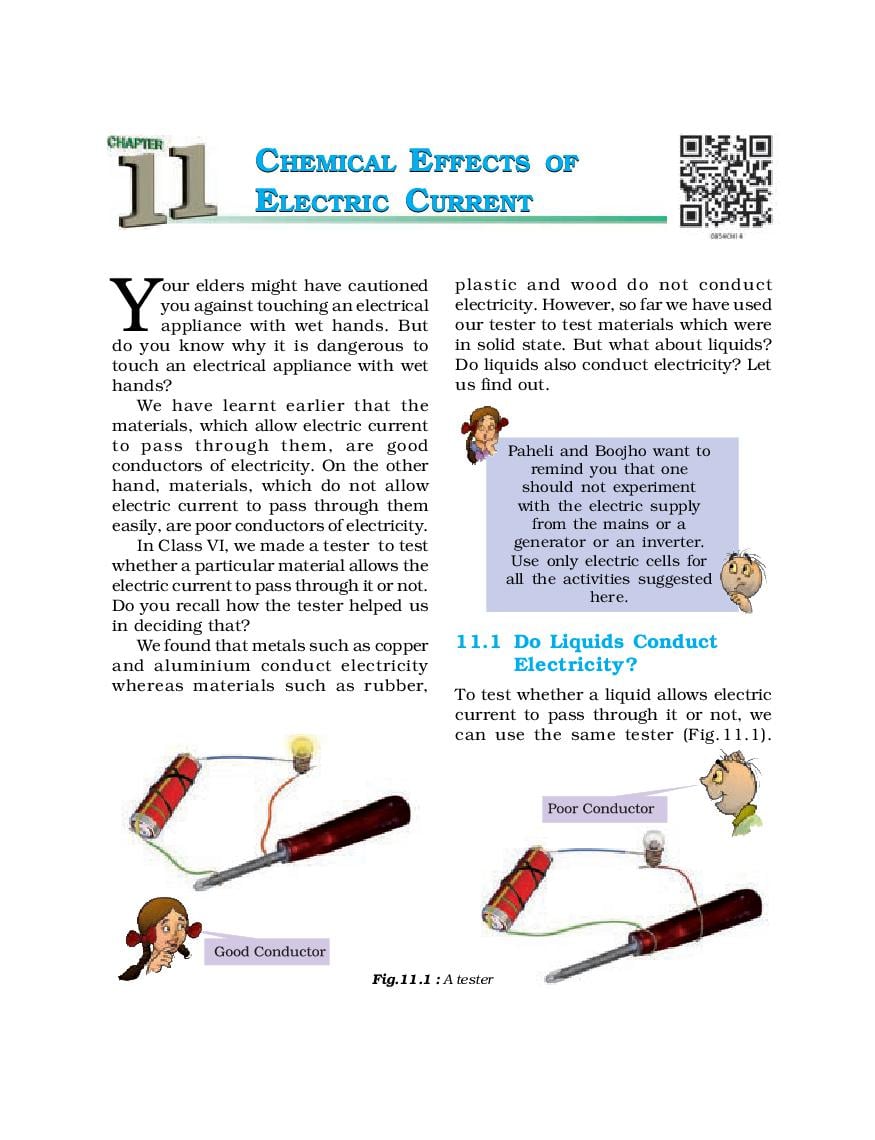
can use the same tester (Fig.11.1).
Fig.11.1 : A tester
Showing the first page only. Download the PDF above for the complete document.
Document Details
| Board / Org | NCERT |
| Exam | Class 8 |
| Type | Books |
| Pages | 19 |
| Updated | 22 Jul 2026 |