Goa Board Class 12 Question Paper 2025 Clothing Construction
Finished viewing? Save it for later —
Download Goa Board Class 12 Question Paper 2025 Clothing Construction (PDF · 5 pages)About Goa Board Class 12 Question Paper 2025 Clothing Construction
Goa Board Class 12 Question Paper 2025 Clothing Construction is available here for free download. Published by Goa Board for Class 12, this question paper can be viewed online or downloaded as a PDF (5 pages). Candidates preparing for Class 12 can use Goa Board Class 12 Question Paper 2025 Clothing Construction to understand the exam pattern, the type of questions asked, and the overall difficulty level.
Frequently Asked Questions
How can I download Goa Board Class 12 Question Paper 2025 Clothing Construction?
Open this page and click the Download button to save Goa Board Class 12 Question Paper 2025 Clothing Construction as a PDF. It is completely free on AglaSem Docs.
Is Goa Board Class 12 Question Paper 2025 Clothing Construction free to download?
Yes. Goa Board Class 12 Question Paper 2025 Clothing Construction can be viewed online and downloaded as a PDF free of cost on AglaSem Docs.
How many pages does Goa Board Class 12 Question Paper 2025 Clothing Construction have?
Goa Board Class 12 Question Paper 2025 Clothing Construction contains 5 pages, which you can read online or download together as a single PDF.
Where can I find more Class 12 study material?
You can find more Class 12 question papers, sample papers, syllabus, and answer keys on AglaSem Docs.
Goa Board Class 12 Question Paper 2025 Clothing Construction – Text
Read the full text of this question paper below — useful to quickly search, copy and reference the content online without downloading the PDF.
📄 View text version (5 pages)
Page 1
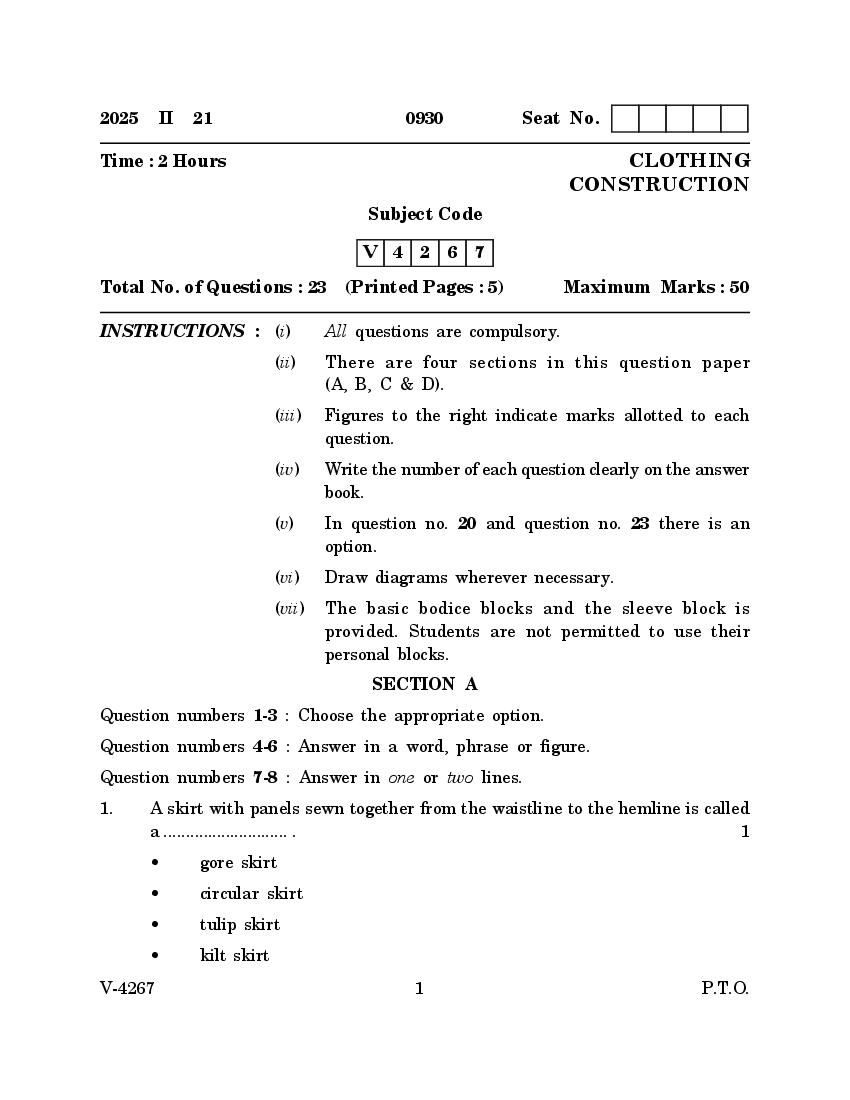
Time : 2 Hours CLOTHING
CONSTRUCTION
Subject Code
V 4 2 6 7
Total No. of Questions : 23 (Printed Pages : 5) Maximum Marks : 50
INSTRUCTIONS : (i) All questions are compulsory.
(ii) There are four sections in this question paper
(A, B, C & D).
(iii) Figures to the right indicate marks allotted to each
question.
(iv) Write the number of each question clearly on the answer
book.
(v) In question no. 20 and question no. 23 there is an
option.
(vi) Draw diagrams wherever necessary.
(vii) The basic bodice blocks and the sleeve block is
provided. Students are not permitted to use their
personal blocks.
SECTION A
Question numbers 1-3 : Choose the appropriate option.
Question numbers 4-6 : Answer in a word, phrase or figure.
Question numbers 7-8 : Answer in one or two lines.
1. A skirt with panels sewn together from the waistline to the hemline is called
a ............................ . 1
• gore skirt
• circular skirt
• tulip skirt
• kilt skirt
V-4267 1 P.T.O.
Page 2
the .................................. . 1
• bias grain
• true bias grain
• crosswise grain
• lengthwise grain
3. Sibyl used a tool to draw circles that represent button and buttonhole placement
on a paper pattern. Name the tool used by Sibyl. 1
• Circle template
• Curve ruler
• French curve
• Flex general ruler
4. Identify the type of skirt given below. 1
5. What is the direction of yarns in a woven fabric known as ? 1
6. Name the category of sleeves which are cut and stitched separately and then
seamed into the circular armhole of a garment. 1
7. Why is an interfacing cut without seam allowance ? 1
8. How are Commercial paper patterns prepared ? 1
SECTION B
Question numbers 9-14 : Answer in three to four lines.
9. Why are paper patterns made larger than body measurements ? 2
V-4267 2
Page 3
straightened ? 2
11. What is the difference between Off centre Crosswise fold and Double
fold ? 2
12. How are collars classified based on the neckline shape and roll of the
collar ? 2
13. What are the first four steps in Commercial garment production ? 2
14. What can be used as design lines to enhance the appearance of a
garment ? 2
SECTION C
Question numbers 15-18 : Answer in five to eight lines.
Question numbers 19-20 : Answer the following.
15. Explain the following terms : 3
(i) Lengthwise grain
(ii) Crosswise grain
(iii) True bias
16. Why are interlinings used in garments ? 3
17. Why are fabrics blended ? 3
18. What is the difference between Piecing and Dovetailing ? 3
19. Dale wants to stitch a top with Round yoke from the shoulders. Illustrate
the steps to convert a basic bodice block to a Round yoke from the
shoulders. 3
20. With the help of diagrams, show the following : 3
(i) Fashion figure of a Square collar
(ii) Assembling of the bodice blocks to draft the collar
(iii) Drafting of a Square Collar
Or
Illustrate the Fashion figure of a Scalloped Collar, the steps for assembling
of the bodice blocks and drafting of the collar.
V-4267 3 P.T.O.
Page 4
Question numbers 21-23 : Answer the following.
21. Why is a Paper pattern known as a ‘Dressmaker’s friend’ ? 4
22. Draw diagrams showing the concept of slash and spread to convert a basic
sleeve pattern to a Puff sleeve gathered at the bottom. 4
Distribution of marks
Fashion figure – ½ mark
Original pattern – ½ mark
Construction stages – 1 mark each
23. Daisy wants to stitch a dress with fullness at the top and bottom edge of
the bodice. Draw diagrams showing the steps in construction. 4
Distribution of marks
Fashion figure of the bodice – ½ mark
Original pattern – ½ mark
Construction stages – 1 mark each
Or
Kate designed a Kurta with neckline darts and waistline darts. With the help
of diagrams, show how to shift the side seam dart of a basic bodice block
to the neckline area.
Distribution of marks
Fashion figure of the bodice – ½ mark
Original pattern – ½ mark
Construction stages – 1 mark each
V-4267 4
Page 5
C/F
Basic
Bodice
Block (Front)
C/B
Basic
Bodice
Block (Back)
Basic
sleeve
V-4267 5 P.T.O.
Document Details
| Board / Org | Goa Board |
| Exam | Class 12 |
| Type | Question Paper |
| Pages | 5 |
| Updated | 24 Sep 2026 |