Goa Board Class 12 Question Paper 2025 Chemistry
Finished viewing? Save it for later —
Download Goa Board Class 12 Question Paper 2025 Chemistry (PDF · 11 pages)About Goa Board Class 12 Question Paper 2025 Chemistry
Goa Board Class 12 Question Paper 2025 Chemistry is available here for free download. Published by Goa Board for Class 12, this question paper can be viewed online or downloaded as a PDF (11 pages). Candidates preparing for Class 12 can use Goa Board Class 12 Question Paper 2025 Chemistry to understand the exam pattern, the type of questions asked, and the overall difficulty level.
Frequently Asked Questions
How can I download Goa Board Class 12 Question Paper 2025 Chemistry?
Open this page and click the Download button to save Goa Board Class 12 Question Paper 2025 Chemistry as a PDF. It is completely free on AglaSem Docs.
Is Goa Board Class 12 Question Paper 2025 Chemistry free to download?
Yes. Goa Board Class 12 Question Paper 2025 Chemistry can be viewed online and downloaded as a PDF free of cost on AglaSem Docs.
How many pages does Goa Board Class 12 Question Paper 2025 Chemistry have?
Goa Board Class 12 Question Paper 2025 Chemistry contains 11 pages, which you can read online or download together as a single PDF.
Where can I find more Class 12 study material?
You can find more Class 12 question papers, sample papers, syllabus, and answer keys on AglaSem Docs.
Goa Board Class 12 Question Paper 2025 Chemistry – Text
Read the full text of this question paper below — useful to quickly search, copy and reference the content online without downloading the PDF.
📄 View text version (11 pages)
Page 1
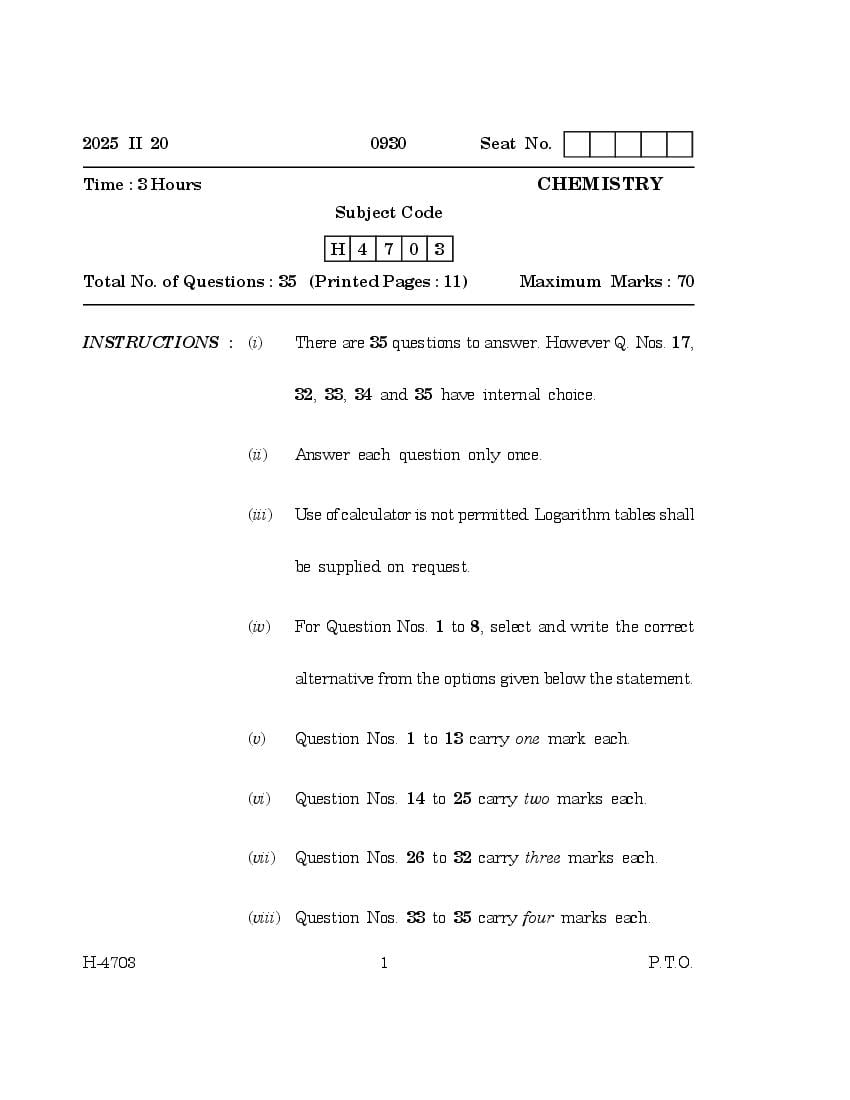
Time : 3 Hours CHEMISTRY
Subject Code
H 4 7 0 3
Total No. of Questions : 35 (Printed Pages : 11) Maximum Marks : 70
INSTRUCTIONS : (i) There are 35 questions to answer. However Q. Nos. 17,
32, 33, 34 and 35 have internal choice.
(ii) Answer each question only once.
(iii) Use of calculator is not permitted. Logarithm tables shall
be supplied on request.
(iv) For Question Nos. 1 to 8, select and write the correct
alternative from the options given below the statement.
(v) Question Nos. 1 to 13 carry one mark each.
(vi) Question Nos. 14 to 25 carry two marks each.
(vii) Question Nos. 26 to 32 carry three marks each.
(viii) Question Nos. 33 to 35 carry four marks each.
H-4703 1 P.T.O.
Page 2
• adrenaline
• thyroxine
• testosterone
• insulin
G for a reaction when a catalyst is added
to it ? 1
• It increases
• It decreases
• It remains unchanged
• It is undefined on addition of catalyst
3. The compound CH3CH2C(CH3)2CH2Cl is a ....................... 1
• primary alkyl halide
• primary allyl halide
• secondary alkyl halide
• secondary benzyl halide
4. Which of the following statements is true regarding the conductivity of
electrolytic solutions ? 1
• It is independent of the size of the ions
• It is independent of the viscosity of the solution
• It decreases with temperature
• It depends on the solvation of ions present in the solution
H-4703 2
Page 3
• 1º > 2º > 3º
• 3º > 1º > 2º
• 3º > 2º > 1º
6. The metallic radii of some transition elements are given below :
Element Iron Cobalt Nickel Copper
Metallic radii/pm 126 125 125 128
An element that has the highest density from the above is .................. . 1
• Nickel
• Cobalt
• Iron
• Copper
7. The product formed in Aldol condensation is ........................ . 1
• an , unsaturated ester
• an -hydroxy aldehyde or ketone
• a -hydroxy acid
• a -hydroxy aldehyde or ketone.
H-4703 3 P.T.O.
Page 4
• Ar < CO2 < CH4 < HCHO
• Ar < CH4 < CO2 < HCHO
9. Write the chemical name of Vitamin C. 1
10. Draw the structure of the chromate ion. 1
11. Write the structural formula of 2-ethoxy-2-methylpropane. 1
12. Define : Activation energy. 1
13. Identify the structure of the missing component in the given reaction
sequence : 1
Toluene conc.HNO3 + conc.H2SO4 ? Fe/HCl 4-aminotoluene
14. Draw a neat labelled diagram of the Hydrogen-Oxygen fuel cell by specifying
the electrolyte and the electrode material used. 2
15. State Faraday’s first law of electrolysis. 2
Calculate for CA Cl2 from the given data :
ºm for Ca+2 = 119.0 S cm2 mol–1 and ºm for Cl–1 = 76.3 S cm2 mol–1
16. Write the IUPAC name of each of the following complexes : 2
(i) K3[Al(C2O4)3]
(ii) [Cr (NH3)4 (H2O)2]Cl3
H-4703 4
Page 5
geometry of the high spin complex [CoF6]–3. 2
Or
17. On the basis of Valence Bond theory, deduce the type of hybridisation and
magnetic character of the tetrahedral complex [Ni(CO)4]. 2
18. Select the correct compound from each of the given pairs.
(i) Which halogen compound from the following will undergo SN2 reaction
faster ? 2
Cl Cl
(ii) Which molecule from the given pair is chiral ?
CH3CH2CH2CH2Br and CH3CH(Br)CH2CH3
19. Write one point of difference as specified in each case : 2
(i) Essential amino acids and non-essential amino acids on the basis of
their synthesis.
(ii) DNA and RNA with respect to the sugar moiety present in them.
20. Name the following : 2
(i) An element of the 3d series that exhibits maximum number of
Oxidation states.
(ii) An alloy which consists of 95% lanthanoid metal along with iron and
other trace elements.
H-4703 5 P.T.O.
Page 6
following reactions : 2
hydroboration-oxidation
(i) C6H5 – CH = CH2 ‘X’
conc . H SO at 413 K
(ii) CH3CH2CH2–OH 2 4 'Y'
22. Write chemical equations for each of the following reactions : 2
(i) Phenol is treated with Bromine water.
(ii) Vapours of ethyl alcohol are passed over heated copper at 573 K.
23. Define azeotropes. State the type of azeotrope formed by a solution exhibiting
positive deviation from Raoult’s Law. 2
24. Identify the structure or name of Compounds ‘P’ and ‘Q’ in the following
reactions : 2
(i) CH3CH2-CONH2 + Br2 + alcoholic NaOH Compound ‘P’ +Na2CO3 +
NaBr + H2O
(ii) + C2H5 – NH2 Compound ‘Q’ + HCl
25. For a reaction, H2 + Cl2 h 2 HCl, the rate law is 2
Rate = k
(i) Write the Order of the reaction.
(ii) State the Unit of rate constant ‘k’ for the above reaction.
H-4703 6
Page 7
following : 3
(i) Rate constant ‘k’.
(ii) Time required for 90% completion of this reaction in minutes.
27. Identify the Name of the reactions which are illustrated by the following
chemical equations : 3
(i) C6H5Br + 2Na + CH3Br C6H5 – CH3 + 2NaBr
Cu 2Cl2
(ii) C6 H 5 N (2 )Cl – + HCl C6 H5Cl + N2
(iii) CH3CH2Cl + AgF CH3CH2F + AgCl
28. Answer the following : 3
(i) Draw and label the facial (fac–) and meridional (mer-) isomers of
[Co (NH3)3(NO2)3].
(ii) Write one point of difference between homoleptic and heteroleptic
complexes.
29. Answer the following :
(i) Write the IUPAC name for : 3
(ii) Name the foul smelling compound obtained when aniline is subjected
to Carbylamine Reaction.
(iii) State two factors that affect the basic strength of amines.
30. Name the following : 3
(i) The linkage between two monosaccharide units in carbohydrates.
(ii) A nonreducing disaccharide which upon hydrolysis gives equimolar
mixture of D(+) glucose and D(-) fructose.
(iii) The product obtained when glucose is heated with HI.
H-4703 7 P.T.O.
Page 8
decomposition with zinc and water forms Compound ‘B’ and Compound ‘C’
as products. Compound ‘B’ gives Fehling’s test as well as a positive iodoform
test. Compound ‘C’ gives a positive iodoform test and not the Fehling’s test.
Write the appropriate chemical equation involved in the formation of
Compounds B and C from the alkene. Also write the names of Compounds
B and C. 3
32. With respect to ‘d’ and ‘f’ block elements, answer the following : 3
(i) Predict which of the following ions will be coloured in aqueous
solution ?
Cr3+, Zn2+, Cu1+, Ni2+
(ii) Write the complete ionic equation for the oxidising action of acidified
permanganate ions on ferrous ions.
(iii) State the reason : Actinoid contraction is greater from element to
element than Lanthanoid contraction.
Or
32. With respect to ‘d’ and ‘f’ block elements, answer the following : 3
(i) Predict which of the following ions will exhibit magnetic moment ?
Sc3+, Fe2+, Ti4+, Co2+
(ii) Write the complete ionic equation for the conversion of dichromate ion
into chromate ion.
(iii) State the reason : Zirconium and Hafnium have similar atomic radii.
H-4703 8
Page 9
(i) Draw a neat labelled graph to represent the dependence of Vapour
pressure on mole fraction of a component of a binary solution
exhibiting ideal behaviour.
(ii) Calculate the Osmotic pressure of a 5% (w/v) solution of urea (molar
mass 60) at 27ºC.
(Given : R = 0.083 litre bar K–1mol–1)
Or
33. With respect to Solutions, answer the following : 4
(i) Draw a neat labelled graph to represent the elevation in boiling point
of a solvent upon the addition of a non-volatile solute.
(ii) Calculate the mole fraction of KI in an aqueous solution containing
20% of KI by mass.
(Given : At. mass of K = 39, I = 127, H = 1, O = 16)
34. On the basis of the given data, answer the questions below : 4
A galvanic cell is set up at 25ºC with the following half cells.
Ag1+(10–3 M)/Ag(s) and Cu2+ (10–1 M)/Cu(s)
(Given : Eº Ag1+/Ag = 0.80 V, EºCu2+/Cu = 0.34 V)
(i) Write the net cell reaction taking place in this cell.
(ii) Is it possible to store a solution of Copper sulphate in a silver
vessel ?
(iii) Calculate Ecell at the given concentrations.
2.303 RT
(Consider the value of as 0.06 in the calculation)
F
H-4703 9 P.T.O.
Page 10
34. On the basis of the given half reactions, answer the questions below : 4
Al3+(aq) + 3e– Al(s) ............... Eº = – 1.66V
Ni2+(aq) + 2e– Ni(s) ............... Eº = – 0.25 V
(i) Represent an electrochemical cell using Nickel and Aluminium
electrodes as per cell conventions.
(ii) Among Ni and Al, which is a better reducing agent ?
(iii) Calculate the equilibrium constant (Kc) for the cell reaction.
2.303 RT
(Consider the value of as 0.06 in the calculation)
F
35. Answer the following : 4
(i) Select the carboxylic acid from the following having the highest acid
strength :
4-nitrobenzoic acid, benzoic acid, 4-methoxybenzoic acid
(ii) Write the chemical equation for the preparation of an oxime from
acetaldehyde.
(iii) Identify the reagent/s and the final product in each of the following
Name reactions :
(a) Etard Reaction with methylbenzene.
(b) Clemmensen reduction of acetone.
H-4703 10
Page 11
35. Answer the following : 4
(i) Select a compound that is most reactive towards nucleophilic addition
reaction from the following :
Acetone, acetaldehyde, propionaldehyde.
(ii) Write the chemical equation involved when Sodium acetate is heated
with sodalime.
(iii) Identify the reagent/s and the main reactant in each of the following
Name reactions :
(a) Preparation of acetophenone by Friedel Craft’s acylation.
(b) Preparation of -bromopropanoic acid by Hell Volhard Zelinsky
Reaction.
H-4703 11 P.T.O.
Document Details
| Board / Org | Goa Board |
| Exam | Class 12 |
| Type | Question Paper |
| Pages | 11 |
| Updated | 24 Sep 2026 |