UPSC IAS 2015 Question Paper for Geology Paper-I
Finished viewing? Save it for later —
Download UPSC IAS 2015 Question Paper for Geology Paper-I (PDF · 4 pages)About UPSC IAS 2015 Question Paper for Geology Paper-I
UPSC IAS 2015 Question Paper for Geology Paper-I is available here for free download. Published by UPSC for UPSC CSE (IAS), this question paper can be viewed online or downloaded as a PDF (4 pages). Candidates preparing for UPSC CSE (IAS) can use UPSC IAS 2015 Question Paper for Geology Paper-I to understand the exam pattern, the type of questions asked, and the overall difficulty level.
Frequently Asked Questions
How can I download UPSC IAS 2015 Question Paper for Geology Paper-I?
Open this page and click the Download button to save UPSC IAS 2015 Question Paper for Geology Paper-I as a PDF. It is completely free on AglaSem Docs.
Is UPSC IAS 2015 Question Paper for Geology Paper-I free to download?
Yes. UPSC IAS 2015 Question Paper for Geology Paper-I can be viewed online and downloaded as a PDF free of cost on AglaSem Docs.
How many pages does UPSC IAS 2015 Question Paper for Geology Paper-I have?
UPSC IAS 2015 Question Paper for Geology Paper-I contains 4 pages, which you can read online or download together as a single PDF.
Where can I find more UPSC CSE (IAS) study material?
You can find more UPSC CSE (IAS) question papers, sample papers, syllabus, and answer keys on AglaSem Docs.
UPSC IAS 2015 Question Paper for Geology Paper-I – Text
Read the full text of this question paper below — useful to quickly search, copy and reference the content online without downloading the PDF.
📄 View text version (4 pages)
Page 1
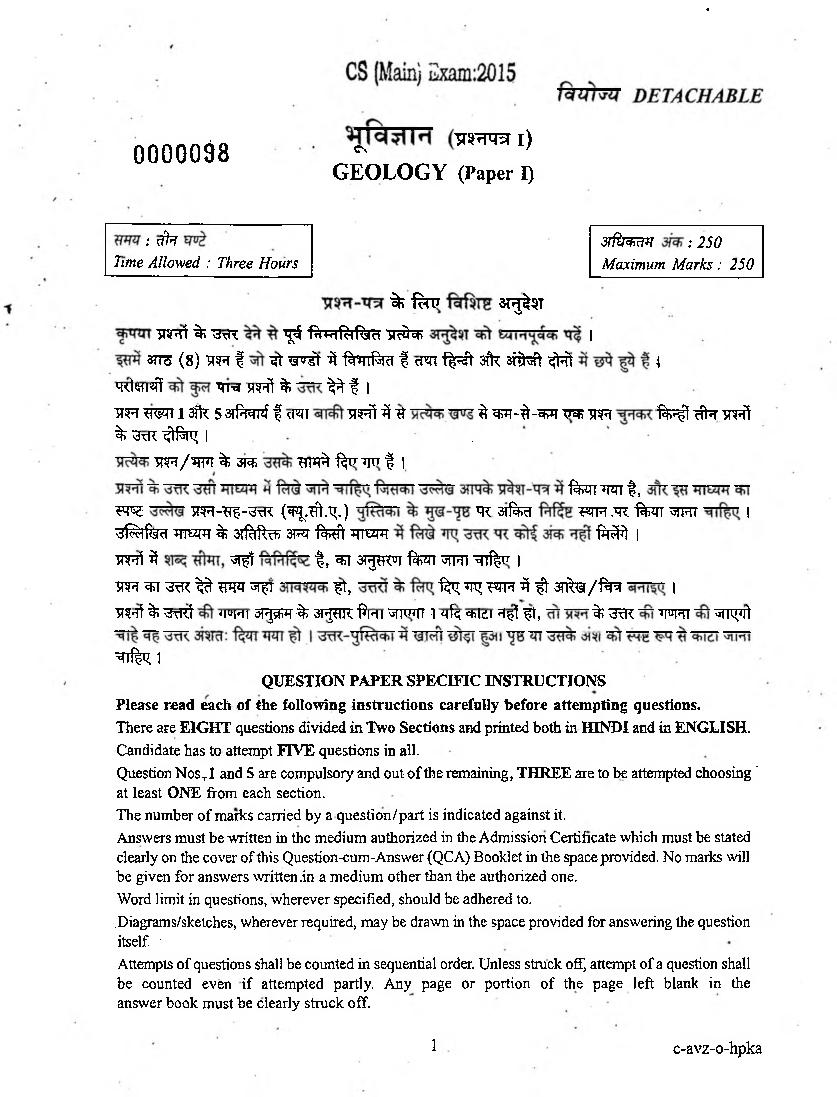
nnnnr>Aa W T O I)
0000098 ^ '
GEOLOGY (Paper I)
: tfr? 3ffy%m : 250
Time Allowed : Three Hours Maximum Marks: 250
% f^TT 3F5&T
t o * % T3rR ^ ftnfM Vd 'x&s i
3TT3 (8) TO f ?t TT^fr 3 £wjRjd | cm i1|^ .3fk sifrsft ^ f t \
M<1^11=41 TTTrT M*h1 % ^ "f I
TO WTT \$k$ 3Tft^rf | <TCT 31^ 3 TT $ ^T-t-^TT TT^ TO ■%£[ ^ 3^
% 3tR qlfct^ | .
T O / ? IF T % 3T^ T T P # f^ T T T C T f |
ta rw f,
W2 t o - ^ - ^ tR (^/tft/q.) ^ artef ftr jr t o ^trt i
^fisR i ^Ttzm % tffefUb 3RT feft TfTWr 1 ^ I
TOt 3 ^ t , ^T 3T^T^I fe n ufHI ^rf^T I
t o ^ t^ r ^ tw t ^ t ft, 1^ ^ ^ ^ ^ 3 r i ^ / f ^ i
’E S ' l t % 3 t R | -MUM I oFJsfc-H % 3 F p T K 1^1*11 ^ T T T r n } q fc j ^ I d l H $ I " f t , % 3 tR 7 Tu P f T '* 11^ 1)
^i%qi
QUESTION PAPER SPECIFIC INSTRUCTIONS
Please read each of the following instructions carefully before attempting questions.
There are EIGHT questions divided in Two Sections and printed both in HINDI and in ENGLISH.
Candidate has to attempt FTVE questions in all.
Question NosYl and 5 are compulsory and out of the remaining, THREE are to be attempted choosing '
at least ONE from each section.
The number of marks carried by a question/part is indicated against it.
Answers must be written in the medium authorized in the Admission Certificate which must be stated
clearly on the cover of this Question-cum-Answer (QCA) Booklet in the space provided. No marks will
be given for answers written .in a medium other than the authorized one.
Word limit in questions, wherever specified, should be adhered to.
.Diagrams/sketches, wherever required, may be drawn in the space provided for answering the question
itself. •
Attempts of questions shall be counted in sequential order. Unless struck off, attempt of a question shall
be counted even if attempted partly. Any page or portion of the page left blank in the
answer book must be clearly struck off.
1 c-avz-o-hpka
Page 2
f '
1. 37c^ % 3rTC w m 150 qsft 3 :
Answer the following in about 150 words each : 10x5=50
L(a)* A % 3*ftcTST?fr 3ft? f i w *rc
i
Discuss the characteristics and properties of the lithosphere and the asthenosphere.
' 1(>
i.(b) faspftfes, '«rg*fegfl 3fit TrfirfWt %\
Differentiate between panchromatic, multispectral and hyperspectral images. 10
i.(c) ^TfW t 3rk I
Using neat diagrams, classify and describe drainage patterns. 10
l.(d) ^ 3T^ft % 3T5^TFR % 3 M %
w i ^rftrq i
Using neat sketches, describe the types of faults in relation to the orientation of the
stress axes. 10
1.(e) 3rk (^tfWrr) % ^ % wfocffa irin i
Discuss the geometric relationship between cleavage and folding. 10
2^a) 3{fc 'Sg&ftm 3fk
TTfftj TKIfcmt I
• Describe the types of plate boundaries and comment on the nature of seismicity
and volcanism associated with them. 20
2.(b) cFFT 3m ^f % ^TCI 3ffc %cTT^cft m \aft % ^RT 31WI^ % % # T ^Teft
^-3TTffM I (
Describe the landforms produced by wave erosion and from the sediments
deposited by longshore currents. 15
2.(c) fe z lw f ? ff^rra ^ w f 3ffc
TT^ cfuf^f 1
What are tectonites ?. Describe their types and their significance using neat
sketches. 15
3.(a) 3rfasfr ^ 1^, %w w r gfciWR l
Using appropriate diagrams, describe Ramsay’s classification of folds in detail.
20
3.(b) • ^TqF 3ffc sftfWT TTff % ^ |
Differentiate between the terrestrial and the Jovian planets. 15
c-avz-o-hpka 2
Page 3
Describe various fluvial landforms formed in response to rejuvenation. 15
4.(a) TOT % 3#( Tr f ^ f t ^-SnffcRF <pRT |
Compare the geomorphic features along the Eastern and Western coasts of India.
20
4.(b) ^FThT (%fM) % f^JRT ^ i
Discuss the evolution of the foreland basins along the orogenic belts. 15
4.(c) ^rr irRrca 3rfei w ffaT f ? ^r% i
What is Mohr’s stress diagram? Describe its significance. 15
‘B’ SECTION ‘B’
5. f W M w t 3J?^F tr 150 t ;
Write notes on the following in about 150 words each: 10 x 5=50
5.(a) "q^ 3ffc I
Differentiate between a cast and a real shell. 10
s.(b) 3 4 ^rr i
Generation of ‘Megalospheric* and ‘Microspheric’ tests in foraminifers. 10
5^c) #TRF TO' 1
H ie‘Great Boundary Fault’. 1G
5*(d) 3W 1
Buttress dams. 10
5.(e). SfR-1^ I
Alkali-aggregate reaction. 10
6.(a) . #rafaT WRTt % ■$, M .% 1*R 3TcTO^ arf^FTWt *R #3R .ft*n ^TFTT t ?
%
. .What are the essential characters of rocks to be considered as aconstruction
material ? Add a note on aggregates. 20
6.(b) Tt $ f w i # 7 R’f l M tt^ f^ T i
Give an account of the evolutionary trends in Equidaer 15
6.(c) Wd TTrfoRTcf STcTfej 3?fc ^TcT ^R ^ tf^ r |
Discuss the Maleri Beds, their faunal content and age. 15
3 c-avz-o-hpka
Page 4
% t ^ra! 3 f ^ r t ? fafovr w rcf % ^ i
Define biostratigraphy. How does it differ from lithostratigraphy and chronostrati-
graphy? Discuss various types of ‘Biozones’. 20
7.(b) sftow % 3i5^w 3 ftftr % fngra ^tf^rq L^srfsrc
>mteiT Tim ('flRlt’i) ftw ft i
/' Explain the principle of electrical resistivity method in the exploration of
groundwater. Add a note on vertical electrical sounding. ' 15
7.(c) 3TWtWT W ffcTT 'f ? ^ MCpHOI^FT % ^ 3 ^TTcft t I ? '
What is petrifaction ? How does it differ from permineralisation ? ' 15
8.(a) STf^r (^ M s ) w f A w f ? t ^TfW
What are conodonts and their major types ? Briefly discuss their geological
history. • 20
Discuss the depositional and climatic conditions during the Siwalik times. 15
.(c) mUv\ fcfWr % ^ fk*m i
Give an account of various types of rainwater harvesting methods. 15
4
Document Details
| Board / Org | UPSC |
| Exam | UPSC CSE (IAS) |
| Type | Question Paper |
| Pages | 4 |
| Updated | 30 Apr 2026 |