UPSC IAS 2015 Question Paper for Geology Paper-II
Finished viewing? Save it for later —
Download UPSC IAS 2015 Question Paper for Geology Paper-II (PDF · 5 pages)About UPSC IAS 2015 Question Paper for Geology Paper-II
UPSC IAS 2015 Question Paper for Geology Paper-II is available here for free download. Published by UPSC for UPSC CSE (IAS), this question paper can be viewed online or downloaded as a PDF (5 pages). Candidates preparing for UPSC CSE (IAS) can use UPSC IAS 2015 Question Paper for Geology Paper-II to understand the exam pattern, the type of questions asked, and the overall difficulty level.
Frequently Asked Questions
How can I download UPSC IAS 2015 Question Paper for Geology Paper-II?
Open this page and click the Download button to save UPSC IAS 2015 Question Paper for Geology Paper-II as a PDF. It is completely free on AglaSem Docs.
Is UPSC IAS 2015 Question Paper for Geology Paper-II free to download?
Yes. UPSC IAS 2015 Question Paper for Geology Paper-II can be viewed online and downloaded as a PDF free of cost on AglaSem Docs.
How many pages does UPSC IAS 2015 Question Paper for Geology Paper-II have?
UPSC IAS 2015 Question Paper for Geology Paper-II contains 5 pages, which you can read online or download together as a single PDF.
Where can I find more UPSC CSE (IAS) study material?
You can find more UPSC CSE (IAS) question papers, sample papers, syllabus, and answer keys on AglaSem Docs.
UPSC IAS 2015 Question Paper for Geology Paper-II – Text
Read the full text of this question paper below — useful to quickly search, copy and reference the content online without downloading the PDF.
📄 View text version (5 pages)
Page 1
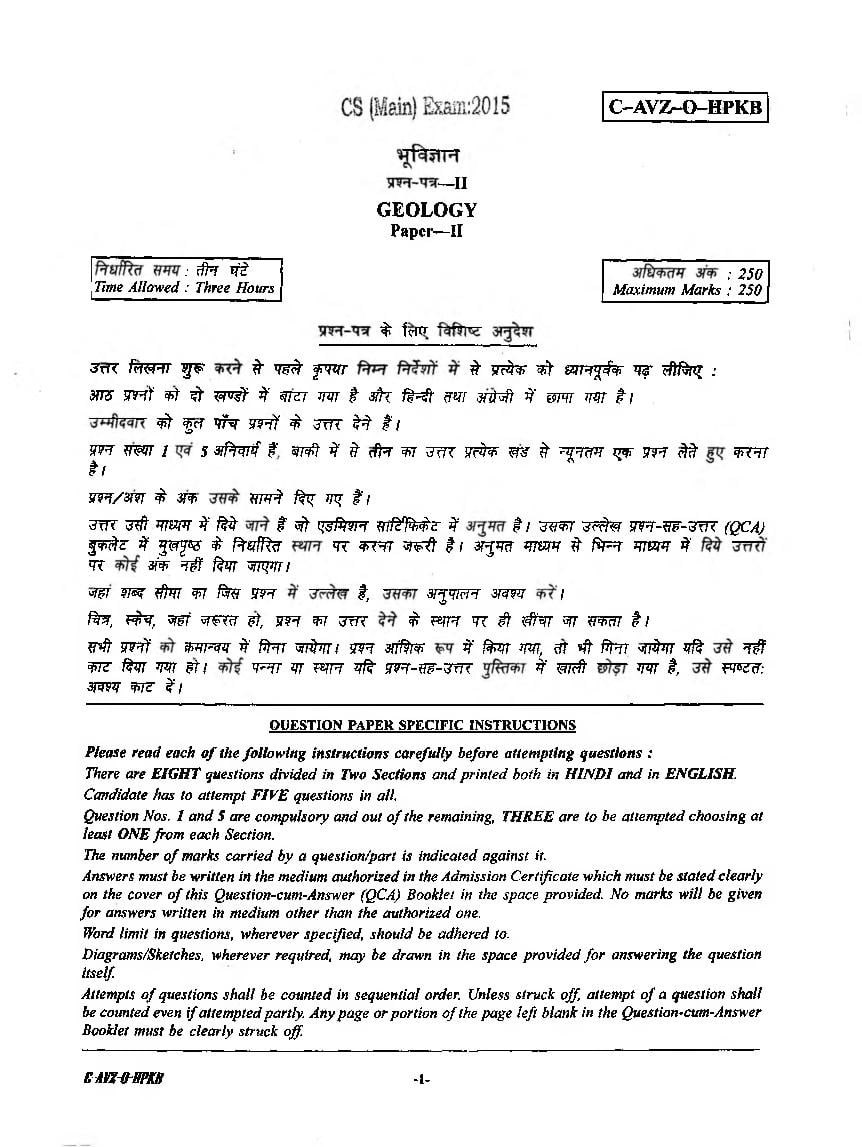
— II
GEOLOGY
P a p e r — II
: #T ^ : 250
Time Allowed : Three Hours Maximum Marks : 250
% fcRT
3rfT [rib'll ^ # W# fW ^ 37#$“ # g?7+jyf» ^ cft/frq ;
3773* smf ¥f i t &*£f $ mzr w i # r fi&ft wm 3nteft #' &m mr # /
& tgcr ih r i m f $ s w ^ #'/
9W ?7OTi 5 3rf^f #’ ^ #■ # rfr?W 3 m w f a W& # ^ I W T T?F W f c# ^77
#/
jm /m $ m* mw$ fat nq i i
^frr xtft m m % fft $ tit itfftniH w ffibfe % # / -j u w 3rd® m - w - v m (QCA)
p # ? #* gwpa* £ ftfsifFfa v r ^ r r zrwft i f s r jw w # f ^ r m m #'
77 3/^r ^ forr uTTWI
»m w z tffcr w far xft #, sp^wm m w /
fte, ^ w , ^ TOTf wt, wr m um $ w in tz & ^ fw w m m i i
frtt m f m i* & #’ ^rr ^ 77/ w r 377^ #' few nw, wt *ft firm »n$w vft i£ t
^rz fftr m zti 7^77 m m i vft w n -m -zrrr #' ^ 7?# mr i, ?wcf:
37W w ? /
QUESTION PAPER SPECIFIC INSTRUCTIONS
Please read each of the following instructions carefully before attempting questions :
There are EIGHT questions divided in Two Sections and printed both in HINDI and in ENGLISH.
Candidate has to attempt FIVE questions in all.
Question Nos. 1 and 5 are compulsory and out o f the remaining, THREE are to be attempted choosing at
least ONE from each Section.
The number o f marks carried by a question/part is indicated against it.
Answers must be written in the medium authorized in the Admission Certificate which must be stated clearly
on the cover of this Question-cum-Answer (QCA) Booklet in the space provided. No marks will be given
for answers written in medium other than the authorized one.
Word limit in questions, wherever specified, should be adhered to.
Diagrams/Sketches, wherever required, may be drawn in the space provided for answering the question
itself.
Attempts o f questions shall be counted in sequential order. Unless struck off, attempt o f a question shall
be counted even if attempted partly. Any page or portion o f the page left blank in the Question-cum-Answer
Booklet must be clearly struck off.
CAVZ-fhHPKB -I-
Page 2
SECTION—A
q . i( a ) m i m m t tiw n a ff ^ tj$ < # i^ W » i
i
Discuss the structures of inosilicates with neat sketches and mineralogical examples.
10
Q. l(b) (f^#pr) ^ w rr^ ^ srcr ^ w r
Explain the phenomenon of twinning and discuss the twinning in feldspars with neat
sketches. 10
Q. 1(c) W I ? f^T^RT ^Teft ^ 3fftf^£TF TR I
What is a peritectic ? Discuss an appropriate reaction that represents a peritectic. 10
Q. 1(d) ^ R ’ % ^ #eff % J^TFTe: ^
srrsnr m f^fT «rr w t ?
Explain how granulite facies rocks can be texturally and mineralogically differentiated
from amphibolite facies rocks. 10
Q. 1(e) ‘siganwC ^ T 3TPT ? I ¥?T t
^ f^TcT t ?
Ripple marks are common in sandstones and siltstones. Why are they rare in conglomerates
and shales ? 10
Q. 2(a) w z sm % ^rftfcr cff^f
3^r 3TT|rfM ^TT{ ^#R f ^ TPT I
With neat sketches describe the symmetry elements and forms of the normal class of the
isometric system. Name three minerals belonging to this class. 20
Q. 2(b) ^jfrFR ^ R T ^ 3^T 71 WcT^T 'tR |
Discuss the classification and chemistry of clay minerals. 20
Q. 2(c) FtcTT t , W t ^ ^ ^TTCT
W TR T t ?
While quartz is completely absent in the mantle, why is it the most common mineral on
the continents ? 10
C-AVHhBPKB -2 -
Page 3
^ r tw r te ^ F P ^ tot W t ?
What are the different discontinuities within the earth picked up by seismic waves ? What
are the petrological explanations for each of these discontinuities ? 20
Q. 3(b) f^TRfvte ^ W T^cft t TPft' % W 3FcR t ?
(i) -> -> _> T$rzttm%z -> w w -»
(ii) ^cT -> ^ -» f ^ : -> ^TTW
What do the following two series signify and what is the difference between the two?
(i) Chlorite -> Biotite -> Garnet -> Staurolite -> Kyanite -> Sillimanite
(ii) Shale Slate -> Phyllite -> Schist -> Gneiss. 10
Q. 3(c) w t ? ^icfT^d ^ w t ? wi TrTT
% W W T 3ntoFf ^ ^ t ?
What is a Komatiite ? What is the reason for the spinifex texture shown by
Komatiites ? From your answer discuss the possible reason why Komatiites are found
mostly in the Archean. 20
Q. 4(a) ^TT ^ w f ) 3ftr W O T % WT ^ |
Explain the process of lithification and diagenesis with special reference to limestones.
20
Q. 4(b) $ faror ^ i
Discuss the evolution and characteristic features of the major sedimentary basins of India.
20
Q. 4(c) ‘*rf^T m ^ |q;, tt^t 3rr^*r t ?r
% f^r w Fftrri
Considering the Bowen’s reaction series, discuss how an igneous rock will be affected
during retrogressive transformation. 10
^
SECTION—B
Q. 5(a) w s t w f M Ttf srn
% 3FcTT F7^5T ^ I
Explain the difference between syngenetic and epigenetic deposits with neat sketches and
suitable examples. 10
C-AK-OWKB -3 -
Page 4
% 1%^# 'ft ^#R f % yism f 3ftr OTTttearf ^t i
What are the placer minerals produced from beach sands in India ? Describe the properties
and uses of any two of these minerals. 10
Q. 5(c) fepfhr TjfOT ^ttcTCT^TR % f^Tcff ^;.3^5nWl'
wi f R w ^ i t;
Briefly describe the principles and applications of self-potential and induced polarization
methods of electrical prospecting. 10
Q. 5(d) ft^cTer ^ t sptt f c # s h tft fHvfffr wiTt % Trmfcfi ^rrftzx
TO-TO t ? ffrf «FTT^ ^ 3 -# ^ ^ 4~*#F^ $ ’3 5W &\t %
to wm ^\
What are the chemical parameters which determine the coordination number of a cation
in crystal structure ? Illustrate with examples of cations in 3-fold and 4-fold coordination
in rock forming minerals. 10
Q. 5(e) srj^t % to #cr f w ^ ^ to I ?
What are the sources of marine pollution and their effect on marine eco-system ? 10
Q. 6(a) aftr ^ w t\iz wf%«ff t f c t T f w t
^ (cftcT trf^cT'T # ^ifq i WTTJ «TR :
Fe = 56, 0=161
Which one of the two minerals, magnetite and hematite, contains more iron ? Illustrate
by calculating iron concentration (in wt. %) of magnetite and hematite. Atomic weight of
Fe - 56, O = 16. 10
Q. 6(b) ■ ^ % sr o -|3Tf^cnd^
jf tfrpsnr w t ?
Explain the process of formation of magmatic sulphide deposit. What is the characteristic
mineral assemblage of magmatic sulphide deposit ? 15
Q. 6(c) f^TPT-^Tfef Tprefa *rc %\r sjcfeF arrsnf^r m m
fcr*rtft fer^f i
Write a note on air-borne magnetic survey and its advantage over ground based magnetic
survey. 10
Q. 6(d) TO I ? *jfW TeFT^T % ^JcTeT TT
fcoquft |
What are the methods of underground mining of mineral deposits ? Add a note on impact
of underground mining on ground surface and environment. 15
C-Affl-Q-BPKB -4 -
Page 5
F T ^t^ T ^qfMr ^t ^ 1
Give a list of the major petroliferous basins of India. Describe the geology and hydrocarbon
occurrence of Bombay High oilfield. 15
Q. 7(b) *rror % # 3RFF f¥^t' i t affr sp p ^ r ^ 1
Describe different categories of ore reserves and their application in the Indian context.
10
Q. 7(c) *j*rarr#PF ^r, ^ ^ arr^rmr w r
I ™
Describe the methods of geochemical prospecting and the geologicalconditions in which
these methods are adopted. 15
Q. 7(d) ^ ^ tfW ^ flrST $ irirf^rm FfaT 11 ftricFfc T3pRT
^ $ ^T*T, ferf^ I
Explain how substitution of one element by another takes place in minerals.Write a note
on solid solution with example from silicate minerals. 10
Q. 8(a) ^ etti? tf^FT I c t e 3T*r^ fa&qf $ srf^eTOTY
^f'T sf¥ |
Describe the iron ore basins in Singhbhum craton and the characteristics of associated
iron ore deposits. 15
Q. 8(b) eft jz m n w fMSnrr w f ? ^ r t t ^ ■mft ^frf^rr ^ w
cpfa ^ 1
What are the gravity separation methods of ore beneficiation ? Describe the process of
heavy media separation of coal. 15
Q. 8(c) ^ «I^Mdl W t ? tef ^ ^ 3TOFF % FT^T
I
What is polymorphism in minerals ? Explain with suitable examples from rock forming
minerals and ore minerals. 10
Q. 8(d) w r $ tfM-qjter 3nt^T ^ 1 w u zf $ f¥ r m
p\ r> \ __ P\ , , .,cy pv "v .
M Ic^ ll tern I
Describe different types of radioactive wastes. Write a note on the methods of disposal
of radioactive wastes. 10
CAVZ-O-HPKB -5 -
Document Details
| Board / Org | UPSC |
| Exam | UPSC CSE (IAS) |
| Type | Question Paper |
| Pages | 5 |
| Updated | 30 Apr 2026 |