UGC NET Arab Culture and Islamic Studies Question Paper 2018
Finished viewing? Save it for later —
Download UGC NET Arab Culture and Islamic Studies Question Paper 2018 (PDF · 32 pages)About UGC NET Arab Culture and Islamic Studies Question Paper 2018
UGC NET Arab Culture and Islamic Studies Question Paper 2018 is available here for free download. Published by NTA for UGC National Eligibility Test, this question paper can be viewed online or downloaded as a PDF (32 pages). Candidates preparing for UGC National Eligibility Test can use UGC NET Arab Culture and Islamic Studies Question Paper 2018 to understand the exam pattern, the type of questions asked, and the overall difficulty level.
Frequently Asked Questions
How can I download UGC NET Arab Culture and Islamic Studies Question Paper 2018?
Open this page and click the Download button to save UGC NET Arab Culture and Islamic Studies Question Paper 2018 as a PDF. It is completely free on AglaSem Docs.
Is UGC NET Arab Culture and Islamic Studies Question Paper 2018 free to download?
Yes. UGC NET Arab Culture and Islamic Studies Question Paper 2018 can be viewed online and downloaded as a PDF free of cost on AglaSem Docs.
How many pages does UGC NET Arab Culture and Islamic Studies Question Paper 2018 have?
UGC NET Arab Culture and Islamic Studies Question Paper 2018 contains 32 pages, which you can read online or download together as a single PDF.
Where can I find more UGC National Eligibility Test study material?
You can find more UGC National Eligibility Test question papers, sample papers, syllabus, and answer keys on AglaSem Docs.
UGC NET Arab Culture and Islamic Studies Question Paper 2018 – Text
Read the full text of this question paper below — useful to quickly search, copy and reference the content online without downloading the PDF.
📄 View text version (32 pages)
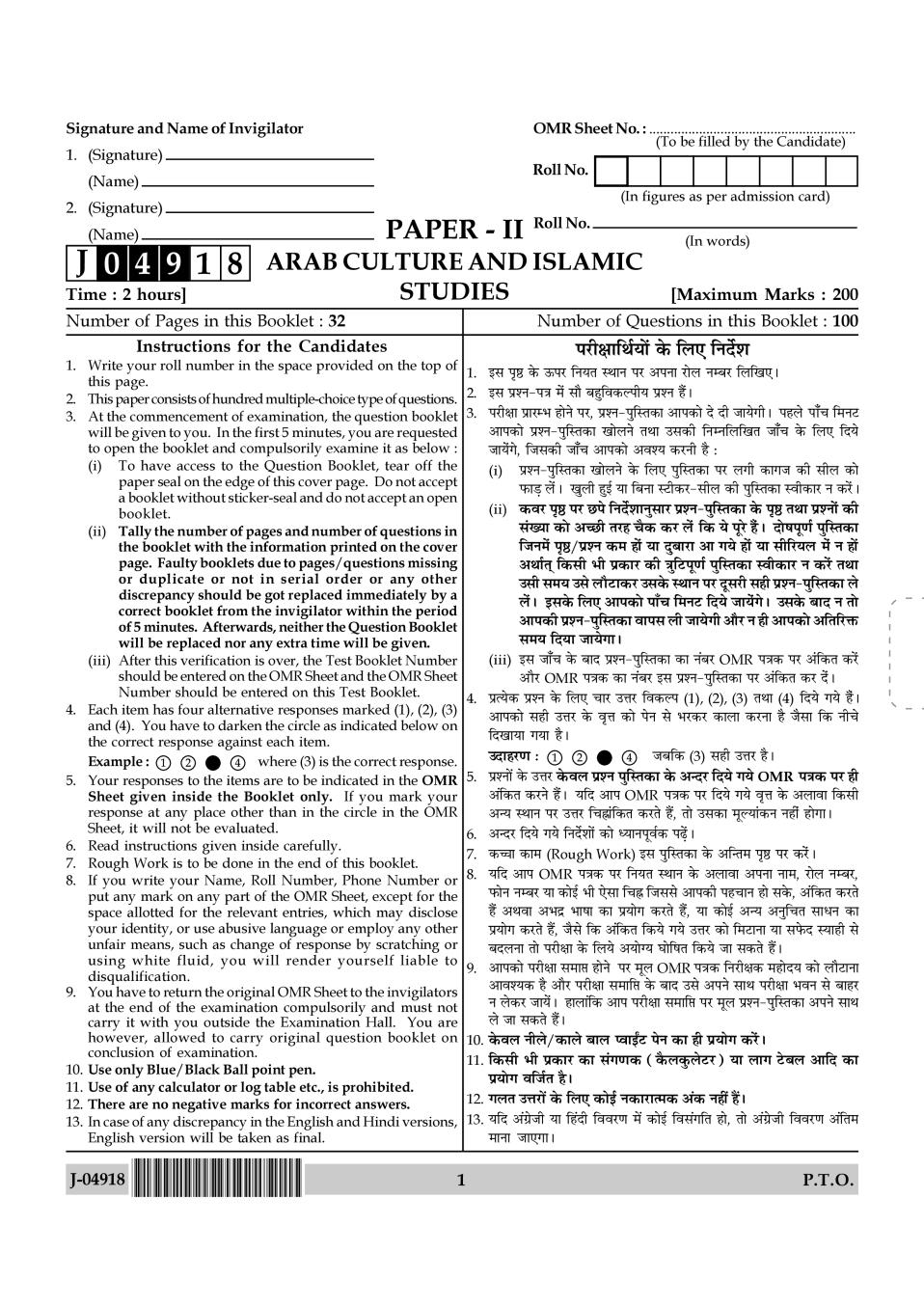
Page 1
(To be filled by the Candidate)
1. (Signature)
Roll No.
(Name)
(In figures as per admission card)
2. (Signature)
(Name) PAPER - II Roll No. (In words)
J 0 4 9 1 8 ARAB CULTURE AND ISLAMIC
Time : 2 hours] STUDIES [Maximum Marks : 200
Number of Pages in this Booklet : 32 Number of Questions in this Booklet : 100
Instructions for the Candidates ¬⁄UˡÊÊÁÕ¸ÿÙ¢ ∑§ Á‹∞ ÁŸŒ¸‡Ê
1. Write your roll number in the space provided on the top of
1. ß‚ ¬ÎDU ∑§ ™§¬⁄U ÁŸÿà SÕÊŸ ¬⁄U •¬ŸÊ ⁄UÙ‹U Ÿê’⁄U Á‹Áπ∞–
this page.
2. This paper consists of hundred multiple-choice type of questions. 2. ß‚ ¬˝‡Ÿ-¬òÊ ◊¢ ‚ÊÒ ’„ÈÁfl∑§À¬Ëÿ ¬˝‡Ÿ „Ò¥–
3. At the commencement of examination, the question booklet 3. ¬⁄UˡÊÊ ¬˝Ê⁄êU÷ „ÙŸ ¬⁄U, ¬˝‡Ÿ-¬ÈÁSÃ∑§Ê •Ê¬∑§Ù Œ ŒË ¡ÊÿªË– ¬„‹U ¬UÊ°ø Á◊Ÿ≈U
will be given to you. In the first 5 minutes, you are requested •Ê¬∑§Ù ¬˝‡Ÿ-¬ÈÁSÃ∑§Ê πÙ‹Ÿ ÃÕÊ ©‚∑§Ë ÁŸêŸÁ‹Áπà ¡Ê°ø ∑§ Á‹∞ ÁŒÿ
to open the booklet and compulsorily examine it as below : ¡Êÿ¢ª, Á¡‚∑§Ë ¡Ê°ø •Ê¬∑§Ù •fl‡ÿ ∑§⁄UŸË „Ò —
(i) To have access to the Question Booklet, tear off the (i) ¬˝‡Ÿ-¬ÈÁSÃ∑§Ê πÙ‹Ÿ ∑§ Á‹∞ ¬ÈÁSÃ∑§Ê ¬⁄U ‹ªË ∑§Êª¡ ∑§Ë ‚Ë‹ ∑§Ê
paper seal on the edge of this cover page. Do not accept
a booklet without sticker-seal and do not accept an open
»§Ê«∏ ‹¢U– πÈ‹Ë „È߸ ÿÊ Á’ŸÊ S≈UË∑§⁄U-‚Ë‹U ∑§Ë ¬ÈÁSÃ∑§Ê SflË∑§Ê⁄U Ÿ ∑§⁄¢U–
booklet. (ii) ∑§fl⁄U ¬ÎDU ¬⁄U ¿U¬ ÁŸŒ¸‡ÊÊŸÈ‚Ê⁄U ¬˝‡Ÿ-¬ÈÁSÃ∑§Ê ∑§ ¬ÎDU ÃÕÊ ¬˝‡ŸÙ¢ ∑§Ë
(ii) Tally the number of pages and number of questions in ‚¢ÅÿÊ ∑§Ù •ë¿UË Ã⁄U„ øÒ∑§ ∑§⁄U ‹¢U Á∑§ ÿ ¬Í⁄U „Ò¢U– ŒÙ·¬Íáʸ ¬ÈÁSÃ∑§Ê
the booklet with the information printed on the cover Á¡Ÿ◊¢ ¬ÎDU/¬˝‡Ÿ ∑§◊ „Ù¢ ÿÊ ŒÈ’Ê⁄UÊ •Ê ªÿ „Ù¢ ÿÊ ‚ËÁ⁄Uÿ‹U ◊¢ Ÿ „Ù¢
page. Faulty booklets due to pages/questions missing •ÕʸØ Á∑§‚Ë ÷Ë ¬˝∑§Ê⁄U ∑§Ë òÊÈÁ≈U¬Íáʸ ¬ÈÁSÃ∑§Ê SflË∑§Ê⁄U Ÿ ∑§⁄¢U ÃÕÊ
or duplicate or not in serial order or any other ©‚Ë ‚◊ÿ ©‚ ‹Uı≈UÊ∑§⁄U ©‚∑§ SÕÊŸ ¬⁄U ŒÍ‚⁄UË ‚„Ë ¬˝‡Ÿ-¬ÈÁSÃ∑§Ê ‹
discrepancy should be got replaced immediately by a
‹¢– U ß‚∑§ Á‹∞ •Ê¬∑§Ù ¬Ê°ø Á◊Ÿ≈U ÁŒÿ ¡Êÿ¢ª– ©‚∑§ ’ÊŒ Ÿ ÃÙ
correct booklet from the invigilator within the period
of 5 minutes. Afterwards, neither the Question Booklet •Ê¬∑§Ë ¬˝‡Ÿ-¬ÈÁSÃ∑§Ê flʬ‚ ‹Ë ¡ÊÿªË •ı⁄U Ÿ „Ë •Ê¬∑§Ù •ÁÃÁ⁄UQ§
will be replaced nor any extra time will be given. ‚◊ÿ ÁŒÿÊ ¡ÊÿªÊ–
(iii) After this verification is over, the Test Booklet Number (iii) ß‚ ¡Ê°ø ∑§ ’ÊŒ ¬˝‡Ÿ-¬ÈÁSÃ∑§Ê ∑§Ê Ÿ¥’⁄U OMR ¬òÊ∑§ ¬⁄U •¢Á∑§Ã ∑§⁄¢U
should be entered on the OMR Sheet and the OMR Sheet •Uı⁄U OMR ¬òÊ∑§ ∑§Ê Ÿ¥’⁄U ß‚ ¬˝‡Ÿ-¬ÈÁSÃ∑§Ê ¬⁄U •¢Á∑§Ã ∑§⁄U Œ¢–
Number should be entered on this Test Booklet. 4. ¬˝àÿ∑§ ¬˝‡Ÿ ∑§ Á‹∞ øÊ⁄U ©ûÊ⁄U Áfl∑§À¬ (1), (2), (3) ÃÕÊ (4) ÁŒÿ ªÿ „Ò¢–
4. Each item has four alternative responses marked (1), (2), (3)
and (4). You have to darken the circle as indicated below on
•Ê¬∑§Ù ‚„Ë ©ûÊ⁄U ∑§ flÎûÊ ∑§Ù ¬Ÿ ‚ ÷⁄U∑§⁄U ∑§Ê‹Ê ∑§⁄UŸÊ „Ò ¡Ò‚Ê Á∑§ ŸËø
the correct response against each item. ÁŒπÊÿÊ ªÿÊ „Ò–
Example : where (3) is the correct response. ©ŒÊ„⁄UáÊ — ¡’Á∑§ (3) ‚„Ë ©ûÊ⁄U „Ò–
5. Your responses to the items are to be indicated in the OMR 5. ¬˝ ‡ ŸÊ¥ ∑§ ©ûÊ⁄U ∑ §fl‹ ¬˝‡Ÿ ¬ÈÁSÃ∑§Ê ∑§ •ãŒ⁄U ÁŒÿ ªÿ OMRU ¬òÊ∑§ ¬⁄U „Ë
Sheet given inside the Booklet only. If you mark your •¥ Á∑§Ã ∑§⁄UŸ „Ò¥– ÿÁŒ •Ê¬ OMR U ¬òÊ∑§ ¬⁄U ÁŒÿ ªÿ flÎûÊ ∑§ •‹ÊflÊ Á∑§‚Ë
response at any place other than in the circle in the OMR •ãÿ SÕÊŸ ¬⁄U ©ûÊ⁄U ÁøqÊ¢Á∑§Ã ∑§⁄Uà „Ò¥, ÃÙ ©‚∑§Ê ◊ÍÀUÿÊ¢∑§Ÿ Ÿ„Ë¢ „٪ʖ
Sheet, it will not be evaluated. 6. •ãŒ⁄U ÁŒÿ ªÿ ÁŸŒ¸‡ÊÙ¢ ∑§Ù äÿÊŸ¬Ífl¸∑§ ¬…∏¢U–
6. Read instructions given inside carefully.
7. ∑§ìÊÊ ∑§Ê◊ (Rough Work) ß‚ ¬ÈÁSÃ∑§Ê ∑§ •ÁãÃ◊ ¬ÎDU ¬⁄U ∑§⁄¢U–
7. Rough Work is to be done in the end of this booklet.
8. If you write your Name, Roll Number, Phone Number or 8. ÿÁŒ •Ê¬ OMR ¬òÊ∑§ ¬⁄U ÁŸÿà SÕÊŸ ∑§ •‹ÊflÊ •¬ŸÊ ŸÊ◊, ⁄UÊ‹ Ÿê’⁄U,
put any mark on any part of the OMR Sheet, except for the »§ÊŸ Ÿê’⁄U ÿÊ ∑§Ê߸ ÷Ë ∞‚Ê Áøq Á¡‚‚ •Ê¬∑§Ë ¬„øÊŸ „Ê ‚∑§, •¥Á∑§Ã ∑§⁄UÃ
space allotted for the relevant entries, which may disclose „Ò¥ •ÕflÊ •÷Œ˝ ÷Ê·Ê ∑§Ê ¬˝ÿʪ ∑§⁄Uà „Ò¥, ÿÊ ∑§Ê߸ •ãÿ •ŸÈÁøà ‚ÊœŸ ∑§Ê
your identity, or use abusive language or employ any other ¬˝ÿʪ ∑§⁄Uà „Ò¥, ¡Ò‚ Á∑§ •¥Á∑§Ã Á∑§ÿ ªÿ ©ûÊ⁄U ∑§Ê Á◊≈UÊŸÊ ÿÊ ‚»§Œ SÿÊ„Ë ‚
unfair means, such as change of response by scratching or ’Œ‹ŸÊ ÃÊ ¬⁄UˡÊÊ ∑§ Á‹ÿ •ÿÊÇÿ ÉÊÊÁ·Ã Á∑§ÿ ¡Ê ‚∑§Ã „Ò¥–
using white fluid, you will render yourself liable to
9. •Ê¬∑§Ù ¬⁄UˡÊÊ ‚◊Ê# „ÙŸ §¬⁄U ◊Í‹ OMR ¬òÊ∑§ ÁŸ⁄UˡÊ∑§ ◊„ÙŒÿ ∑§Ù ‹Uı≈UÊŸÊ
disqualification.
9. You have to return the original OMR Sheet to the invigilators •Êfl‡ÿ∑§ „Ò •ı⁄U ¬⁄UˡÊÊ ‚◊ÊÁ# ∑§ ’ÊŒ ©‚ •¬Ÿ ‚ÊÕ ¬⁄UˡÊÊ ÷flŸ ‚ ’Ê„⁄U
at the end of the examination compulsorily and must not Ÿ ‹∑§⁄U ¡Êÿ¢– „Ê‹Ê¥Á∑§ •Ê¬ ¬⁄UˡÊÊ ‚◊ÊÁ# ¬⁄U ◊Í‹ ¬˝‡Ÿ-¬ÈÁSÃ∑§Ê •¬Ÿ ‚ÊÕ
carry it with you outside the Examination Hall. You are ‹ ¡Ê ‚∑§Ã „Ò¥–
however, allowed to carry original question booklet on 10. ∑§fl‹ ŸË‹/∑§Ê‹ ’Ê‹U åflÊßZ≈U ¬Ÿ ∑§Ê „Ë ¬˝ÿʪ ∑§⁄¢U–
conclusion of examination.
11. Á∑§‚Ë ÷Ë ¬˝∑§Ê⁄U ∑§Ê ‚¢ªáÊ∑§ (∑Ò§‹∑ȧ‹≈U⁄U) UÿÊ ‹Êª ≈U’‹ •ÊÁŒ ∑§Ê
10. Use only Blue/Black Ball point pen.
11. Use of any calculator or log table etc., is prohibited.
¬˝ÿÙª flÁ¡¸Ã „Ò–
12. There are no negative marks for incorrect answers. 12. ª‹Ã ©ûÊ⁄UÊ¥ ∑§ Á‹∞ ∑§Ê߸ Ÿ∑§Ê⁄UÊà◊∑§ •¥∑§ Ÿ„Ë¥ „Ò¥–
13. In case of any discrepancy in the English and Hindi versions, 13. ÿÁŒ •¥ª˝¡Ë ÿÊ Á„¥ŒË Áflfl⁄UáÊ ◊¥ ∑§Ê߸ Áfl‚¥ªÁà „Ê, ÃÊ •¥ª˝¡Ë Áflfl⁄UáÊ •¥ÁÃ◊
English version will be taken as final. ◊ÊŸÊ ¡Ê∞ªÊ–
J-04918 !J-04918-PAPER-II! 1 P.T.O.
Page 2
PAPER - II
Note : This paper contains hundred (100) objective type questions of two (2) marks each. All
questions are compulsory.
1. Ghassan was under the suzerainty of :
(1) Iraq (2) Iran (3) Yemen (4) Byzantium
2. Hubal the main deity of the Arabs during Pre-Islamic days was brought to Makkah from Syria
by :
(1) ‘Amr ibn Zuhair (2) ‘Amr ibn Luhayy
(3) ‘Amr ibn Samawal (4) ‘Amr ibn al-’Abd
3. Ziyad ibn Mu‘awiyah was the name of the Mu‘allaqah writer :
(1) Al-Nabighah al-Dhubyani (2) Imru’ul Qays
(3) Al-A’sha (4) ‘Antarah ibn Shaddad
4. The Christian delegation that visited the Prophet came from :
(1) Ta’if (2) Najran (3) San‘a (4) Tabuk
5. The companion of the Prophet who is credited with the Tafsir of a large number of the Quranic
verses is :
(1) Abu Bakr (2) Umar (3) Ushman (4) Ali
6. The direction of prayer at Madinah was changed to Ka‘bah.
(1) Six months after the migration
(2) Sixteen months after the migration
(3) Twenty four months after the migration
(4) After the conquest of Makkah
7. The deserts of al-Nufud and al-Rub ‘al-Khali are joined by a strip of red desert land called :
(1) Al-Sahra al-Hamra (2) Al-Dahna
(3) Al-Nafaq al-Ahmar (4) Al-Fam al-Saghir
8. Ayyam al-Tashriq fall in the month of :
(1) Sha’ban (2) Ramadan
(3) Shawwal (4) Dhi al-Hijjah
J-04918 !J-04918-PAPER-II! 2 Paper-II
Page 3
¬˝‡Ÿ-¬òÊ - II
ÁŸŒ¸‡Ê — ß‚ ¬˝‡Ÿ-¬òÊ ◊¥ ‚ÊÒ (100) ’„È-Áfl∑§À¬UËÿ ¬˝‡Ÿ „Ò¥– ¬˝àÿ∑§ ¬˝‡Ÿ ∑§ ŒÙ (2) •¢∑§ „Ò¥– ‚÷Ë ¬˝‡Ÿ •ÁŸflÊÿ¸ „Ò¥–
1. $ªS‚ÊŸ Á∑§‚∑§ •ÊÁœ¬àÿ ◊¥ ÕÊ?
(1) ß⁄UÊ∑§ (2) ߸⁄UÊŸ (3) ÿ◊Ÿ (4) ’Ò$¡Áã≈Uÿ◊
2. ßS‹Ê◊ ¬Ífl¸ ∑§Ê‹ ∑§Ê •⁄U’Ê¥ ∑§Ê ◊ÈÅÿ ŒflÃÊ „È’‹ ‚ËÁ⁄UÿÊ ‚ ◊Ä∑§Ê Á∑§‚∑§ mÊ⁄UÊ ‹ÊÿÊ ªÿÊ?
(1) •◊˝ ßéŸ $¡È„Ò⁄U (2) •◊˝ ßéŸ ‹È„Òÿ
(3) •◊˝ ßéŸ ‚◊fl‹ (4) •◊˝ ßéŸ •‹-•éŒ
3. Á$¡ÿÊŒ ßéŸ ◊È•ÊÁflÿÊ Á∑§‚ ◊È•À‹$∑§Ê ‹π∑§ ∑§Ê ŸÊ◊ ÕÊ?
(1) •‹-ŸÊÁ’$ª„ •‹ $¡È’ÿÊŸË (2) ß◊L§ ©‹ $∑Ò§‚
(3) •‹-•ÊÚ‡ÊÊ (4) •ãÃ⁄UÊ ßéŸ ‡ÊŒ˜ŒÊŒ
4. ¬Ò$ªê’⁄U ‚. ∑§ ¬Ê‚ •ÊŸ flÊ‹Ê ß¸‚Ê߸ ¬˝ÁÃÁŸÁœ◊¥«U‹ ∑§„Ê° ‚ •ÊÿÊ ÕÊ?
(1) ÃÊß$»§ (2) Ÿ¡⁄UÊŸ (3) ‚Ÿ•Ú (4) Ã’Í∑§
5. fl„ ‚„Ê’Ë Á¡ã„Ê¥Ÿ ‚’‚ íÿÊŒÊ $∑ȧ⁄U•ÊŸ ∑§Ë •ÊÿÃÊ ∑§Ë Ã$»§‚Ë⁄U ∑§Ê ’ÿÊŸ Á∑§ÿÊ —
(1) •’Í ’∑˝§ (2) ©◊⁄U (3) ©S◊ÊŸ (4) •‹Ë
6. ◊ŒËŸ ◊¥ Ÿ◊Ê$¡ ∑§Ë ÁŒ‡ÊÊ ∑§Ê’Ê ∑§Ë •Ê⁄U ∑§’ ¬Á⁄UflÁøà „È߸ ÕË —
(1) Á„¡⁄Uà ∑§ ¿U— ◊„ËŸ ’ÊŒ
(2) Á„¡⁄Uà ∑§ ‚Ê‹„ ◊„ËŸ ’ÊŒ
(3) Á„¡⁄Uà ∑§ øÊÒ’Ë‚ ◊„ËŸ ’ÊŒ
(4) ◊Ä∑§Ê ∑§Ë Áfl¡ÿ ∑§ ’ÊŒ
7. •‹-ŸÈ$»Í§Œ •ÊÒ⁄U •‹-L§’ •‹-$πÊ‹Ë ∑§ ◊L§SÕ‹ ∞∑§ ‹Ê‹ ◊L§SÕ‹Ë ¬≈˜≈UË mÊ⁄UÊ ¡È«∏ „Ò¥, ©‚ ∑§„Ê ¡ÊÃÊ „Ò —
(1) •‹-‚„⁄UÊ •‹-„◊⁄UÊ (2) •‹-Œ„ŸÊ
(3) •‹ Ÿ$»§$∑§ •‹-•„◊⁄U (4) •‹-$»§◊ •‹-‚$ªË⁄U
8. •ƒÿÊ◊È‹ ÇÊ⁄UË$∑§ Á∑§‚ ◊„ËŸ ◊¥ „Êà „Ò¥?
(1) ‡ÊÊ’ÊŸ (2) ⁄U◊$¡ÊŸ
(3) ‡Ê√flÊ‹ (4) Á$¡‹ Á„í¡„
J-04918 !J-04918-PAPER-II! 3 Paper-II
Page 4
(1) Talhah (2) Harith ibn Hisham
(3) Abu Sufyan (4) ‘Attab ibn Usayd
10. The Jews of Khaybar were allowed to remain in possession of their lands on the payment
of :
(1) 1/10 of the produce (2) 1/5 of the produce
(3) 1/4 of the produce (4) 1/2 of the produce
11. One of the following incidents is described in the Qur’an as ‘‘a clear victory” :
(1) Pact of Madinah (Mithaq Madinah)
(2) Conquest of Khaybar
(3) Treaty of Hudaybiyyah
(4) Conquest of Makkah
12. The Tahwil (Change) of Qiblah is mentioned in the Surah :
(1) Al-Baqarah (2) Al-Tahrim (3) Al-Taghabun (4) Al-Hadid
13. Identify the commentator of the Qur’an who belonged to Madinite School of Tafsir.
(1) Masruq ibn al-Ajda’ (2) Ta’us ibn Kaysan
(3) Muhammad ibn Ka’b (4) Sa‘id ibn Jubair
14. This question consists of three statements. Indicate the correct answer from the alternatives given
below by using the code :
(a) In affairs such as various financial transactions, making a will and acquiring a small loan, the
parties involved should not write down a document.
(b) Gambling and interest are some horrendous forms of usurpation.
(c) The wealth of every Muslim must necessarily be distributed after his demise amongst his
heirs as per the instructions given in the Qur’an.
Code :
(1) (b) and (c) are correct, but (a) is wrong.
(2) (a) is correct, but (b) and (c) are wrong.
(3) (b) is correct, but (a) and (c) are wrong.
(4) (c) is correct, but (a) and (b) are wrong.
J-04918 !J-04918-PAPER-II! 4 Paper-II
Page 5
(1) ÃÀ„Ê (2) „ÊÁ⁄U‚ ßéŸ Á„‡ÊÊ◊
(3) •’Í ‚È$çÿÊŸ (4) •ûÊÊ’ ßéŸ ©‚ÒŒ
10. $πÒ’⁄U ∑§ ÿ„ÍÁŒÿÊ¥ ∑§Ê •¬ŸË ¡◊ËŸ ¬⁄U ∑§ÊÁ’¡ ⁄U„Ÿ ∑§ Á‹∞ Á∑§ÃŸÊ ÷ȪÃÊŸ ∑§⁄UŸÊ ÕÊ?
(1) ¬ÒŒÊflÊ⁄U ∑§Ê 1/10 (2) ¬ÒŒÊflÊ⁄U ∑§Ê 1/5
(3) ¬ÒŒÊflÊ⁄U ∑§Ê 1/4 (4) ¬ÒŒÊflÊ⁄U ∑§Ê 1/2
11. ÁŸêŸÁ‹Áπà ÉÊ≈UŸÊ•Ê¥ ◊¥ Á∑§‚ $∑ȧ⁄U•ÊŸ ◊¥ “¬Íáʸ Áfl¡ÿ” ∑§„Ê ªÿÊ „Ò?
(1) ◊ŒËŸ ∑§Ê ‚◊¤ÊÊÒÃÊ (◊Ë‚Ê$∑§ ◊ŒËŸÊ)
(2) $πÒ’⁄U ∑§Ë Áfl¡ÿ
(3) „ÈŒÒÁ’ÿÊ ∑§Ë ‚¥Áœ
(4) ◊Ä∑§Ê ∑§Ë Áfl¡ÿ
12. Á$∑§’‹ ∑§Ë ÃéŒË‹Ë ∑§Ê Á$¡∑˝§ $∑ȧ⁄U•ÊŸ ∑§Ë Á∑§‚ ‚Í⁄U„ ◊¥ „Ò?
(1) •‹-’$∑§⁄U„ (2) •‹-Ä⁄UË◊ (3) •‹-Ã$ªÊ’ÈŸ (4) •‹-„ŒËŒ
13. $∑ȧ⁄U•ÊŸ ∑§ √ÿÊÅÿÊ∑§Ê⁄U ∑§Ê ÁøÁã„à ∑§⁄¥U ¡Ê Ã$»§‚Ë⁄U ∑§ ◊ŒŸË S∑ͧ‹ ‚ ‚¥’¥ÁœÃ „Ò–
(1) ◊‚M§$∑§ ßéŸ •‹-•íŒÊ (2) ÃÊ™§‚ ßéŸ ∑§‚ÊŸ
(3) ◊È„ê◊Œ ßéŸ ∑§•Ú’ (4) ‚߸Œ ßéŸ ¡È’Ò⁄U
14. ß‚ ¬˝‡Ÿ ◊¥ ÃËŸ ∑§ÕŸ „Ò¥– ŸËø ÁŒÿ ªÿ ∑ͧ≈U ∑§Ê ¬˝ÿʪ ∑§⁄Uà „È∞ Áfl∑§À¬Ê¥ ◊¥ ‚ ‚„Ë ©ûÊ⁄U ŒËÁ¡∞ —
(a) ÁflÁ÷ÛÊ ÁflûÊËÿ ‹Ÿ-ŒŸ, fl‚Ëÿà ’ŸÊŸ •ÊÒ⁄U ¿UÊ≈UÊ ´§áÊ ‹Ÿ ¡Ò‚ ◊Ê◊‹Ê¥ ◊¥ ‡ÊÊÁ◊‹ ‹ÊªÊ¥ ∑§Ê Á‹ÁπÃ
¬˝◊ÊáÊ Ÿ„Ë¥ Á‹πŸÊ øÊÁ„∞–
(b) ¡È•Ê •ÊÒ⁄U ‚ÍŒ •ŸÊÁœ∑§Ê⁄U ª˝„áÊ ∑§ ÷ÿÊŸ∑§ ¬˝∑§Ê⁄U „Ò¥–
(c) $∑ȧ⁄U•ÊŸ ◊¥ ÁŒÿ ªÿ ÁŸŒ¸‡ÊÊ¥ ∑§ •ŸÈ‚Ê⁄U ¬˝àÿ∑§ ◊ÈÁS‹◊ ∑§Ë ŒÊÒ‹Ã ©‚∑§ ◊⁄UŸ ∑§ ’ÊŒ •Êfl‡ÿ∑§ M§¬ ‚
©‚∑§ ©ûÊ⁄UÊÁœ∑§ÊÁ⁄UÿÊ¥ ◊¥ ÁflÃÁ⁄Uà ∑§⁄U ŒË ¡Êÿ–
∑ͧ≈U —
(1) (b) •ÊÒ⁄U (c) ‚„Ë „Ò¥, ‹Á∑§Ÿ (a) ª‹Ã „Ò–
(2) (a) ‚„Ë „Ò, ‹Á∑§Ÿ (b) •ÊÒ⁄U (c) ª‹Ã „Ò¥–
(3) (b) ‚„Ë „Ò, ‹Á∑§Ÿ (a) •ÊÒ⁄U (c) ª‹Ã „Ò¥–
(4) (c) ‚„Ë „Ò, ‹Á∑§Ÿ (a) •ÊÒ⁄U (b) ª‹Ã „Ò¥–
J-04918 !J-04918-PAPER-II! 5 Paper-II
Page 6
(1) Sir Syed Ahmad Khan - Tafsir al-Qur’an wa Huwa al-Huda wa al-Furqan
(2) Abul Ala Maududi - Tafhim al-Qur’an
(3) Abul Kalam Azad - Ruh al-Ma’ani
(4) Ashraf Ali Thanvi - Bayan al-Qur’an
16. Which of the following is correctly matched ?
(1) Ibn Jarir al-Tabari - Al-Siraj al-Munir
(2) Fakhr al-Din al-Razi - Mafatih al-Ghaib
(3) Al-Zamakhshari - Al-Kashf wa al-Bayan ‘An Tafsir al-Qur’an
(4) Ibn Kathir - Al-Bahr al-Muhit
17. One who is not included among the seven eminent jurists belonging to Tabi ‘een.
(1) Qasim ibn Abdullah (2) Khalid ibn Ma’dan
(3) Sa‘id ibn Musayyib (4) Sulaiman ibn Yasar
18. This question consists of three statements. Indicate correct answer from the alternatives given
below :
(a) The Zanadiqah have fabricated a large number of traditions in the name of the Prophet.
(b) Ahmad ibn Hanbal has said that Hadith and Tafsir had been more affected by forgery than
any other branch of literature.
(c) Imam Bukhari selected 12,000 genuine traditions from the collection of 1,00,000 traditions
in circulation.
Code :
(1) (a) is correct, but (b) and (c) are wrong.
(2) (a) and (c) are correct, but (b) is wrong.
(3) (a) and (b) are correct, but (c) is wrong.
(4) (b) and (c) are correct, but (a) is wrong.
19. Arrange the following books in order they appeared. Use the code given below :
(a) Sunan Abi Daud
(b) Musnad Ahmad ibn Hanbal
(c) Sahih Muslim
(d) Muwatta Imam Malik
Code :
(1) (a), (c), (b), (d) (2) (b), (d), (a), (c)
(3) (d), (b), (c), (a) (4) (c), (a), (d), (b)
J-04918 !J-04918-PAPER-II! 6 Paper-II
Page 7
(1) ‚⁄U ‚ÒÿŒ •„◊Œ πÊ° - Ã$»§‚Ë⁄U •‹-$∑ȧ⁄U•ÊŸ flÊ „ÈflÊ •‹-„ÈŒÊ flÊ •‹-$»È§⁄U$∑§ÊŸ
(2) •’È‹ •Ê‹Ê ◊ÊÒŒÍŒË - Ã$»§„Ë◊ •‹-$∑§È⁄U•ÊŸ
(3) •’È‹ ∑§‹Ê◊ •Ê$¡ÊŒ - L§„ •‹-◊•ÊŸË
(4) •‡Ê⁄U$»§ •‹Ë ÕÊŸflË - ’ÿÊŸ •‹-$∑ȧ⁄U•ÊŸ
16. ÁŸêŸÁ‹Áπà ◊¥ ‚ ∑§ÊÒŸ-‚Ë ¡Ê«∏Ë ‚„Ë „Ò?
(1) ßéŸ ¡⁄UË⁄U •‹-Ã’⁄UË - •‹-Á‚⁄UÊ¡ •‹-◊ÈŸË⁄U
(2) $»§$∫ •‹-ŒËŸ •‹-⁄UÊ$¡Ë - ◊$»§ÊÃË„ •‹-$ªÒ’
(3) •‹-$¡◊$$ŇÊ⁄UË - •‹-∑§‡$»§ flÊ •‹-’ÿÊŸ •Ÿ Ã$»§‚Ë⁄U •‹-$∑ȧ⁄U•ÊŸ
(4) ßéŸ ∑§‚Ë⁄U - •‹-’„⁄U •‹-◊È„ËÃ
17. ‚Êà ¬˝◊Èπ $»§∑§Ë„Ê¥ ◊¥ ÃÊÁ’߸Ÿ ‚ ߟ◊¥ ‚ ∑§ÊÒŸ ‚¥’¥ÁœÃ Ÿ„Ë¥ „Ò?
(1) $∑§ÊÁ‚◊ ßéŸ •éŒÈÀ‹Ê„ (2) $πÊÁ‹Œ ßéŸ ◊•ŒÊŸ
(3) ‚߸Œ ßéŸ ◊È‚ÒÁƒÿ’ (4) ‚È‹◊ÊŸ ßéŸ ÿ‚⁄U
18. ß‚ ¬˝‡Ÿ ◊¥ ÃËŸ ∑§ÕŸ „Ò¥– ŸËø ÁŒÿ ªÿ Áfl∑§À¬Ê¥ ◊¥ ‚ ‚„Ë ©ûÊ⁄U ÁøÁã„à ∑§ËÁ¡∞ —
(a) $¡ãŒÁ$∑§ÿÊ¥ Ÿ ’«∏Ë ◊ÊòÊÊ ◊¥ ¬Ò$ªê’⁄U ‚. ∑§ ŸÊ◊ ‚ „ŒË‚¥ ª…∏ ‹Ë ÕË–
(b) •„◊Œ ßéŸ „¥’‹ Ÿ ∑§„Ê Á∑§ „ŒË‚ •ÊÒ⁄U Ã$»§‚Ë⁄U ‚ÊÁ„àÿ ∑§Ë Á∑§‚Ë •ãÿ ‡ÊÊπÊ ∑§Ë •¬ˇÊÊ ¡Ê‹‚Ê¡Ë
‚ •Áœ∑§ ¬˝÷ÊÁflà ÕË–
(c) ß◊Ê◊ ’È$πÊ⁄UË Ÿ 1,00,000 „ŒË‚Ê¥ ∑§ ¬˝øÁ‹Ã ‚¥∑§‹Ÿ ◊¥ ‚ 12,000 flÊSÃÁfl∑§ „ŒË‚Ê¥ ∑§Ê øÈŸÊ–
∑ͧ≈U —
(1) (a) ‚„Ë „Ò, ‹Á∑§Ÿ (b) •ÊÒ⁄U (c) $ª‹Ã „Ò¥–
(2) (a) •ÊÒ⁄U (c) ‚„Ë „Ò¥, ‹Á∑§Ÿ (b) $ª‹Ã „Ò–
(3) (a) •ÊÒ⁄U (b) ‚„Ë „Ò¥, ‹Á∑§Ÿ (c) $ª‹Ã „Ò–
(4) (b) •ÊÒ⁄U (c) ‚„Ë „Ò¥, ‹Á∑§Ÿ (a) $ª‹Ã „Ò–
19. ÁŸêŸÁ‹Áπà ¬ÈSÃ∑§Ê¥ ∑§Ê ©Ÿ∑§ ¬˝∑§Ê‡ÊŸ ∑§ ∑˝§◊ ◊¥ √ÿflÁSÕà ∑§ËÁ¡∞ ŸËø ÁŒÿ ªÿ ∑ͧ≈U ∑§Ê ¬˝ÿʪ ∑§ËÁ¡∞ —
(a) ‚ÈŸŸ •’Ë ŒÊ©Œ
(b) ◊È‚ŸŒ •„◊Œ ßéŸ „¥’‹
(c) ‚„Ë ◊ÈÁS‹◊
(d) ◊ÈflûÊÊ ß◊Ê◊ ◊ÊÁ‹∑§
∑ͧ≈U —
(1) (a), (c), (b), (d) (2) (b), (d), (a), (c)
(3) (d), (b), (c), (a) (4) (c), (a), (d), (b)
J-04918 !J-04918-PAPER-II! 7 Paper-II
Page 8
was :
(1) Zaid ibn Harith (2) Mu’adh ibn Jabal
(3) Abdullah ibn Mas’ud (4) Abu Musa Ash’ari
21. During the Caliphate of Abu Bakr, those who refused to pay Zakat belonged to the tribes in :
(1) Fustat (2) Halab (3) Yaman (4) Hudaibiyah
22. Match the following. Identify the correct answer and mark the same in the code given below :
List-I List-II
(a) Saqifah Bani Sa‘idah (i) Musaylamah
(b) Banu Hanifah (ii) Sa’ad ibn ‘Ubadah
(c) ‘Atiq (iii) Aswad ‘Ansi
(d) Yaman (iv) Abdullah ibn Abi Qahafah
Code :
(a) (b) (c) (d)
(1) (iii) (iv) (i) (ii)
(2) (ii) (i) (iv) (iii)
(3) (iii) (ii) (i) (iv)
(4) (i) (ii) (iii) (iv)
23. ‘The Muslim women (Protection of Rights on Divorce) Act’ was passed in :
(1) 1970 A.D. (2) 1975 A.D. (3) 1980 A.D. (4) 1986 A.D.
24. Arrange the following Sufis in chronological order. Use the code given below :
(a) Fariduddin Ganjshakar
(b) Burhanuddin Gharib
(c) Nizamuddin Awliya
(d) Muinuddin Chishti
Code :
(1) (a), (c), (b), (d) (2) (c), (b), (a), (d)
(3) (d), (a), (c), (b) (4) (b), (a), (d), (c)
J-04918 !J-04918-PAPER-II! 8 Paper-II
Page 9
(1) $¡ÒŒ ßéŸ „ÊÁ⁄U‚ (2) ◊•Ê$¡ ßéŸ ¡’‹
(3) •éŒÈÀ‹Ê„ ßéŸ ◊‚ÍŒ (4) •’Í ◊Í‚Ê •‡Ê•⁄UË
21. •’Í ’∑˝§ ∑§Ë Á$π‹Ê$»§Ã ∑§ ŒÊÒ⁄UÊŸ $¡∑§Êà ŒŸ ‚ ◊ŸÊ ∑§⁄UŸ flÊ‹ $∑§’Ë‹ ∑§„Ê° ‚ ‚¥’¥ÁœÃ Õ?
(1) $»È§SÃÊà (2) „‹’ (3) ÿ◊Ÿ (4) „ÈŒÒÁ’ÿÊ
22. ÁŸêŸÁ‹Áπà ∑§Ê ‚È◊Á‹Ã ∑§⁄¥U– ‚„Ë ©ûÊ⁄U ∑§Ê ÁøÁqà ∑§ËÁ¡∞ ÃÕÊ ©‚ ŸËø ÁŒÿ ªÿ ∑ͧ≈U ◊¥ ‚ øÈŸ¥ —
‚ÍøË - I ‚ÍøË - II
(a) ‚$∑§Ë$»§Ê ’ŸË ‚Êߌ„ (i) ◊È‚Ò‹◊Ê
(b) ’ŸÍ „ŸË$»§Ê (ii) ‚•Œ ßéŸ ©’ÊŒÊ
(c) •ÃË$∑§ (iii) •SflŒ •ã‚Ë
(d) ÿ◊Ÿ (iv) •éŒÈÀ‹Ê„ ßéŸ •’Ë $∑§„Ê$»§Ê
∑ͧ≈U —
(a) (b) (c) (d)
(1) (iii) (iv) (i) (ii)
(2) (ii) (i) (iv) (iii)
(3) (iii) (ii) (i) (iv)
(4) (i) (ii) (iii) (iv)
23. “◊ÈÁS‹◊ ◊Á„‹Ê (ËÊ∑§ ¬⁄U ‚¥⁄UˇÊáÊ ∑§Ê •Áœ∑§Ê⁄U) •ÁœÁŸÿ◊” ∑§’ ¬ÊÁ⁄Uà „È•Ê ÕÊ?
(1) 1970 ߸. (2) 1975 ߸. (3) 1980 ߸. (4) 1986 ߸.
24. ŸËø ÁŒ∞ ª∞ ∑ͧ≈U ∑§Ê ¬˝ÿʪ ∑§⁄Uà „È∞ ÁŸêŸÁ‹Áπà ‚ÍÁ$»§ÿÊ¥ ∑§Ê ∑§Ê‹ÊŸÈ‚Ê⁄U √ÿflÁSÕà ∑§ËÁ¡∞ —
(a) »˜§⁄UˌȌ˜ŒËŸ ª¥¡‡Ê∑§⁄U
(b) ’È⁄U„ÊŸÈgËŸ $ª⁄UË’
(c) ÁŸ$¡Ê◊ÈgËŸ •ÊÒÁ‹ÿÊ
(d) ◊È߸ŸÈgËŸ Áø‡ÃË
∑ͧ≈U —
(1) (a), (c), (b), (d) (2) (c), (b), (a), (d)
(3) (d), (a), (c), (b) (4) (b), (a), (d), (c)
J-04918 !J-04918-PAPER-II! 9 Paper-II
Page 10
(a) Al-Walid II
(b) Umar Ibn Abdul Aziz
(c) Abdul Malik
(d) Sulayman
Code :
(1) (a), (c), (d), (b) (2) (b), (d), (a), (c)
(3) (c), (d), (b), (a) (4) (d), (c), (a), (b)
26. One of the following is not counted among the four political geniuses of the Arab Muslims :
(1) Al-Mughirah Ibn Shu’bah (2) Abu Musa al-Ashari
(3) ‘Amr Ibn al-’Às (4) Mu‘awiyah
27. The Naqshbandi Sufi order was established in India by :
(1) Muinuddin Chishti (2) Fariduddin Ganjshakar
(3) Bahauddin Zakariya (4) Baqi Billah
28. Al-Khalil Ibn Ahmad is credited with having compiled the first :
(1) Arabic travelogue (2) Arabic dictionary
(3) Arabic grammar (4) Arabic history
29. The population under the Umayyads was divided into :
(1) Two social classes (2) Three social classes
(3) Four social classes (4) Five social classes
30. One of the following Caliphs was known as the fifth rightly guided caliph :
(1) Al-Walid (2) Umar bin Abdul Aziz
(3) Sulayman (4) Hisham
31. The famous Abbasid poet Abul Atahiyah died in Baghdad in the reign of :
(1) Mahdi (2) Harun Rashid (3) Amin (4) Mamun
32. Arrange the following Umayyad rulers in chronological order. Use the code given below :
(a) Al-Walid (b) Mu’awiyah (c) Marwan (d) Hisham
Code :
(1) (a), (b), (d), (c) (2) (b), (c), (a), (d)
(3) (d), (b), (c), (a) (4) (c), (d), (b), (a)
J-04918 !J-04918-PAPER-II! 10 Paper-II
Page 11
(a) •‹-fl‹ËŒ II
(b) ©◊⁄U ßéŸ •éŒÈ‹ •$¡Ë$¡
(c) •éŒÈ‹ ◊Á‹∑§
(d) ‚È‹Ò◊ÊŸ
∑ͧ≈U —
(1) (a), (c), (d), (b) (2) (b), (d), (a), (c)
(3) (c), (d), (b), (a) (4) (d), (c), (a), (b)
26. •⁄U’ ◊ÈÁS‹◊Ê¥ ∑§ øÊ⁄U ⁄UÊ¡ŸËÁÃ∑§ ¬˝ÁÃ÷ʇÊÊÁ‹ÿÊ¥ ◊¥ ÁŸêŸÁ‹Áπà ◊¥ ‚ ∑§ÊÒŸ Ÿ„Ë¥ ÁªŸÊ ¡ÊÃÊ „Ò?
(1) •‹-◊È$ªË⁄U„ ßéŸ ‡ÊÊ’ÊÚ (2) •’Í ◊Í‚Ê •‹-•‡Ê•⁄UË
(3) •◊˝ ßéŸ •‹-•ÊÚ‚ (4) ◊È•ÊÁflÿÊ
27. ÷Ê⁄Uà ◊¥ Ÿ$$ćʒãŒË ‚Í$»§Ë Á‚‹Á‚‹Ê Á∑§‚∑§ mÊ⁄UÊ SÕÊÁ¬Ã „È•Ê?
(1) ◊È߸ŸÈŒ˜ŒËŸ Áø‡ÃË (2) $»§⁄UˌȌ˜ŒËŸ ª¥¡‡Ê∑§⁄U
(3) ’„Ê©Œ˜ŒËŸ $¡∑§Á⁄UÿÊ (4) ’Ê$∑§Ë Á’À‹Ê„
28. •‹-$π‹Ë‹ ßéŸ •„◊Œ ∑§Ê Á∑§‚∑§ ‚fl¸¬˝Õ◊ ‚¥∑§‹Ÿ ∑§Ê üÊÿ ¡ÊÃÊ „Ò?
(1) •⁄U’Ë ‚$»§⁄UŸÊ◊Ê (2) •⁄U’Ë ‡ÊéŒ∑§Ê‡Ê
(3) •⁄U’Ë √ÿÊ∑§⁄UáÊ (4) •⁄U’Ë ßÁÄʂ
29. ©◊ÁflÿÊ¥ ∑§ •¥Ãª¸Ã ¡Ÿ‚¥ÅÿÊ ’°≈UË „È߸ ÕË —
(1) ŒÊ ‚Ê◊ÊÁ¡∑§ flªÊZ ◊¥ (2) ÃËŸ ‚Ê◊ÊÁ¡∑§ flªÊZ ◊¥
(3) øÊ⁄U ‚Ê◊ÊÁ¡∑§ flªÊZ ◊¥ (4) ¬Ê°ø ‚Ê◊ÊÁ¡∑§ flªÊZ ◊¥
30. ÁŸêŸÁ‹Áπà $π‹Ë$»§Ê•Ê¥ ◊¥ ‚ Á∑§‚ ¬Ê°øflÊ¥ ⁄UÊÁ‡ÊŒË $π‹Ë$»§Ê ∑§„Ê ¡ÊÃÊ ÕÊ?
(1) •‹-fl‹ËŒ (2) ©◊⁄U Á’Ÿ •éŒÈ‹ •$¡Ë$¡
(3) ‚È‹◊ÊŸ (4) Á„‡ÊÊ◊
31. ¬˝Á‚h •é’Ê‚Ë ∑§Áfl •’È‹ •ÃÊÁ„ÿÊ ∑§Ë ◊ÎàÿÈ ’$ªŒÊŒ ◊¥ Á∑§‚∑§ ‡ÊÊ‚Ÿ∑§Ê‹ ◊¥ „È߸?
(1) ◊„ŒË (2) „ÊL§Ÿ ⁄U‡ÊËŒ (3) •◊ËŸ (4) ◊Ê◊ÍŸ
32. ÁŸêŸÁ‹Áπà ©◊flË ‡ÊÊ‚∑§Ê¥ ∑§Ê ∑§Ê‹ÊŸÈ‚Ê⁄U √ÿflÁSÕà ∑§ËÁ¡∞– ŸËø ÁŒÿ ªÿ ∑ͧ≈U ∑§Ê ¬˝ÿʪ ∑§ËÁ¡∞ —
(a) •‹-fl‹ËŒ (b) ◊È•ÊÁflÿÊ (c) ◊⁄UflÊŸ (d) Á„‡ÊÊ◊
∑ͧ≈U —
(1) (a), (b), (d), (c) (2) (b), (c), (a), (d)
(3) (d), (b), (c), (a) (4) (c), (d), (b), (a)
J-04918 !J-04918-PAPER-II! 11 Paper-II
Page 12
(1) Abu Muslim al-Khurasani (2) Sharik Ibn Shaikh al-Mahri
(3) Ziyad Ibn Salih (4) Al-Qahir Billah
34. The Caliphate of Uthman lasted during the period :
(1) 634 - 644 A.D. (2) 632 - 634 A.D.
(3) 644 - 656 A.D. (4) 656 - 660 A.D.
35. The Umayyad empire reached its greatest expansion during the reigns of :
(1) Mu’awiyah and Yazid (2) Al-Walid and Hisham
(3) Yazid and Marwan (4) Mu’awiyah II and Abdul Malik
36. The first Abbasid Caliph to resume holy war against the Byzantines was :
(1) Abu Jafar al-Mansur (2) Al-Mahdi
(3) Al-Amin (4) Al-Mamun
37. The foundation stone of the Abbasid capital Baghdad was laid by :
(1) Abul Abbas al-Saffah (2) Abu Ja‘far al-Mansur
(3) Mahdi (4) Hadi
38. Arrange the following Caliphs in chronological order. Use the code given below :
(a) Harun Rashid
(b) Al-Mahdi
(c) Al-Mutawakkil
(d) Al-Wathiq
Code :
(1) (a), (c), (b), (d) (2) (c), (b), (a), (d)
(3) (d), (c), (b), (a) (4) (b), (a), (d), (c)
39. Abu Tammam is best known in Arabic literature for his :
(1) Travel writings
(2) Compilation of the rules of Arabic Prosody
(3) Compilation of Diwanul Hamasah
(4) Tafsir writings
J-04918 !J-04918-PAPER-II! 12 Paper-II
Page 13
(1) •’Í ◊ÈÁS‹◊ •‹-$πÈ⁄UÊ‚ÊŸË (2) ‡ÊÊÁ⁄U∑§ ßéŸ ‡Ê$π •‹-◊„⁄UË
(3) Á$¡ÿÊŒ ßéŸ ‚ÊÁ‹„ (4) •‹-$∑§ÊÁ„⁄U Á’À‹Ê„
34. $π‹Ë$»§Ê ©S◊ÊŸ ∑§Ê ‡ÊÊ‚Ÿ∑§Ê‹ ÕÊ —
(1) 634 - 644 ߸. (2) 632 - 634 ߸.
(3) 644 - 656 ߸. (4) 656 - 660 ߸.
35. ©◊flË ‡ÊÊ‚Ÿ ∑§Ê Á∑§‚∑§ ‡ÊÊ‚Ÿ∑§Ê‹ ◊¥ ‚’‚ •Áœ∑§ ÁflSÃÊ⁄U Á◊‹Ê?
(1) ◊È•ÊÁflÿÊ •ÊÒ⁄U ÿ$¡ËŒ (2) •‹ fl‹ËŒ •ÊÒ⁄U Á„‡ÊÊ◊
(3) ÿ$¡ËŒ •ÊÒ⁄U ◊⁄UflÊŸ (4) ◊È•ÊÁflÿÊ II •ÊÒ⁄U •éŒÈ‹ ◊Á‹∑§
36. ’Ò$¡ãÃËÁŸÿÊ¥ ∑§ ÁflL§h ÿÈh ‚fl¸¬˝Õ◊ Á∑§‚ •é’Ê‚Ë $π‹Ë$»§Ê Ÿ ¬ÈŸ— •Ê⁄¥U÷ Á∑§ÿÊ ÕÊ?
(1) •’Í ¡Ê$»§⁄U •‹-◊¥‚Í⁄U (2) •‹-◊„ŒË
(3) •‹-•◊ËŸ (4) •‹-◊Ê◊ÍŸ
37. •é’ÊÁ‚ÿÊ¥ ∑§Ë ⁄UÊ¡œÊŸË ’$ªŒÊŒ ∑§Ë •ÊœÊ⁄UÁ‡Ê‹Ê Á∑§‚∑§ mÊ⁄UÊ ⁄UπË ªß¸ ÕË?
(1) •’È‹ •é’Ê‚ •‹-‚$$ç$»§Ê„ (2) •’Í ¡Ê$»§⁄U •‹-◊¥‚Í⁄U
(3) ◊„ŒË (4) „ÊŒË
38. ÁŸêŸÁ‹Áπà $π‹Ë$»§Ê•Ê¥ ∑§Ê ∑§Ê‹ÊŸÈ‚Ê⁄U √ÿflÁSÕà ∑§ËÁ¡∞– ŸËø ÁŒÿ ªÿ ∑ͧ≈U ∑§Ê ¬˝ÿʪ ∑§ËÁ¡∞ —
(a) „ÊL§Ÿ ⁄U‡ÊËŒ
(b) •‹-◊„ŒË
(c) •‹ ◊ÈÃflÁÄ∑§‹
(d) •‹ flÊÁ‚$∑§
∑ͧ≈U —
(1) (a), (c), (b), (d) (2) (c), (b), (a), (d)
(3) (d), (c), (b), (a) (4) (b), (a), (d), (c)
39. •⁄U’ ‚ÊÁ„àÿ ◊¥ •’Í Ãê◊Ê◊ •¬Ÿ Á∑§‚ ∑§Êÿ¸ ∑§ Á‹∞ ¬˝Á‚h „Ò?
(1) ÿÊòÊÊ flÎûÊÊ¥Ã
(2) •⁄U’Ë ¿¥UŒ ∑§ ÁŸÿ◊Ê¥ ∑§Ê ‚¥∑§‹Ÿ
(3) ŒËflÊŸÈ‹ „◊Ê‚Ê ∑§Ê ‚¥∑§‹Ÿ
(4) Ã$»§‚Ë⁄U ‹πŸ
J-04918 !J-04918-PAPER-II! 13 Paper-II
Page 14
(1) Al-Shammasiyah (2) Samarra
(3) Raqqah (4) Kufah
41. The last Abbasid Caliph at Baghdad was :
(1) Al-Nasir (2) Al-Zahir
(3) Al-Musta‘sim (4) Al-Mustansir
42. In the first pledge of Aqabah, the number of disciples from Yathrib was :
(1) eight (2) ten (3) twelve (4) fifteen
43. Which of the following is correctly matched ?
(1) Tulunids - Saif al Dawlah
(2) Hamadanids - Sa id al Dawlah
(3) Idrisids - Abdul Rahman bin Rustam
(4) Tahirids - Nasir al Din
44. The founder of the Aghlabid dynasty was :
(1) Ibrahim bin Aghlab (2) Ziyadatullah Aghlabi
(3) Abu Iqal Aghlab (4) Abul Abbas Muhammad Aghlabi
45. Fas (Moracco) was the capital of :
(1) Ikhshidis (2) Tulunids (3) Aghlabids (4) Idrisids
46. Which one of the following is not correctly matched ?
(1) Al Suyuti - Abbasid
(2) Aziz Jamal al Din Yusuf - Mamluk
(3) Al Zahir - Fatimid
(4) Rudki - Samanid
47. The official language of Saljuqs was :
(1) Arabic (2) Persian (3) Turkish (4) Pashto
J-04918 !J-04918-PAPER-II! 14 Paper-II
Page 15
(1) •‹-‡Êê◊Ê‚Ëÿ„ (2) ‚Ê◊⁄Uʸ
(3) ⁄U$Ä$∑§„ (4) ∑ͧ$»§Ê
41. ’$ªŒÊŒ ∑§Ê •¥ÁÃ◊ •é’Ê‚Ë $π‹Ë$»§Ê ∑§ÊÒŸ ÕÊ?
(1) •‹-ŸÊÁ‚⁄U (2) •‹-$¡ÊÁ„⁄U
(3) •‹-◊ÈSÃÊÁ‚◊ (4) •‹-◊ÈSÃ¥Á‚⁄U
42. •$∑§’Ê ∑§Ë ¬˝Õ◊ ’Ò•Ã (‚¥∑§À¬) ◊¥ ÿ‚Á⁄U’ ‚ Á∑§ÃŸ Á‡Êcÿ ‡ÊÊÁ◊‹ Õ?
(1) •Ê∆U (2) Œ‚ (3) ’Ê⁄U„ (4) ¬¥Œ˝„
43. ÁŸêŸÁ‹Áπà ◊¥ ‚ ∑§ÊÒŸ ‚Ë ¡Ê«∏Ë ‚„Ë „Ò?
(1) ÃÍ‹ÍŸË - ‚Ò$»È§Œ˜ŒÊÒ‹Ê
(2) „◊ŒÊŸË - ‚߸ŒÈŒ˜ŒÊÒ‹Ê
(3) ߌ⁄UË‚Ë - •éŒÈ⁄¸U„◊ÊŸ Á’Ÿ L§SÃ◊
(4) ÃÊÁ„⁄UË - Ÿ‚ËL§Œ˜ŒËŸ
44. •$ª‹’Ë ‡ÊÊ‚Ÿ ∑§Ê ‚¥SÕʬ∑§ ÕÊ —
(1) ß’˝ÊÁ„◊ Á’Ÿ •$ª‹’ (2) Á$¡ÿÊŒÃÈÀ‹Ê„ •$ª‹’Ë
(3) •’Í ß$∑§Ê‹ •$ª‹’ (4) •’Í •é’Ê‚ ◊È„ê◊Œ •$ª‹’Ë
45. $»§Ê‚ (◊Ê⁄UÄ∑§Ê) ⁄UÊ¡œÊŸË ÕË —
(1) ß$π‡ÊËÁŒÿÊ¥ ∑§Ë (2) ÃÍ‹ÍÁŸÿÊ¥ ∑§Ë (3) •$ª‹Á’ÿÊ¥ ∑§Ë (4) ߌ⁄UËÁ‚ÿÊ¥ ∑§Ë
46. ÁŸêŸÁ‹Áπà ◊¥ ‚ ∑§ÊÒŸ ‚Ë ¡Ê«∏Ë ‚„Ë Ÿ„Ë¥ „Ò?
(1) •‹-‚ÈÿÍÃË - •é’Ê‚Ë
(2) •$¡Ë¡ ¡◊Ê‹ÈŒ˜ŒËŸ ÿÍ‚È$»§ - ◊◊‹Í∑§
(3) •‹ ¡ÊÁ„⁄U - $»§ÊÁÃ◊Ë
(4) L§Œ∑§Ë - ‚Ê◊ÊŸË
47. ‚À¡Í$∑§Ê¥ ∑§Ë •ÊÁœ∑§ÊÁ⁄U∑§ ÷Ê·Ê ÕË —
(1) •⁄U’Ë (2) $»§Ê⁄U‚Ë (3) ÃÈ∑§Ë¸ (4) ¬‡ÃÊ
J-04918 !J-04918-PAPER-II! 15 Paper-II
Page 16
(1) Fatimids - 909 - 1150 A.D.
(2) Zangids - 1127 - 1262 A.D.
(3) Ayyubids - 1171 - 1250 A.D.
(4) Mamluks - 1250 - 1470 A.D.
49. The first Burji Mamluk sultan was :
(1) Aybak (2) Al Zahir Saif al Din Barquq
(3) Al Ashraf Saif al Din (4) Al Nasir al Din Faraj
50. Fatimids shifted their capital from Mahdia to Cairo in the year :
(1) 968 A.D. (2) 970 A.D. (3) 973 A.D. (4) 977 A.D.
51. The last Caliph of Fatimid dynasty was :
(1) Al Mustali (2) Al Mustansir (3) Al Zafir (4) Al Àdid
52. Shaikh Safiuddin the founder of the Safaviyah tariqah was the disciple and Khalifah of :
(1) Abdul Qadir Gilani (2) Abul Hasan al-Junaid
(3) Shah Ni‘matullah Wali Kirmani (4) Shaikh Zahid Gilani
53. The elements of the doctrine of incarnation are traceable among the :
(1) Babis (2) Zaidis (3) Hanafis (4) Malikis
54. The 8th Imam of ‘Ithna Ashari’ Shii Sect was :
(1) Musa Kazim (2) Ali Zaynul Abidin
(3) Ali al-RiÅa (4) Ali al-Hadi
55. The Iranian scholar who authored the book under the title Islamology was :
(1) Mulla Sadra (2) Ali Shariati
(3) Ayatullah Khomaini (4) Rafsanjani
J-04918 !J-04918-PAPER-II! 16 Paper-II
Page 17
(1) $»§ÊÁÃ◊Ë - 909 - 1150 ߸.
(2) ¡
$ ª¥ Ë - 1127 - 1262 ߸.
(3) •ƒÿÍ’Ë - 1171 - 1250 ߸.
(4) ◊◊‹Í∑§ - 1250 - 1470 ߸.
49. ¬˝Õ◊ ’ȡ˸ ◊◊‹Í∑§ ‚ÈÀÃÊŸ (‡ÊÊ‚∑§) ÕÊ —
(1) ∞’∑§ (2) •‹ $¡ÊÁ„⁄U ‚Ò$»È§Œ˜ŒËŸ ’⁄U$∑ͧ$∑§
(3) •‹ •‡Ê⁄$»§ ‚Ò$»È§Œ˜ŒËŸ (4) •‹ ŸÊÁ‚L§Œ˜ŒËŸ $»§⁄U¡
50. »§ÊÁÃÁ◊ÿÊ¥ Ÿ •¬ŸË ⁄UÊ¡œÊŸË ◊„ÁŒÿÊ ‚ $∑§ÊÁ„⁄UÊ Á∑§‚ fl·¸ ¬Á⁄UflÁøà ∑§Ë?
(1) 968 ߸. (2) 970 ߸. (3) 973 ߸. (4) 977 ߸.
51. $»§ÊÁÃ◊Ë ‡ÊÊ‚Ÿ ∑§Ê‹ ∑§ •ÁãÃ◊ ‡ÊÊ‚∑§ Õ —
(1) •‹ ◊ÈSÃÊ‹Ë (2) •‹ ◊ÈSÃ¥Á‚⁄U (3) •‹ $¡ÊÁ$»§⁄U (4) •‹ •ÊÁ$¡Œ
52. ‚$»§ÁflÿÊ Ã⁄UË$∑§ ∑§ ‚¥SÕʬ∑§ ‡Êπ ‚$»§Ë©Œ˜ŒËŸ Á∑§‚∑§ Á‡Êcÿ •ÊÒ⁄U $πÁ‹$»§Ê Õ?
(1) •éŒÈ‹ $∑§ÊÁŒ⁄U ªË‹ÊŸË (2) •’È‹ „‚Ÿ •‹ ¡ÈŸÒŒ
(3) ‡ÊÊ„ Ÿ◊ÃÈÀ‹Ê„ fl‹Ë Á∑§⁄U◊ÊŸË (4) ‡Êπ $¡ÊÁ„Œ ªË‹ÊŸË
53. •flÃÊ⁄U ∑§ Á‚hʥà ∑§ Ãûfl ߟ◊¥ ‚ Á∑§‚◊¥ ¬Êÿ ¡Êà „Ò¥?
(1) ’Ê’Ë (2) $¡ÒŒË (3) „Ÿ$»§Ë (4) ◊ÊÁ‹∑§Ë
54. Á‡ÊÿÊ◊à “ßSŸÊ •‡Ê⁄UË” ∑§ 8fl¥ ß◊Ê◊ Õ —
(1) ◊Í‚Ê ∑§ÊÁ$¡◊ (2) •‹Ë $¡ÒŸÈ‹ •ÊÁ’ŒËŸ
(3) •‹Ë •‹-Á⁄U$¡Ê (4) •‹Ë •‹-„ÊŒË
55. ßS‹Ê◊Ê‹ÊÚ¡Ë ‡ÊË·¸∑§ ¬ÈSÃ∑§ Á∑§‚ ߸⁄UÊŸË ÁflmÊŸ Ÿ Á‹πË ÕË?
(1) ◊ÈÀ‹Ê ‚Œ⁄UÊ (2) •‹Ë ‡Ê⁄UË•ÃË
(3) •ÊÿÃÈÀ‹Ê„ πÊ◊ÒŸË (4) ⁄U$ç‚ã¡ÊŸË
J-04918 !J-04918-PAPER-II! 17 Paper-II
Page 18
(1) Revolution of 1979 - Ayatullah Khomaini
(2) Ghulaman Forces - Shah Ismail
(3) Qizilbashi Forces - Shah Abbas
(4) Janisari Forces - Bayazid-I
57. The founder of Ghaznavid dynasty was :
(1) Murad I (2) Subuktigin
(3) Mahmud Ghaznavi (4) Ismail
58. The author of ‘al-Fasl fi al-Milal wa al-Ahwa wa al-Nihal was :
(1) Ibn Bajjah (2) Ibn Hazm
(3) Ibn Rushd (4) Ibn al-Baytar
59. The Khawarij were annihilated in the battle of :
(1) Jamal (2) Qadisiyyah (3) Jisr (4) Nahrawan
60. Nawab Siddiq Hasan Khan was the author of :
(1) Kitab al-Tawhid (2) Parda
(3) Ithaf al-Nubala al-Muttaqin (4) Tadwin-i-hadith
61. The concept of ‘Hukumat-i Ilahiya’ was propounded in the Indian subcontinent by :
(1) Tayyib Qasmi (2) Qasim Nanawtawi
(3) Abul AtÂ’ Maududi (4) Anwar Shah Kashmiri
62. In the initial stage the first ‘Zawiyah’ of the Sanusi movement was established at :
(1) Egypt (2) Makkah
(3) Madinah (4) Libya
63. Musa ibn Nusair was recalled on the charge of insubordination by the Caliph :
(1) Al-Walid ibn Abdul Malik (2) Sulayman ibn Abdul Malik
(3) Marwan ibn Abdul Malik (4) Hisham ibn Abdul Malik
J-04918 !J-04918-PAPER-II! 18 Paper-II
Page 19
(1) 1979 ∑§Ë ∑˝§Ê¥Áà - •ÊÿÃÈÀ‹Ê„ $πÊ◊ÒŸË
(2) $ªÈ‹Ê◊ÊŸ ‚ŸÊ∞° - ‡ÊÊ„ ßS◊Êß‹
(3) Á$∑§Á$¡‹’ʇÊË ‚ŸÊ∞° - ‡ÊÊ„ •é’Ê‚
(4) ¡ÊÁŸ‚Ê⁄UË ‚ŸÊ∞° - ’Êÿ$¡ËŒ-I
57. $ª¡ŸflË ‡ÊÊ‚Ÿ ∑§Ê ‚¥SÕʬ∑§ ∑§ÊÒŸ ÕÊ?
(1) ◊È⁄UÊŒ I (2) ‚È’ÈÁÄê˟
(3) ◊„◊ÍŒ $ª¡ŸflË (4) ßS◊Ê߸‹
58. “•‹-$»§S‹ $»§Ë •‹-Á◊‹‹ flÊ •‹-•„flÊ flÊ •‹-ÁŸ„‹” ∑§ ‹π∑§ Õ —
(1) ßéŸ ’Êí¡„ (2) ßéŸ „ï◊
(3) ßéŸ L§‡Œ (4) ßéŸ •‹-’ÒÃÊ⁄U
59. $πflÊÁ⁄U¡ Á∑§‚ ÿÈh ◊¥ ŸSßʒÍà „È∞ Õ?
(1) ¡◊‹ (2) $∑§ÊÁŒÁ‚ÿÊ (3) Á¡‚˝ (4) Ÿ„⁄UflÊŸ
60. ŸflÊ’ Á‚Œ˜ŒË$∑§ „‚Ÿ πÊŸ ‹π∑§ Õ —
(1) Á∑§ÃÊ’È‹ ÃÊÒ„ËŒ (2) ¬ŒÊ¸
(3) ßà„Ê$»§ •‹ ŸÈ’‹Ê •‹-◊ÈûÊ$∑§ËŸ (4) ÃŒ˜flËŸ-∞-„ŒË‚
61. ÷Ê⁄UÃËÿ ©¬◊„Êmˬ ◊¥ “„È∑§◊Ã-∞ ß‹ÊÁ„ÿÊ” ∑§Ë ‚¥∑§À¬ŸÊ Á∑§‚Ÿ ¬˝ÁìÊÁŒÃ ∑§Ë ÕË?
(1) ÃÒÁƒÿ’ $∑§Ê‚◊Ë (2) $∑§ÊÁ‚◊ ŸÊŸÊÒÃflË
(3) •’È‹ •ÃÊ ◊ÊÒŒÍŒË (4) •Ÿfl⁄U ‡ÊÊ„ ∑§‡◊Ë⁄UË
62. •Ê⁄¥UÁ÷∑§ •flSÕÊ ◊¥ ‚ŸÍ‚Ë •Ê¥ŒÊ‹Ÿ ∑§Ê ¬„‹Ê “$¡ÊÁflÿÊ” ∑§„Ê° SÕÊÁ¬Ã „È•Ê ÕÊ —
(1) Á◊‚˝ (2) ◊Ä∑§Ê
(3) ◊ŒËŸÊ (4) ‹ËÁ’ÿÊ
63. •fl„‹ŸÊ ∑§ •Ê⁄Uʬ ◊¥ ◊Í‚Ê ßéŸ ŸÈ‚Ò⁄U ∑§Ê Á∑§‚ $π‹Ë$»§Ê Ÿ flʬ‚ ’È‹ÊÿÊ ÕÊ?
(1) •‹-fl‹ËŒ ßéŸ •éŒÈ‹ ◊Á‹∑§ (2) ‚È‹◊ÊŸ ßéŸ •éŒÈ‹ ◊Á‹∑§
(3) ◊⁄UflÊŸ ßéŸ •éŒÈ‹ ◊Á‹∑§ (4) Á„‡ÊÊ◊ ßéŸ •éŒÈ‹ ◊Á‹∑§
J-04918 !J-04918-PAPER-II! 19 Paper-II
Page 20
(1) Muhammad ibn Qasim (2) Qutaibah ibn Muslim
(3) Tariq ibn Ziyad (4) Uqba ibn Nafi
65. Which one of the following is correctly matched ?
(1) Banu Nasr - Constantinople
(2) Banu Abbad - Aleppo
(3) Muwahhids - Damascus
(4) Almoravids - South Spain
66. Arrange the rule of the following Amirs of Cordova chronologically. Use the code given below :
(a) Al-Hakam I
(b) Hisham I
(c) Abd al-Rahman III
(d) Al-Mundhir
Code :
(1) (c), (b), (d), (a) (2) (a), (b), (c), (d)
(3) (d), (a), (c), (b) (4) (b), (a), (d), (c)
67. Read the following statements carefully and identify the wrong statement :
(1) Abdur Rahman - I was the grandson of Hisham, the tenth Caliph of Damascus.
(2) The Capital of Umayyad rule of Spain was Cordova.
(3) Nuruddin Abu Ishaq al-Bitröji was an Abbasid astronomer.
(4) Al-Baytar was the botanist and pharmacist of Spain.
68. The question consists of four statements. Indicate the correct answer from the alternatives given
below :
(a) Abdur Rahman - II ruled from 822 A.D. to 852 A.D.
(b) He was the 8th ruler of the Umayyad Kingdom of Spain.
(c) He was later surnamed as ‘Al-Amin’.
(d) He was a zealous patron of music and astronomy.
Code :
(1) (a) and (d) are correct, but (b) and (c) are wrong.
(2) (a) and (c) are correct but (d) and (b) are wrong.
(3) (d) is correct but (a), (b) and (c) are wrong.
(4) (c) and (b) are correct but (a) and (d) are wrong.
J-04918 !J-04918-PAPER-II! 20 Paper-II
Page 21
(1) ◊È„ê◊Œ ßéŸ $∑§ÊÁ‚◊ (2) $∑ȧÃÒ’Ê„ ßéŸ ◊ÈÁS‹◊
(3) ÃÊÁ⁄U$∑§ ßéŸ Á$¡ÿÊŒ (4) ©$∑§’Ê ßéŸ ŸÊ$»§
65. ÁŸêŸÁ‹Áπà ◊¥ ‚ ∑§ÊÒŸ ‚Ë ¡Ê«∏Ë ‚„Ë „Ò?
(1) ’ŸÍ Ÿd - ∑ȧ‚ÃÈãÃÈÁŸÿÊ
(2) ’ŸÍ •é’ÊŒ - •Á‹å¬Ê
(3) ◊ÈflÁ±„ŒËŸ - ŒÁ◊‡$∑§
(4) •‹◊È⁄UÊÁ’ÃËŸ - ŒÁˇÊáÊ S¬Ÿ
66. ÁŸêŸÁ‹Áπà $∑ȧÃȸ’Ê ∑§ •◊Ë⁄UÊ¥ (‡ÊÊ‚∑§Ê¥) ∑§Ê ∑§Ê‹ÊŸÈ‚Ê⁄U ∑˝§◊’h ∑§ËÁ¡∞ ÃÕÊ ŸËø ÁŒÿ ªÿ ∑ͧ≈U ∑§Ê ¬˝ÿʪ
∑§⁄¥U —
(a) •‹-„∑§◊ I
(b) Á„‡ÊÊ◊ I
(c) •éŒ •‹ ⁄U„◊ÊŸ III
(d) •‹ ◊ÈŸÁ$¡⁄U
∑ͧ≈U —
(1) (c), (b), (d), (a) (2) (a), (b), (c), (d)
(3) (d), (a), (c), (b) (4) (b), (a), (d), (c)
67. ÁŸêŸÁ‹Áπà ∑§ÕŸÊ¥ ∑§Ê ‚ÊflœÊŸË ‚ ¬Á…∏ÿ •ÊÒ⁄U $ª‹Ã ∑§ÕŸ ∑§Ê ÁøÁqà ∑§ËÁ¡∞ —
(1) •éŒÈ⁄¸U„◊ÊŸ - I ŒÁ◊‡$∑§ ∑§ Œ‚fl¥ $π‹Ë$»§Ê Á„‡ÊÊ◊ ∑§Ê ¬ÊÃÊ ÕÊ–
(2) S¬Ÿ ◊¥ ©◊flË ‡ÊÊ‚Ÿ ∑§Ë ⁄UÊ¡œÊŸË $∑ȧÃȸ’Ê ÕË–
(3) ŸÈL§Œ˜ŒËŸ •’Í ßS„Ê$∑§ •‹-Á’ÃM§¡Ë ∞∑§ •é’Ê‚Ë πªÊ‹‡ÊÊSòÊË ÕÊ–
(4) •‹-’ÒÃÊ⁄U S¬Ÿ ∑§Ê flŸS¬ÁÇÊÊSòÊË •ÊÒ⁄U •ÊÒ·Áœ‡ÊÊSòÊË ÕÊ–
68. ß‚ ¬˝‡Ÿ ◊¥ øÊ⁄U ∑§ÕŸ „Ò¥– ŸËø ÁŒÿ ªÿ Áfl∑§À¬Ê¥ ◊¥ ‚ ‚„Ë ©ûÊ⁄U ŒËÁ¡∞ —
(a) •éŒÈ⁄¸U„◊ÊŸ - II Ÿ 822 ߸. ‚ 852 ߸. Ã∑§ ‡ÊÊ‚Ÿ Á∑§ÿÊ–
(b) fl„ S¬Ÿ ∑§ ©◊flË ‡ÊÊ‚Ÿ ∑§Ê 8flÊ° ‡ÊÊ‚∑§ ÕÊ–
(c) ©‚∑§Ê ’ÊŒ ◊¥ “•‹-•◊ËŸ” ∑§Ë ¬ŒflË ŒË ªß¸–
(d) fl„ ‚¥ªËà •ÊÒ⁄U πªÊ‹‡ÊÊSòÊ ∑§Ê ©à‚Ê„Ë ‚¥⁄UˇÊ∑§ ÕÊ–
∑ͧ≈U —
(1) (a) •ÊÒ⁄U (d) ‚„Ë „Ò¥ ‹Á∑§Ÿ (b) •ÊÒ⁄U (c) $ª‹Ã „Ò¥–
(2) (a) •ÊÒ⁄U (c) ‚„Ë „Ò¥ ‹Á∑§Ÿ (d) •ÊÒ⁄U (b) $ª‹Ã „Ò¥–
(3) (d) ‚„Ë „Ò ‹Á∑§Ÿ (a), (b) •ÊÒ⁄U (c) $ª‹Ã „Ò¥–
(4) (c) •ÊÒ⁄U (b) ‚„Ë „Ò¥ ‹Á∑§Ÿ (a) •ÊÒ⁄U (d) $ª‹Ã „Ò¥–
J-04918 !J-04918-PAPER-II! 21 Paper-II
Page 22
(1) 1300 A.D. (2) 1289 A.D. (3) 1299 A.D. (4) 1257 A.D.
70. Sulaiman the magnificent was known to his people by the honorific title of :
(1) Nishanchi (2) Al-Qanöni
(3) Al-Shaikh al-Ra’is (4) Al-Mu‘allim al-Thani
71. Which one of the following is not correctly matched ?
(1) Conquest of Constantinople - 1453 A.D.
(2) Hat-i Sharif-i Gulhane - 1839 A.D.
(3) Abolition of Caliphate - 1924 A.D.
(4) Conquest of Egypt by Salim-I - 1671 A.D.
72. The question contains four statements. Indicate the correct answer from the alternatives given
below :
(a) Amir Hasan Al‘Sijzi was the Khalifah of Shaikh Nizamuddin Awliya.
(b) The Shrine of Gesudaraz is located at Bidar.
(c) Burhan-al-Din Gharib was the Khalifah of Shaikh Nasiruddin Chiragh of Delhi.
(d) Khairul Majalis is the malfuzat of Shaikh Nasiruddin Chiragh of Delhi.
Code :
(1) (a) and (b) are correct but (c) and (d) are wrong.
(2) (a) and (d) are correct but (b) and (c) are wrong.
(3) (d) and (b) are correct but (a) and (c) are wrong.
(4) (b) and (a) are correct but (d) and (c) are wrong.
73. The most distinguished architect that Turkey produced was :
(1) Al-BayÂsi (2) Hunayn ibn Ishaq
(3) Al-Mawsili (4) SinÂn
74. Ismat Inono was the Prime Minister of :
(1) Turkey (2) Algeria (3) Egypt (4) Spain
J-04918 !J-04918-PAPER-II! 22 Paper-II
Page 23
(1) 1300 ߸. (2) 1289 ߸. (3) 1299 ߸. (4) 1257 ߸.
70. ‚È‹◊ÊŸ Œ ◊ÒÇŸËÁ»§‚¥≈U •¬Ÿ ‹ÊªÊ¥ ∑§ ’Ëø Á∑§‚ ‚ê◊ÊŸ‚Íø∑§ ŸÊ◊ ‚ ¡ÊŸÊ ¡ÊÃÊ ÕÊ —
(1) ÁŸ‡ÊÊãøË (2) •‹-$∑§ÊŸÍŸË
(3) •‹-‡Êπ •‹ ⁄U߸‚ (4) •‹-◊È•ÁÀ‹◊ •‹-‚ÊŸË
71. ÁŸêŸÁ‹Áπà ◊¥ ‚ ∑§ÊÒŸ ‚Ë ¡Ê«∏Ë ‚„Ë Ÿ„Ë¥ „Ò?
(1) $∑ȧSÃÈãÃÈÁŸÿÊ ∑§Ë Áfl¡ÿ - 1453 ߸.
(2) „ÊÃ-∞-‡Ê⁄UË$»§-∞ ªÈ‹„ÊŸ - 1839 ߸.
(3) Á$π‹Ê$»§Ã ∑§Ê •ãà - 1924 ߸.
(4) ‚‹Ë◊-I mÊ⁄UÊ Á◊d ∑§Ë Áfl¡ÿ - 1671 ߸.
72. ß‚ ¬˝‡Ÿ ◊¥ øÊ⁄U flÊÄÿ „Ò¥– ŸËø ÁŒ∞ ª∞ Áfl∑§À¬Ê¥ ◊¥ ‚ ‚„Ë ©ûÊ⁄U ∑§Ê ÁøÁqà ∑§ËÁ¡∞–
(a) •◊Ë⁄U „‚Ÿ •Ê‹Ê Á‚í$¡Ë, ‡Ê$π ÁŸ$¡Ê◊ÈgËŸ •ÊÒÁ‹ÿÊ ∑§ $π‹Ë$»§Ê Õ–
(b) ªÊ‚Í Œ⁄UÊ$¡ ∑§Ê ◊$∑§’⁄UÊ Á’Œ⁄U ◊¥ ÁSÕà „Ò–
(c) ’È⁄U„ÊŸÈgËŸ $ª⁄UË’, ‡Ê$π Ÿ‚ËM§gËŸ Áø⁄UÊ$ª Œ„‹flË ∑§ $π‹Ë$»§Ê Õ–
(d) “$πÒL§‹ ◊¡ÊÁ‹‚” ‡Ê$π Ÿ‚ËM§gËŸ Áø⁄UÊ$ª Œ„‹flË ∑§ “◊‹$»Í§$¡ÊÔ „Ò¥– .
∑ͧ≈U —
(1) (a) •ÊÒ⁄U (b) ‚„Ë „Ò¥ ‹Á∑§Ÿ (c) •ÊÒ⁄U (d) ª‹Ã „Ò¥–
(2) (a) •ÊÒ⁄U (d) ‚„Ë „Ò¥ ‹Á∑§Ÿ (b) •ÊÒ⁄U (c) ª‹Ã „Ò¥–
(3) (d) •ÊÒ⁄U (b) ‚„Ë „Ò¥ ‹Á∑§Ÿ (a) •ÊÒ⁄U (c) ª‹Ã „Ò¥–
(4) (b) •ÊÒ⁄U (a) ‚„Ë „Ò¥ ‹Á∑§Ÿ (d) •ÊÒ⁄U (c) ª‹Ã „Ò¥–
73. ÃÈ∑§Ë¸ ∑§Ê ‚flʸÁœ∑§ ¬˝Á‚h flÊSÃÈ∑§Ê⁄U ∑§ÊÒŸ ÕÊ?
(1) •‹-’ÿÊ‚Ë (2) „ÈŸÒŸ ßéŸ ßS„Ê$∑§
(3) •‹-◊ÊÒÁ‚‹Ë (4) Á‚ŸÊŸ
74. ßS◊Ã ßŸÊŸÊ ∑§„Ê° ∑§Ê ¬˝œÊŸ◊¥òÊË ÕÊ?
(1) ÃÈ∑§Ë¸ (2) •À¡ËÁ⁄UÿÊ (3) Á◊d (4) S¬Ÿ
J-04918 !J-04918-PAPER-II! 23 Paper-II
Page 24
portion of the book :
(1) Al-Hawi fi-al-Tibb (2) Al-Qanun fi-al-Tibb
(3) Al-Tasrif (4) Kamil al-Sina’at fi-al-Tibb
76. Author of the book ‘Firdaws al-Hikmah’ was :
(1) Ibn Rushd (2) Ali Ibn Sahl al-Tabari
(3) Ibn al-Jazzar (4) Ibn Zuhr
77. One of the following was the greatest historical philosopher produced by Islam :
(1) Ibn Khaldun (2) Ibn Khallikan
(3) Ibn Qutaybah (4) SÂ’id Ibn Ahmad al-Andalusi
78. Which of the following is not correctly matched ?
(1) Ahmad al-Qalqashandi - Subh al-A‘sha
(2) Shamsuddin al-Dimashqi - Al-Wafi bi-al-Wafayat
(3) Abul Fida - Taqwim al-Buldan
(4) Ibn Hajar - Al-Durar al-Kaminah
79. The book “Al-Ahkam-al-Sultaniyah” is authored by :
(1) Ibn Rushd (2) Ibn Khallikan
(3) Al-Mawardi (4) Ibn Al- Athir
80. The Muhammadan Anglo oriental college got the status of University in the year :
(1) 1914 A.D. (2) 1920 A.D. (3) 1924 A.D. (4) 1930 A.D.
81. Ibn Taymiyah was born in :
(1) Harran (2) Tehran (3) Cairo (4) Taif
82. Ibn Khaldun was appointed as Maliki Qazi (Judge) by :
(1) Mansur Qalawun (2) Zahir Barquq
(3) Zahir Baybars (4) Al Nasir
J-04918 !J-04918-PAPER-II! 24 Paper-II
Page 25
ÁflSÃÊ⁄U¬Ífl¸∑§ ’ÃÊÿÊ „Ò?
(1) •‹-„ÊflË $»§Ë-•‹-ÁÃé’ (2) •‹-$∑§ÊŸÍŸ $»§Ë-•‹-ÁÃé’
(3) •‹-Â⁄UË$»§ (4) ∑§ÊÁ◊‹ •‹-Á‚Ÿ•Ê •Ã $»§Ë-•‹-ÁÃé’
76. “Á$»§⁄UŒÊÒ‚ •‹ Á„∑§◊Ê” Á∑§ÃÊ’ ∑§ ‹π∑§ Õ —
(1) ßéŸ L§‡Œ (2) •‹Ë ßéŸ ‚„‹ •‹-Ã’⁄UË
(3) ßéŸ •‹-¡ï$¡Ê⁄U (4) ßéŸ $¡È„⁄U
77. ÁŸêŸÁ‹Áπà ◊¥ ‚ ßS‹Ê◊ ∑§ ◊„ÊŸ ∞ÁÄÊÁ‚∑§ ŒÊ‡Ê¸ÁŸ∑§ ∑§ÊÒŸ Õ?
(1) ßéŸ $πÀŒÍŸ (2) ßéŸ $πÁÀ‹∑§ÊŸ
(3) ßéŸ $∑ȧÃÒ’„ (4) ‚Ê߸Œ ßéŸ •„◊Œ •‹-•ãŒ‹Í‚Ë
78. ÁŸêŸÁ‹Áπà ◊¥ ‚ ∑§ÊÒŸ ‚Ë ¡Ê«∏Ë ‚„Ë Ÿ„Ë¥ „Ò?
(1) •„◊Œ •‹-$∑§À$∑§‡Ê¥ŒË - ‚Èé„ •‹-•Ê‡ÊÊ
(2) ‡Êê‚ÈŒ˜ŒËŸ •‹-ÁŒ◊‡$∑§Ë - •‹-flÊ$»§Ë ’Ë-•‹-fl$»§ÊÿÊÃ
(3) •’È‹ Á»§ŒÊ - Ã$$ÄflË◊ •‹-’ÈÀŒÊŸ
(4) ßéŸ „¡⁄U - •‹-ŒÈ⁄U⁄U •‹-∑§ÊÁ◊ŸÊ
79. ““•‹ ∞„∑§Ê◊ •‹ ‚È‹ÃÊÁŸÿÊ”” ŸÊ◊∑§ ¬ÈSÃ∑§ Á∑§‚∑§ mÊ⁄UÊ Á‹πË ªß¸?
(1) ßéŸ L§‡Œ (2) ßéŸ $πÁÀ‹∑§ÊŸ
(3) •‹ ◊ÊflŒË¸ (4) ßéŸ •‹-•‚Ë⁄U
80. ◊Ê„ê◊«UŸ ∞¥Ç‹Ê •ÊÁ⁄Uÿã≈U‹ ∑§ÊÚ‹¡ ∑§Ê Á∑§‚ fl·¸ Áfl‡flÁfllÊ‹ÿ ∑§Ê Œ¡Ê¸ ¬˝Êåà „È•Ê?
(1) 1914 ߸. (2) 1920 ߸. (3) 1924 ߸. (4) 1930 ߸.
81. ßéŸ ÃÒÁ◊ÿ„ ∑§Ê ¡ã◊ SÕÊŸ ÕÊ —
(1) „⁄UʸŸ (2) Ä⁄UÊŸ (3) $∑§ÊÁ„⁄UÊ (4) ÃÊ∞$»§
82. ßéŸ $πÀŒÍŸ Á∑§‚ ∑§ mÊ⁄UÊ ◊ÊÁ‹∑§Ë $∑§Ê$¡Ë (ãÿÊÿʜˇÊ) ÁŸÿÈÄà Á∑§ÿ ªÿ?
(1) ◊Ÿ‚Í⁄U $∑§‹Ê™§Ÿ (2) $¡ÊÁ„⁄ ’⁄U$∑ͧ$∑§U
(3) ¡ÊÁ„⁄U ’’⁄U‚ (4) •‹ ŸÊÁ‚⁄U
J-04918 !J-04918-PAPER-II! 25 Paper-II
Page 26
(1) 1939 A.D. (2) 1949 A.D. (3) 1954 A.D. (4) 1959 A.D.
84. Arrange the following scholars chronologically. Use the code given below :
(a) Ibn Taymiyah
(b) Al Mawardi
(c) Al Ghazali
(d) Ibn Khaldun
Code :
(1) (a), (b), (c), (d) (2) (c), (a), (d), (b)
(3) (b), (c), (a), (d) (4) (d), (b), (c), (a)
85. Muhammad Abduh was the rector of :
(1) Madrasah-e-Nizamiyah (2) Jamia Azhar
(3) Darul Hikmah (4) Bait-al Hikmah
86. Arrange the following scholars according to the date of their demise. Use the code given below :
(a) Muhammad Abduh
(b) Hasan al Banna
(c) Sir Syed Ahmad Khan
(d) Allama Iqbal
Code :
(1) (c), (a), (d), (b) (2) (b), (d), (a), (c)
(3) (d), (b), (c), (a) (4) (a), (c), (b), (d)
87. The Arab Philosopher who regarded the Neo-Pythagorean mathematics as the basis of all sciences
was :
(1) Al-Farabi (2) Al-Kindi (3) Al-Ghazali (4) Ibn Rushd
88. The Arab Philosopher who syncretised Platonism, Aristotelianism and Sufism was :
(1) Al-Razi (2) Al-Ghazali (3) Al-Kindi (4) Al-Farabi
89. Tahafut Tahafut al-Falasifah , was written by :
(1) Al-Ghazali (2) Al-Farabi (3) Ibn Rushd (4) Ibn Tufayl
J-04918 !J-04918-PAPER-II! 26 Paper-II
Page 27
(1) 1939 ߸. (2) 1949 ߸. (3) 1954 ߸. (4) 1959 ߸.
84. ÁŸêŸÁ‹Áπà ÁflmÊŸÊ¥ ∑§Ê ∑§Ê‹ÊŸÈ‚Ê⁄U √ÿflÁSÕà ∑§ËÁ¡∞– ŸËø ÁŒÿ ªÿ ∑ͧ≈U ∑§Ê ¬˝ÿʪ ∑§ËÁ¡∞ —
(a) ßéŸ ÃÒÁ◊ÿ„
(b) •‹ ◊ÊflŒË¸
(c) •‹ $ª$¡Ê‹Ë
(d) ßéŸ $πÀŒÍŸ
∑ͧ≈U —
(1) (a), (b), (c), (d) (2) (c), (a), (d), (b)
(3) (b), (c), (a), (d) (4) (d), (b), (c), (a)
85. ◊È„ê◊Œ •éŒÈ„ Á∑§‚ ‡ÊÒÁˇÊ∑§ ‚¥SÕÊ ∑§ ⁄UÄ≈U⁄U Õ?
(1) ◊Œ⁄U‚Ê-∞-ÁŸ$¡ÊÁ◊ÿÊ (2) ¡ÊÁ◊ÿÊ •$¡„⁄U
(3) ŒÊL§‹ Á„∑§◊„ (4) ’ÒÃÈ‹ Á„∑§◊„
86. ÁŸêŸÁ‹Áπà ÁflmÊŸÊ¥ ∑§Ê ©Ÿ∑§Ë ◊ÎàÿÈ ∑§ fl·¸ ∑§ •ŸÈ‚Ê⁄U √ÿflÁSÕà ∑§ËÁ¡∞– ŸËø ÁŒÿ ªÿ ∑ͧ≈U ∑§Ê ¬˝ÿʪ
∑§ËÁ¡∞ —
(a) ◊È„ê◊Œ •éŒÈ„
(b) „‚Ÿ •‹ ’ÛÊÊ
(c) ‚⁄U ‚ÒƒÿŒ •„◊Œ πÊ°
(d) •À‹Ê◊Ê ß$∑§’Ê‹
∑ͧ≈U —
(1) (c), (a), (d), (b) (2) (b), (d), (a), (c)
(3) (d), (b), (c), (a) (4) (a), (c), (b), (d)
87. fl„ •⁄U’ ŒÊ‡Ê¸ÁŸ∑§ Á¡‚Ÿ Ÿfl ¬ÊßÕʪÊÁ⁄UÿÊ߸ ªÁáÊà ∑§Ê ‚÷Ë ÁflôÊÊŸÊ¥ ∑§ •ÊœÊ⁄U ‚ ÁfløÊ⁄U Á∑§ÿÊ ÕÊ —
(1) •‹-»§Ê⁄UÊ’Ë (2) •‹-Á∑§ãŒË (3) •‹-$ª$¡Ê‹Ë (4) ßéŸ M§‡Œ
88. fl„ •⁄U’ ŒÊ‡Ê¸ÁŸ∑§ Á¡‚Ÿ å‹≈UÊflÊŒ, •⁄USÃÍflÊŒ •ÊÒ⁄U ‚$Í»§ËflÊŒ ∑§Ê ‚◊Áãflà Á∑§ÿÊ ÕÊ —
(1) •‹-⁄UÊ$¡Ë (2) •‹-$ª$¡Ê‹Ë (3) •‹-Á∑§ãŒË (4) •‹-$»§Ê⁄UÊ’Ë
89. ÄÊ$»È§Ã ÄÊ$»È§Ã •‹-»§‹ÊÁ‚$»§Ê Á∑§‚∑§ mÊ⁄UÊ Á‹πË ªß¸?
(1) •‹-$ª$¡Ê‹Ë (2) •‹-$»§Ê⁄UÊ$’Ë (3) ßéŸ L§‡Œ (4) ßéŸ ÃÈ$»Ò§‹
J-04918 !J-04918-PAPER-II! 27 Paper-II
Page 28
below by using the code :
(a) Caliph Hisham was considered by Arab Historians as the last statesman of the house of
Umayyah.
(b) The magnificent Dome of the Rock was built by Caliph Abdul Malik.
(c) Dome of the Rock is located in Damascus.
Code :
(1) (a) and (c) are correct, but (b) is wrong.
(2) (a) and (b) are correct, but (c) is wrong.
(3) (b) is correct, but (a) and (c) are wrong.
(4) (b) and (c) are correct, but (a) is wrong.
91. The city of Ramlah in Palestine was built by :
(1) Caliph Abdul Malik (2) Caliph Umar Bin Abdul Aziz
(3) Caliph Sulayman (4) Caliph Hisham
92. This question comprises three statements. Indicate the correct answer from the alternatives given
below by using the code :
(a) Nasiruddin Tusi considerably advanced the knowledge of Planetary Astronomy
(b) He criticised Ptolemy for his views expressed in the Almagest
(c) Tusi did his research work at the Shammasiyah Observatory
Code :
(1) (a) is correct, but (b) and (c) are wrong.
(2) (a) and (c), are correct, but (b) is wrong.
(3) (a) and (b) are correct, but (c) is wrong.
(4) (b) and (c) are correct, but (a) is wrong.
93. The Bhakti movement was initiated as a cult of love and devotion by the :
(1) AlvÂr and Adiyar Brahmins
(2) Pandits and Pujaris of North-India
(3) Lingayats
(4) Nag Panthis
J-04918 !J-04918-PAPER-II! 28 Paper-II
Page 29
(a) •⁄U’ ßÁÄʂ∑§Ê⁄UÊ¥ mÊ⁄UÊ $π‹Ë$»§Ê Á„‡ÊÊ◊ ∑§Ê ©◊ÁflÿÊ¥ ∑§ •¥ÁÃ◊ ⁄UÊ¡ŸËÁÃôÊ ∑§ M§¬ ◊¥ ◊ÊŸÊ ªÿÊ ÕÊ–
(b) ∑ȧé’ÃÈS‚$π⁄UÊ $π‹Ë$»§Ê •éŒÈ‹ ◊Á‹∑§ mÊ⁄UÊ ’ŸflÊÿÊ ªÿÊ ÕÊ–
(c) ∑ȧé’ÃÈS‚$π⁄UÊ ŒÁ◊‡∑§ ◊¥ ÁSÕà „Ò–
∑ͧ≈U —
(1) (a) •ÊÒ⁄U (c) ‚„Ë „Ò¥, ‹Á∑§Ÿ (b) ª‹Ã „Ò–
(2) (a) •ÊÒ⁄U (b) ‚„Ë „Ò¥, ‹Á∑§Ÿ (c) ª‹Ã „Ò–
(3) (b) ‚„Ë „Ò, ‹Á∑§Ÿ (a) •ÊÒ⁄U (c) ª‹Ã „Ò¥–
(4) (b) •ÊÒ⁄U (c) ‚„Ë „Ò¥, ‹Á∑§Ÿ (a) ª‹Ã „Ò–
91. Á$»§Á‹SÃËŸ ◊¥ ⁄U◊‹Ê ‡Ê„⁄U Á∑§‚∑§ mÊ⁄UÊ ’ŸÊÿÊ ªÿÊ —
(1) $π‹Ë$»§Ê •éŒÈ‹ ◊Á‹∑§ (2) $π‹Ë$»§Ê ©◊⁄U Á’Ÿ •éŒÈ‹ •$¡Ë$¡
(3) $π‹Ë$»§Ê ‚È‹◊ÊŸ (4) $π‹Ë$»§Ê Á„‡ÊÊ◊
92. ß‚ ¬˝‡Ÿ ◊¥ ÃËŸ ∑§ÕŸ ‚◊ÊÁ„à „Ò¥– ∑ͧ≈U ∑§Ê ¬˝ÿʪ ∑§⁄Uà „È∞ ŸËø ÁŒÿ ªÿ Áfl∑§À¬Ê¥ ◊¥ ‚ ‚„Ë ©ûÊ⁄U ߥÁªÃ
∑§⁄¥U —
(a) Ÿ‚ËL§Œ˜ŒËŸ ÃÍ‚Ë Ÿ ‚Êfl¸÷ÊÒÁ◊∑§ πªÊ‹ÁfllÊ ∑§ ôÊÊŸ ∑§Ê ∑§Ê»§Ë •Êª ’…∏ÊÿÊ–
(b) ©‚Ÿ •À◊Á¡S≈U ◊¥ flÁáʸà ≈UÊÚÀ◊Ë ∑§ ÁfløÊ⁄UÊ¥ ∑§Ë •Ê‹ÊøŸÊ ∑§Ë–
(c) ÃÍ‚Ë Ÿ •¬ŸÊ ‡ÊÊœ∑§Êÿ¸ ‡Êê◊ÊÁ‚ÿ„ flœ‡ÊÊ‹Ê ◊¥ Á∑§ÿÊ–
∑ͧ≈U —
(1) (a) ‚„Ë „Ò, ‹Á∑§Ÿ (b) •ÊÒ⁄U (c) $ª‹Ã „Ò¥–
(2) (a) •ÊÒ⁄U (c) ‚„Ë „Ò¥, ‹Á∑§Ÿ (b) $ª‹Ã „Ò–
(3) (a) •ÊÒ⁄U (b) ‚„Ë „Ò¥, ‹Á∑§Ÿ (c) ª‹Ã „Ò–
(4) (b) •ÊÒ⁄U (c) ‚„Ë „Ò¥, ‹Á∑§Ÿ (a) ª‹Ã „Ò–
93. ÷ÁÄà Ä⁄UË∑§ ¬˝◊ •ÊÒ⁄U ‚◊¬¸áÊ ∑§ ¬¥Õ ∑§ M§¬ ◊¥ Á∑§‚∑§ mÊ⁄UÊ •Ê⁄¥U÷ Á∑§ÿÊ ªÿÊ?
(1) •Ê‹flÊ⁄U •ÊÒ⁄U •ÊÁŒÿÊ⁄U ’˝ÊrÊáÊ
(2) ©ûÊ⁄-÷Ê⁄Uà ∑§ ¬¥Á«UÃÊ¥ •ÊÒ⁄U ¬È¡ÊÁ⁄UÿÊ¥ mÊ⁄UÊ
(3) Á‹¥ªÊÿÃ
(4) ŸÊª¬¥ÕË
J-04918 !J-04918-PAPER-II! 29 Paper-II
Page 30
(1) Ithna-Asharis (2) Zaydis (3) Ismailis (4) Akhbaris
95. The concept of ‘Pan-Ottomanism’ was propounded by :
(1) Kamal Ataturk (2) Zia Gokalp
(3) Young Turks (4) Committee of Union and Progress
96. The greatest Arab Indologist was :
(1) Al Masödi (2) Al Biruni
(3) Merchant Sulayman (4) Ibn Battutah
97. Khalid Ibn Barmak was the first incumbent of the office of :
(1) Qazi al Quzat (2) Muhtasib
(3) Vizier (4) Diwan Al Barid
98. The first mosque erected in a conquered land was that of :
(1) Al-Kufah (2) Al-Basrah
(3) Al-Qahirah (4) Al-Qyrawan
99. Inventor of the Muhaqqaq style of Calligraphy was :
(1) Rayhani (2) Ibn Muqlah
(3) Ibn al-Bawwab (4) Ibrahim al-Mawsili
100. One of the following was the greatest writer on the theory of music :
(1) Al-Mawardi (2) Al-Farabi (3) Al-Kindi (4) Ziryab
-oOo-
J-04918 !J-04918-PAPER-II! 30 Paper-II
Page 31
(1) ßSŸÊ - •‡Ê⁄UË (2) $¡ÒŒË (3) ßS◊Ê߸‹Ë (4) •$π’Ê⁄UË
95. “¬ÊÚŸ •ÊÚ≈UÊ◊ÊÁŸï◊” ∑§Ë ‚¥∑§À¬ŸÊ Á∑§‚Ÿ ¬˝ÁìÊÁŒÃ ∑§Ë ÕË?
(1) ∑§◊Ê‹ •ÃÊÃÈ∑¸§ (2) Á$¡•Ê ªÊ∑§À¬
(3) ÿ¥ª ÃÈ∑¸§ (4) ∞∑§ÃÊ •ÊÒ⁄U ¬˝ªÁà ∑§Ë ‚Á◊ÁÃ
96. ◊„ÊŸ •⁄U’ ÷Ê⁄UÃËÿ ÁfllʇÊÊSòÊË (ßã«UÊ‹ÊÚÁ¡S≈U) ÕÊ —
(1) •‹ ◊‚ÍŒË (2) •‹ Á’L§ŸË
(3) ‚È‹◊ÊŸ ÃÊÁ¡⁄U (4) ßéŸ ’ÃÍÃÊ
97. πÊÁ‹Œ ßéŸ ’◊¸∑§ Á∑§‚ ∑§Êÿʸ‹ÿ ∑§Ê ¬„‹Ê ¬ŒÊÁœ∑§Ê⁄UË ÕÊ?
(1) $∑§Ê$¡Ë •‹ $∑ȧ$¡Êà (2) ◊È„ÃÁ‚’
(3) fl$¡Ë⁄U (4) ŒËflÊŸÈ‹ ’⁄UËŒ
98. ¡ËÃË ªß¸ ÷ÍÁ◊ ¬⁄U ’ŸÊ߸ ªß¸ ¬„‹Ë ◊ÁS¡Œ ∑§„Ê° ∑§Ë „Ò?
(1) •‹-∑ͧ$»§Ê (2) •‹-’‚⁄UÊ
(3) •‹-$$∑§ÊÁ„⁄UÊ (4) •‹-$∑Ò§⁄UflÊŸ
99. ∑Ò§‹Ëª˝Ê$»§Ë (‚È‹πŸ) ∑§Ë ◊È„$Ä$∑§$∑§ ‡ÊÒ‹Ë ∑§ •ÊÁflc∑§Ê⁄U∑§ Õ —
(1) ⁄ÒU„ÊŸË (2) ßéŸ ◊È$Ä‹„
(3) ßéŸ •‹ ’√flÊ’ (4) ß’˝Ê„Ë◊ •‹-◊ÊÒÁ‚‹Ë
100. ‚¥ªËà ∑§ Á‚hʥà ¬⁄U ÁŸêŸÁ‹Áπà ◊¥ ‚ ¬˝Á‚h ‹π∑§ Õ —
(1) •‹-◊ÊflŒË¸ (2) •‹-$»§Ê⁄UÊ’Ë (3) •‹-Á∑§ãŒË (4) $Á¡⁄UÿÊ’
-oOo-
J-04918 !J-04918-PAPER-II! 31 Paper-II
Page 32
J-04918 !J-04918-PAPER-II! 32 Paper-II
Document Details
| Board / Org | NTA |
| Exam | UGC National Eligibility Test |
| Type | Question Paper |
| Pages | 32 |
| Updated | 30 Apr 2026 |