UPSC IAS 2015 Question Paper for History Paper-I
Finished viewing? Save it for later —
Download UPSC IAS 2015 Question Paper for History Paper-I (PDF · 8 pages)About UPSC IAS 2015 Question Paper for History Paper-I
UPSC IAS 2015 Question Paper for History Paper-I is available here for free download. Published by UPSC for UPSC CSE (IAS), this question paper can be viewed online or downloaded as a PDF (8 pages). Candidates preparing for UPSC CSE (IAS) can use UPSC IAS 2015 Question Paper for History Paper-I to understand the exam pattern, the type of questions asked, and the overall difficulty level.
Frequently Asked Questions
How can I download UPSC IAS 2015 Question Paper for History Paper-I?
Open this page and click the Download button to save UPSC IAS 2015 Question Paper for History Paper-I as a PDF. It is completely free on AglaSem Docs.
Is UPSC IAS 2015 Question Paper for History Paper-I free to download?
Yes. UPSC IAS 2015 Question Paper for History Paper-I can be viewed online and downloaded as a PDF free of cost on AglaSem Docs.
How many pages does UPSC IAS 2015 Question Paper for History Paper-I have?
UPSC IAS 2015 Question Paper for History Paper-I contains 8 pages, which you can read online or download together as a single PDF.
Where can I find more UPSC CSE (IAS) study material?
You can find more UPSC CSE (IAS) question papers, sample papers, syllabus, and answer keys on AglaSem Docs.
UPSC IAS 2015 Question Paper for History Paper-I – Text
Read the full text of this question paper below — useful to quickly search, copy and reference the content online without downloading the PDF.
📄 View text version (8 pages)
Page 1
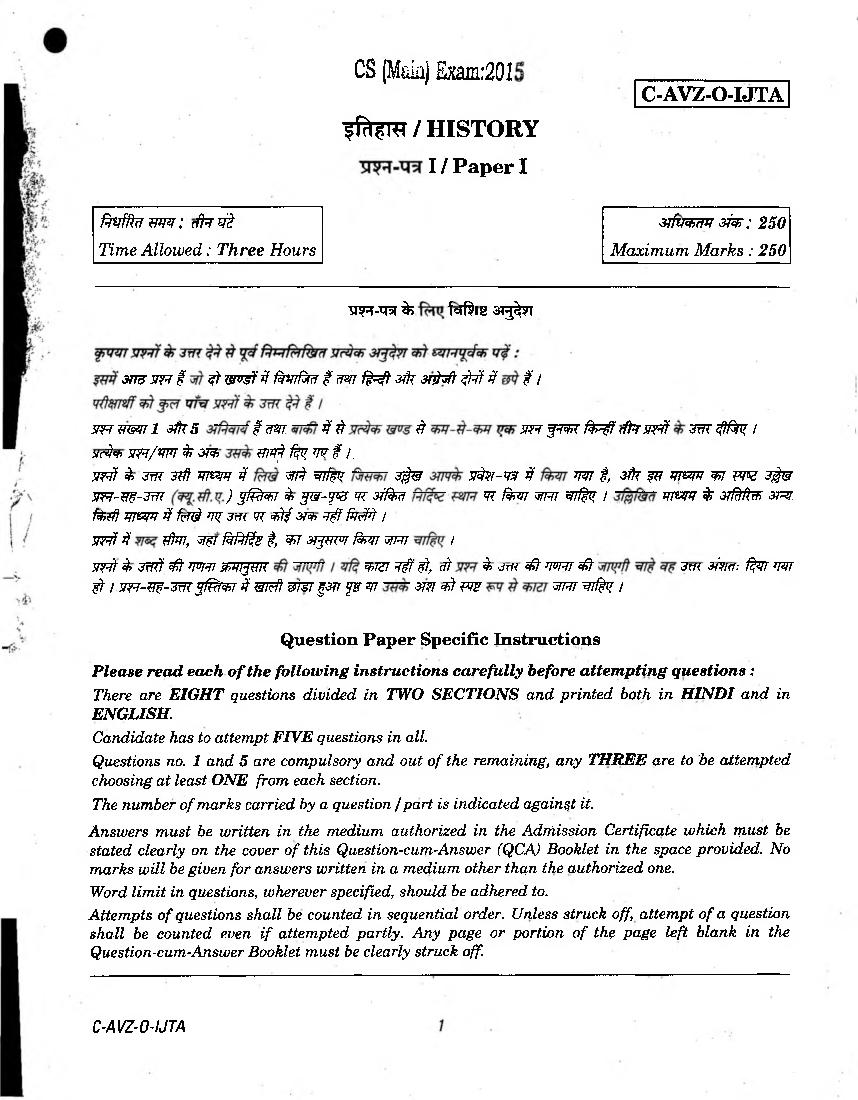
C-AVZ-O-IJTA
't f k m / H I S T O R Y
I / P aper I
ftvffcaww: rftwvZ ajfmtm 3 & : 250
Time A llow ed: Three Hours Maximum M arks: 250
3nR-*T3r % fcrf^ia 313^1
3m jpr $ & w z f # fawfcm f mr f&ft sfk wfrft &?f # #'/
W R w m l 3fk5 f ww $d d jm ipm f&g?cf
ucd*) JIFf/WT & 3ff> Wtif ftp? TRTf /.
w ft $> 3m 3tft m&m $ zrd mfp* 3§w j&n-m # ?m t, tfk w m*m w ?w 3$&
jm -w-Jfft ) %f$m $> ^-^0Tw 3Tfer<7 w fow wu wrf& 1 m m & zfM ft 3&r
f<h tfi W & R $ frF & ^ J ffi 7?" <#)/ 373> W iff fife ftf /
w rf $ tftm, wrfeftfife #, w 3j^m fam wm t
JW it $> 3177^ ^ f WFfJ fbHI^H/i ^yfZT ^ f $ , cff$> drf< & 7JUR I & drf< 3/V/rf; f& I W 7
& / Wf-w-3fn3f$i+i $ wtftwter^&r ys a?T sm*3 pm <mr wiffc /
Question Paper Specific Instructions
Please read each of the following instructions carefully before attempting questions:
There are EIGHT questions divided in TWO SECTIONS and printed both in HINDI and in
ENGLISH.
Candidate has to attempt FIVE questions in all.
Questions no. 1 and 5 are compulsory and out of the remaining, any THREE are to be attempted
choosing at least ONE from each section.
The number o f marks carried by a question / part is indicated against it.
Answers must be written in the medium authorized in the Admission Certificate which must be
stated clearly on the cover of this Question-ciim-Answer (QCA) Booklet in the space provided. No
marks will be given for answers written in a medium other than the authorized one .
Word limit in questions, wherever specified should be adhered to.,
Attempts of questions shall be counted in sequential order. Unless struck off, attempt o f a question
shall be counted even if attempted partly. Any page or portion o f the page left blank in the
Question-cum-Answer Booklet must be clearly struck off.
C-A VZ-O'IJTA
Page 2
SECTION A
Q l. 3TN3it ^ w te ('J5 4 TR) 'CR 3 ?fer 1^R ^8fRf 3Tfc 3P^ft
gf^RKT if 3^3 t ^ ? P m 30 ?T®?S I
JTnfe tR jj^ f; * sjh % foil ^sjR-ftljfat }f%<r sbHy«R 1 ^ ^ f I
Identify the following places marked on the map supplied to you (on page 4)
and write a short note of about 30 words on each of them in your
Questi.on-cum-Answer Booklet. Locational hints for each of the places marked
on the map are given below seriatim : 2 —x20=50
2
(i) ^ W F 13#T W=T
A Neolithic site
(ii) ^ W ig r fk T O
A Neolithic site
(iii) ^ujicblcflH T O
A Harappan site
A Megalithic site
(v) F l c q r ^ T r f r r 1
A Harappan site
(vi)
A painted-Grey-ware site
(vii) Rltflcrl^
An inscriptional site
(viii) TK
An important ancient city
(ix)
An ancient port
(x) to t
A site of ancient cave-paintings
C-AVZ-O-UTA 2
Page 3
A Buddhist site
(xii)
An educational centre
(xiii) THH
Brahmadeya village
(xiv) 'jxmrtl
An ancient capital
(xv) W fFft
An ancient capital
(xvi) ^Tf^C
A temple site
(xvii) yr4Vi
An ancient capital
(xviii)
An ancient sea-port
(xix)
An archaeological temple site
(xx)
A Harappan site
C-AVZ-O-UTA 3
Page 4
Page 5
ft*TT 3JT ^^ScTT t ?
How far can the ancient Indian Sruti literature be used as historical
sources ? ' 15
(b) f5°TT WRrnT w i % c^rut f stt ft w sttsptut %
c£r<jt i ft^Mi i
The decline of Harappan civilization was caused by ecological
degradation rather than external invasion. Discuss. 20
(c) 3TRf ^RTT I ; ^THrTT t l”
WHIdMHIrH'b I
“Archaeology knows of no Aryans; only literature knows of Aryans.”
Examine critically. 15
Q3. (a) ^ | f t itf^trR =& 3T^W sn 3 mR^^hT ^ ’TTOt
3 ^ srrfift ^ k w h ! ^ ^ f^n an ?
How far is it correct to say that changes in the post-Vedic economy gave
birth to new religious movements in India ? 20
(b) ^rwrnrthr *rcm % w«t « r a ^ ’srffir
3m iR^cT i
Delineate the nature and impact of India’s contact with Western Asia
and the Mediterranean world during the Mauryan period. 15
(c) “ 5fr#T crft^T uiifM. ftronsft ^ ^ jf ^ % ^r ftrcoi
^ (i#ret ^ trmrte; siW t w ?: tft
“Not only does ancient Tamil literature furnish an accurate picture of
widely disparate classes; it also describes the social condition of Tamil
country as it was.” Discuss. 15
C-AVZ-O-IJTA 5
Page 6
3Rga c^Tf^rq; i
Trace the role of guilds and trade organisations in the development of
early Indian economy. . 15
.■ (b) ipk r it ftfifflf tfFTT 3 ^dl<J>d (tte-^R) < 4 l^ d l
3T#?51 I ycfiisi I
Kailasa temple built at Ellora marks the culmination of rock-cut
architecture in India. Elucidate. 15 '
(c) w refl % srsfft 3>$fra w f e w ?*rt % ^rra M
^ aft ?
How could the local self-government under the Cholas adjust with their
centralised administrative structure ? 20
C-AVZ-O-IJTA 6
Page 7
Q5. pHfdfidd 'SR^R TO W WWI 150 51®^f if :
Answer the following questions in about 150 words each : 10x5=50
(a) W fft irf% 35T fiftRT f e w !.
Give a brief account of the early medieval temple architecture of
Kashmir.
(b) ?
Why is Mamallapuram famous ?
(c) % 3?#T t o f f l eft TF^-SW ifT % «fiT
3?r)<a l
Mention the salient features of the polity of Vijayanagara Empire under
Krishnadevaraya.
(d) ^TTtcrTjS?ft 3T*TCT ^ %W W 33HJ; $ ?
What measures did Balban adopt to combat the Mongol menace ?
(e) t w f e r i)wr | % wra* t^p sjrirR, sjt ?
How does Tuzuk-i-Babri testify that Babar had been a cultured man ?
Q6. (a) W # *IR?r 3 % 3J^R
W t *BT WTsfa f ?
Do the evidences of land ownership at our disposal support the theory of
the prevalence of feudalism in early medieval India ? 15
(b) <£t ^-TF3R«r T O # cTSfT -Mlli|ch-y!)IWH
I
Discuss in brief the land-revenue system and judicial administration of
the Delhi Sultanate. 15
(c) “ qjft ^ wjckfc-fH wnwf % s n f e fe r c f 3?ft
3TOt (TO3Tt) ^ 3TW W jff w ^rft f e f t W7T JTTCT <335
^ 3 araw i” wftrar 3 I
“Sufis and medieval mystic saints failed to modify either the religious
ideas and practices or the outward structure of Islamic/Hindu societies
to any appreciable extent.” Comment for/against. 20
C-A VZ-O-UTA 7
Page 8
Make an estimate of Rana Kumbha as a patron of literature and art. 20
(b) ^ 'Rmi ?
Why should the sixteenth century be regarded as the period of Indian
Renaissance ? 15
(c) ^ m ; m <ft s n w $
ftgcRf ^ 4 2ft l” ^ M s ¥7 t SSTFf 3 ^
'ritspji cfrtfsni, i
“Taritrism, if not in practice, at least on conceptual level challenged
patriarchy.” Examine Tantrism specially keeping in mind the above
context. 15
Q 8. (a) 3, 3 1 ^ qiffei-TFSFftffo; ef ^ftfM %
3Tf|^ftsT 8JT |” JfiSR ^1 cftftur |
. “In medieval Indian history Akbar was unique for his religio-political
ideas and policies.” Analyse this statement. 20
(b) titfNl-i # tt *iKci if Tmfta sisjsqwn 3^nftT
3TTrR-ftifr «ft ?
Will it not be correct to say that the rural economy in Mughal India was
relatively self-sufficient ? 15
(c) fcronsrf % 3rf!H>iflci;(k m yiHiPi* ymiH %
3 5? ri ^tfiru, I
, , Compare the Peshwas’ bureaucratic management with that of the
Imperial Mughal administration. 15
C-AVZ-0 IJTA 8
Document Details
| Board / Org | UPSC |
| Exam | UPSC CSE (IAS) |
| Type | Question Paper |
| Pages | 8 |
| Updated | 30 Apr 2026 |