UPSC IAS 2015 Question Paper for Law Paper-I
Finished viewing? Save it for later —
Download UPSC IAS 2015 Question Paper for Law Paper-I (PDF · 9 pages)About UPSC IAS 2015 Question Paper for Law Paper-I
UPSC IAS 2015 Question Paper for Law Paper-I is available here for free download. Published by UPSC for UPSC CSE (IAS), this question paper can be viewed online or downloaded as a PDF (9 pages). Candidates preparing for UPSC CSE (IAS) can use UPSC IAS 2015 Question Paper for Law Paper-I to understand the exam pattern, the type of questions asked, and the overall difficulty level.
Frequently Asked Questions
How can I download UPSC IAS 2015 Question Paper for Law Paper-I?
Open this page and click the Download button to save UPSC IAS 2015 Question Paper for Law Paper-I as a PDF. It is completely free on AglaSem Docs.
Is UPSC IAS 2015 Question Paper for Law Paper-I free to download?
Yes. UPSC IAS 2015 Question Paper for Law Paper-I can be viewed online and downloaded as a PDF free of cost on AglaSem Docs.
How many pages does UPSC IAS 2015 Question Paper for Law Paper-I have?
UPSC IAS 2015 Question Paper for Law Paper-I contains 9 pages, which you can read online or download together as a single PDF.
Where can I find more UPSC CSE (IAS) study material?
You can find more UPSC CSE (IAS) question papers, sample papers, syllabus, and answer keys on AglaSem Docs.
UPSC IAS 2015 Question Paper for Law Paper-I – Text
Read the full text of this question paper below — useful to quickly search, copy and reference the content online without downloading the PDF.
📄 View text version (9 pages)
Page 1
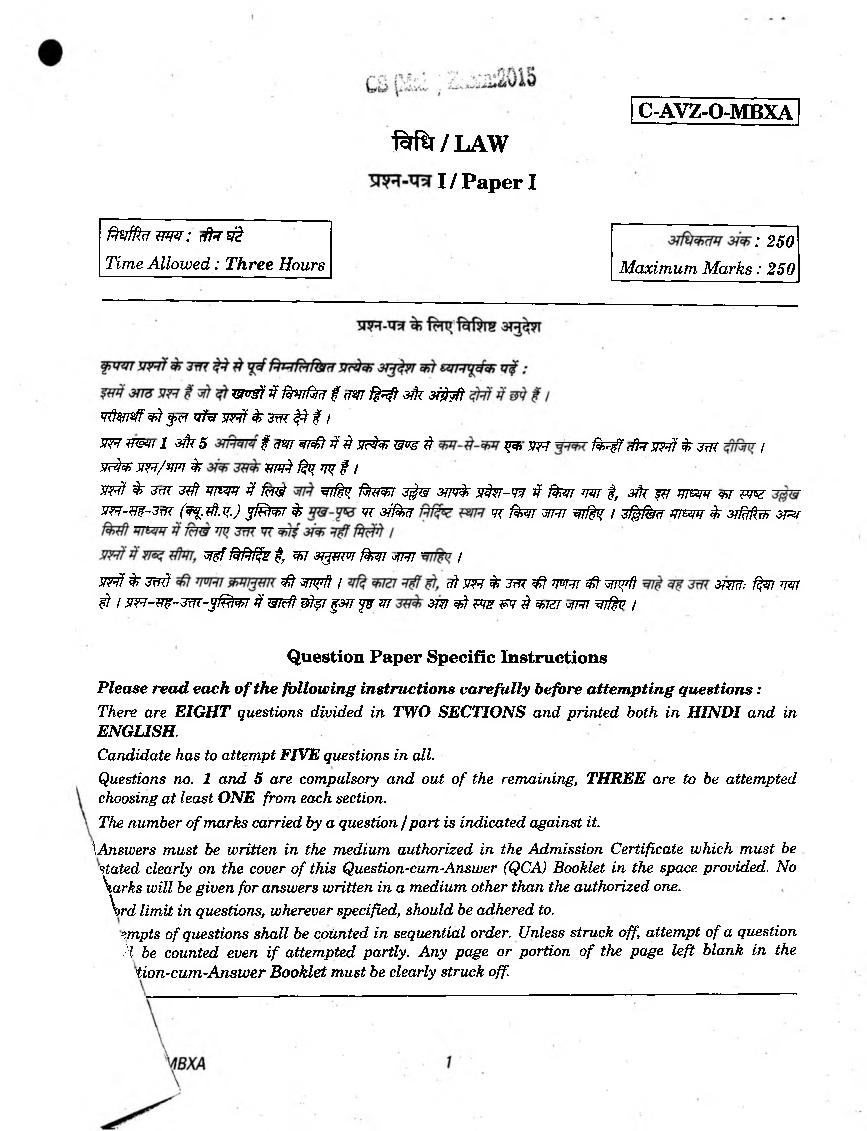
1¥St/ l a w
I / P aper I
ftvffcrim : rfkwi : 250
Time Allowed: Three Hours Maximum M arks: 250
jsmsf $ fewf&T f <m fj&f 37k 3T^ff
ytf&rzff#J>c7 vfw m f $ 3W # # /
W
fH
te
w 1 3ik5 ic
wtw
f&$#w
tfaws# >3777
t^ fe^
frftw
wff# 3 m /
w fo wr/*m % mfi ffc w? # /
wd&Jrtfitftm
&m$friz
t w
rf&fim
w3$@3777^ xdw
-w# fo
ww i, 3ffcjwm
&m*
m ?w
WT-m-3T?r (*%&.?.) jf&W % 7T 3 ^ 7 W faff ^TRTmf& / 5®^(7 mm & 3fMm 3FV
w f faftftg ff w 3%mw fan *tmt 1
jmf&&
nf &m
?ft1ctiwr&3
& /jm -w -3 fK -% f$ & r # ®7c#®!$r gsrr y^ w sm # ?w m # $>izr *trt 'mfa* /
Question Paper Specific Instructions
Please read each of the following instructions carefully before attempting questions:
There are EIGHT questions divided in TWO SECTIONS and printed both in HINDI and in
ENGLISH.
Candidate has to attempt FIVE questions in all.
Questions no. 1 and 5 are compulsory and out of the remaining, THREE are to be attempted
choosing at least ONE from each section.
The number o f marks carried by a question /part is indicated against it.
\Answers must be written in the medium authorized in the Admission Certificate which must be
stated clearly on the cover o f this Question-cumAnswer (QCA) Booklet in the space provided. No
\arks will be given for answers written in a medium other than the authorized one.
\rd limit in questions, wherever specified, should be adhered to.
vmpts of questions shall be counted in sequential order. Unless struck off, attempt o f a question
H be counted even if attempted partly. Any page or portion of the page left blank in the
fion-cum-Answer Booklet must be clearly struck off.
Page 2
SECTION A
Q l#
Answer the following in about 150 words each : 10x5=50
(a) sitRNf, 3ffc w r r i ^ 12
% 3I%5Rf % fc^, ^ t ^rr f^J^T ^ ^
%IT fcjcKfatf, cFT ^ T # ^ n rR ^ |W ^
tuw<m srrzrf^ I ? 3^ 3rrc % t o 3 i
Given the contemporary economic, political and social realities, critically
evaluate the judicial framework developed to determine whether an
agency/body is ‘State’ for the purposes of Article 12. Is the test currently
too narrow ? Justify your answer. 10
(b) it m % 3 amwr w f r s r r c I fa 72 affc 161 % tp s ? #
3fk T M W f iHI 2?IT 3I^R ^FT %
fatr ^§5TT i^TT ? cf?T % %W % =FI
What would be your opinion regarding the view that the exercise of
powers by the President and Governors under Article 72 and 161 to
grant mercy should also be open to Constitutional Challenge ? Discuss
with reference to recent cases of the Apex Court of the country. 10
(c ) “ *IR W % 'H f a l R «FT 3 1 3 = c ^ 1 4 s r f fa t jR cpt 1 R I ^ r r a i t ^ f f a ? ^ fxR T c P f f a W
<St ^ iRT ^ 3 1 1 l” ^ W8J 3 *raf fa w Wfanfafi
%/grcr sfa w w f a s *3 3rm 11
“Article 14 of the Constitution of India forbids class legislation not
reasonable classification.” Examine and also discuss how far equality of
status and opportunity are achieved by this Constitutional provision. 10
(d) *ITCcT % if ‘rffapjrfi’ 3}fc Vit+MId’ 5l®?f ^ ’TftfllfaT 3ifk ^ f a
I ?n*f wifahdl W tft 3 ^ 3 I
Define and distinguish between the terms ‘Lokayukta’ aiid ‘Lokpal’ in
the Indian context. Also mention about its relevance. 10
C-A VZ-O-MBXA 2
Page 3
^ W|cf ?*n^i ^ f ? w Trftrt^f % f^pr 3nq
^T-% *K1li»l ? 10
What do you understand by the expression ‘independence of judiciary* ?
Why is it being discussed/debated/questioned too much nowadays ?
What reasons would you give for this development5?
Q 2. (a) “ a ifosR ’ cri 3pf s # r - 3 r f ^ r t 5*$ | i”
% 3 ^ 3 % STO f a TT I ^fI 3Tp7oij^HI grflRFR’ 3}k
‘oiiRhJid’ % s f f a a r m t ? I
“Right to life means something more than mere animal existence.”
Discuss with reference to case law. Is there any difference between the
expression ‘right to life’ and ‘personal liberty* ? Explain critically. 20
(b ). “ smR *hft iir«R # r r I ^ 3 3 # tsrt, 3tcR
3?fc ^ ^tcTT | l”
^FT *Wldl-eRlr*W 3?fa l if t e d 3 *TM % 5TCH ^ f^rfcT
^>1 I
“The Prime Minister is the keystone of the Cabinet arch because he is
responsible for its formation, life and death.” Critically examine the
above statement in the light of various provisions of the Constitution
and determine the position of the Prime Minister of India in the
Cabinet. 15
(c) ‘f et e; Wl ^dl ’ % %frF3T=FT IcIWIT t l f t . ' i q t e ' l t 3*071 3WR
^ ^TT | I 3TTT '5RFR y d $111^1, FTT* %
ttM % g it w r f - ^ n # 3 i i s i t e ; -s m r ^ t s i f t
*RFt % sfer i
The horizon of ‘Legal aid* has been widened best, still the impact is
totally missing. How would you resolve this crisis which is ruining the
life of millions of poor people of our country over the years ? Suggest
some concrete measures to make it more effective and implementative. 15
C-AVZ-O-MBXA 3
Page 4
|, zsrzfttt ^ -sfcm gq; ^r aifamPfo Mfoftmaft % t o
mcmr-i^ h c& spprft ti^r ^ 3r ^-3?? fi % smm ^
WTM^nrtW TJy^iravT I
In light of the fact that the Constitution of India has no express
proliibition on delegated legislation, critically evaluate the basis for
different judicial positions either prohibiting excessive delegation or
permitting delegation without Constitutional limitations. 20
(b) 153fft 16%
*ffar I i IciRiv^d %*fr I ^n«T, ^
SlJSPfrr i|!M iR ^>f 'ClteftRTSff cR 3 ^ 9 I
What is ‘Protected discrimination’ ? Examine how far it is constitutional
under Article 15 and 16. Give reference of decided cases. Also mention
the limitations of these articles as per its application. 15
(c) “q to f % 3rqft?i4 afk st^ ct 3, sjje d ? 246 3
T33 ^ 3TfcW W tTRT *IHT l” I W«t
W 'SS ^ ’Tt I ‘arcf affc 3TC % ftqjRr’
3% ‘fl'fl'A is€ % # t t ?
“The non-obstante clause in Article 246 ought to be regarded as last
resource in case of an inevitable and irreconcilable conflict between the
lists.” Examine critically. Also discuss the abuse/abuses related to this
clause. Is there any connection between the doctrine of ‘pith and
substance' and ‘non-obstante clause’ ? 15
Q4. (a) 3?=r s tn iw i 3n t e *nfef>T c^rc ^ % f?ni,
W ^ ^sr 3 dt+aiBi'fi fagraf % feraro ark if swrc
Under what circumstances, apart from concerned parties, a third party
has locus standi to move writ petition before the High Court or,-Supreme
Court ? How has this procedure helped in developing and promoting
democratic principles in the country ? 20
C-AVZ-O-MBXA 4
i
!•
Page 5
(b) *JTCcf %-:#raFT % anftq K ft TT3^T % TPJJIWr ^rfrPft '*51 F W t W W
I 3TTC f t n f c l f i s i d - 3 % f t “ 3 W -T F H fW ■#. TFSJ# % ,
f t m % 3 ?# ? 3 R IR H % i^ fft lW 3 | ” f t g JPSR
^ ?
Critically evaluate the powers of the Governor of a State as provided
under the Constitution of India. How would you interpret the following
observation that “the role of a Lieutenant Governor is no more than that
o f a facilitator of administration under the President’s control” ? 15
(c) ~siw<rM % srcr %*rf % sifeisrcf sft. tfsst ^ ^
% In^ich cfdf % f ^ w ^ m r w r % ^fcr w e i
W 3TFT w f t r o t w f f t $ ft? ft ^ M jjy c ll ^ $
tjwiRi irs^gj ? %8jt, ^rRSjf, srf, t # # r a srra %
^ 3, w ftw w. i
Explain the opinion of the Supreme Court of India regarding the relation
between the Fundamental Rights and Directive Principles of State
Policy in the light of its decided cases. Do you agree with the view that
giving primacy to one over the other is to disturb the harmony of the
Constitution ? Comment with reference to the present day scenario
relating to education, health, religion, etc. 15
C-AVZ-O-MBXA 5
Page 6
SECTION B
Q5. RnfciRaa ^ yr^ch ‘SRT3tR rFT^T 150 ?T®^t (cifisn*:
i *
Answer the following in about 150 words each : 10x5=50
(a) “ 3TFSF % 3TOR f e w WVcH”! f , *TSlft 3TcRf^r
fagra ^R^rtt fomt, amtfqcT ark TFsq 'rc srfacjrrcf % t o r r %
^RI -| l” *TOT#=Rl’J<fsF ■ftcqnft I
“Today there is a huge shift of the basis of International law though the
principal component of International law is represented by binding
rules, imposing duties and conferring rights upon the state.” Comment
critically. 10
(b) sicRf^hi ‘yry4«i sfe ^P iqR n <sr
iw ^ 3 iw ft-^ r ^ itm I , v
4 w 3TRhr I ? ^R ”T i
Evaluate the importance and relevance of ‘Extradition Treaty’, under
International law. Is a state liable to extradite an offender, who has
been accused of a political murder in a neighbouring state ? Give
reasons. , 1 0
(c) *prr 3 w. i
Discuss the efficacy of International Humanitarian law in the protection
of Prisoners of War. 10
(d) “ 3-icRK*k f e g o?ra^n aft ?rff% % f^ r | i” w j
i wsf ‘arcRf^hr 3jidch=d<’ ^ W rm i w bw 3
3fr( (c|cbiy^n<rl ^ fi ^ <#T-t 5ig?3 33T1T fj ? ^ I
“International Terrorism is a threat to world order and peace.”
Elucidate. Also define the term ‘International Terrorism’. What major
steps have been taken up by the developed, and developing countries in
this respect ? Discuss. 10
(e) i *n*r ^ eft 3T-*njf$: % qftwraf
Explain the principles of ‘Ratification of a Treaty. Also examine the
consequences of non-ratification of a treaty. 10
C-AVZ-O-MBXA 6
Page 7
-%JfT f , 3TRN WTOT TO I % *TR3 ^
w TiNrft -^rraf B^nspjjN; artf % sftt
w h ^ % w f ^rftosr w ^ f %3T f I t o *r? a M ^ k ^ m i ? r
(a n ^ A ) # ^Ptc(i4 3#i*iRdi % 3??pfct afimnT ? ^ I ?rra ^t,
w 'gm f?r 3#i4>iRdi «Ff ;p M t 1 ^ ^ *ramr % *n«F«r 3
t
The Republic of Marshall Islands (RMI) recently filed an application
against India in the International Court of Justice (ICJ) alleging India’s
breach of its obligation to pursue in good faith and conclude negotiations
leading to nuclear disarmament. Would it fall under the compulsory
jurisdiction of ICJ ? Discuss. Also mention about the possibility of
challenging this jurisdiction by India. 20
(b) “ >13^ ■# <i*^l■Mdi 3ik -ggrsrem ti^r aifc 3ft HFift* % #er
3# t% sr f t fe s I i” i war ‘<ts$*wi’ ,
affc ‘-ii^^Hcti’ % i
“A man’s nationality is a continuing legal relationship between the
sovereign state on the one hand and the citizen on the other.” Explain
the above statement. Also mention the difference between ‘nationality’,
‘double nationality’ and ‘statelessness’. 15
(c) 'ftRferfera ; # q ftw i aft 3 ^% :
(i) ti^ ^ itrrit 3 ^ TtF^rr
(ii) <l«ra: *IFTO 3*k ftfSra:
*FTOft, WRRft’ -SfJt w I
Define and distinguish between the following:
(i) Recognition of State and Recognition of Government
(ii) De facto and De jure recognition
Also explain the concept ‘Collective recognition’. 15
C-AVZ-O-MBXA 7
Page 8
T 5 R ^ /3 rtora # ftfM ^ ■HHicil-=iHirMeh I ST«T # , ‘HK’FR W *
3^ |w H % frfa % 3 t# t w ttr -Przncff m
i
Critically evaluate the laws/conventions/practices available for the
protection and preservation of marine environment under International
law. Also discuss the rules provided under International law for ‘transit
passage’ and its abuses. 20
(b) sicRf^hf fen<t srifajyf s m l i
3t r wiHrsif % 3 arrq% sw r arffcra; | ?
=ini§«, i
Discuss the various peaceful means of resolving International disputes.
Which one according to you is more practical in the context of problems
t
of the present day ? Give reasons. 25
(c) 3RRf^rferRr % ^ft ^rr 3t4 I ■gg^i 92^ w
I ? 3^ ^ t f a s 5iwi: t ? w=if i
What is the meaning of the term ‘Territorial Asylum’, under
International law ? What are its major components ? And how is it
different from the term ‘Territorial Sovereignty’ ? Discuss. 15
Q8. (a) T]^ ^ ^ ^ WT
^T. Tl^f % ‘srifcT w W 3Wft 'strates sjfosT % (v|N4|^ ?Tfrf5
■g^H TOt f i %w 3 3TOI W a n ^ R I ?-w
% 3*5 3TFf *TTTfpf-fef (Tte-^r) yjiisn 1
i
Critically examine the provisions of the UN Charter which enables the
UN to perform its primary role of ‘peace keeping’ among nations. What
is your assessment regarding this function of the UN ? Suggest some
measures or a road-map for this purpose. 20
C-AVZ-O-MBXA 8
Page 9
w | ? w ? ■ftfiiH i ^ tft % 3 'Hifa^ij €t f srar ^ft 3 ,
*ft ^ cRTWF ficbc^HI % i^RTH ^ *ft * R f |
Under modern International law what meaning has been assigned to the
term ‘High Sea’ ? Explain. Also discuss the scope of the concept of
freedom of the High Sea with reference to legality of nuclear test in the
areas of High Sea.
(c) “ aricn 3, aim kjk I l” lOTuft cftftpi |
3iri<i^4f iW r a ft ^ fM ft ^
sft i”
“In the ultimate analysis individuals alone are the subjects of
International law.” Comment. Also discuss the Transformation theory in
the context of the relation between International law and Municipal
law.
C'AVZ'Q-MBXA 9
Document Details
| Board / Org | UPSC |
| Exam | UPSC CSE (IAS) |
| Type | Question Paper |
| Pages | 9 |
| Updated | 30 Apr 2026 |