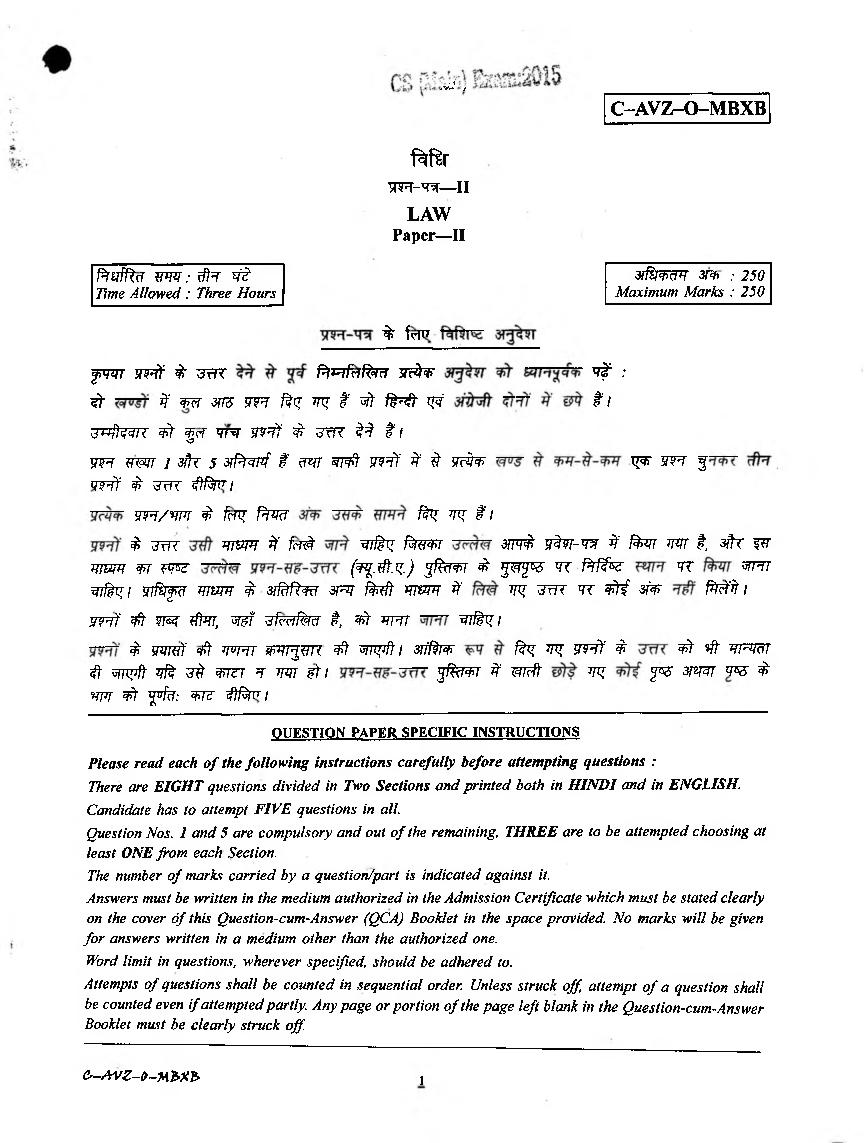
UPSC IAS 2015 Question Paper for Law Paper-II
Finished viewing? Save it for later —
Download UPSC IAS 2015 Question Paper for Law Paper-II (PDF · 5 pages)About UPSC IAS 2015 Question Paper for Law Paper-II
UPSC IAS 2015 Question Paper for Law Paper-II is available here for free download. Published by UPSC for UPSC CSE (IAS), this question paper can be viewed online or downloaded as a PDF (5 pages). Candidates preparing for UPSC CSE (IAS) can use UPSC IAS 2015 Question Paper for Law Paper-II to understand the exam pattern, the type of questions asked, and the overall difficulty level.
Frequently Asked Questions
How can I download UPSC IAS 2015 Question Paper for Law Paper-II?
Open this page and click the Download button to save UPSC IAS 2015 Question Paper for Law Paper-II as a PDF. It is completely free on AglaSem Docs.
Is UPSC IAS 2015 Question Paper for Law Paper-II free to download?
Yes. UPSC IAS 2015 Question Paper for Law Paper-II can be viewed online and downloaded as a PDF free of cost on AglaSem Docs.
How many pages does UPSC IAS 2015 Question Paper for Law Paper-II have?
UPSC IAS 2015 Question Paper for Law Paper-II contains 5 pages, which you can read online or download together as a single PDF.
Where can I find more UPSC CSE (IAS) study material?
You can find more UPSC CSE (IAS) question papers, sample papers, syllabus, and answer keys on AglaSem Docs.
UPSC IAS 2015 Question Paper for Law Paper-II – Text
Read the full text of this question paper below — useful to quickly search, copy and reference the content online without downloading the PDF.
📄 View text version (5 pages)
Page 1
C -A V Z -O -M B X B
ftftr
w - w —II
LA W
Paper—II
faS7fltcT ?7W; fft? ^ 3{ffrpm 3&> ; 250
77me Allowed : Three Hours Maximum Marks : 250
% fvITT
fW T jw if £ ^WT ftHfrlfeRT JT&fr vf :
it $ w? 3(T5 9w ^ w N ft5# ^ fI
jufltfTT # f or T W 5 ^ ' # TnT ^ #'/
yw hw l aft? 5 zfftrwf f w*ff wr¥f jnif $ # ? f^ ^ w f
tpFT? £ JT7T tffa r /
m / w r $ fcry f t m ft? w f /
£ jw t m m % fcr& w #t? t e i 377^ ? tw -w # ’ to " m #; z ftr w
m m w ?w (?%.&.?.) j/^ tw £ gw^s" *?t ftflfe- *?r ^ rr
W7/^7 wftlf cf mum % 3fftf&tf 3!W ffaft WWW #* w JYR VT ^ 3fa fifcfit I
wwf ¥f m s # 77; W^f z frd fa d i r # ^77^T ^ 7 t^ /
£ T W f q# W FTT 3*773*777 ^ W 7^ / 37/tf^T ^ ^ 5^' ^ # *# W FW T
if *m?ft vfe 3# w z t ^ m r wt 1 %Rxt'$T #’ ^ 7?# w y 5? 3 /w w ^
W # y fe ^ ^ f o r/
QUESTION PAPER SPECIFIC INSTRUCTIONS
Please read each o f the following instructions carefully before attempting questions :
There are EIGHT questions divided in Two Sections and printed both in HINDI and in ENGLISH.
Candidate has to attempt FIVE questions in all.
Question Nos. 1 and 5 are compulsory and out o f the remaining, THREE are to be attempted choosing at
least ONE from each Section.
The number o f marks carried by a question/part is indicated against it.
Answers must be written in the medium authorized in the Admission Certificate which must be stated clearly
on the cover o f this Question-cum-Answer (QCA) Booklet in the space provided. No marks will be given
fo r answers written in a medium other than the authorized one.
Word limit in questions, wherever specified, should be adhered to.
Attempts o f questions shall be counted in sequential order. Unless struck off attempt o f a question shall
be counted even if attempted partly. Any page or portion o f the page left blank in the Question-cum-Answer
Booklet must be clearly struck off.
C'-AVZ-O-H'bX'b 1
Page 2
SECTION—A
Q. 1 faHfcjRNd % 3T^> '3tTT efiWT 150 TOf | 3*R£ff dffc -M ite f ^ W
^ t ^ frr ^ :
Answer the following in about 150 words each. Support your answer with legal provisions
and judicial pronouncements : 10x5=50
Q. 1(a) v1'-ai^|vti"dT, '% fM \ Wfrcrm i?\ wpj;3ttosr #nn ^rt.faffcr $ <spgm <r^ffa
^ tti" ^ ^ w r ^ ftrqoft
“The enforcement of any disability arising out of ‘Untouchability’ shall be an offence
i
punishable in accordance with law.” Comment in the light of protection of Civil Rights.
10
Q. 1(b) SfFRlte ^TPT ^ W lf^r f^T I t( w ^
^ 3mTET-?rrf^RTf ^ STCT ^ ^ f^TiftrT f^TT «TTcfT t \” I
“The criminal justice is administered in India by punishing the wrongdoer and the object
of punishment is viewed differently by different criminologists.” Elucidate. 10
Q. 1(c) ftftr *f, 3ihjcJWiflfaff w 3t1t^ %•”
i
“Liability of joint tort feasors in Law of Tort is Joint and Several.” Discuss. 10
Q. 1(d) “m n t e ^ arrosr Trfeer % fax? t T ^tt s i t e <a?fcpj¥ % # et srtsr w f,
3m^r ^tt wf, after t, srtsi ^r^ff # irt, ^ wtfct
t l ” 3IT#SFT7?*re> |
“To constitute the offence of criminal conspiracy there must be an agreement to do, or
cause to be done, an illegal act, or an act which is not illegal by illegal means.” Critically
examine. 10
Q. 1(e) mm\ % p um Ffen snrr 299(3) # ardk
smxrfW w urt 300(4) % 3t# t ^ #r wr^fr i
Explain with the help of decided cases as to when Culpable Homicide under Section
299(3) will become Murder under Section 300(4) of Indian Penal Code. 10
Q. 2(a) T[f TRjxHT mu% ^Tit ^\ # fat
^ ^ t, ^ ^rf^T % ^ "nf t r ' I
“No communication made in good faith is an offence by reason of any harm to the person
to whom it is made, if it is made for the benefit of that person.” Critically examine.
20
£-y*V£-i>-M&X£ 2
Page 3
3fTTOf^ 3^T R ^T 3mTST ^ T |3fT WT t I' '
Explain the various circumstances under which a ‘public servant’ is said to commit the
offence of “Criminal misconduct” under ‘The Prevention of Corruption Act, 1988’. 15
Q. 2(c) W f^TT 3?ta*r ^TT e*ifa ^iRd UHfri % % cfRld
w 3 f ir o t ? f^ F ft ^ r q ; i
Whether the conduct of depriving someone from possession of property without causing
wrongful gain or wrongful loss amount to theft ? Comment. 15
Q, 3(a) "v3M^=WI W tm 1986 f^ T O f % f¥^TT°T % feR, # T tflHlPi* HT^TT
t \” ^ rf^ i
“The Consumer Protection Act, 1986 provides a three tier structure for redressal of
complaints.” Elucidate. 20
Q. 3(b) “eifa> (w ) tr^ 3 T O I, ^ ^ t r ' T O l^ l
“Public nuisance is a crime whereas private nuisance is a civil wrong.” Explain. 15
Q. 3(c) “sm $ w f ^ 3 tm % f q 1 1 " 3t^ tt
% m *f f ^ r m tt\
“State liability in Torts has undergone an acute transformation in recent times.” Discuss
in the light of latest judicial pronouncements. 15
q . 4(a) f ^ wtwt t
Discuss with the help of judicial pronouncements the situations in which plaintiff may
prove apparently non-defamatory statements as defamatory. 20
Q. 4(b) jW N ^r # w rw r % % w f tfiJKufl % ^ w r
cfT^t 3^r yf^^|41 ^ f f % ^tSTT SZTR ^ Weft I I
Discuss with the help of decided cases where the Court while deciding cases on contributory
negligence keeps in mind the negligence on the part of plaintiff and defendant both.
15
Q. 4(c) ^ 3r^r f^cpft ^ ^ ^
# w\ft % 3rr^nT i ^' -p^RT PrufasRT W it t f^ n r
“Total restraint on the liberty of movement of a person, however short its duration may
be, will amount to false imprisonment.” Discuss with the help of relevant case law.
15
3
Page 4
SECTION—B
I
Q. 5 fe # # T c T ^ M TSrR WJWT 150 f%ftpF ^WS?f 3Tk ^fTf^ fW*ff
WflWI % TJrR % : . .
Answer the following in about 150 words each. Support your answer with relevant
legal provisions and decided cases : 10x5=50
Q. 5(a) T&AXT3p fercf % B % SPT^ ^ W % #TFT ¥% W IF *f i t m ,
' t m i -3f 'Wt # 5,000 ^ ^
WZF^m FtcfT 11 TRf A ^T ^RRT % ^ F P f^ T STjqf^T TFcft I 3fk q f t 'P I - W !
b o t ^rteT f^wHcf ^en t|i f ^ r w r i
A, a singer, contracts with B, the manager of a restaurant, to sing at his restaurant for two
nights every week during next two months; and B engages to pay to her 5,000/- rupees
for each night’s performance. On the sixth night, A wilfully absents herself from the
restaurant and B, in consequence, rescinds the contract. Decide. 10
Q. 5(b) ( f ts n iw .) *nf^T m s f a ;# ra p r % s r y # ? 32 # spcpfa,
$ ^rf%cT ^ ^fT ^ tjct ztftm ii % t o N - % w & m w
# r M taT
“PIL writ petition cannot be filed' in the Supreme Court under Article 32 of Indian
Constitution only if a question concerning the enforcement of ‘Fundamental Rights’ is
involved.” Comment. 10
Q. 5(c) “Wt M T , ^ -q^rnc ^ff^T ^ 3?#T W 3T^ 3® m t\ ^RT^Jcft
^ in te w N t W stct ^fcfe wtfI % sricii'ftchTi: t o r w i I,
w ¥t, w w r Yfcr ^ w r I, -q fM te
^ T Ft, t^ rn r t o t iM w t e r n ^ ^ m ^K it, ^ w m ^ i i
“Every agreement by which any party thereto is.restricted absolutely from enforcing his
i
rights under or in respect of any contract, by the usual legal proceedings in the ordinary
Tribunals, or which limits the time within which he may thus enforce his right is void to
that extent.” Explain the exceptions, if any, of this principle. 10
Q. 5(d) cfrrf f i t o t ■qr sarf% $ w r ^rc ^ f ^ f t f^ tr i
Write a note on im pact of noise pollution on the health of the people.’ 10
i
Q. 5(e) (t o f w t ) faftRT te r a t' i
Discuss the various principles of ‘mediation’. 10
Q. 6(a) “m m 4 m ^ ^#rsrpr to r, w m % i” i
“A hire purchase agreement is a bailment plus an agreement to sell.” Explain. 20
e,~AVZ-&~MbXh 4
Page 5
^ftrT $ 3TT^T $ ^ ^ WFTC ^ f f t ^Tcft FTfa % W5& ^T ^ T t , ‘stfcPjftf
Ff^T’ ^Fciltf) t l ” W ^ |
“A contract by which one party promises to save the other from loss caused to him by
the conduct of the promisor himself or by the conduct of any other person, is called, a
contract of indemnity”. Explain. 15
Q. 6(c) iz 1970 ^ 3 f# r srf^mf sppjftr ( c n ^ n r ) % f^ w
^tfuTTTI
Discuss various provisions of Compulsory Licencing under Patents Act, 1970. 15
Q. 7(a) " to rp r forrcf $ ^ ^ ^ Ft
t 3m ^ Ft WtTT | | " *TRiHI^ I
“An ‘Arbitration Agreement’ with respect to existing disputes, may or may not be in the
form of an Arbitration clause in the main contract.” Explain. 20
Q. 7(b) $ *TFT^ W T 0 \m ^1% ^ ^
FtcTT t I" ^ * 1 ^ I
“The individual deserves to be protected against the possibility of exploitation inherent
in ‘Standard Form of Contract’.” Explain. 15
Q. 7(c) $ wrjti % f^ftr w u ^ i
Explain the law relating to minor’s agreements. 15
Q. 8(a) “W fopr ^rf^T ^ w OTfrT f^TT % # ^eTT ^ T T , f ^ T *?$TWt‘
arm Ft t” 3n w fate ^ srt afk f%Hr ^t ^ wr ^
i
“In a contract of sale of goods property or ownership in the goods will pass from seller
to the buyer which the parties intend to pass.” Explain the statement with necessary legal
provisions and case law. 20
Q. 8(b) W y5T?FT' % W 3 ff^ r t , W^T: WTT^t I t wf WIT
f^F=r t ?
Explain clearly what is meant by ‘negotiation and endorsement’. How doesnegotiation
differ from ordinary assignment ? 15
Q. 8(c) ^t f^RT^T TOT t I ^ ^ ^
wett^ *w!kr<T $ 3*tei< # r W - W Ft% f ?
Explain the various circumstances in which a firm may be dissolved. What are the rights
and obligations of partners after dissolution of firm ? 15
Z-AVZ-O -M frXb 5
Document Details
| Board / Org | UPSC |
| Exam | UPSC CSE (IAS) |
| Type | Question Paper |
| Pages | 5 |
| Updated | 30 Apr 2026 |