ISC Class 12 Sample Paper 2023 History
Finished viewing? Save it for later —
Download ISC Class 12 Sample Paper 2023 History (PDF · 5 pages)About ISC Class 12 Sample Paper 2023 History
ISC Class 12 Sample Paper 2023 History is available here for free download. Published by CISCE for Class 12, this sample paper can be viewed online or downloaded as a PDF (5 pages). Candidates preparing for Class 12 can use ISC Class 12 Sample Paper 2023 History to understand the exam pattern, the type of questions asked, and the overall difficulty level.
Frequently Asked Questions
How can I download ISC Class 12 Sample Paper 2023 History?
Open this page and click the Download button to save ISC Class 12 Sample Paper 2023 History as a PDF. It is completely free on AglaSem Docs.
Is ISC Class 12 Sample Paper 2023 History free to download?
Yes. ISC Class 12 Sample Paper 2023 History can be viewed online and downloaded as a PDF free of cost on AglaSem Docs.
How many pages does ISC Class 12 Sample Paper 2023 History have?
ISC Class 12 Sample Paper 2023 History contains 5 pages, which you can read online or download together as a single PDF.
Where can I find more Class 12 study material?
You can find more Class 12 question papers, sample papers, syllabus, and answer keys on AglaSem Docs.
ISC Class 12 Sample Paper 2023 History – Text
Read the full text of this sample paper below — useful to quickly search, copy and reference the content online without downloading the PDF.
📄 View text version (5 pages)
Page 1
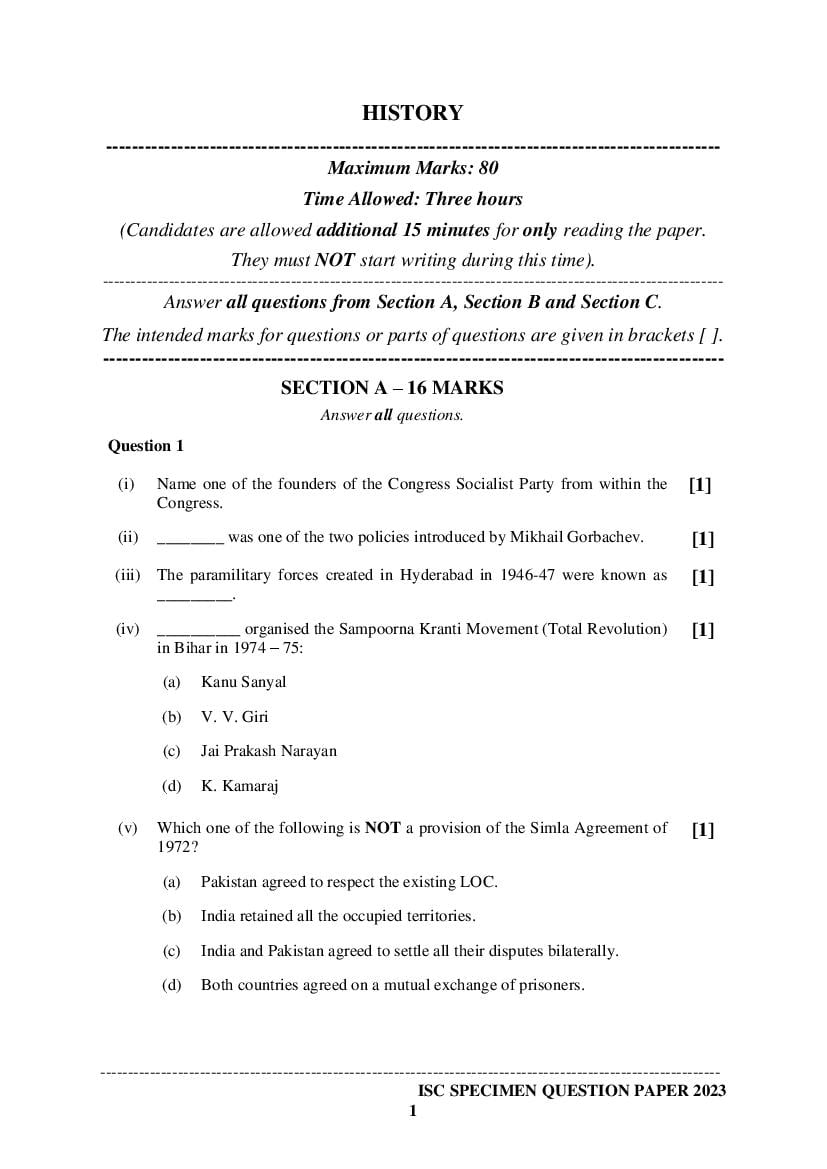
-----------------------------------------------------------------------------------------------
Maximum Marks: 80
Time Allowed: Three hours
(Candidates are allowed additional 15 minutes for only reading the paper.
They must NOT start writing during this time).
Answer all questions from Section A, Section B and Section C.
The intended marks for questions or parts of questions are given in brackets [ ].
------------------------------------------------------------------------------------------------
SECTION A – 16 MARKS
Answer all questions.
Question 1
(i) Name one of the founders of the Congress Socialist Party from within the [1]
Congress.
(ii) ________ was one of the two policies introduced by Mikhail Gorbachev. [1]
(iii) The paramilitary forces created in Hyderabad in 1946-47 were known as [1]
_________.
(iv) __________ organised the Sampoorna Kranti Movement (Total Revolution) [1]
in Bihar in 1974 – 75:
(a) Kanu Sanyal
(b) V. V. Giri
(c) Jai Prakash Narayan
(d) K. Kamaraj
(v) Which one of the following is NOT a provision of the Simla Agreement of [1]
1972?
(a) Pakistan agreed to respect the existing LOC.
(b) India retained all the occupied territories.
(c) India and Pakistan agreed to settle all their disputes bilaterally.
(d) Both countries agreed on a mutual exchange of prisoners.
1
Page 2
(a) lightning speed.
(b) living space.
(c) anti-communist.
(d) conscription.
(vii) Which event completed the Iron Curtain? [1]
(a) Berlin Blockade
(b) Communist takeover of Czechoslovakia
(c) Churchill’s Iron Curtain speech
(d) Creation of NATO
(viii) State the significance of the defeat of Germany in the Battle of Stalingrad. [1]
(ix) What was the aim of the Hundred Flowers campaign? [1]
(x) Name one women’s organisation that led the anti-dowry movement in the [1]
1970s and 1980s in India.
(xi) State the main objective of the Food for Work programme. [1]
(xii) Why did the Congress split into two factions in 1969? [1]
(xiii) Why was Direct Action launched in 1946? [1]
(xiv) Who wrote the book The Feminine Mystique? [1]
(xv) State one offer made by the Peel Commission. [1]
(xvi) Who were the fedayeen? [1]
SECTION B – 32 MARKS
Question 2 [4]
Comment on the role of Potti Sriramalu in the demand for a separate state of Andhra.
2
Page 3
(i) Discuss the main issues that led to the agitation in Assam in 1980s.
OR
(ii) Explain any four main terms of the Rajiv-Longowal Accord (Memorandum of
Settlement on Punjab) signed in 1985.
Question 4 [4]
Examine the role of Indira Gandhi in the creation of Bangladesh in 1971.
Question 5 [4]
What problems did Indian women experience, according to the Towards Equality
Report of 1974?
Question 6 [4]
Define Britain and France’s policy of Appeasement towards Germany and Italy
between 1935 and 1939. Give any three examples of Appeasement.
Question 7 [4]
Account for the Communist victory over the KMT in 1949.
Question 8 [4]
What were the main grievances of the black Africans against the white settlers in
Kenya?
Question 9 [4]
(i) Briefly trace the events that led to the transition to black majority rule in South
Africa in the 1990s.
OR
(ii) Analyse the socio-cultural impact of the Second Wave Feminist Movement in
the USA.
3
Page 4
Question 10 [8]
(i) Trace the development of the Kisan Sabha Movement and the trade union
movement in India in the 1930s and 1940s.
OR
(ii) Examine the controversy between the Congress and the Muslim League in
1946 over the question of: (a) being part of the Constituent Assembly (b) being
part of the Interim Government.
Question 11 [8]
“The President has proclaimed an emergency. This is nothing to panic about.” Indira
Gandhi.
In the context of this quote, evaluate the positive as well as the negative aspects of
the Emergency of 1975-77.
Question 12 [8]
(i) The basic causes of conflict during the Cold War lay in the differences of
principles between communist and democratic states. In this context, explain
the following:
(a) The Truman Doctrine
(b) The Marshall Plan
OR
(ii) Communism was swept away by a rising tide of popular opposition and mass
demonstrations. In this context, answer the following:
(a) Why did Mikhail Gorbachev introduce reforms in the USSR?
(b) Briefly discuss the events that led to the end of Communism in East
Germany.
4
Page 5
“The area known as the Middle East has been one of the world’s most troubled
regions, especially since 1945.” Norman Lowe.
In the context of this quote, answer the following:
(i) What was the impact of the increased immigration of Jews into Palestine in
the 1930s and 1940s?
(ii) What were the causes and consequences of the first Arab-Israeli War of
1948-49?
5
Document Details
| Board / Org | CISCE |
| Exam | Class 12 |
| Type | Sample Paper |
| Pages | 5 |
| Updated | 30 Apr 2026 |