Kerala Class 5 First Term Question Paper 2025 Basic Science
Finished viewing? Save it for later —
Download Kerala Class 5 First Term Question Paper 2025 Basic Science (PDF · 9 pages)About Kerala Class 5 First Term Question Paper 2025 Basic Science
Kerala Class 5 First Term Question Paper 2025 Basic Science is available here for free download. Published by Kerala Board for Class 5, this question paper can be viewed online or downloaded as a PDF (9 pages). Candidates preparing for Class 5 can use Kerala Class 5 First Term Question Paper 2025 Basic Science to understand the exam pattern, the type of questions asked, and the overall difficulty level.
Frequently Asked Questions
How can I download Kerala Class 5 First Term Question Paper 2025 Basic Science?
Open this page and click the Download button to save Kerala Class 5 First Term Question Paper 2025 Basic Science as a PDF. It is completely free on AglaSem Docs.
Is Kerala Class 5 First Term Question Paper 2025 Basic Science free to download?
Yes. Kerala Class 5 First Term Question Paper 2025 Basic Science can be viewed online and downloaded as a PDF free of cost on AglaSem Docs.
How many pages does Kerala Class 5 First Term Question Paper 2025 Basic Science have?
Kerala Class 5 First Term Question Paper 2025 Basic Science contains 9 pages, which you can read online or download together as a single PDF.
Where can I find more Class 5 study material?
You can find more Class 5 question papers, sample papers, syllabus, and answer keys on AglaSem Docs.
Kerala Class 5 First Term Question Paper 2025 Basic Science – Text
Read the full text of this question paper below — useful to quickly search, copy and reference the content online without downloading the PDF.
📄 View text version (9 pages)
Page 1
•= Shikgha
Samagn SAMAGRA SHIKSHA 2025-2026
SUMMATIVE ASSESSMENT— 1
BASIC SCIENCE Time: 2 hrs 15
Class : 5 minutes
Instructions
and understandingthe
• 15 minutes cool-off time is allotted for reading
activities.
• Answer any six questions.
correct one.
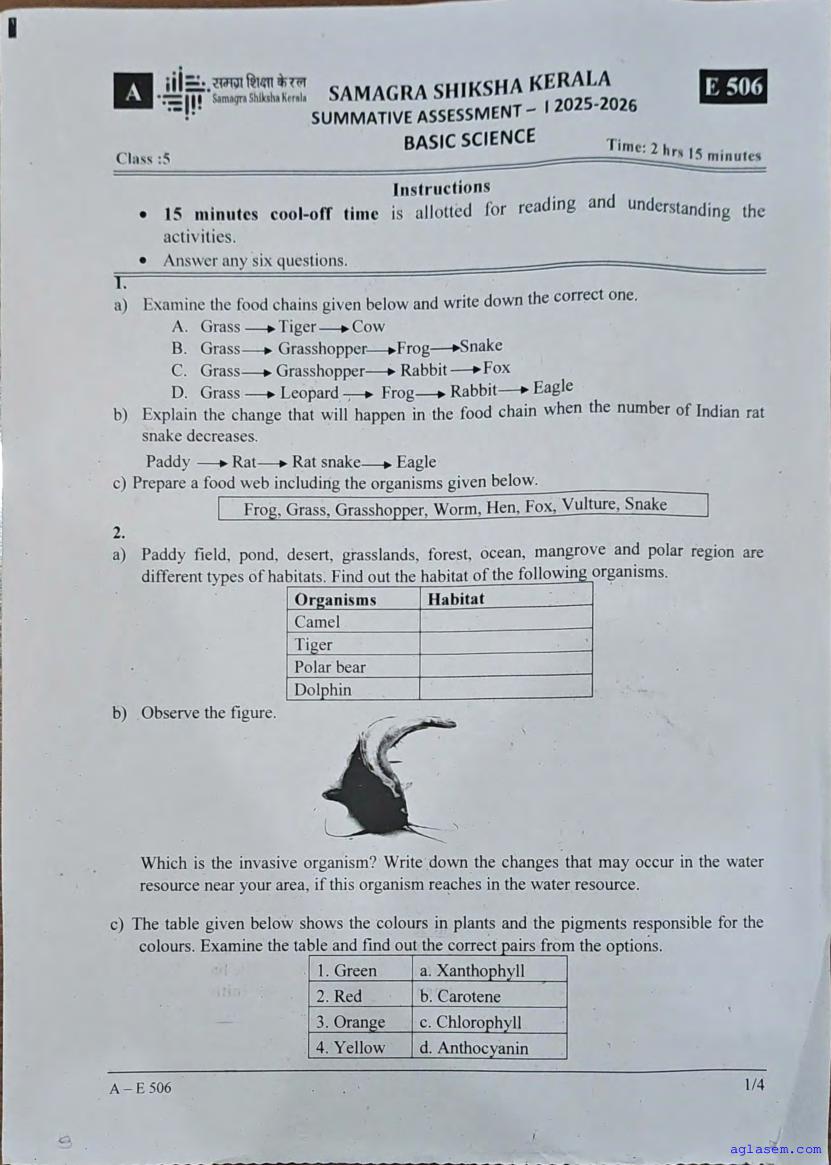
a) Examine the food chains given below and write down the
A. Grass Tiger Cow
B. Grass—+
C. Rabbit—>Fox
D. Grass Leopard Eagle
b) Explain the change that will happen in the food chain when the number of Indian rat
snake decreases.
Paddy Rat—+ Rat Eagle
c) Prepare a food web including the organisms given below.
Fro , Grass, Grassho er, Worm, Hen, Fox, Vulture, Snake
2.
a) Paddy field, pond, desert, grasslands, forest, ocean, mangrove and polar region are
different types of habitats. Find out the habitat of the followin organisms.
Or anisms Habitat
Camel
Polar bear
DOI hin
b) Observe the figure.
Which is the invasive organism? Write down the changes that may occur in the water
resource near your area, if this organism reaches in the water resource.
c) The table given below shows the colours in plants and the pigments responsible for the
colours. Examine the table and find out the correct airs from the options.
1. Green a. Xantho h Il
2. Red b. Carotene
3. Oran e c. Chloro h Il
4. Yellow d. Anthoc anin
A -E 506 1/4
Page 2
a) Figures (l)
and (2) show the gaseous exchange that takes place in plants during day and
night. Observe (2) and write down the gases a and b.
DAV NIGHT
Respir.tio•
C•rboø dioxide
a..
(1) (2)
b) Fill in the blanks accordingly.
I prepare food for myself. But I
absorb water and minerals from
the host plant.
a. Vanda
c) Read the following statements.
i) All organisms use oxygen and carbon dioxide for respiration.
ii) Carbondioxide formed in plants as a result of respiration is utilized for
photosynthesis during day time.
iii) Plants utilize atmospheric carbon dioxide for photosynthesis.
iv) Gaseous exchange in plants occurs through the minute pores called stomata.
Choose the correct set.
a) ii, iii, iv Correct b) i, ii, iii Correct
c) i, iii, iv Correct d) i, 'ii, iv Correct
4. This question has two parts 4(A) and 4(B). Answer either 4(A) or 4(B) completely.
Dengue fever spreads
Nelmala: Dengue fever spreads in Nelmala panchayat. This disease is spread
by an organism that lays eggs in water in the discarded plastic bags. The
panchayat and the Health Department are taking necessary initial steps to
control dengue fever.
Did you notice the news report?
A -E 506 2/4
Page 3
fever?
b) Write two other measures to
avoid the conditions which favour the spread of this
organism?
c) There are diseases other than communicable diseases. Examine and completethe table
given below.
a Communicable diseases
Heart disease b..
Cancer Con •unctivitis
Jaundice
Diabetes
OR
a) The -table given below shows the way in which organisms enter the body and the
diseases they cause. Complete the table suitably.
Wa s of ent into the bod Diseases
Throu h soil 1
2. Tuberculosis
Throu h food and water 3........
4. Le ros
b) We can take care to prevent diseases by maintaining personal hygiene. Write four other
measures to be taken care of to prevent diseases.
c) Examine the statement and reason•given below and write the correct option.:
Statement —Bud rot spreads quickly to coconut trees.
Reason - Plants also affect infections like animals.
A. Statement is correct, but the reason is wrong.
B. Statement is wrong, the reason is correct.
c. Statement and reason are correct.
D. Statement and reason are wrong.
5. That. is vaccination.
I don't have
diseases. Then, why
should I take
injection.
a) Did you notice the conversation? Vaccinations should be taken even in the absence of
illness. Write your opinion on this statement.
b) Read the situations given below.
l) Rice batter ferments
2) Removes dirt from the clothes.
3) Decomposes organic remains and adds to soil.
4) Transmits communicable diseases.
3/4
A-E 506
Page 4
A. Situation 1, B. Situation l, 3
2
C. Situation l, 4 D. Situation 3, 4
c) Poepare a poster on 'Environmental Hygiene' as part of
the poster exhibition organized
by the Health Club.
6. Question 6
has two parts 6(A) and 6(B). Answer cither 6(A) or 6(B) completely.
6. (A) The
functions of water in lants are iven below. Fill in the blanks.
a. Functions of water in plants Photosynthesis
b) Some information from a water test result is iven below.
Com onent examined Presence
Colour No
Odour Yes
Bacteria Yes
Can this water be used for drinking? Explain the reason.
c) Find and write the correct statement from the following.
A. The heart contains the most water in the human body.
B. The blood contains the most water in the human body.
C. The bones contain the most water in the human body.
D. The brain contains the most water in the human body.
OR
a) Various stages of water purification are given below. Write
them in order.
• It permits impurities to settle.
• It filters large impurities.
• It destroys pathogens.
• It filters using different layered sieves.
b) The ability of objects to float on water enables us to travel on a raft.
Write two other
situations where this ability is used.
c) Two statements related to water supply system are given below.
Statement 1 —Water from the rivers are purified and supplied to
homes for
drinking and other purposes.
Statement -2 Water from the rivers is pumped directly to the homes.
Which of the following is correct.
A. Statement 1 is true, Statement 2 is false.
B. Statement 1 is false, Statement 2 is true.
C. Statement l, 2 are true.
D. Statement 1, 2 are false.
A -E 506 4/4
Page 5
1 2025-2026
2 15
mlcôogcnaB(Jô
1.
2
1.
a)
A. ôs)o] AJ(.nŻ
.
b) n0)6ȚPo
CAJO 0--10)
(7$
c) mnnooąoâ-łejogaoeło
n-l)ęJ, t-A03AOS1, ccĐ)091, ôflôaô,
2.
a) 01003, a-.)20, ô0š, cĐ.s03, cĐmga-3ôOŠ,
majoauaT3gom5. mnłomoo
OSôo
coouônclaô
A 506
Page 6
1. a. ooomonn1(53
3. c. noolooo
4.
A. I-c, 2-b, 3-c, 4-b
D. I-c, 2-d, 3-a, 4-d
3.
AJIOO (2) a, b nocml
0001
a..
(1) (2)
eocno
moa3 mnnooo
QJca-tM
a.
A - 506 2/5
Page 7
iii)
iv)
UD01CO)06Tr;
a) ii, iii, iv b) i, ii, iii
c) i, iii, iv d) i, ii, iv
4.(A),
4. 4.(A), 4.(B)
CO 00000
UQDIA1cęd..
C) COOC06M3(JÔ 22205.
0000).
b
ôsoaôamô
d..
1)
2)
eze-10J20 3
cĐ)2No
A - 506 3/5
Page 8
ô0(ö6mo
c.
5.
nosěô6)őmo.
4) n-JôdýQJSOW1ôUÔ
ava3dgmuô
C) msc•mucm cnJ0(Nô
ce-1ô6Ť cnJ0(Nd
6. 6.(A), 6.(B) 6.(A), 6.(B)
6. (A) pejo wdmangoőmv
QJIS2CnJOQ)QJ
a. (Elô0Uö
wdmaBUô
4/5
A - 506
Page 9
A' 0010
pelo arocrunlolejosrry.
D' Rejo oe-jcA001eJ06ò.
• moenmJ6ÙB(fò
(mslooaò
• .t-•ae.msu noncrn.
b) a16UBOSODI(T3 000 •
dh91QJ06mcqo. oa3òe6ZB(Jò
V
-2 cmolsv OJIs1c0)21celR
A. 1 (.noloomï, 2
B. 1 00906715, 2
C. (QJ(UOQjm1, 2
D. (QJQOQJCD1, 2
A 506 5/5
Document Details
| Board / Org | Kerala Board |
| Exam | Class 5 |
| Type | Question Paper |
| Pages | 9 |
| Updated | 29 Aug 2026 |