UPSC IAS 2015 Question Paper for Mathematics Paper-I
Finished viewing? Save it for later —
Download UPSC IAS 2015 Question Paper for Mathematics Paper-I (PDF · 9 pages)About UPSC IAS 2015 Question Paper for Mathematics Paper-I
UPSC IAS 2015 Question Paper for Mathematics Paper-I is available here for free download. Published by UPSC for UPSC CSE (IAS), this question paper can be viewed online or downloaded as a PDF (9 pages). Candidates preparing for UPSC CSE (IAS) can use UPSC IAS 2015 Question Paper for Mathematics Paper-I to understand the exam pattern, the type of questions asked, and the overall difficulty level.
Frequently Asked Questions
How can I download UPSC IAS 2015 Question Paper for Mathematics Paper-I?
Open this page and click the Download button to save UPSC IAS 2015 Question Paper for Mathematics Paper-I as a PDF. It is completely free on AglaSem Docs.
Is UPSC IAS 2015 Question Paper for Mathematics Paper-I free to download?
Yes. UPSC IAS 2015 Question Paper for Mathematics Paper-I can be viewed online and downloaded as a PDF free of cost on AglaSem Docs.
How many pages does UPSC IAS 2015 Question Paper for Mathematics Paper-I have?
UPSC IAS 2015 Question Paper for Mathematics Paper-I contains 9 pages, which you can read online or download together as a single PDF.
Where can I find more UPSC CSE (IAS) study material?
You can find more UPSC CSE (IAS) question papers, sample papers, syllabus, and answer keys on AglaSem Docs.
UPSC IAS 2015 Question Paper for Mathematics Paper-I – Text
Read the full text of this question paper below — useful to quickly search, copy and reference the content online without downloading the PDF.
📄 View text version (9 pages)
Page 1
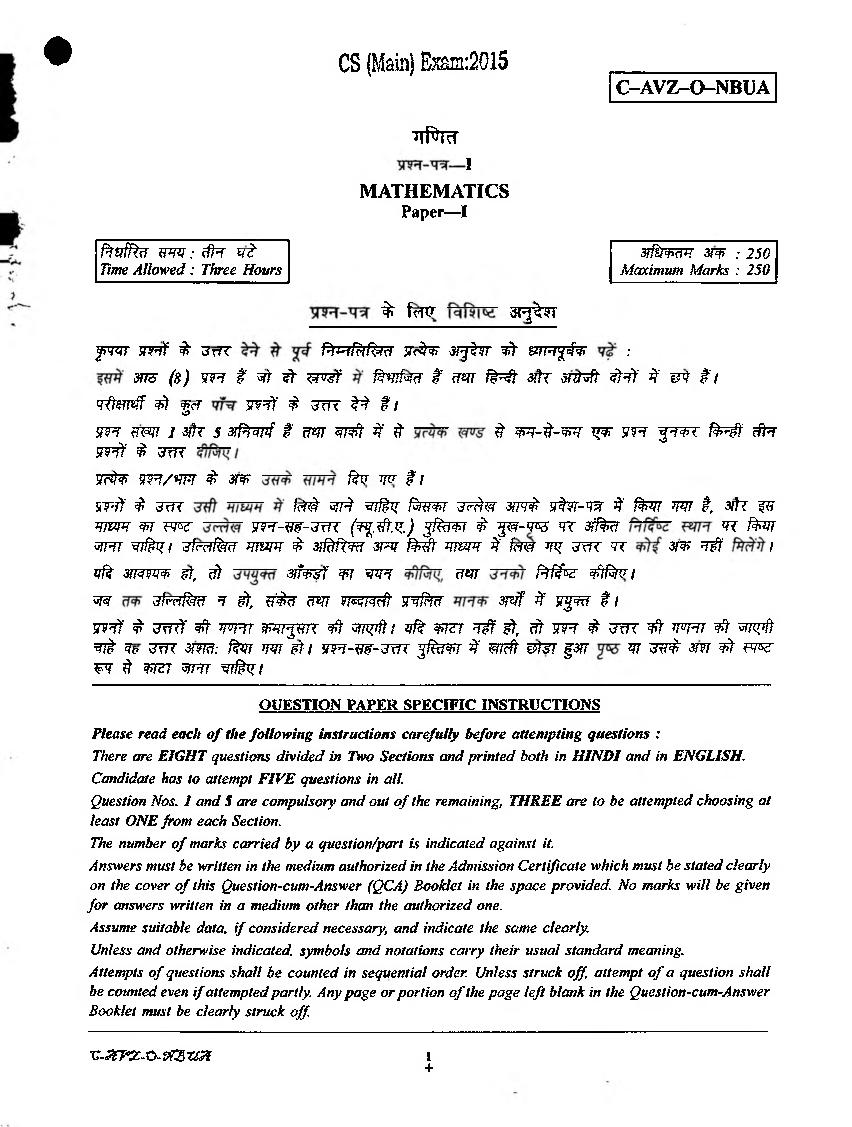
G-AVZ-O-NBUA
Tlf^TrT
I
MATHEMATICS
Paper—I
PrvfFfrr w : #=r w i 3ff&Fm 3T¥ : 250
Time Allowed: Three Hours Maximum Marks : 250
% frftr s f j& t
fim jm f ^ 3r7TP n = r f^ m X cfcz w f t v r # y/Hg«f+ :
&JZ (8) wt $ *?t i t w*sf fit*nfvfd' $ mr f&ft $h mfrft if if $ wt i t
v fifflff # <£of
o w fF £ \Jr7T ^ #I
jot fr^?r 1 3ftr 5 yfowf i mr wi¥t #' # # wr-i-*m w z f t jm rr f ^ f rffr
snpff £ z m
3c*fa> W FT/'m £ 3f¥ far tjjt f /
STF# £ 3 W /cT# W $ W #^ ftm > T JF&W 3 fN $ 7#W-W #' ^ 7 7 W #, 3 f k fff
w sw w ? w w v w -w -zm : (*%.&%.) yf&mi $ j w - t o ? t 3 ^ t i t fe w
WFTT W!%m j/rc?/&<? *fT&l*T $ tfRtft'ffi 3FU M W tm $ fcfW W SWT TT 3R? ^ I
z# sjjcRfflcfi $tf $ srM&f m w f mr foffw tftftnri
m zfrrrf&ti n it, w$w mr mmcff w^m m f # jtjw # /
m t' £ swtf ^ m m m i$ m ¥f wrfti vft mzi *iit it, tit wm $ v m ¥f mm &f wrwff
w£ $f> z m mm: few mr wt i w rr-w -zm yf&ivr #‘ m ft ®ter f srr m ;?w£ m # ? w
wv # to t mm wfeqi
QUESTION PAPER SPECIFIC INSTRUCTIONS
Please read each of the following instructions carefully before attempting questions :
There are EIGHT questions divided in Two Sections and printed both in HINDI and in ENGLISH.
Candidate has to attempt FIVE questions in all
Question Nos. I and 5 are compulsory and out of the remaining, THREE are to be attempted choosing at
least ONE from each Section.
The number of marks carried by a question/part is indicated against it.
Answers must be written in the medium authorized in the Admission Certificate which must be stated clearly
on the cover of this Question-cum-Answer (QCA) Booklet in the space provided. No marks will be given
for answers written in a medium other than the authorized one.
Assume suitable data, if considered necessary, and indicate the same clearly.
Unless and otherwise indicated, symbols and notations carry their usual standard meaning.
Attempts of questions shall be counted in sequential order. Unless struck off attempt of a question shall
be counted even if attempted partly. Any page or portion of the page left blank in the Question-cum-Answer
Booklet must be clearly struck off.
V-&T°Z~0~ s£B7&Z 1
+
Page 2
SECTION—A
Q. 1(a) fti* in? V, « (1, 1, 2, 4), V2 - (2, -1 , -5 , 2), V3 - (1, - 1 , -4 , 0) cWT
v 4 = (2, l, l, 6) tfti+a : FRfa # i m vs -m t ? ^trc % w $f w# i
The vectors Vj - (1, 1, 2, 4), V2 - (2, - I , - 5 , 2), V 3 = (1, - 1 , - 4 , 0) and
V4 = (2, 1, 1 ,6 ) are linearly independent. Is it true ? Justify your answer. 10
Q. 1(b) PlHfcHfed 3 W ftcT 3^T dr^M I^ f ^ lf c R :
"1 2 3 4"
2 1 4 5
1 5 5 7 -
8 1 14 17_
Reduce the following matrix to row echelon form and hence find its rank :
"1 2 3 4'
2 1 4 5
1 5 5 7 10
8 1 14 17
Q. 1(c) frRfeffefl tffaT *TR f^T icR :
? \ *•/
Evaluate the following lim it:
10
Q. 1(d) PlHlelfifl'tf HHWiA 7TPT :
Vsinx
Vsinx + Vcosx
cosx
Evaluate the following integral:
It
Vsinx
10
%-&PZ-0-tf35r&i 2
Page 3
x2 + y2 + z2 —2x - 4y + 2z - 3 = 0 Fref TOTT t l FT?f TO t
For what positive value of a, the plane ax - 2y + z + 12 = 0 touches the sphere
x2 + y2 + z2 - 2x - 4y + 2z - 3 = 0 and hence find the point of contact. 10
1 0 0
Q. 2(a) lift 3TT^ A= 1 0 1 era 3nc^ a30 to tffair
0 1 0
1 0 0
If matrix A= 1 0 1 then find A30. 12
0 1 0
Q. 2(b) ^ 0i«rai+K Z'z ^ ^ ^RcTT %I t'Z $ ^JTrTR CFTPTT ?t, eft
3TOR f^TT 3TJTO I
A conical tent is of given capacity. For the least amount of Canvas required, for it, find
the ratio of its height to the radius of its base. 13
Q. 2(c) PrnfclfiNd 3lT<a^ % 3?T^FT ttftT V? 3fT^7H TO :
1 1 3“
1 5 1
3 1 1_
Find the eigen values and eigen vectors of the matrix :
1 13
1 5 1 12
3 1 1
Q. 2(d) ^ 5yz - 8zx - 3xy = 0 4<tH< cF^c( ^ ^ WW
6x = 3y = 2z it, <ra 3pir i t i
If 6x = 3y = 2z represents one of the three mutually perpendicular generators of the cone
5yt -* 8zx - 3xy = 0 then obtain the equations of the other two generators. 13
Q. 3(a) V ®R3 <TOT T e A(V) «IFT a{, A(V) * I1 nft
T(ap a^ a3) = (2aj + 5aj + a3, -3at + % - a3, -a, + 2a2 + 3a3)
^ itt 11 era 3na r<
V' = (lr 0, 1) V2 = (-1, 2, 1) V3 = (3, -1, 1)
3n^jF T t o i
'Q-2EyaZX>-<
$ & l& t 3
+
Page 4
T(ap a^ a3) = (2a{ + 5 ^ + ^ - 3 s l + % - a3, - a j + 2a2 + 3a3)
]
What is the matrix T relative to the basis
V, - (1, 0, 1) V2 = (-1, 2, 1) v 3 - (3, -1, 1) ? 12
Q. 3(b) x2 + y2 + z2 — 1 f^^IcT (2, 1 , 3 ) ^ 3rf£j<t>dH 1? I
Which point of the sphere x2 + y2 + z2 = 1 is at the maximum distance from the point
(2, 1, 3) ? 13
Q. 3(c) (i) Wrier fr'+lfcTi' (2, 3, 1) ^ (4, -5 , 3) % t *T
x -m $ w ^ rr 1 1
Obtain the equation of the plane passing through the points (2, 3 ,1 ) and (4, -5, 3)
parallel to x-axis. 6
(ii) f i n i t e :
x~a+d_ y -a _ z-a-d x-b+c= y~b= z-b-c
a -8 a a +5 P~Y P P +Y
1 1 ^ ft, ^ ^mcfcT
ftw 1 1
Verify if the lines :
x -a +d _ y -a z-a-d x-b+c_ y -b _ z-b-c
a -5 a a +5 anC* P~Y P P +Y
are coplanar. If yes, then find the equation of the plane in which they lie. 7
Q. 3(d) f ^ T SHPficH ^ ;
JJ ( x - y ) 2cos2(x + y)dxdy
R
t, ittf W5WT (71, 0) (271, 7t) (71, 271) (0, 7l) t !
Evaluate the integral
JJ (x - y)2cos2(x + y) dx dy
R
where R is the rhombus with successive vertices as (n, 0) (2?t, 71) (71, 27t)(0, 7t). 12
V -P TP Z-'O -'& B xm 4
+
Page 5
Q. 4(a) PlH frftekl JTFT Rf^rfcfq :
/ / V l y - x 7] d x d y
WT R = [-1, 1 ; 0, 2].
Evaluate l i V l y - ^ 2 1 dxdy
R
where R = [-1, 1 ; 0, 2]. 13
Q. 4(b) R4 ^ t f^ n - m *rg^RT
{(1, 0, 0, 0), (0, 1, 0, 0), (1, 2, 0, 1), (0, 0, 0, 1)}
STTT f ^ n f e r 11 ?T cW ^ m iK
Find thedimension o f the subspace of R4, spanned by the set
{(1, 0, 0, 0), (0, 1, 0, 0), (1, 2, 0, 1), (0, 0, 0, 1)}
Hence find its basis. 12
Q. 4(c) x2 + y2 = 2z ^ ^TRcTcT ^PR?TcT
X= 0 ^ 'Mi?! !? I OT fwRT ^TT }<sfl ^ c ft f |
Two perpendicular tangent planes to the paraboloid x2 + y2 = 2z intersect in a straight line
in the plane x = 0. Obtain the curve to which this straight line touches. 13
Q. 4(d) ttit TtfeFT
x2 - x - J y
2 (*> y) * (o, o)
f(x, y) = x +y
o (x, y) = (0, 0)
^ f^T FRTcir ^ 3T^epfteT
For the function
x2 - x ,/ y
2 » (x, y )* (0 , 0)
f(x, y) = x +y
0 (x, y) = (0, 0)
Examine the continuity and differentiability. 12
5
+
Page 6
SECTION—B
Q. 5(a) PlHlrlftRT 3T^ kT MWTTW ^ FeT :
x co sx — + y(xsinx + cosx) = l.
dx
Solve the differential equation :
dy
x c o s x ~ + y(xsm x + cosx) = l. 10
dx 7
Q. 5(b) PlHfclfad 3T^cT FcT :
(2xy4ey + 2xy3 + y)dx + (xV ^y - x2y2 - 3x)dy = 0.
Solve the differential equation :
(2xy4ey + 2xy3 + y)dx + (x2) ^ - x2y2 - 3x)dy = 0. 10
Q. 5(c) ^ ^cT 3TT^rf ^ (WFT/qJT.) ^ TFT t , 3MFT ‘a’ ^ 3||ckf+ld ‘J* f |
2
^ 7TTST f^«TfcT $ -a ^ %1T fcT^m j^TT xSTFT, ^ 3TR?jwr
T ^cfT «rrq, ^ » TO 3MHT TTTcJTT ^tf^T I
A body moving under SHM has an amplitude ‘a’ and time period *T\ If the velocity is
*2 ’
trebled, when the distance from mean position is —a >the period being unaltered, find
3
the new amplitude. 10
Q. 5(d) 8 kg *fTT ^ ^ f s r r rTcT ^ M HK Wt ^ "'TT W ^TPT 11 ^
M I j ^ \ % ^RT ^ % b TR, 3;sf f^TT W ^ ^ $
w zm *rrc w w 11 T ttft ^ i
A rod o f 8 kg is movable in a vertical plane about a hinge at one end, another end
is fastened a weight equal to half of the rod, this end is fastened by a string of
length / to a point at a height b above the hinge vertically. Obtain the tension in the string.
- 10
Q. 5(e) <?T m £ \ x2 + y2 + z2 - 9 = 0 cf*TT z = x2 + y2 - 3 $ f ^ § (2, - 1 , 2 ) ^
OT I
Find the angle between the surfaces x2 + y2 + z2 - 9 = 0 and z = x2 + y2 - 3 at
(2,- 1, 2). 10
v-&r°z~o-z£8?&t 6 I
+ '1
► t 1
ul
Page 7
t ?ft V ^ ^TFT I dcMSHIt^ 3 ^ cT tl4W*°l ^FT ScT f^hlfal' 1
Find the constant a so that (x + y)a is the Integrating factor of
(4x2 + 2xy + 6y)dx + (2x2 + 9y + 3x)dy = 0 and hence solve the differential equation.
12
Q. 6(b) ^ w r m *nr ^ ^ m 4 kg t , $ w r ^ i< m
M f I fat ^ ^ f^RT^T ^sftrr yJTT^ ^ f | $
60° I I f^PTT $ f^ScT W#
^>t <+>f'on ^rnr i
Two equal ladders o f weight 4 kg each are placed so as to lean at A against each other
with their ends resting on a rough floor, given the coefficient o f friction is |i. The ladders
at A make an angle 60° with each other. Find what weight on the top would cause them
to slip. 13
Q. 6(c) qft ^ ^ 5 X x 2 - nyz = (X + 2)x 4 x ^ + z3 = 4(1,-1 , 2)TTT
eTt X^ n PHlfcIHI
Find the value o f X and ji so that the surfaces X x 2 - p y z =(X + 2)x and 4x2y + z3 = 4
may intersect orthogonally at (1, -1 , 2). 12
Q. 6(d) ^ 13r^fa, ^ 3n^f% ^ ? tt t ; ‘a’
t ^ r r 11 ^ arrrm w htcjr- ^ tf^ r i
A mass starts from rest at a distance ‘a’ from the centre of forcewhich attractsinversely
as the distance. Find the time of arriving at the centre. 13
Q. 7(a) (i) ft'Hfctf&d dMIfl f ^ T W M X STTRT ^tf^T :
s
■e""5
T *?) s2 +25
(ii) ciiKiiti ^HlcK "STzihT Pl*-ifeiRaa
y" + y = t, y(0) = 1, y'(0) = - 2
?cr f^rfcrm
(i) Obtain Laplace Inverse transform of
(ii) Using Laplace transform, solve
y" + y = t, y(0) = 1, y'(0) - - 2. 6+6=12
Tj-znKZ-o-rtSr&t 7
+
Page 8
H*5f fTTT^R ¥F§ t f^T^r 3?$ffa t I ?Fg ^ ^ glT cf x ^ t
$ 3TTOTC *TT ^ t «TT H^TMT t I ^ ^ ^T 3fsftM ^ T 30° ? h
?t, <rt ^ ^t %rr u ^ f^srf^i ^ tf^ r i
A particle is projected from the base of a hill whose slope is that o f a right circular cone,
whose axis is vertical. The projectile grazes the vertex and strikes the hill again at a point
on the base. If the semivertical angle of the cone is 30°, h is height, determine the initial
velocity u of the projection and its angle of projection. 13
Q. 7(c)
F = (x2 + xy2)i + (y2 + x2y)j
^ fejT w f | *k<7Tftd W Sfa F ^ ^ \ m : W ^tf^T I
A vector field is given by
F = (x2 + xy2)i + (y2 + x2y)j
Verify that the field F is irrotational or not. Find the scalar potential. 12
Q. 7(d)
x = py - p2
^1 Set Pl^lfctU, 3I5T p = v v
dx
Solve the differential equation
, dy
x = PY ~ P where p = — . 13
dx
Q. 8(a) m iii to v f^ r frfar f a r f r w ^
^ z-ft t, ^ farfr £ 3 i
Find the length of an endless chain which will hang over a circular pulley of radius ‘a"
so as to be in contact with the two-thirds of the circumference of the pulley. 12
Q. 8(b) ^ ^ ttcf <sfcr % 3t# t, ^ f^rqcr srtr sfr ^ f, ^ 11
^ry ^ Tmf ^ Trq^r^T a, b t (a > b), *TPf W I
A particle moves in a plane under a force, towards a fixed centre, proportional to the
distance. If the path of the particle has two apsidal distances a, b (a > b), then find the
equation o f the path. 13
V-&7°Z-0-tf8z&% 8
Page 9
| e"x(sin y dx + cos y dy)
c
/
^5T C ^ z tm f, f^RT^ (0, 0), (7t, 0),
vv ° ’ lzy
Evaluate ‘J e *(sin y dx +cosy d y )} where C is the rectangle with vertices (0, 0), (n 9 0),
71 f
12
*2,
Q. 8 (d) f ^ T FcT ^
„ 4 d4y , 3 d3y 2 d2y dy
+ 6x —-■+ 4x — y - 2x — - 4y - x + 2cos(logc x) .
dx dx dx dx
Solve :
:4^ - j + 6x3^ -y + 4x2^ - ~ - 2 x — - 4 y = x2 +2cos(log x ) . 13
dx4 dx3 dx2 dx c
v-zrp°z-o~'tf$z&% 9
+
Document Details
| Board / Org | UPSC |
| Exam | UPSC CSE (IAS) |
| Type | Question Paper |
| Pages | 9 |
| Updated | 30 Apr 2026 |