Finished viewing? Save it for later —
Download UPSC IAS 2015 Question Paper for Mathematics Paper-II (PDF · 8 pages)About UPSC IAS 2015 Question Paper for Mathematics Paper-II
UPSC IAS 2015 Question Paper for Mathematics Paper-II is available here for free download. Published by UPSC for IAS, this question paper can be viewed online or downloaded as a PDF (8 pages). Candidates preparing for IAS can use UPSC IAS 2015 Question Paper for Mathematics Paper-II to understand the exam pattern, the type of questions asked, and the overall difficulty level.
Frequently Asked Questions
How can I download UPSC IAS 2015 Question Paper for Mathematics Paper-II?
Open this page and click the Download button to save UPSC IAS 2015 Question Paper for Mathematics Paper-II as a PDF. It is completely free on AglaSem Docs.
Is UPSC IAS 2015 Question Paper for Mathematics Paper-II free to download?
Yes. UPSC IAS 2015 Question Paper for Mathematics Paper-II can be viewed online and downloaded as a PDF free of cost on AglaSem Docs.
How many pages does UPSC IAS 2015 Question Paper for Mathematics Paper-II have?
UPSC IAS 2015 Question Paper for Mathematics Paper-II contains 8 pages, which you can read online or download together as a single PDF.
Where can I find more IAS study material?
You can find more IAS question papers, sample papers, syllabus, and answer keys on AglaSem Docs.
UPSC IAS 2015 Question Paper for Mathematics Paper-II – Text
Read the full text of this question paper below — useful to quickly search, copy and reference the content online without downloading the PDF.
📄 View text version (8 pages)
Page 1
WW : 3T^ : 250
^ ^ fiRfafisTfl f i M ^ f ^ n 'ffr a q i^ * ^ )
^ $ f ^ 3 H 3 O T l ^ * i T T f * f t %<$ ^ 3tM ^ f I
auJkcM ^ ^ % 3 tR ^ 11
TO Ws9T 1 3fK 5 3 ? to f I cmi 3T^t r o t 3 $ TTf^qfJ W ^ $ Hcfi WR cffaTO! % 3tR
ilr^«h OT/^FT % ‘f^TcT 3R> "33% W & 1^ ^ f I
t o ! % -m 3#iftT *n«ra ^ % ! *rA t e s i 3 # a w& idm-m 3 t o ^wr I , afa w Tmzm ^r t o
T O -W -^ tR ( ^ o # o T*o) ^ f ^ T % Tg&fS ^ M s W R ^ t o ■5TR1 Tnf^fcf 3R?
f^b’tfl "RIW? ^ Rrttsl ^ 3tR ^ «$| 3^> "P-R^tl
-qfe 3m w z it, eft w ^ t f ^ ?«n vrnrn M s ^ f ^ i
<ras ^ ^%?i ?n*n 3r^fcf?r 3t«t! 3 sp> f i
3ERt % M m l ~£\ ¥H 1 O T ^ K ^ ftl ^ l^ i T[T7 3^ft % 3rR ^ ^ ^PTcH ^ *nx>rft 3$ T O ^!
^ #i 3 w ft ^ ^ ^ &m\ y® % vft Tgk: wiz <?tf^i
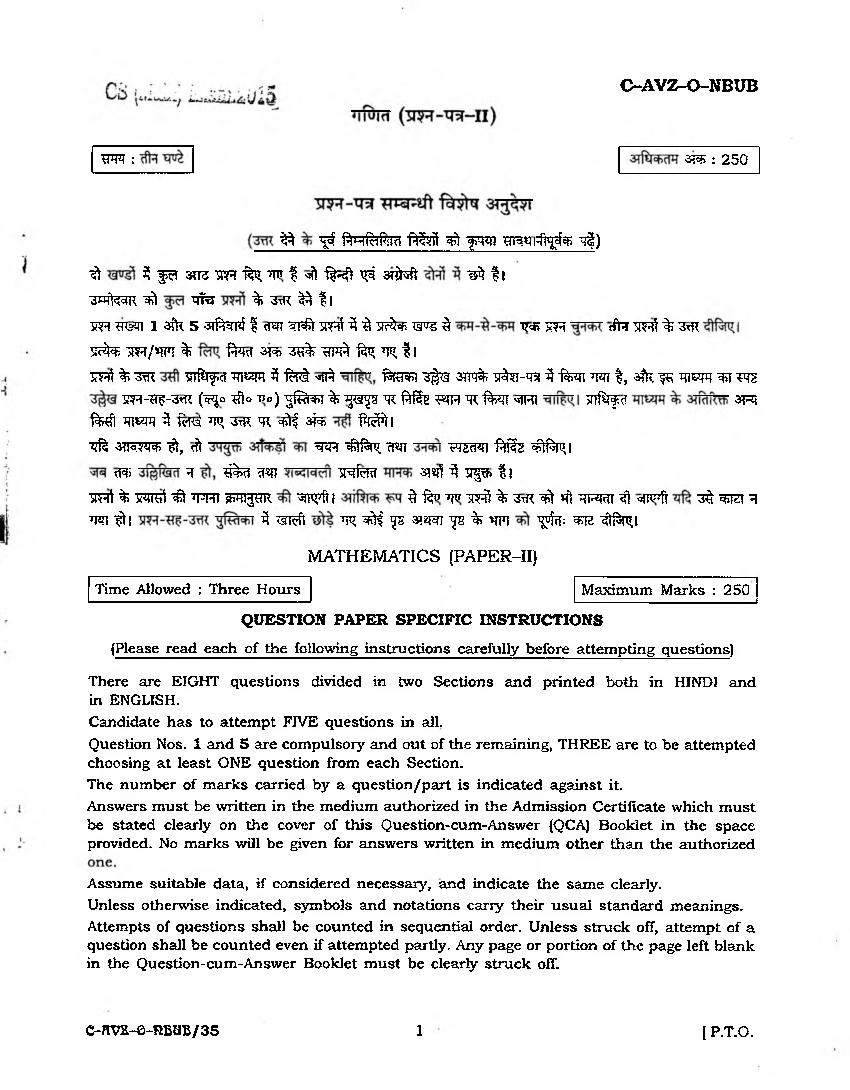
MATHEMATICS (PAPER-II)
Time Allowed : Three Hours Maximum Marks : 250
QUESTION PAPER SPECIFIC INSTRUCTIONS
(Please read each of the following instructions carefully before attempting questions)
There are EIGHT questions divided in two Sections and printed both in HINDI and
in ENGLISH.
Candidate has to attempt FIVE questions in all.
Question Nos. 1 and 5 are compulsory and out of the remaining, THREE are to be attempted
choosing at least ONE question from each Section.
The number of marks carried by a question/part is indicated against it.
Answers must be written in the medium authorized in the Admission Certificate which must
be stated clearly on the cover of this Question-cum-Answer (QCA) Booklet in the space
provided. No marks will be given for answers written in medium other than the authorized
Assume suitable data, if considered necessary, and indicate the same clearly.
Unless otherwise indicated, symbols and notations carry their usual standard meanings.
Attempts of questions shall be counted in sequential order. Unless struck off, attempt of a
question shall be counted even if attempted partly. Any page or portion of the page left blank
in the Question-cum-Answer Booklet must be clearly struck off.
e-ffVX-0-RB8B/35 1 [ P.T.O.
Page 2
1. (a) ' (i) ^ 8 ^rn2?n'#f^T|
How many generators are there of the cyclic group G of order 8? Explain.
(ix) 4% ^^PJp {e, a, b, c} e dr^M^ (snfifefe) «Hi5?^
"31? fe> t Hlfl 1» I
Taking a group {e, a, b, c} of order 4, where e is the identity, construct
composition tables showing that one is cyclic while the other is not.
5+5=10
(b) ^ w i te s t m m % to 11
Give an example of a ring having identity but a subring of this having a
different identity. 10
(c) W ^ ( - i ) n+ 1- J L _ % v fiv m vfasm i
n =1 n +1
^ oo
Test the convergence and absolute convergence of the series V (- l)rl + 1—----- . 10
n =1 ^ +1
(d) % W l v{x, i j j - \n{x2 +T/2) + x + i y M ^ t ^1 W f u[x, W
/( 2 } = u + iy z %^ ^ ^Tcl ^TTT|
Show that the function v{x, ]J\ = ln (x 2 + y2) + x + y is harmonic. Find its
conjugate harmonic function u{x, ly). Also, find the corresponding analytic
function f{z!\ = u + iv in terms of z, 10
(e) ftnfafed w m i T& M t ^ % frR wi:
Solve the following assignment problem to maximize the sales : 10
Territories ($fc)
1 27 m N V7
A 3 4 5 6 7
B 4 15 13 7 6
C 6 13 12 5 11
D 7 12 15 8 5
E 8 13 10 6 9
C-7IVX-0-RBHB/35 2
Page 3
W hiten (j) t, cTt /?' clrHM* 3 ^ ? 0(1) 11
If i? is a ring with unit element 1 and <J> is a homomorphism of R onto R',
prove that $(1) is the unit element of R'. 15
(b) W i
_ I n* n+1 n
/W =
0, x=0
ftRH I? eft £ / { x ) d x ^ I ^ H P
Is the function
\—^~r < X < -i-
/(*)=" n+1 n
[0 , x =0
Riemann integrable? If yes, obtain the value of [\f{x)dx.
JQ 15
(c) w i / ( z ) = — 2 z 3 - ~ % 2 = 0 % c M 3 3m r t f ^ t o
z 2 -3 z +2
Find all possible Taylor’s and Laurent’s series expansions of the function
2 z-3
/(z) - ------- about the point z - 0.
z -3 z +2 20
3. (a) 3*=nfa W1 ^ ^
r e 2 +1
dz; C :\ z\ -2
z{z + l){z-~ i)‘
*TR te# p r|
State Cauchy’s residue theorem. Using it, evaluate the integral
r 6 2 +1
f ---- g- +1— dz; C: |z| = 2
Jc z{z + \ ){ z -i)2 15
oo
(fy M V ---- — ---- % feTC,
n=i (1 + n2x 2)
nx
Test the series of functions V -----—— for uniform convergence. 15
n=l (1 + n X )
C-?TVK-0-RBaB/35 3 ( P.T.O.
Page 4
"^tf^nr z = Xj + 2x2 - 3 x 3 + 4 x4
ft
x \ + x 2 + 2x3 + 3 x 4 =12
x 2 + 2x3 + x 4 = 8
x l> *2> X3> JC4
Consider the following linear programming problem :
Maximize Z = x { + 2x2 - 3 x 3 + 4x4
subject to
x : + x 2 + 2x3 + 3 x 4 =12
x 2 + 2x3 + x 4 = 8
X j, x 2, x 3, x 4 £ 0
I 3?R 3 T O 3 W t fSFTcT W I?
Using the definition, find its all basicsolutions.Which of these are
degenerate basic feasible solutions and which arenon-degenerate basic
feasible solutions?
(a) smnfl^*Fra
I/I?
Without solving the problem, show that it has an optimal solution. Which
of the basic feasible solution(s) is/are optimal? 20
4. (a) W fW effecI W pm W I cTCT TTTrf f? ^FTT %, cfr ^cTT^
% ^ 1? :
Do the following sets form integral domains with respect to ordinary addition
and multiplication? If so, state if they are fields : 5+6+4=15
(i) b42 % ^ ^ b ^
The set of numbers of the form b j2 with b rational
(ii) m
The set of even integers
(iii) ^fH ti^<<
The set of positive integers
(b) x 2 +2 y 2 < 1 ^ W I /(x, £/) = x 2 +3 y 2 -zy% TO ftndH iIRt
TO ^ t f^ l
Find the absolute maximum and minimum values of the function
/(*> y ) ~ x2 +3y2 - y over the region x 2 + 2 y 2 <1. 15
C-ffVZ-0-RBHB /35 4
f
Page 5
wm\ ^ TTR^ft 3 left wm\ ^r ^ ^ :
s rte p te n z =2x1- 4 x 2 + 5 x 3
%
Xj + 4x2 - 2 x 3 < 2
- x t + 2x2 + 3x3 £ 1
X j, x 2, x 3 £0
Solve the following linear programming problem by the simplex method. Write
its dual. Also, write the optimal solution of the dual from the optimal table of
the given problem : 20
Maximize Z - 2 x x - 4 x 2 + 5 x 3
subject to
x L + 4 x 2 - 2 x 3 <2
-Xj + 2 x 2 + 3 x 3 £1
X j , x 2, x 3 £0
Tgvz— B / S e c tio n — B
5. (a) ETftOT
Q/2 + z 2 - x 2) p - 2xyq + 2xz = 0
p = — cmTg = ~ , ^ t
dx 3y
Solve the partial differential equation
{y2 + z 2 - x 2) p - 2xyq + 2xz = 0
, 3z , dz
where p = — and q = — .
dx dy 10
(b) (D2 + D D '- 2 D /2)u = e x+y ^ ^ ^ tf^ , ^ t j D = A ^ r £>' = — .
3x 3i/
Solve (D2 + D D ' - 2 D '2) u - e x+ y, where D = ~ and D ' = A . 10
3x 3i/
fc/ ((p a q ) —» r) v ({pA q) - » - r ) % frR cffa p, g, r 3 (3T«ren
f^fr^fcr ^ ^rm fan ^ tt^ M u t 1%
Find the principal (or canonical) disjunctive normal form in three variables
p, q, r for the Boolean expression ((p a q) - » r) v ((p a q) - » -r). Is the given
Boolean expression a contradiction or a tautology? 10
C-HV2-0-RBHB/35 5 [ P.T.O.
Page 6
3rtb w i t^n ^ t f ^ r a 'm jnfcifta C& t^h) ffcg *ft t r
Consider a uniform flow U0 in the positive x-direction. A cylinder of radius a is
located at the origin. Find the stream function and the velocity potential. Find
also the stagnation points. 10
(e) VcFWm x 2 + y 2 + z 2 = a2, z 2 0 %, O Z ~ m % ^Sr3-
Calculate the moment of inertia of a solid uniform hemisphere
x 2 + y2 + z 2 = a2, z > 0 with mass m about the OZ-axis. 10
7i7 {)? N r\ r\
6. (a) p c o s [x + jJ)+q sin (x + ty) = z, p = — cMI q - — , ^ ^ t f^ l
dx dy
dz
Solve for the general solution p cos [x + y) + q sin (x + y) = z, where p = — and
9x
9z
dy 15
fbj WTC ^ e fe fi ^PTFTT ^ ^ -^n
ft 1
Solve the plane pendulum problem using the Hamiltonian approach and show
that H is a constant of motion. 15
(c) w r 3T?r^ft ^ M i a ^ w t I :
x : - 1 2 3 4
f{x ) : -1 11 31 69
/ (l-5)in?i^tftm
Find the Lagrange interpolating polynomial that fits the following data :
x : —1 2 3 4
f{x ) : -1 11 31 69
F in d / (I -5). 20
7. fc j
wf - u xx+l i =0 , 0 <x<f , f >0
u (0, f) = u (£ t) = 0, t£0
u(x, 0) = x(/ - x), 0<x</
C-ffVX-0-RBHB/35 6
Page 7
ut -U xx + Ti —0, 0 <x<l, t> 0
u(0, t) = u{l, t) =0, t£0
u{x, 0) = x { l- x ), 0<x<l 15
(b) swm h - 0*2 % '^ iiid ^ tth
^ = x ( y - x ) , i/(2) = 3 ^F?r 3TcRia [2, 2-4] 3 W ^ t f^ l
dx
Solve the initial value problem — = x [ y - x ) , y{2) = 3 in the interval [2, 2-4]
dx
using the Runge-Kutta fourth-order method with step size h = 0-2. 15
(c) Tj^ % ^ | :
H = — -b qp e~ at + — q 2e~at{a + be~at) + —q 2
2a 2 2
a, b, it foA||<h<^^ R^iieh ^ ?T«n p u4id <>qlH=Q^a 11
A Hamiltonian of a system with one degree of freedom has the form
H = —----bqpe~at + — q 2e~at{a+be~at) + —q 2
2a 2 2
where a, b, k are constants, q is the generalized coordinate and p is the
corresponding generalized momentum.
(i) % "SFRT ^
Find a Lagrangian corresponding to this Hamiltonian.
(U) ^ ^ ^ t o ^ ^ snfaci 11
Find an equivalent Lagrangian that is not explicitly dependent on time.
10+10=20
8. (a) srifte w fa m
2 d2u 0 d2u 2 du du n
x — - - 2xy--------+ y — - + x — + y — = 0
dx dxdy dy2 dx dy
^ ^ - # f ^ cjstt t o w i
Reduce the second-order partial differential equation
2 d2u 0 d2u 2 d2u du du n
x — - - 2 x y --------+ y z — - + x — + y — = 0
dx2 dxdy dy2 9* dy
into canonical form. Hence, find its general solution. 15
e-nV2-0-RBOB/35 7 [ P.T.O.
Page 8
- 2 x 2 + 10x2 *~x3 - x 4 =15
-X j - x 2 +10x3 - 2 x 4 =27
- x x - x 2 - 2 x 3 +10 x 4 = - 9
qFl Wi ^TTcT (^R ^ tf^ ) I
Find the solution of the system
l O x j - 2 x 2 - x 3 - x 4 =3
-2 x j +10x2 - x 3 - x 4 =15
-X i - x 2 +10x3 - 2 x 4 = 2 7
—X| ~ x 2 - 2 x 3 +10x4 = - 9
using Gauss-Seidel method (make four iterations). 15
(C) f t 3T O: ^TfcT 3 tfTcTrq ^ 4 ) ^ 1 % *TTC1 W 1 3*f^cE| ^ I m i 3
3*1 ^ ^ ^ 3^1? spjoftt I , f t qro T O ^RI
irf\ %\
In an axisymmetric motion, show that stream function exists due to equation
of continuity. Express the velocity components in terms o f the stream function.
Find the equation satisfied by the stream function if the flow is irrotational. 20
★★★
e-ffVX-0-RBOB/35 8 SB6—470
Document Details
| Board / Org | UPSC |
| Exam | IAS |
| Type | Question Paper |
| Pages | 8 |
| Updated | 30 Apr 2026 |