ISC Class 12 Sample Paper Indian Music Carnatic
Finished viewing? Save it for later —
Download ISC Class 12 Sample Paper Indian Music Carnatic (PDF · 4 pages)About ISC Class 12 Sample Paper Indian Music Carnatic
ISC Class 12 Sample Paper Indian Music Carnatic is available here for free download. Published by CISCE for Class 12, this sample paper can be viewed online or downloaded as a PDF (4 pages). Candidates preparing for Class 12 can use ISC Class 12 Sample Paper Indian Music Carnatic to understand the exam pattern, the type of questions asked, and the overall difficulty level.
Frequently Asked Questions
How can I download ISC Class 12 Sample Paper Indian Music Carnatic?
Open this page and click the Download button to save ISC Class 12 Sample Paper Indian Music Carnatic as a PDF. It is completely free on AglaSem Docs.
Is ISC Class 12 Sample Paper Indian Music Carnatic free to download?
Yes. ISC Class 12 Sample Paper Indian Music Carnatic can be viewed online and downloaded as a PDF free of cost on AglaSem Docs.
How many pages does ISC Class 12 Sample Paper Indian Music Carnatic have?
ISC Class 12 Sample Paper Indian Music Carnatic contains 4 pages, which you can read online or download together as a single PDF.
Where can I find more Class 12 study material?
You can find more Class 12 question papers, sample papers, syllabus, and answer keys on AglaSem Docs.
ISC Class 12 Sample Paper Indian Music Carnatic – Text
Read the full text of this sample paper below — useful to quickly search, copy and reference the content online without downloading the PDF.
📄 View text version (4 pages)
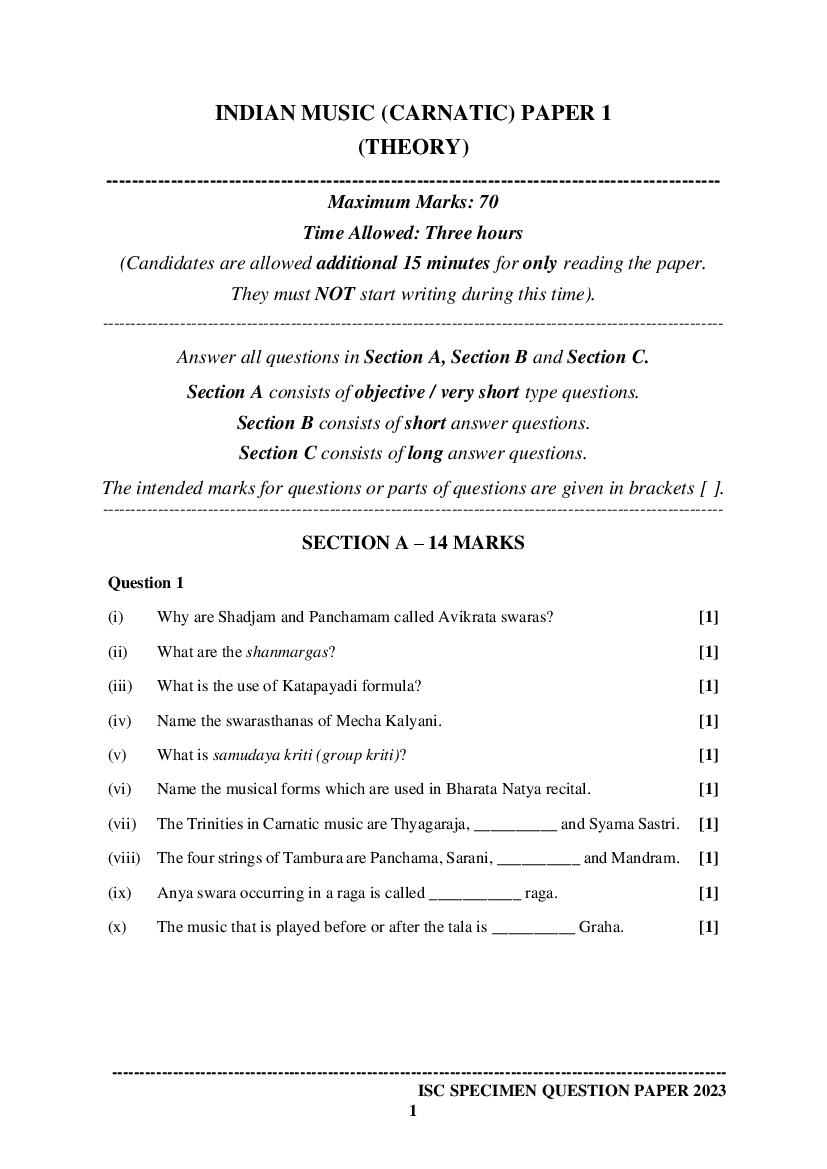
Page 1
(THEORY)
-----------------------------------------------------------------------------------------------
Maximum Marks: 70
Time Allowed: Three hours
(Candidates are allowed additional 15 minutes for only reading the paper.
They must NOT start writing during this time).
----------------------------------------------------------------------------------------------------------------
Answer all questions in Section A, Section B and Section C.
Section A consists of objective / very short type questions.
Section B consists of short answer questions.
Section C consists of long answer questions.
The intended marks for questions or parts of questions are given in brackets [ ].
----------------------------------------------------------------------------------------------------------------
SECTION A – 14 MARKS
Question 1
(i) Why are Shadjam and Panchamam called Avikrata swaras? [1]
(ii) What are the shanmargas? [1]
(iii) What is the use of Katapayadi formula? [1]
(iv) Name the swarasthanas of Mecha Kalyani. [1]
(v) What is samudaya kriti (group kriti)? [1]
(vi) Name the musical forms which are used in Bharata Natya recital. [1]
(vii) The Trinities in Carnatic music are Thyagaraja, __________ and Syama Sastri. [1]
(viii) The four strings of Tambura are Panchama, Sarani, __________ and Mandram. [1]
(ix) Anya swara occurring in a raga is called ___________ raga. [1]
(x) The music that is played before or after the tala is __________ Graha. [1]
1
Page 2
(a) Nyasa
(b) Amsa
(c) Graha
(d) Jati
(xii) The number of main strings in Gottuvadyam is: [1]
(a) 6
(b) 7
(c) 8
(d) 5
(xiii) Statement I : Anya swara appears in Upanga raga. [1]
Statement II : Anya swara appears in Bhashanga raga.
(a) Statement I and II both are correct.
(b) Statement I and II both are incorrect.
(c) Statement I is correct and II is incorrect.
(d) Statement I is incorrect and II is correct.
(xiv) Statement I : Upanga ragas are Janya ragas. [1]
Statement II : Bhashanga ragas are Janaka ragas.
(a) Statement I and II both are correct.
(b) Statement I and II both are incorrect.
(c) Statement I is correct and II is incorrect.
(d) Statement I is incorrect and II is correct.
2
Page 3
Question 2 [4]
Write a short note on javali.
Question 3 [4]
Briefly write on Chapu Tala and its varieties.
Question 4
(i) Explain how Rishabha-Gandhara and Dhaivata-Nishada are arranged in [4]
72 Mela scheme.
OR
(ii) (a) What are mnemonics? [1]
(b) Write svara mnemonics and mela mnemonics. [3]
Question 5
(i) Give any two examples of Dvi Anya Swara Bhashanga raga. [1]
(ii) What is a Bhashanga raga? [3]
Question 6 [4]
(i) Give any four lakshanas of Chakravakam.
OR
(ii) Write any four sancharas of Chakravakam.
Question 7 [4]
Differentiate between Jati Swaram and Swara Jati.
3
Page 4
Explain the following Gamakas with examples:
(i) Ahata
(ii) Pratyahata
SECTION C – 28 MARKS
Question 9 [7]
Draw the diagram of a Violin and name its parts.
Question 10 [7]
Discuss Kriti and its decorative angas.
Question 11 [7]
(i) Write the life history of Swati Tirunal and his contribution to music?
OR
(ii) Write the life history of Muthuswami Dikshitar and his contribution to music?
Question 12 [7]
“Nanu palimpa Nadachi vachchitivo, naa prana natha” is the raga Mohana set to Adi
tala.
Who is the composer of this kriti? Narrate the incident behind this composition.
4
Document Details
| Board / Org | CISCE |
| Exam | Class 12 |
| Type | Sample Paper |
| Pages | 4 |
| Updated | 29 Aug 2026 |